
BuddhistCatholicContemplativeEvangelicalGeneral ChristianHinduJewishLatter-day SaintMuslimNew VisionsProgressive Christian
Beliefs
- Buddhist
- Catholic
- Contemplative
- Evangelical
- General Christian
- Hindu
- Jewish
- Latter-day Saint
- More Voices
- Muslim
- New Visions
- Pagan
- Progressive Christian
Topics
- Religion News
- Food and Religion
- Sports and Religion
- Religious Art
- Religious Music and Entertainment
- Religious Events
- History and Religion
- Style and Religion
- Politics and Religion
- Women in Religion
- Recreation Outdoors and Religion
- Business Finance and Religion
- Careers Workplace and Religion
- Education and Religion
- Family Parenting and Religion
- Health Fitness and Religion
- Home and Religion
- Relationships and Religion
- Technology and Religion
- Travel and Religion
Columnists
- Buddhist Columnists
- Business Finance and Religion Columnists
- Careers Workplace and Religion Columnists
- Catholic Columnists
- Contemplative Columnists
- Education and Religion Columnists
- Evangelists Columnists
- Family Parenting and Religion Columnists
- General Christian Columnists
- Health Fitness and Religion Columnists
- Hindu Columnists
- History and Religion Columnists
- Home and Religion Columnists
- Jewish Columnists
- More Voices Columnists
- Latter Day Columnists
- Muslim Columnists
- New Visions Columnists
- Nonreligious Columnists
- Pagan Columnists
- Politics and Religion Columnists
- Progressive Columnists
- Recreation Outdoors and Religion Columnists
- Relationships and Religion Columnists
- Religion News Columnists
- Religious Art Columnists
- Religious Events Columnists
- Religious Music and Entertainment Columnists
- Sports and Religion Columnists
- Style and Religion Columnists
- Technology and Religion Columnists
- Travel and Religion Columnists
- Women in Religion Columnists
Resource Library
- 2026 Calendar
- Library of World Religions
- The 100 Most Holy Places on Earth
- Patheos Answers
- Podcasts
- Videos
- Faith Leaders Database
- Anglican Episcopalian
- Bahai
- Baptist
- Buddhism
- Christianity
- Confucianism
- Eastern Orthodoxy
- Hinduism
- Holiness and Pentecostal
- ISKCON
- Islam
- Judaism
- Lutheran
- Methodist
- The Church of Jesus Christ of Latter-day Saints
- New Age
- Paganism
- Presbytarian and Reformed
- Protestantism
- Religion Behind the Scenes
- Roman Catholic
- Scientology
- Shia Islam
- Sikhism
- Sufism
- Sunni Islam
- Taoism
- Zen
- See all religions
Research Tools
 Ad-Free & Subscriber Log-In Subscription Support
Ad-Free & Subscriber Log-In Subscription Support
Follow Patheos 

- Trending:
- Forgiveness
- |
- Marriage
- |
- Consciousness
- |
- Death Penalty
- |
- Election
- |
- Halloween

- Home
- Catholic
- The Two Faces Of Sin
The Two Faces Of Sin
Last updated on: August 15, 2024 at 10:19 am by David Schloss
The Two Faces Of Sin 2024-08-15T10:19:37-04:00 David Schloss
Patheos Explore the world's faith through different perspectives on religion and spirituality! Patheos has the views of the prevalent religions and spiritualities of the world.
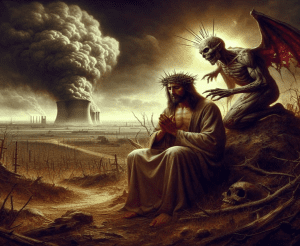
Art by Fran Soto.
As Catholics, we hear the word sin almost as frequently as we hear our own name. However, our concept of sin is often oversimplified and reduced to only what a person does. In his seminal work Cur Deus Homo? (why the God-man?), Saint Anselm identifies two modalities of sin that will be discussed in this essay.
The first modality – the one most of us think of – is an action contrary to God’s will. Often, sin is seen as a failure in genuine love for God and neighbor caused by a perverse attachment to certain goods. It wounds man’s nature and injures human solidarity (See the Catechism of the Catholic Church).
Because sin can be of differing severity, the Catholic Church distinguishes between venial and deadly sins. Venial sins are acts that, while contrary to God’s will, damage but do not destroy one’s relationship with God. On the other hand, mortal or deadly sins are grave and deliberate acts against the will of God. Mortal sins are so severe that they sunder our relationship with God and place our souls in danger of damnation.
As indicated, this type of sin is a verb, an action done (or not done) that falls within the categories of venial or mortal sins. Can sin be a noun, as well? Can sin be an entity and not just an act? I want to highlight two biblical passages that seem to suggest precisely this.
“We know that the law is spiritual; but I am carnal, sold into slavery to sin. What I do, I do not understand. For I do not do what I want, but I do what I hate. Now, if I do what I do not want, I concur that the law is good. So now it is no longer I who do it, but sin that dwells in me. [Emphasis mine].” (See Romans 7:14-20).
Here, we see references to both “faces” of sin. The verse presents evidence of what the Church refers to as concupiscence, or the subordination of man’s desires to the dictates of reason, and the propensity of human nature to sin as a result of original sin. Because humans possess free will, they are capable of acting contrary to God’s will. Moreover, because the effects of original sin have darkened the intellect, the capacity to recognize the objective good is seriously compromised.
More commonly, concupiscence refers to the spontaneous movement of the will toward whatever the imagination portrays as pleasant and away from whatever it portrays as painful. However, concupiscence also includes such unruly desires as pride, ambition, and envy. (See Hardon, John. Catholic Dictionary. 2013). This we may call the first face of sin. The second face of sin is an entity Saint Paul claims dwells within him.
The second verse I want to examine takes on an even darker, more insidious tone. “For our struggle is not with flesh and blood but with the principalities, with the powers, with the world rulers of this present darkness, with the evil spirits in the heavens.” (Ephesians 6:12). Again, we see sin (evil) as an entity or force. When this verse is taken in conjunction with Romans 6:16, the implication is that sin is not simply the result of choices and actions taken by the individual but a power that acts on or even enslaves human beings.
The belief that sin is not just something we are inclined to do but a force that entraps us provides insight into the salvific work of the Crucifixion of Christ. To understand why, I will return to Ephesians 6:12. Saint Paul notes that for believers, the struggle is not with, or at least not only with, our human frailties. What exactly are these “principalities and powers”?
Principalities and powers generally describe angelic powers, whether good or bad. However, in this context, the verse turns dark with the mention of the rulers and the spiritual wickedness in the heavenly places. Again, the implication is that sin is not just something we do but an entity that causes us to sin even when we are cognizant that we are sinning. This conclusion allows us to understand Saint Paul’s puzzlement more clearly: “What I do, I do not understand. For I do not do what I want, but I do what I hate.”
From what has been said, we ought not to consider ourselves innocent pawns compelled by evil. To do so would deny human free will. Rather, we should see ourselves – difficult as this may be – as complicit with the forces of evil. C.S. Lewis captures this concept. “Fallen man is not simply an imperfect creature who needs improvement; he is a rebel who must lay down his arms.” (Lewis, C. S. Mere Christianity. Zondervan, 2001).
If we see sin as composed of two faces, it provides a point of departure for understanding the Crucifixion. When sin is understood as a personal act that requires atonement, then the Crucifixion of Christ can be seen through the lens of sacrifice, which makes atonement for sins possible. This can be best understood in the satisfaction theory of atonement.
The second face of sin requires us to recognize it as a power that must be destroyed. Understood this way, the Crucifixion becomes the manner in which God defeats the power of sin and death. This view of sin and the Crucifixion is best understood as the Christus Victor theory of atonement.
In this exposition, I have sought to show the two faces of sin. The first – the one we most commonly associate with the word – is an intentional and knowing act against the will of God. The second “face” of sin suggests that sin is a power under which we live; a power we struggle with in a fallen world.
I close with a quote from Flannery O’Connor’s book “Wise Blood.” “If I was in sin, I was in it before I ever committed any.”
Previous Post

May 5, 2024
The Problems With Process Theology
Next Post

May 19, 2024 The Temple Veil
Recent Comments
"Why would it matter if atheism is wrong? The fact that Catholic and Protestant scholars ..."
Beyond the Absence of Belief: The ..."
"Kaiser Member Service Proponents often compare atheism to not collecting stamps—it is the lack of ..."
Beyond the Absence of Belief: The ..."
""these dual denials (objective truth and objective meaning)"This is not accurate. Post-modern thought does not ..."
Defending the Faith in a Post-Truth ..."
"The theologians still haven't received the memo. Your opposition are no longer atheists, but they ..."
Defending the Faith in a Post-Truth ..."
Browse Our Archives
Select a Category Abortion Atheism Catholicism. Catholicism. God. Theophany. Christmas Eschatology Faith and Works. God. Holy Spirit Intelligent Design Jesus Christ Justice Law Politics Protestantism Religion Sabbath Salvation. Soteriology. The Bible Theology Uncategorized
Select a Month October 2026 September 2026 August 2026 July 2026 June 2026 May 2026 April 2026 March 2026 February 2026 January 2026 December 2025 November 2025 October 2025 September 2025 August 2025 July 2025 June 2025 May 2025 April 2025 March 2025 February 2025 January 2025 December 2024 November 2024 October 2024 September 2024 August 2024 July 2024 June 2024 May 2024 April 2024 March 2024 February 2024 January 2024 December 2023 November 2023 October 2023 September 2023 August 2023 July 2023 June 2023 May 2023 April 2023 March 2023 February 2023 January 2023 December 2022 November 2022 October 2022 September 2022 August 2022 July 2022 June 2022 May 2022 April 2022 March 2022 February 2022 January 2022 December 2021
Follow Us!
TAKE THE
Religious Wisdom Quiz
Who said, "Here I am, send me!"?
Select your answer to see how you score.
Elijah Moses Isaiah Peter
Related posts from Summa Catholic

The Anatomy of Divine Revelation in Catholic Thought

Beyond the Absence of Belief: The Implications of...

Can Catholic Apologetics Survive a Postmodern World?

From Samaria to Sanctity: Analyzing The Woman At...
TRENDING AT PATHEOS Catholic

Rejecting Doom: Christian Hope And Human Action
Christianity is a religion of hope. We are to have hope and...

It’s What Comes From Within Which Matters
One of the most difficult things for us to understand is why...

Why I Choose the Eucharist Over the Sermon
Choose the Eucharist, Not the Sermon What are we supposed to get...

5 Design Elements Found in Spiritually Rooted Homes
Putting Spirituality Into Home Decor Our homes are more than our living...

Credo: A Story of God Told with the...
About 10 years ago, I began to imagine a personal "Credo" that...

The Anatomy of Divine Revelation in Catholic Thought
The claim that God has made Himself known to human beings is...
view all Catholic blogs
What Are Your Thoughts?leave a comment
Ad-Free & Subscriber Log-In Subscription Support
- About Us
- 2026 Calendar
- Videos
- Podcasts
- Library of World Religions
- Faith In Media Tracker
- Advertise With Us
- Write for Us
- Privacy Policy
- Terms of Service
- Do Not Sell My Data
- Contact Us
- Radiant Digital
- Manage Newsletter Subscriptions
- Unsubscribe From Notifications
- Sitemap
Copyright 2008-2026, Patheos. All rights reserved.
Subscription Support Ad-Free & Subscriber Log-In
Follow Patheos