
BuddhistCatholicContemplativeEvangelicalGeneral ChristianHinduJewishLatter-day SaintMuslimNew VisionsProgressive Christian
Beliefs
- Buddhist
- Catholic
- Contemplative
- Evangelical
- General Christian
- Hindu
- Jewish
- Latter-day Saint
- More Voices
- Muslim
- New Visions
- Pagan
- Progressive Christian
Topics
- Religion News
- Food and Religion
- Sports and Religion
- Religious Art
- Religious Music and Entertainment
- Religious Events
- History and Religion
- Style and Religion
- Politics and Religion
- Women in Religion
- Recreation Outdoors and Religion
- Business Finance and Religion
- Careers Workplace and Religion
- Education and Religion
- Family Parenting and Religion
- Health Fitness and Religion
- Home and Religion
- Relationships and Religion
- Technology and Religion
- Travel and Religion
Columnists
- Buddhist Columnists
- Business Finance and Religion Columnists
- Careers Workplace and Religion Columnists
- Catholic Columnists
- Contemplative Columnists
- Education and Religion Columnists
- Evangelists Columnists
- Family Parenting and Religion Columnists
- General Christian Columnists
- Health Fitness and Religion Columnists
- Hindu Columnists
- History and Religion Columnists
- Home and Religion Columnists
- Jewish Columnists
- More Voices Columnists
- Latter Day Columnists
- Muslim Columnists
- New Visions Columnists
- Nonreligious Columnists
- Pagan Columnists
- Politics and Religion Columnists
- Progressive Columnists
- Recreation Outdoors and Religion Columnists
- Relationships and Religion Columnists
- Religion News Columnists
- Religious Art Columnists
- Religious Events Columnists
- Religious Music and Entertainment Columnists
- Sports and Religion Columnists
- Style and Religion Columnists
- Technology and Religion Columnists
- Travel and Religion Columnists
- Women in Religion Columnists
Resource Library
- 2026 Calendar
- Library of World Religions
- The 100 Most Holy Places on Earth
- Patheos Answers
- Podcasts
- Videos
- Faith Leaders Database
- Anglican Episcopalian
- Bahai
- Baptist
- Buddhism
- Christianity
- Confucianism
- Eastern Orthodoxy
- Hinduism
- Holiness and Pentecostal
- ISKCON
- Islam
- Judaism
- Lutheran
- Methodist
- The Church of Jesus Christ of Latter-day Saints
- New Age
- Paganism
- Presbytarian and Reformed
- Protestantism
- Religion Behind the Scenes
- Roman Catholic
- Scientology
- Shia Islam
- Sikhism
- Sufism
- Sunni Islam
- Taoism
- Zen
- See all religions
Research Tools
 Ad-Free & Subscriber Log-In Subscription Support
Ad-Free & Subscriber Log-In Subscription Support
Follow Patheos 

- Trending:
- Forgiveness
- |
- Marriage
- |
- Consciousness
- |
- Death Penalty
- |
- Election
- |
- Halloween

- Home
- Catholic
- Education and Religion
- The Four Fathers
The Four Fathers
Last updated on: March 3, 2024 at 11:17 am by David Schloss
The Four Fathers 2024-03-03T11:17:23-05:00 David Schloss
Patheos Explore the world's faith through different perspectives on religion and spirituality! Patheos has the views of the prevalent religions and spiritualities of the world.
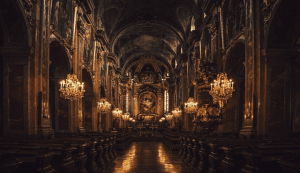
Art by Leonhard Niederwimmer.
Plato once observed that beginnings are the most critical aspect of any endeavor. This principle may be applied to religions as much as to any other enterprise. Doubtless, several factors have led to the growth and enduring success of Catholicism, but the work and sacrifice of many early Catholics cannot be understated.
In this essay, I will briefly examine four men whose lives of virtue and holiness made them not only saints but fathers of the Church. It should be noted that, unlike sainthood, there is no fixed criteria for being considered a Church father. Nevertheless, Church fathers are generally those teachers and writers of the early centuries whom the Church recognizes as her special witnesses of the faith.
Finally, I have placed the four in order of their birth. This categorization is not intended to indicate the effect or influence that these men have had on Catholicism.
Saint Ambrose
Perhaps more well-known for his influence on another Church father, Saint Augustine, Saint Ambrose would immensely influence Catholicism and theology in his own right.
Born Aurelius Ambrosius in present-day Germany, Ambrose’s childhood would have exposed him more to the politics of the Roman Empire than to the precepts of Catholicism. Ambrose’s father was a Roman prefect, and Ambrose spent his formative years in Rome. Influenced by his older sister, a nun, Ambrose would eventually be named Bishop of Milan. In an effort to detach from worldly concerns, the newly minted Bishop gave away his money and land to the poor.
While much can be said of Ambrose, I will highlight two facets of his life that have profoundly affected the Church. The first aspect was the manner in which Ambrose framed the relationship between the Church and government. Prior to the influence of Christianity, it was common practice in the Roman Empire to equate the Caesars with the gods of the Roman pantheon. It was Ambrose who argued successfully that even Caesar was subject to “orders from Christ.” A consequence of this change meant that the leader of the world’s greatest empire was subject to the influence of the Church.
Ambrose’s second significant accomplishment was his opposition to the Arian movement. Arianism posited that Jesus was a created being and, therefore, not equivalent to God. Despite being condemned by the Council of Nicea in 325, Arianism remained popular in the Roman Empire. However, owing to Saint Ambrose’s ardent defense of the Holy Trinity, Arianism would soon evanescence.
Saint Jerome
Eusebius Sophronius Hieronymus, soon to be known as Saint Jerome, was born in 347 in present-day Croatia. Eventually sent to Rome to study classical literature and rhetoric, Jerome was baptized by Pope Liberius in 366.
While in Rome, he studied Greek, Latin, history, and philosophy. He developed the practice of copying most of the works he read. Leaving Rome in his early twenties, he traveled to Trier in Gaul and transcribed the works of Saint Hilary. After returning to Italy, he continued his theological studies.
In 382, Pope Damasus commissioned Jerome to translate the Bible from Greek into Latin. The process of translating Scripture would take some twenty years. In addition to his writing, Saint Jerome founded several monasteries, a covenant, and a hostel for pilgrims.
Nevertheless, Saint Jerome’s translation of the Bible into Latin marks his legacy. The significance of Jerome’s rendering of the Bible in Latin lies in the fact that it allowed the entirety of the Roman Empire, including much of what today is Western Europe, access to Scripture.
Saint Jerome was named a doctor and father of the Catholic Church in 1989.
Saint Augustine
It has been said that a saint is a sinner who perseveres. Perhaps no other saint in the Church’s history more exemplifies this philosophy than Augustine. Born in North Africa in 354, Augustine’s youth was marked by instability and the impetuousness common to the young. Augustine’s irreligiosity was a source of pain for his mother, Saint Monica, who prayed for his conversion. Her prayers were answered when Saint Ambrose finally baptized Augustine in 387.
Of the many accomplishments, Augustine was among the first to synthesize philosophy (he was influenced by Plato) and Catholic theology. A prodigious writer, Augustine authored approximately one thousand documents on philosophy and theology. Two of his most famous works, Confessions and City of God, have profoundly influenced Catholicism and philosophy.
Confessions is almost two different books. The first half or so is autobiographical. The second half of the book is a theological and philosophical treatise on the nature of eternity, as well as a commentary on the Book of Genesis.
The City of God presents two conflicting world views. The first, The City of God, is characterized by devotion to God. By contrast, The City of Man is a world dominated by self-love and self-deification. Augustine concludes that since human beings are made for God, they can only be happy in The City of God.
Lastly, Saint Augustine is credited with his opposition to Pelagianism. Pelagianism argued that human nature was not fallen – they denied original sin – and a belief in human perfectibility. Augustine insisted that we could only be saved and perfected through the action of God’s grace.
Saint Gregory
One could suggest that Saint Gregory had the Papacy in his blood. Born into a wealthy family in 540, Gregory’s great-great-grandfather was Pope Felix III. It is thought that Gregory was also related to Pope Agapetus I.
Owing to his station in life, Gregory was well-educated and may have trained for a career in law. Caught between a life of religious contemplation and public duty, Gregory would eventually enter into monastic life. He would rise to the Papacy in 590.
Gregory would face immense political difficulties as Pope. Despite dealing with the threats posed by the Byzantine Empire and the Lombard Kingdom, Pope Gregory had a substantial and permanent influence on Catholicism.
A passionate advocate of missionary work, Pope Gregory sent missionaries to Anglo-Saxon Britain. Gregory made notable changes and additions to the Roman liturgy, from moving the Our Father to its present place in the Mass to forbidding subdeacons from wearing chasubles. Pope Gregory was canonized after he died in 604.
Catholicism owes much to its rich history and tradition. In this essay, I have sought to provide a brief overview of the four fathers of the Catholic Church, whose place in history is fixed and whose effect on Catholicism remains in place.
Education and Religion
History and Religion
Previous Post

February 25, 2024
The Perennial Logos
Next Post
March 10, 2024 ACTS of Prayer
Browse Our Archives
Select a Category Abortion Atheism Catholicism. Catholicism. God. Theophany. Christmas Eschatology Faith and Works. God. Holy Spirit Intelligent Design Jesus Christ Justice Law Politics Protestantism Religion Sabbath Salvation. Soteriology. The Bible Theology Uncategorized
Select a Month October 2026 September 2026 August 2026 July 2026 June 2026 May 2026 April 2026 March 2026 February 2026 January 2026 December 2025 November 2025 October 2025 September 2025 August 2025 July 2025 June 2025 May 2025 April 2025 March 2025 February 2025 January 2025 December 2024 November 2024 October 2024 September 2024 August 2024 July 2024 June 2024 May 2024 April 2024 March 2024 February 2024 January 2024 December 2023 November 2023 October 2023 September 2023 August 2023 July 2023 June 2023 May 2023 April 2023 March 2023 February 2023 January 2023 December 2022 November 2022 October 2022 September 2022 August 2022 July 2022 June 2022 May 2022 April 2022 March 2022 February 2022 January 2022 December 2021
Follow Us!
TAKE THE
Religious Wisdom Quiz
Who said, 'My kingdom is not of this world'?
Select your answer to see how you score.
Paul Peter Jesus John
Related posts from Summa Catholic
Creation, Preservation, and Teleology in Catholic Theology

The Anatomy of Divine Revelation in Catholic Thought

Beyond the Absence of Belief: The Implications of...

Can Catholic Apologetics Survive a Postmodern World?
TRENDING AT PATHEOS Catholic

Creation, Preservation, and Teleology in Catholic Theology
As I write this, it is very early Monday morning. Like millions...

The Parable Of The Sower And The Word...
One of Christ’s most famous parables is that of the sower who...

Rejecting Doom: Christian Hope And Human Action
Christianity is a religion of hope. We are to have hope and...

Why I Choose the Eucharist Over the Sermon
Choose the Eucharist, Not the Sermon What are we supposed to get...

5 Design Elements Found in Spiritually Rooted Homes
Putting Spirituality Into Home Decor Our homes are more than our living...

Credo: A Story of God Told with the...
About 10 years ago, I began to imagine a personal "Credo" that...
view all Catholic blogs
Ad-Free & Subscriber Log-In Subscription Support
- About Us
- 2026 Calendar
- Videos
- Podcasts
- Library of World Religions
- Faith In Media Tracker
- Advertise With Us
- Write for Us
- Privacy Policy
- Terms of Service
- Do Not Sell My Data
- Contact Us
- Radiant Digital
- Manage Newsletter Subscriptions
- Unsubscribe From Notifications
- Sitemap
Copyright 2008-2026, Patheos. All rights reserved.
Subscription Support Ad-Free & Subscriber Log-In
Follow Patheos