
BuddhistCatholicContemplativeEvangelicalGeneral ChristianHinduJewishLatter-day SaintMuslimNew VisionsProgressive Christian
Beliefs
- Buddhist
- Catholic
- Contemplative
- Evangelical
- General Christian
- Hindu
- Jewish
- Latter-day Saint
- More Voices
- Muslim
- New Visions
- Pagan
- Progressive Christian
Topics
- Religion News
- Food and Religion
- Sports and Religion
- Religious Art
- Religious Music and Entertainment
- Religious Events
- History and Religion
- Style and Religion
- Politics and Religion
- Women in Religion
- Recreation Outdoors and Religion
- Business Finance and Religion
- Careers Workplace and Religion
- Education and Religion
- Family Parenting and Religion
- Health Fitness and Religion
- Home and Religion
- Relationships and Religion
- Technology and Religion
- Travel and Religion
Columnists
- Buddhist Columnists
- Business Finance and Religion Columnists
- Careers Workplace and Religion Columnists
- Catholic Columnists
- Contemplative Columnists
- Education and Religion Columnists
- Evangelists Columnists
- Family Parenting and Religion Columnists
- General Christian Columnists
- Health Fitness and Religion Columnists
- Hindu Columnists
- History and Religion Columnists
- Home and Religion Columnists
- Jewish Columnists
- More Voices Columnists
- Latter Day Columnists
- Muslim Columnists
- New Visions Columnists
- Nonreligious Columnists
- Pagan Columnists
- Politics and Religion Columnists
- Progressive Columnists
- Recreation Outdoors and Religion Columnists
- Relationships and Religion Columnists
- Religion News Columnists
- Religious Art Columnists
- Religious Events Columnists
- Religious Music and Entertainment Columnists
- Sports and Religion Columnists
- Style and Religion Columnists
- Technology and Religion Columnists
- Travel and Religion Columnists
- Women in Religion Columnists
Resource Library
- 2026 Calendar
- Library of World Religions
- The 100 Most Holy Places on Earth
- Patheos Answers
- Podcasts
- Videos
- Faith Leaders Database
- Anglican Episcopalian
- Bahai
- Baptist
- Buddhism
- Christianity
- Confucianism
- Eastern Orthodoxy
- Hinduism
- Holiness and Pentecostal
- ISKCON
- Islam
- Judaism
- Lutheran
- Methodist
- The Church of Jesus Christ of Latter-day Saints
- New Age
- Paganism
- Presbytarian and Reformed
- Protestantism
- Religion Behind the Scenes
- Roman Catholic
- Scientology
- Shia Islam
- Sikhism
- Sufism
- Sunni Islam
- Taoism
- Zen
- See all religions
Research Tools
 Ad-Free & Subscriber Log-In Subscription Support
Ad-Free & Subscriber Log-In Subscription Support
Follow Patheos 

- Trending:
- Forgiveness
- |
- Marriage
- |
- Consciousness
- |
- Death Penalty
- |
- Election
- |
- Halloween

- Home
- Catholic
- Education and Religion
- Salvation, Suffering, And Death
Salvation, Suffering, And Death
Last updated on: August 15, 2024 at 10:19 am by David Schloss
Salvation, Suffering, And Death 2024-08-15T10:19:45-04:00 David Schloss
Patheos Explore the world's faith through different perspectives on religion and spirituality! Patheos has the views of the prevalent religions and spiritualities of the world.
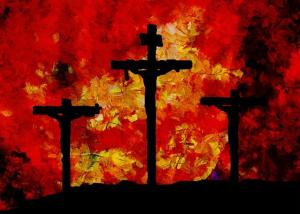
Art By Raheel Shakeel.
“Amen, amen, I say to you, whoever keeps my word will never see death.” – John 8:51.
Every Catholic, indeed every person who has ever professed faith in God, has died. Many of those, Catholics and non-Catholics alike, have suffered greatly. How do we reconcile the suffering and death of so many faithful with the belief that God has saved us? Formulated differently, is it possible to speak meaningfully of salvation if suffering and death remain ever present to us?
In this paper, I will argue that the existence of suffering and death do not preclude salvation. To do this, I will examine the nature of sin and the meaning of salvation in the context of Catholic theology.
Sin is “a word, deed or desire in opposition to the eternal law.” (Saint Augustine). In turn, the eternal law is the mind of God. Because sin can be placed within the greater context of evil, and evil is a lack of a good that ought to be present, sin can also be understood as a privation of virtue.
Violations of the laws of man have consequences, and so too do the laws of God. If we see sin as a violation of God’s laws, we can expect sin to have consequences. Scripture tells us that one such consequence of sin is death. (See Romans 6:23). Moreover, since all have sinned (Romans 3:23), all human beings are subject to death. Making matters even more grave is the fact that humans cannot save themselves. Since sin is an act against an infinite God, finite humans are incapable of providing recompense for sin.
In a sense, God’s efforts to rescue mankind from sin is what salvation is all about. For this reason, the Bible depicts several efforts by God to reconcile Himself with human beings, culminating in Christ. Because Jesus Christ is both God and man, He is in the unique position to be able to effect salvation. By taking upon Himself our sin, Christ paid the price for the cost of that sin. By His Resurrection, Christ provides a path to restoring human beings to the justification lost by original sin. (See Romans 4:25).
So far, so abstract, but what does it mean for the individual Catholic? What does it mean to be saved? Catholicism’s relationship with salvation is somewhat complex. This complexity is primarily due to two different, though related, topics.
First, salvation is a process, and only those who “Endure to the end will be saved.” The second point is the very controversial teaching of the Church vis-a-vis “work” and salvation. Perhaps “work” is the wrong word; we are to cooperate with God in our salvation, and this cooperation most efficaciously takes place in the sacraments. We cannot save ourselves; we can, however, cooperate with the process that leads to our salvation. (See Matthew 7:21).
The above provides the foundation for the question at hand. If death and the attendant suffering are the result of sin, and if Christ has saved us from sin, why do the faithful still suffer and die? There are several ways to address this question. First, it is essential that we clarify a significant misunderstanding about death, which in turn requires an understanding of life.
All living things are composed of a spiritual soul and a material or physical body. Because a body is composed of parts, it is subject to corruption (suffering) and death. This process is entirely natural. What is not natural, what Christ came to save us from, is what the Bible calls “the second death.”
The term second death appears several times in the Book of Revelation. For the sake of brevity, I will simply define the second death as the eternal separation of the soul from God. Some authorities suggest that the second death involves the destruction of the soul. Regardless, the “second death” is distinguished from the more familiar concept of death, which is the separation of the soul from the body.
All of this rests on the fact of the Resurrection of Christ. Christ was laid in a tomb and covered by a large stone. The stone, metaphorically speaking, separates the dead from the living. By His Resurrection, not only was the tomb’s stone thrust aside, but the very gates of Heaven were opened. No longer does death mean separation from God, but rather death means to be “away from the body and at home with the Lord.” (See 2 Corinthians 5:8).
Thus far, I have sought to explain the Catholic concepts of salvation and death. Accepting that Christ has saved us from the effect of sin (i.e., the second death), one problem remains. Yes, Christ has saved me from my sins; yes, He has made it possible for me to spend eternity in Heaven, but why must I suffer in this life? There are two aspects of this.
First, we live in a fallen world. While Christ has made the salvation of the soul possible, our world remains beset by the effects of original and personal sin. “All of creation groans in pain,” Saint Paul writes. This “groaning” will only cease when creation is redeemed at the Second Coming.
The second aspect is that we can give meaning to our suffering. Or, more accurately, God has given us the ability to give meaning to pain. We can accomplish this by uniting our suffering to Jesus’ suffering on the Cross. This process, known as redemptive suffering, allows us to participate in and cooperate with our redemption.
I would like to conclude by observing that the apostles and members of the early Church believed that suffering and death were opportunities to grow closer to God. While death meant that one was “at home with the Lord,” suffering allows one to share in Christ’s Passion and, therefore, participate in our own redemption. Saint Paul put it this way, “Now I rejoice in my sufferings for your sake, and in my flesh, I complete what is lacking in Christ’s afflictions for the sake of his body, that is, the church” (Colossians 1:24). In suffering, we can, albeit limitedly, become like Christ, and is that not what being Catholic is all about?
Education and Religion
History and Religion
Previous Post
March 24, 2024
A Personal God?
Next Post
April 7, 2024 Thoughts On Intelligent Design
Recent Comments
"Why would it matter if atheism is wrong? The fact that Catholic and Protestant scholars ..."
Beyond the Absence of Belief: The ..."
"Kaiser Member Service Proponents often compare atheism to not collecting stamps—it is the lack of ..."
Beyond the Absence of Belief: The ..."
""these dual denials (objective truth and objective meaning)"This is not accurate. Post-modern thought does not ..."
Defending the Faith in a Post-Truth ..."
"The theologians still haven't received the memo. Your opposition are no longer atheists, but they ..."
Defending the Faith in a Post-Truth ..."
Browse Our Archives
Select a Category Abortion Atheism Catholicism. Catholicism. God. Theophany. Christmas Eschatology Faith and Works. God. Holy Spirit Intelligent Design Jesus Christ Justice Law Politics Protestantism Religion Sabbath Salvation. Soteriology. The Bible Theology Uncategorized
Select a Month October 2026 September 2026 August 2026 July 2026 June 2026 May 2026 April 2026 March 2026 February 2026 January 2026 December 2025 November 2025 October 2025 September 2025 August 2025 July 2025 June 2025 May 2025 April 2025 March 2025 February 2025 January 2025 December 2024 November 2024 October 2024 September 2024 August 2024 July 2024 June 2024 May 2024 April 2024 March 2024 February 2024 January 2024 December 2023 November 2023 October 2023 September 2023 August 2023 July 2023 June 2023 May 2023 April 2023 March 2023 February 2023 January 2023 December 2022 November 2022 October 2022 September 2022 August 2022 July 2022 June 2022 May 2022 April 2022 March 2022 February 2022 January 2022 December 2021
Follow Us!
TAKE THE
Religious Wisdom Quiz
What did Jesus give to Judas at the Last Supper?
Select your answer to see how you score.
A scroll A robe A cup of wine A piece of bread
Related posts from Summa Catholic

The Anatomy of Divine Revelation in Catholic Thought

Beyond the Absence of Belief: The Implications of...

Can Catholic Apologetics Survive a Postmodern World?

From Samaria to Sanctity: Analyzing The Woman At...
TRENDING AT PATHEOS Catholic

Rejecting Doom: Christian Hope And Human Action
Christianity is a religion of hope. We are to have hope and...

It’s What Comes From Within Which Matters
One of the most difficult things for us to understand is why...

Why I Choose the Eucharist Over the Sermon
Choose the Eucharist, Not the Sermon What are we supposed to get...

5 Design Elements Found in Spiritually Rooted Homes
Putting Spirituality Into Home Decor Our homes are more than our living...

Credo: A Story of God Told with the...
About 10 years ago, I began to imagine a personal "Credo" that...

The Anatomy of Divine Revelation in Catholic Thought
The claim that God has made Himself known to human beings is...
view all Catholic blogs
What Are Your Thoughts?leave a comment
Ad-Free & Subscriber Log-In Subscription Support
- About Us
- 2026 Calendar
- Videos
- Podcasts
- Library of World Religions
- Faith In Media Tracker
- Advertise With Us
- Write for Us
- Privacy Policy
- Terms of Service
- Do Not Sell My Data
- Contact Us
- Radiant Digital
- Manage Newsletter Subscriptions
- Unsubscribe From Notifications
- Sitemap
Copyright 2008-2026, Patheos. All rights reserved.
Subscription Support Ad-Free & Subscriber Log-In
Follow Patheos