
BuddhistCatholicContemplativeEvangelicalGeneral ChristianHinduJewishLatter-day SaintMuslimNew VisionsProgressive Christian
Beliefs
- Buddhist
- Catholic
- Contemplative
- Evangelical
- General Christian
- Hindu
- Jewish
- Latter-day Saint
- More Voices
- Muslim
- New Visions
- Pagan
- Progressive Christian
Topics
- Religion News
- Food and Religion
- Sports and Religion
- Religious Art
- Religious Music and Entertainment
- Religious Events
- History and Religion
- Style and Religion
- Politics and Religion
- Women in Religion
- Recreation Outdoors and Religion
- Business Finance and Religion
- Careers Workplace and Religion
- Education and Religion
- Family Parenting and Religion
- Health Fitness and Religion
- Home and Religion
- Relationships and Religion
- Technology and Religion
- Travel and Religion
Columnists
- Buddhist Columnists
- Business Finance and Religion Columnists
- Careers Workplace and Religion Columnists
- Catholic Columnists
- Contemplative Columnists
- Education and Religion Columnists
- Evangelists Columnists
- Family Parenting and Religion Columnists
- General Christian Columnists
- Health Fitness and Religion Columnists
- Hindu Columnists
- History and Religion Columnists
- Home and Religion Columnists
- Jewish Columnists
- More Voices Columnists
- Latter Day Columnists
- Muslim Columnists
- New Visions Columnists
- Nonreligious Columnists
- Pagan Columnists
- Politics and Religion Columnists
- Progressive Columnists
- Recreation Outdoors and Religion Columnists
- Relationships and Religion Columnists
- Religion News Columnists
- Religious Art Columnists
- Religious Events Columnists
- Religious Music and Entertainment Columnists
- Sports and Religion Columnists
- Style and Religion Columnists
- Technology and Religion Columnists
- Travel and Religion Columnists
- Women in Religion Columnists
Resource Library
- 2026 Calendar
- Library of World Religions
- The 100 Most Holy Places on Earth
- Patheos Answers
- Podcasts
- Videos
- Faith Leaders Database
- Anglican Episcopalian
- Bahai
- Baptist
- Buddhism
- Christianity
- Confucianism
- Eastern Orthodoxy
- Hinduism
- Holiness and Pentecostal
- ISKCON
- Islam
- Judaism
- Lutheran
- Methodist
- The Church of Jesus Christ of Latter-day Saints
- New Age
- Paganism
- Presbytarian and Reformed
- Protestantism
- Religion Behind the Scenes
- Roman Catholic
- Scientology
- Shia Islam
- Sikhism
- Sufism
- Sunni Islam
- Taoism
- Zen
- See all religions
Research Tools
 Ad-Free & Subscriber Log-In Subscription Support
Ad-Free & Subscriber Log-In Subscription Support
Follow Patheos 

- Trending:
- Forgiveness
- |
- Marriage
- |
- Consciousness
- |
- Death Penalty
- |
- Election
- |
- Halloween

- Home
- Catholic
- Education and Religion
- ACTS of Prayer
ACTS of Prayer
Last updated on: March 10, 2024 at 11:01 am by David Schloss
ACTS of Prayer 2024-03-10T11:01:01-04:00 David Schloss
Patheos Explore the world's faith through different perspectives on religion and spirituality! Patheos has the views of the prevalent religions and spiritualities of the world.
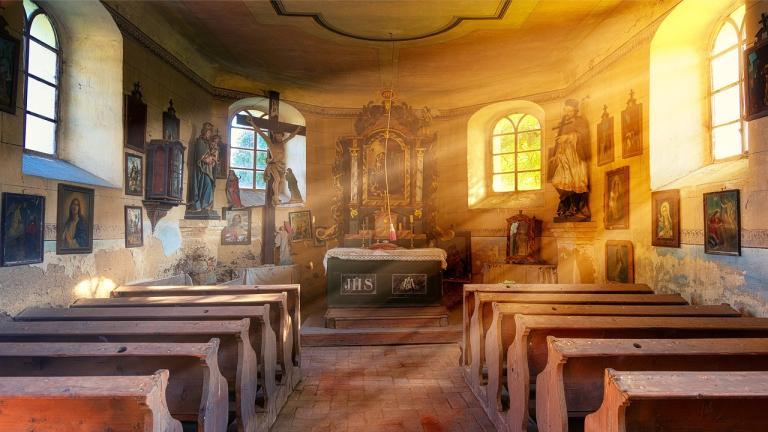
Art by Jplenio.
Is there anything more quintessential to religious faith than prayer? Regardless of the faith tradition, prayer is an essential component of what it means to be a believer in God.
Nevertheless, prayer can be, and frequently is, defined in several ways. At its most basic, prayer manifests one’s relationship with God. However, since one’s relationship with God is frequently multifaceted, prayer too often has varying aspects associated with it. In this paper, I will examine four components that comprise prayer. An acronym for these components is ACTS: adoration, confession, thanksgiving, and supplication.
Adoration
To understand adoration, we must understand the object of adoration, which is God. Unfortunately, understanding God is, in principle, impossible for human beings. Owing, however, to Divine Revelation and two thousand years of Catholic theology, we can attribute certain traits to God. We can speak of God as the source of creation, infinitely perfect, and the highest good. Because of this, and more, God alone is owed supreme honor.
The honor and praise owed to God alone is called adoration. Therefore, adoration can be defined as an act of religion by which God is recognized as alone worthy of supreme honor. It is at once an act of mind and will, expressing itself in certain types of prayers, postures of praise, and acts of reverence and sacrifice. In what form do these prayers, praise, and acts of reverence and sacrifice take?
The apex of adoration is the Eucharist. Here, the prayers, praise, reverence, and sacrifice that comprise adoration are present. In addition, the Catholic Church recognizes the great value of Eucharistic adoration. While it is true that one can pray anywhere, the Eucharistic adoration differs from other forms of prayer in one significant way. Because Christ’s body, blood, soul, and divinity are substantially present in the Eucharist, Eucharistic adoration is particularly intimate and personal.
Confession
The necessity to confess one’s sins is at the heart of the New Testament. If one wanted a minimalist summary of the New Testament, it would be “repent and believe the good news.” (Mark 1:15). To be sure, repentance is not the same as confession. Repentance requires metanoia – a spiritual and transformative change. However, repentance can not take place without confession.
In the Catholic faith, confession is a process. The first step is an examination of conscience. This involves prayerfully examining one’s deeds, words, and thoughts to identify what sins one has committed. An example of this process would be a close reading of the Ten Commandments and comparing the Commandments against one’s own actions.
The examination of conscience is typically done in preparation for partaking of the sacrament of reconciliation. However, it can also be done as a stand-alone practice in addition to reciting the Act of Contrition.
Thanksgiving
There are numerous reasons why Catholicism asserts that God is owed our gratitude. I will briefly touch on five of them.
The first three reasons are similar in that they are, at least partially, philosophical. First, God is the efficient cause of creation. Everything that exists ultimately owes its existence to God. It is altogether proper to give thanks to that which has caused one to exist.
The second reason requires understanding that everything that exists is an effect. Nothing in creation is the cause of its own existence. Since an effect can only operate so long as the cause sustains it, gratitude is owed to God for maintaining our existence.
The third reason continues the arc of the first two reasons. God is that for which human beings are made. The highest good that humans can attain is communion with God. Saint Augustine memorably stated the concept this way, “You have made us for yourself O Lord, and our heart is restless until it rests in you.”
The fourth reason is that God is the objective standard of good and truth. This is a matter of natural law, positive (man-made) law, and ethics. It is a subject deserving of more treatment than I can provide here. Suffice it to say that the existence of objective morality is reliant upon God.
The last reason for giving thanks to God is, to put it simply, that Jesus Christ is the sole source of our salvation. This reason involves soteriology and, again, is beyond the scope of this essay.
The mechanism by which Catholics give thanks to God is, of course, prayer. It is telling that a translation of the word Eucharist is thanksgiving. In and through the Mass, Catholics profess the proper gratitude owed to God.
Supplication
The last component of ACTS is supplication. When one thinks of prayer, it is frequently in the context of supplication.
Within the context of prayer, supplication is more commonly referred to as petitionary prayer. It is an act by which one seeks some perceived good from God. However, one encounters a dilemma. If God is good and omniscient, why do we need to pray at all? After all, Christ tells us that God the Father knows our needs before we even pray. (See Matthew 6:8). There are several answers to this dilemma.
Prayer properly orders the creature (human beings) to their creator (God). Moreover, Scripture indicates that while God knows our needs, He waits for us to ask. “Ask, and it will be given to you; seek, and you will find; knock, and the door will be opened to you.” (Matthew 7:7). Finally, prayer, particularly petitionary prayer, evidences the trust in God that is at the heart of faith.
The sin qua non of the Catholic faith is prayer. In this article, I have sought to examine four aspects of prayer: adoration, confession, thanksgiving, and supplication.
Education and Religion
History and Religion
Previous Post
March 3, 2024
The Four Fathers
Next Post

March 17, 2024 On The Transcendence And Immanence Of God
Browse Our Archives
Select a Category Abortion Atheism Catholicism. Catholicism. God. Theophany. Christmas Eschatology Faith and Works. God. Holy Spirit Intelligent Design Jesus Christ Justice Law Politics Protestantism Religion Sabbath Salvation. Soteriology. The Bible Theology Uncategorized
Select a Month October 2026 September 2026 August 2026 July 2026 June 2026 May 2026 April 2026 March 2026 February 2026 January 2026 December 2025 November 2025 October 2025 September 2025 August 2025 July 2025 June 2025 May 2025 April 2025 March 2025 February 2025 January 2025 December 2024 November 2024 October 2024 September 2024 August 2024 July 2024 June 2024 May 2024 April 2024 March 2024 February 2024 January 2024 December 2023 November 2023 October 2023 September 2023 August 2023 July 2023 June 2023 May 2023 April 2023 March 2023 February 2023 January 2023 December 2022 November 2022 October 2022 September 2022 August 2022 July 2022 June 2022 May 2022 April 2022 March 2022 February 2022 January 2022 December 2021
Follow Us!
TAKE THE
Religious Wisdom Quiz
According to Hebrews, who serves as a copy and shadow of what is in heaven?
Select your answer to see how you score.
The apostles The angels The priests in the earthly sanctuary The prophets
Related posts from Summa Catholic

The Anatomy of Divine Revelation in Catholic Thought

Beyond the Absence of Belief: The Implications of...

Can Catholic Apologetics Survive a Postmodern World?

From Samaria to Sanctity: Analyzing The Woman At...
TRENDING AT PATHEOS Catholic

The Parable Of The Sower And The Word...
One of Christ’s most famous parables is that of the sower who...

Rejecting Doom: Christian Hope And Human Action
Christianity is a religion of hope. We are to have hope and...

Why I Choose the Eucharist Over the Sermon
Choose the Eucharist, Not the Sermon What are we supposed to get...

5 Design Elements Found in Spiritually Rooted Homes
Putting Spirituality Into Home Decor Our homes are more than our living...

Credo: A Story of God Told with the...
About 10 years ago, I began to imagine a personal "Credo" that...

The Anatomy of Divine Revelation in Catholic Thought
The claim that God has made Himself known to human beings is...
view all Catholic blogs
Ad-Free & Subscriber Log-In Subscription Support
- About Us
- 2026 Calendar
- Videos
- Podcasts
- Library of World Religions
- Faith In Media Tracker
- Advertise With Us
- Write for Us
- Privacy Policy
- Terms of Service
- Do Not Sell My Data
- Contact Us
- Radiant Digital
- Manage Newsletter Subscriptions
- Unsubscribe From Notifications
- Sitemap
Copyright 2008-2026, Patheos. All rights reserved.
Subscription Support Ad-Free & Subscriber Log-In
Follow Patheos