
BuddhistCatholicContemplativeEvangelicalGeneral ChristianHinduJewishLatter-day SaintMuslimNew VisionsProgressive Christian
Beliefs
- Buddhist
- Catholic
- Contemplative
- Evangelical
- General Christian
- Hindu
- Jewish
- Latter-day Saint
- More Voices
- Muslim
- New Visions
- Pagan
- Progressive Christian
Topics
- Religion News
- Food and Religion
- Sports and Religion
- Religious Art
- Religious Music and Entertainment
- Religious Events
- History and Religion
- Style and Religion
- Politics and Religion
- Women in Religion
- Recreation Outdoors and Religion
- Business Finance and Religion
- Careers Workplace and Religion
- Education and Religion
- Family Parenting and Religion
- Health Fitness and Religion
- Home and Religion
- Relationships and Religion
- Technology and Religion
- Travel and Religion
Columnists
- Buddhist Columnists
- Business Finance and Religion Columnists
- Careers Workplace and Religion Columnists
- Catholic Columnists
- Contemplative Columnists
- Education and Religion Columnists
- Evangelists Columnists
- Family Parenting and Religion Columnists
- General Christian Columnists
- Health Fitness and Religion Columnists
- Hindu Columnists
- History and Religion Columnists
- Home and Religion Columnists
- Jewish Columnists
- More Voices Columnists
- Latter Day Columnists
- Muslim Columnists
- New Visions Columnists
- Nonreligious Columnists
- Pagan Columnists
- Politics and Religion Columnists
- Progressive Columnists
- Recreation Outdoors and Religion Columnists
- Relationships and Religion Columnists
- Religion News Columnists
- Religious Art Columnists
- Religious Events Columnists
- Religious Music and Entertainment Columnists
- Sports and Religion Columnists
- Style and Religion Columnists
- Technology and Religion Columnists
- Travel and Religion Columnists
- Women in Religion Columnists
Resource Library
- 2026 Calendar
- Library of World Religions
- The 100 Most Holy Places on Earth
- Patheos Answers
- Podcasts
- Videos
- Faith Leaders Database
- Anglican Episcopalian
- Bahai
- Baptist
- Buddhism
- Christianity
- Confucianism
- Eastern Orthodoxy
- Hinduism
- Holiness and Pentecostal
- ISKCON
- Islam
- Judaism
- Lutheran
- Methodist
- The Church of Jesus Christ of Latter-day Saints
- New Age
- Paganism
- Presbytarian and Reformed
- Protestantism
- Religion Behind the Scenes
- Roman Catholic
- Scientology
- Shia Islam
- Sikhism
- Sufism
- Sunni Islam
- Taoism
- Zen
- See all religions
Research Tools
 Ad-Free & Subscriber Log-In Subscription Support
Ad-Free & Subscriber Log-In Subscription Support
Follow Patheos 

- Trending:
- Forgiveness
- |
- Marriage
- |
- Consciousness
- |
- Death Penalty
- |
- Election
- |
- Halloween

- Home
- Catholic
- Education and Religion
- Does God Suffer?
Does God Suffer?
Last updated on: December 3, 2023 at 10:44 am by David Schloss
Does God Suffer? 2023-12-03T10:44:03-05:00 David Schloss
Patheos Explore the world's faith through different perspectives on religion and spirituality! Patheos has the views of the prevalent religions and spiritualities of the world.
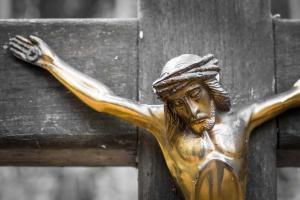
Art by Thomas Didgeman.
From its earliest formulations, Catholic theology has attributed the traits of immutability and impassibility to God’s nature. These traits, which build on ancient Greek philosophy, form much of what can be said about the nature of God.
In this essay, I will explore what immutability and impassibility mean and why these traits have been attributed to God. Finally, I will address some of the problems that immutability and impassibility present regarding Catholic Christology and soteriology.
Because the distance between the Creator and His creation is infinite, it is, in principle, impossible to provide an essential definition of God. There are at least two reasons why this is so. First, an essential definition details the essence of that which is being defined. Since temporal creatures cannot comprehend the eternal, it is impossible for humans to understand God’s essence or nature. The second reason comes to us by way of Divine Revelation and philosophy. That is, God is infinite. Since an essential definition limits the subject (so as to make a distinction) and since that which is infinite cannot be limited (by definition), it is impossible to provide a definition of who God is in His nature.
Nevertheless, that same Divine Revelation and philosophy have provided theology with enough data to attribute specific properties to God. Among these are immutability and impassibility. While immutability and impassibility are similar, they do have significant differences. Immutability refers to the belief that an infinite God is changeless. There are several ways this can be considered.
The first way is to view change as synonymous with cause. That is, a thing is changed when it is caused by something. Whatever is changing is being changed by something else, and that thing is also being changed by another. An acorn changes into a tree, and a child changes into an adult. However, this chain cannot be infinite. Thus, there must be a thing that causes change, but itself is not changed. That is God.
A second way to understand the immutability of God is to realize that change and time cannot be separated. Since God is outside of time (indeed, He is the cause of time), it is manifest that God cannot change.
Thirdly, that which is subject to change is lacking in some perfection. If that were not so, it would not need to change. However, because God necessarily possesses every perfection of being, there is no need for change. This is in agreement with the scriptural data, as well. “For I, the Lord, do not change.” (Malachi 3:6).
Impassibility refers to the belief that God is immune from suffering. Suffering is generally categorized as being either physical or mental (emotional). Since God is a spirit and is omnipotent, He is excluded from physical suffering.
Emotional suffering entails a change in the state of the one suffering, and since God is changeless, it is said that God is impassible. “The Lord [who] is the everlasting God, the Creator of the ends of the earth. He does not faint or grow weary” (Isaiah 40:28).
A contemplation of these characteristics of God suggests some problems, however. The first issue is theological. It is the tendency to see an immutable and impassible God as distant and impersonal in contrast to the immanent and personal.
The second problem is Christological and involves the Incarnation and Crucifixion of Christ. If God cannot suffer, and Christ is God, how can Scripture teach that “Christ also suffered for sins once, the righteous for the sake of the unrighteous”? (1 Peter 3:18). Perhaps even more striking are those biblical verses that attribute emotional states to God. God is said to have taken “pity on his people” and to have “grieved in his heart.” (See Judges 2:18 and Psalm 78:40).
In addressing the first problem, one begins with what God has revealed about Himself. The data provided by the Bible suggests a God Who interacts with and cares for His creation. The God of the Bible speaks to and through His creation. “For I, the Lord, am your God, the Holy One of Israel, your savior. You are precious in my eyes and honored, and I love you.” (Isaiah 43:3-13). Finally, God “so loved the world that He gave His only begotten son.” (John 3:16).
So, despite God’s utter otherness and transcendent nature, He is not a distant, deist god but a God intimately connected to His creation.
A much more difficult problem is presented by suffering as it relates to God. How are we to understand the God Who exhibits emotions? Furthermore, if Christ, as God incarnate, cannot suffer, how can he effectuate our salvation, which requires suffering to reconcile human beings and God?
The anthropomorphic traits attributed to God should be understood analogically. As indicated above, it is, in principle, impossible for human beings to comprehend God. The problem is epistemological, and anthropomorphisms allow us to comprehend the incomprehensible at least partially.
Ultimately, language fails us, and the best we can do is state that God is God, and we are not. Our human expressions are intrinsically inadequate in explaining who God is fully and adequately.
Regarding Christ’s suffering, I follow a Thomistic approach incorporating the hypostatic union into Catholic Christology. The hypostatic union is the belief that there are two perfect natures in Christ, one Divine and one human. (Council of Chalcedon, A.D. 451). It is of great import to the question of Divine impassibility that the two natures of Christ are not mixed; rather, they remain separate natures within the one person of Christ.
In Christ’s human nature, He would have experienced much of what is common to human beings: He was born, became hungry and thirsty, and, significantly, felt sorrow and pain. However, none of those things can be attributed to His Divine nature since the two natures of Christ are separate. The Divine nature of Christ is untouched by the suffering experienced by Christ in His human nature.
Therefore, with respect to the Incarnation, God suffers in His assumed human nature (that of Jesus of Nazareth), while the Divine nature remains impassible. Understood in this way, we can say that God became man, suffered, and died (in His human nature) for our sins (thereby effecting our salvation) while at the same time maintaining that God is impassible.
Education and Religion
History and Religion
Previous Post

November 26, 2023
Away From Anthropocentrism
Next Post

December 10, 2023 Why Two Judgments?
Recent Comments
"Why would it matter if atheism is wrong? The fact that Catholic and Protestant scholars ..."
Beyond the Absence of Belief: The ..."
"Kaiser Member Service Proponents often compare atheism to not collecting stamps—it is the lack of ..."
Beyond the Absence of Belief: The ..."
""these dual denials (objective truth and objective meaning)"This is not accurate. Post-modern thought does not ..."
Defending the Faith in a Post-Truth ..."
"The theologians still haven't received the memo. Your opposition are no longer atheists, but they ..."
Defending the Faith in a Post-Truth ..."
Browse Our Archives
Select a Category Abortion Atheism Catholicism. Catholicism. God. Theophany. Christmas Eschatology Faith and Works. God. Holy Spirit Intelligent Design Jesus Christ Justice Law Politics Protestantism Religion Sabbath Salvation. Soteriology. The Bible Theology Uncategorized
Select a Month October 2026 September 2026 August 2026 July 2026 June 2026 May 2026 April 2026 March 2026 February 2026 January 2026 December 2025 November 2025 October 2025 September 2025 August 2025 July 2025 June 2025 May 2025 April 2025 March 2025 February 2025 January 2025 December 2024 November 2024 October 2024 September 2024 August 2024 July 2024 June 2024 May 2024 April 2024 March 2024 February 2024 January 2024 December 2023 November 2023 October 2023 September 2023 August 2023 July 2023 June 2023 May 2023 April 2023 March 2023 February 2023 January 2023 December 2022 November 2022 October 2022 September 2022 August 2022 July 2022 June 2022 May 2022 April 2022 March 2022 February 2022 January 2022 December 2021
Follow Us!
TAKE THE
Religious Wisdom Quiz
Which is the only book in the Old Testament named after a woman besides Ruth?
Select your answer to see how you score.
Esther Deborah Naomi Miriam
Related posts from Summa Catholic

The Anatomy of Divine Revelation in Catholic Thought

Beyond the Absence of Belief: The Implications of...

Can Catholic Apologetics Survive a Postmodern World?

From Samaria to Sanctity: Analyzing The Woman At...
TRENDING AT PATHEOS Catholic

Rejecting Doom: Christian Hope And Human Action
Christianity is a religion of hope. We are to have hope and...

It’s What Comes From Within Which Matters
One of the most difficult things for us to understand is why...

Why I Choose the Eucharist Over the Sermon
Choose the Eucharist, Not the Sermon What are we supposed to get...

5 Design Elements Found in Spiritually Rooted Homes
Putting Spirituality Into Home Decor Our homes are more than our living...

Credo: A Story of God Told with the...
About 10 years ago, I began to imagine a personal "Credo" that...

The Anatomy of Divine Revelation in Catholic Thought
The claim that God has made Himself known to human beings is...
view all Catholic blogs
What Are Your Thoughts?leave a comment
Ad-Free & Subscriber Log-In Subscription Support
- About Us
- 2026 Calendar
- Videos
- Podcasts
- Library of World Religions
- Faith In Media Tracker
- Advertise With Us
- Write for Us
- Privacy Policy
- Terms of Service
- Do Not Sell My Data
- Contact Us
- Radiant Digital
- Manage Newsletter Subscriptions
- Unsubscribe From Notifications
- Sitemap
Copyright 2008-2026, Patheos. All rights reserved.
Subscription Support Ad-Free & Subscriber Log-In
Follow Patheos