
BuddhistCatholicContemplativeEvangelicalGeneral ChristianHinduJewishLatter-day SaintMuslimNew VisionsProgressive Christian
Beliefs
- Buddhist
- Catholic
- Contemplative
- Evangelical
- General Christian
- Hindu
- Jewish
- Latter-day Saint
- More Voices
- Muslim
- New Visions
- Pagan
- Progressive Christian
Topics
- Religion News
- Food and Religion
- Sports and Religion
- Religious Art
- Religious Music and Entertainment
- Religious Events
- History and Religion
- Style and Religion
- Politics and Religion
- Women in Religion
- Recreation Outdoors and Religion
- Business Finance and Religion
- Careers Workplace and Religion
- Education and Religion
- Family Parenting and Religion
- Health Fitness and Religion
- Home and Religion
- Relationships and Religion
- Technology and Religion
- Travel and Religion
Columnists
- Buddhist Columnists
- Business Finance and Religion Columnists
- Careers Workplace and Religion Columnists
- Catholic Columnists
- Contemplative Columnists
- Education and Religion Columnists
- Evangelists Columnists
- Family Parenting and Religion Columnists
- General Christian Columnists
- Health Fitness and Religion Columnists
- Hindu Columnists
- History and Religion Columnists
- Home and Religion Columnists
- Jewish Columnists
- More Voices Columnists
- Latter Day Columnists
- Muslim Columnists
- New Visions Columnists
- Nonreligious Columnists
- Pagan Columnists
- Politics and Religion Columnists
- Progressive Columnists
- Recreation Outdoors and Religion Columnists
- Relationships and Religion Columnists
- Religion News Columnists
- Religious Art Columnists
- Religious Events Columnists
- Religious Music and Entertainment Columnists
- Sports and Religion Columnists
- Style and Religion Columnists
- Technology and Religion Columnists
- Travel and Religion Columnists
- Women in Religion Columnists
Resource Library
- 2026 Calendar
- Library of World Religions
- The 100 Most Holy Places on Earth
- Patheos Answers
- Podcasts
- Videos
- Faith Leaders Database
- Anglican Episcopalian
- Bahai
- Baptist
- Buddhism
- Christianity
- Confucianism
- Eastern Orthodoxy
- Hinduism
- Holiness and Pentecostal
- ISKCON
- Islam
- Judaism
- Lutheran
- Methodist
- The Church of Jesus Christ of Latter-day Saints
- New Age
- Paganism
- Presbytarian and Reformed
- Protestantism
- Religion Behind the Scenes
- Roman Catholic
- Scientology
- Shia Islam
- Sikhism
- Sufism
- Sunni Islam
- Taoism
- Zen
- See all religions
Research Tools
 Ad-Free & Subscriber Log-In Subscription Support
Ad-Free & Subscriber Log-In Subscription Support
Follow Patheos 

- Trending:
- Forgiveness
- |
- Marriage
- |
- Consciousness
- |
- Death Penalty
- |
- Election
- |
- Halloween

- Home
- Catholic
- Why Resurrection?
Why Resurrection?
Last updated on: November 12, 2023 at 11:11 am by David Schloss
Why Resurrection? 2023-11-12T11:11:42-05:00 David Schloss
Patheos Explore the world's faith through different perspectives on religion and spirituality! Patheos has the views of the prevalent religions and spiritualities of the world.
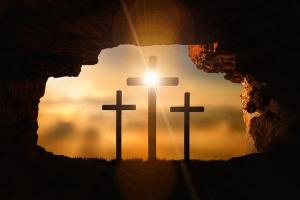
Art by Gerd Altmann.
Among the world’s religions, Catholicism is unique for its profession in that God became a human being, died by crucifixion, and was resurrected. The reasons for these events are irrevocably connected to the salvation of the human race. God became man in the person of Jesus so as to reconcile God and man, to join what had been sundered by original sin. Jesus’s death was payment owed to God for the debt incurred by original sin.
But what about the Resurrection? What purpose(s), if any, did Jesus rising from the dead accomplish?
In this paper, I will discuss five reasons that can be attributed to why the Resurrection took place. Before commencing with that, however, it is appropriate to discuss what is meant by resurrection and its place in religion.
It was said above that Catholicism asserts that Jesus of Nazareth, as God incarnate, was resurrected. Yet the belief in resurrection was not unknown in the ancient world and in its mythology.
Perhaps the most emblematic of the ancient resurrection mythologies involve the Mesopotamian gods, Ishtar and Tammuz. Every winter, Tammuz would die, and for six months, Ishtar traveled to the realm of the dead to rescue him. During that time, the world was robbed of all fertility, reproduction, and growth. Every spring, Allatu, the goddess of the underworld, would allow the imprisoned couple to be sprinkled with the Water of Life and return to the world of the living, bringing life and green vegetation back to the earth. Of course, none of the parties mentioned, Ishtar, Tammuz, or Allatu, were historical figures, and the myth clearly represents the agricultural growth cycles.
Resurrection was certainly not an unknown concept among the Old Testament peoples either, and the resurrection of the dead is a core doctrine of traditional Jewish theology. Within Jewish eschatology, the belief that when the Temple Mount is rebuilt for the third time, the Messiah will come, and the bodies of the dead will be brought back to life and reunited with their souls is foundational.
All this is to point out that the people of Jesus’ time would have been familiar with the concept of resurrection. We see evidence of this knowledge in Martha’s conversation with Jesus after her brother’s death. “Jesus said to her [Martha], ‘Your brother will rise.’ Martha said to him, ‘I know he will rise in the resurrection on the last day.” (See John 11:23).
But does the Resurrection of Christ have any particular effects, whether theologically in terms of a greater understanding of God or regarding soteriology? Moreover, is the Resurrection necessary for our salvation?
The first reason why the Resurrection was appropriate was for the recognition of Divine justice. One aspect of Divine justice is the exaltation of those who humble themselves for God. Scripture provides several examples of this, including Jesus’s own words. “Whoever wishes to be great among you shall be your servant; whoever wishes to be first among you shall be your slave. Just so, the Son of Man did not come to be served but to serve and to give his life as a ransom for many.” (See Matthew 20:26-28).
Since Christ humbled Himself even to death on the Cross, it is appropriate that He should be lifted up to God by virtue of a glorious Resurrection.
The second reason we may apply to the need for the Resurrection is that it provides proof positive that Jesus is who He says, that is, God. It has long been suggested that Christianity would have become one more historical curiosity if Christ had not risen. Indeed, without the Resurrection, Jesus would likely have been considered along with Simon bar Kokhba, a Jewish revolutionary whom the Romans killed. There are no followers of Simon bar Kokhba; there are some two billion Christians who proclaim to be followers of Christ. It is because Jesus rose from the dead that the belief in His divinity was solidified.
The third reason to consider for the Resurrection is that Christ has defeated sin and its consequence, death. In dying on the Cross, “He himself bore our sins in his body upon the cross, so that, free from sin, we might live for righteousness.” (1 Peter 2:24). Additionally, the Resurrection provides hope for our eternal life. Saint Paul puts it this way, “If there is no resurrection of the dead, then neither has Christ been raised. And if Christ has not been raised, then empty [too] is our preaching; empty, too, your faith.” (1 Corinthians 15:13-14).
The fourth reason we may apply for the Resurrection is that it allowed for the coming of the Holy Spirit. Not only does the Holy Spirit enable God to work in and through the believer, but He also makes possible the creation and continued existence of the Catholic Church. This is the meaning of Christ’s words, at least in part. “But I tell you the truth, it is better for you that I go. For if I do not go, the Advocate [i.e., the Holy Spirit] will not come to you. But if I go, I will send him to you.” (See John 16:7).
The fifth and final reason for the Resurrection is the completion of the work of salvation. In addition to again demonstrating Himself to be God, the Resurrection completes the mystery of our salvation and redemption; by His death, Christ freed us from sin, and by His Resurrection, He restored the most important privileges lost by sin. The justification lost by original sin is made possible again through the Resurrection of Christ (see Romans 4:25).
A foundational belief of the Catholic faith is in the God who became a human being, died for our sins, and was resurrected. In this paper, I have endeavored to articulate five reasons why the Resurrection of Christ is paramount to Catholicism.
Previous Post
November 5, 2023
The Threefold Significance Of The Eucharist
Next Post

November 19, 2023 The Dilemma Of Temptation
Recent Comments
"Why would it matter if atheism is wrong? The fact that Catholic and Protestant scholars ..."
Beyond the Absence of Belief: The ..."
"Kaiser Member Service Proponents often compare atheism to not collecting stamps—it is the lack of ..."
Beyond the Absence of Belief: The ..."
""these dual denials (objective truth and objective meaning)"This is not accurate. Post-modern thought does not ..."
Defending the Faith in a Post-Truth ..."
"The theologians still haven't received the memo. Your opposition are no longer atheists, but they ..."
Defending the Faith in a Post-Truth ..."
Browse Our Archives
Select a Category Abortion Atheism Catholicism. Catholicism. God. Theophany. Christmas Eschatology Faith and Works. God. Holy Spirit Intelligent Design Jesus Christ Justice Law Politics Protestantism Religion Sabbath Salvation. Soteriology. The Bible Theology Uncategorized
Select a Month October 2026 September 2026 August 2026 July 2026 June 2026 May 2026 April 2026 March 2026 February 2026 January 2026 December 2025 November 2025 October 2025 September 2025 August 2025 July 2025 June 2025 May 2025 April 2025 March 2025 February 2025 January 2025 December 2024 November 2024 October 2024 September 2024 August 2024 July 2024 June 2024 May 2024 April 2024 March 2024 February 2024 January 2024 December 2023 November 2023 October 2023 September 2023 August 2023 July 2023 June 2023 May 2023 April 2023 March 2023 February 2023 January 2023 December 2022 November 2022 October 2022 September 2022 August 2022 July 2022 June 2022 May 2022 April 2022 March 2022 February 2022 January 2022 December 2021
Follow Us!
TAKE THE
Religious Wisdom Quiz
A plant grew overnight to shade me, then withered, making me angry enough to die. What lesson did God teach through this?
Select your answer to see how you score.
God's Patience with us God's compassion for people Trust in God Our need for Humility
Related posts from Summa Catholic

The Anatomy of Divine Revelation in Catholic Thought

Beyond the Absence of Belief: The Implications of...

Can Catholic Apologetics Survive a Postmodern World?

From Samaria to Sanctity: Analyzing The Woman At...
TRENDING AT PATHEOS Catholic

The Parable Of The Sower And The Word...
One of Christ’s most famous parables is that of the sower who...

Rejecting Doom: Christian Hope And Human Action
Christianity is a religion of hope. We are to have hope and...

Why I Choose the Eucharist Over the Sermon
Choose the Eucharist, Not the Sermon What are we supposed to get...

5 Design Elements Found in Spiritually Rooted Homes
Putting Spirituality Into Home Decor Our homes are more than our living...

Credo: A Story of God Told with the...
About 10 years ago, I began to imagine a personal "Credo" that...

The Anatomy of Divine Revelation in Catholic Thought
The claim that God has made Himself known to human beings is...
view all Catholic blogs
What Are Your Thoughts?leave a comment
Ad-Free & Subscriber Log-In Subscription Support
- About Us
- 2026 Calendar
- Videos
- Podcasts
- Library of World Religions
- Faith In Media Tracker
- Advertise With Us
- Write for Us
- Privacy Policy
- Terms of Service
- Do Not Sell My Data
- Contact Us
- Radiant Digital
- Manage Newsletter Subscriptions
- Unsubscribe From Notifications
- Sitemap
Copyright 2008-2026, Patheos. All rights reserved.
Subscription Support Ad-Free & Subscriber Log-In
Follow Patheos