
BuddhistCatholicContemplativeEvangelicalGeneral ChristianHinduJewishLatter-day SaintMuslimNew VisionsProgressive Christian
Beliefs
- Buddhist
- Catholic
- Contemplative
- Evangelical
- General Christian
- Hindu
- Jewish
- Latter-day Saint
- More Voices
- Muslim
- New Visions
- Pagan
- Progressive Christian
Topics
- Religion News
- Food and Religion
- Sports and Religion
- Religious Art
- Religious Music and Entertainment
- Religious Events
- History and Religion
- Style and Religion
- Politics and Religion
- Women in Religion
- Recreation Outdoors and Religion
- Business Finance and Religion
- Careers Workplace and Religion
- Education and Religion
- Family Parenting and Religion
- Health Fitness and Religion
- Home and Religion
- Relationships and Religion
- Technology and Religion
- Travel and Religion
Columnists
- Buddhist Columnists
- Business Finance and Religion Columnists
- Careers Workplace and Religion Columnists
- Catholic Columnists
- Contemplative Columnists
- Education and Religion Columnists
- Evangelists Columnists
- Family Parenting and Religion Columnists
- General Christian Columnists
- Health Fitness and Religion Columnists
- Hindu Columnists
- History and Religion Columnists
- Home and Religion Columnists
- Jewish Columnists
- More Voices Columnists
- Latter Day Columnists
- Muslim Columnists
- New Visions Columnists
- Nonreligious Columnists
- Pagan Columnists
- Politics and Religion Columnists
- Progressive Columnists
- Recreation Outdoors and Religion Columnists
- Relationships and Religion Columnists
- Religion News Columnists
- Religious Art Columnists
- Religious Events Columnists
- Religious Music and Entertainment Columnists
- Sports and Religion Columnists
- Style and Religion Columnists
- Technology and Religion Columnists
- Travel and Religion Columnists
- Women in Religion Columnists
Resource Library
- 2026 Calendar
- Library of World Religions
- The 100 Most Holy Places on Earth
- Patheos Answers
- Podcasts
- Videos
- Faith Leaders Database
- Anglican Episcopalian
- Bahai
- Baptist
- Buddhism
- Christianity
- Confucianism
- Eastern Orthodoxy
- Hinduism
- Holiness and Pentecostal
- ISKCON
- Islam
- Judaism
- Lutheran
- Methodist
- The Church of Jesus Christ of Latter-day Saints
- New Age
- Paganism
- Presbytarian and Reformed
- Protestantism
- Religion Behind the Scenes
- Roman Catholic
- Scientology
- Shia Islam
- Sikhism
- Sufism
- Sunni Islam
- Taoism
- Zen
- See all religions
Research Tools
 Ad-Free & Subscriber Log-In Subscription Support
Ad-Free & Subscriber Log-In Subscription Support
Follow Patheos 

- Trending:
- Forgiveness
- |
- Marriage
- |
- Consciousness
- |
- Death Penalty
- |
- Election
- |
- Halloween

- Home
- Catholic
- Education and Religion
- Be At Peace
Be At Peace
Last updated on: October 8, 2023 at 10:42 am by David Schloss
Be At Peace 2023-10-08T10:42:49-04:00 David Schloss
Patheos Explore the world's faith through different perspectives on religion and spirituality! Patheos has the views of the prevalent religions and spiritualities of the world.
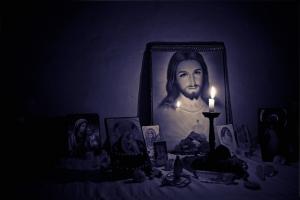
Art by Ha11ok.
“In His will, our peace.” – Dante Alighieri.
Perhaps one of life’s most paradoxical aspects is the natural inclination for peace. Paradoxical because despite this human desire for peace, we inhabit a world filled with anger, hatred, and violence.
In order to understand the reason for this incongruity between the desire for peace and a world riddled with discord, I will examine and contrast the two types of peace, one worldly and the other Godly. I will conclude by showing why worldly peace is inadequate and inferior to the peace afforded by God.
Worldly (secular) peace is the one we are most familiar with. The absence of conflict, tranquility, and harmonious relationships characterizes this kind of peace. It is also the peace of family members who do not speak to one another so as to avoid a fight. Unfortunately, secular peace is frequently not true peace, for it is marked by separation and mistrust. In his “Letter from a Birmingham Jail,” Martin Luther King expressed this type of peace as a “negative” peace. “A negative peace which is the absence of tension to a positive peace which is the presence of justice.” Nevertheless, in a world where nations and individuals are often at odds with one another, this type of peace is undoubtedly attractive and often even necessary.
Doctor King’s comments highlight a significant difference between worldly and Godly peace. Worldly peace seeks to placate and separate. Godly peace, on the other hand, seeks justice and unification.
From a Catholic perspective, this dichotomy between worldly peace and Godly peace is articulated by Christ’s own words, “Peace I leave with you; my peace I give to you. Not as the world gives do I give it to you. Do not let your hearts be troubled or afraid.” (John 14:27). What makes Godly peace different from the peace that the world offers? To answer that question, it is helpful to study the effects of Godly peace before looking at why Godly peace differs from worldly peace.
The first point to note is that, unlike secular peace, God’s peace is not contingent upon circumstances. When we are not arguing with anyone, when our lives are calm, when our country is not at war, we experience worldly peace. However, as soon as any of those circumstances change, we are upset.
In contrast to the contingent nature of secular peace, God’s peace endures regardless of our external circumstances. There are two ways in which the peace provided by God can be understood. In the first way, it is the recognition that sin is the foundation for conflict and upheaval. Owing to the effects of original sin, human beings not only became subject to death but also developed an increasing antipathy between each person and God and between each person and others. One need not make much effort to see the consequences wrought by original sin in our world today. From wars among nations to domestic abuse, strife is ubiquitous.
This leads to the second way to understand Godly peace: as a three-level unifying force. At the first level, one obtains peace with himself. At the second level, one is at peace with others. Finally, one is at peace with God. The Trappist monk Thomas Merton articulated this three-fold peace this way, “We are not at peace with others because we are not at peace with ourselves, and we are not at peace with ourselves because we are not at peace with God.”
In a real sense, peace begins at the level of the individual. Since Godly peace entails a kind of unification, peace at the level of the individual means a proper ordering of the body (passions and emotions) to the soul (rationality and spirituality). Second, one is at peace with other people. While this type of peace is frequently the most problematic, it is predicated upon the love of God. For to love God is to love what God loves, and God loves His creation. Finally, the integrated person must order himself to God.
How can this ordering – and the attendant peace – be obtained? Like our salvation, it cannot be achieved by human effort alone. So, the first step in attaining Godly peace requires God’s Grace. Since Grace is an unmerited favor, one can only pray for it. The second step requires subordinating the body to the soul. Said differently, it is placing reason above the passions. Traditionally, this involves the practice of mortification. Finally, one must be in right relationship with God. This requires partaking of the sacraments, in particular, baptism, confession, and communion.
In his seminal work, “City of God,” Saint Augustine argues that the peace that only God can give is the highest good to obtain. Since peace is ultimately gained by union with God, and since this union is a result of love (caritas), peace – the peace of God – must be our goal in this life.
Education and Religion
History and Religion
Previous Post

October 1, 2023
Fear Of God
Next Post

October 15, 2023 Religious Orders Within Catholicism
Recent Comments
"Why would it matter if atheism is wrong? The fact that Catholic and Protestant scholars ..."
Beyond the Absence of Belief: The ..."
"Kaiser Member Service Proponents often compare atheism to not collecting stamps—it is the lack of ..."
Beyond the Absence of Belief: The ..."
""these dual denials (objective truth and objective meaning)"This is not accurate. Post-modern thought does not ..."
Defending the Faith in a Post-Truth ..."
"The theologians still haven't received the memo. Your opposition are no longer atheists, but they ..."
Defending the Faith in a Post-Truth ..."
Browse Our Archives
Select a Category Abortion Atheism Catholicism. Catholicism. God. Theophany. Christmas Eschatology Faith and Works. God. Holy Spirit Intelligent Design Jesus Christ Justice Law Politics Protestantism Religion Sabbath Salvation. Soteriology. The Bible Theology Uncategorized
Select a Month October 2026 September 2026 August 2026 July 2026 June 2026 May 2026 April 2026 March 2026 February 2026 January 2026 December 2025 November 2025 October 2025 September 2025 August 2025 July 2025 June 2025 May 2025 April 2025 March 2025 February 2025 January 2025 December 2024 November 2024 October 2024 September 2024 August 2024 July 2024 June 2024 May 2024 April 2024 March 2024 February 2024 January 2024 December 2023 November 2023 October 2023 September 2023 August 2023 July 2023 June 2023 May 2023 April 2023 March 2023 February 2023 January 2023 December 2022 November 2022 October 2022 September 2022 August 2022 July 2022 June 2022 May 2022 April 2022 March 2022 February 2022 January 2022 December 2021
Follow Us!
TAKE THE
Religious Wisdom Quiz
Rejoice in the Lord always. I will say it again: __!
Select your answer to see how you score.
Rejoice Pray Hope Believe
Related posts from Summa Catholic

The Anatomy of Divine Revelation in Catholic Thought

Beyond the Absence of Belief: The Implications of...

Can Catholic Apologetics Survive a Postmodern World?

From Samaria to Sanctity: Analyzing The Woman At...
TRENDING AT PATHEOS Catholic

Rejecting Doom: Christian Hope And Human Action
Christianity is a religion of hope. We are to have hope and...

It’s What Comes From Within Which Matters
One of the most difficult things for us to understand is why...

Why I Choose the Eucharist Over the Sermon
Choose the Eucharist, Not the Sermon What are we supposed to get...

5 Design Elements Found in Spiritually Rooted Homes
Putting Spirituality Into Home Decor Our homes are more than our living...

Credo: A Story of God Told with the...
About 10 years ago, I began to imagine a personal "Credo" that...

The Anatomy of Divine Revelation in Catholic Thought
The claim that God has made Himself known to human beings is...
view all Catholic blogs
What Are Your Thoughts?leave a comment
Ad-Free & Subscriber Log-In Subscription Support
- About Us
- 2026 Calendar
- Videos
- Podcasts
- Library of World Religions
- Faith In Media Tracker
- Advertise With Us
- Write for Us
- Privacy Policy
- Terms of Service
- Do Not Sell My Data
- Contact Us
- Radiant Digital
- Manage Newsletter Subscriptions
- Unsubscribe From Notifications
- Sitemap
Copyright 2008-2026, Patheos. All rights reserved.
Subscription Support Ad-Free & Subscriber Log-In
Follow Patheos