
BuddhistCatholicContemplativeEvangelicalGeneral ChristianHinduJewishLatter-day SaintMuslimNew VisionsProgressive Christian
Beliefs
- Buddhist
- Catholic
- Contemplative
- Evangelical
- General Christian
- Hindu
- Jewish
- Latter-day Saint
- More Voices
- Muslim
- New Visions
- Pagan
- Progressive Christian
Topics
- Religion News
- Food and Religion
- Sports and Religion
- Religious Art
- Religious Music and Entertainment
- Religious Events
- History and Religion
- Style and Religion
- Politics and Religion
- Women in Religion
- Recreation Outdoors and Religion
- Business Finance and Religion
- Careers Workplace and Religion
- Education and Religion
- Family Parenting and Religion
- Health Fitness and Religion
- Home and Religion
- Relationships and Religion
- Technology and Religion
- Travel and Religion
Columnists
- Buddhist Columnists
- Business Finance and Religion Columnists
- Careers Workplace and Religion Columnists
- Catholic Columnists
- Contemplative Columnists
- Education and Religion Columnists
- Evangelists Columnists
- Family Parenting and Religion Columnists
- General Christian Columnists
- Health Fitness and Religion Columnists
- Hindu Columnists
- History and Religion Columnists
- Home and Religion Columnists
- Jewish Columnists
- More Voices Columnists
- Latter Day Columnists
- Muslim Columnists
- New Visions Columnists
- Nonreligious Columnists
- Pagan Columnists
- Politics and Religion Columnists
- Progressive Columnists
- Recreation Outdoors and Religion Columnists
- Relationships and Religion Columnists
- Religion News Columnists
- Religious Art Columnists
- Religious Events Columnists
- Religious Music and Entertainment Columnists
- Sports and Religion Columnists
- Style and Religion Columnists
- Technology and Religion Columnists
- Travel and Religion Columnists
- Women in Religion Columnists
Resource Library
- 2026 Calendar
- Library of World Religions
- The 100 Most Holy Places on Earth
- Patheos Answers
- Podcasts
- Videos
- Faith Leaders Database
- Anglican Episcopalian
- Bahai
- Baptist
- Buddhism
- Christianity
- Confucianism
- Eastern Orthodoxy
- Hinduism
- Holiness and Pentecostal
- ISKCON
- Islam
- Judaism
- Lutheran
- Methodist
- The Church of Jesus Christ of Latter-day Saints
- New Age
- Paganism
- Presbytarian and Reformed
- Protestantism
- Religion Behind the Scenes
- Roman Catholic
- Scientology
- Shia Islam
- Sikhism
- Sufism
- Sunni Islam
- Taoism
- Zen
- See all religions
Research Tools
 Ad-Free & Subscriber Log-In Subscription Support
Ad-Free & Subscriber Log-In Subscription Support
Follow Patheos 

- Trending:
- Forgiveness
- |
- Marriage
- |
- Consciousness
- |
- Death Penalty
- |
- Election
- |
- Halloween

- Home
- Catholic
- Education and Religion
- Free Will And The Content Of Faith
Free Will And The Content Of Faith
Last updated on: September 24, 2023 at 10:06 am by David Schloss
Free Will And The Content Of Faith 2023-09-24T10:06:40-04:00 David Schloss
Patheos Explore the world's faith through different perspectives on religion and spirituality! Patheos has the views of the prevalent religions and spiritualities of the world.

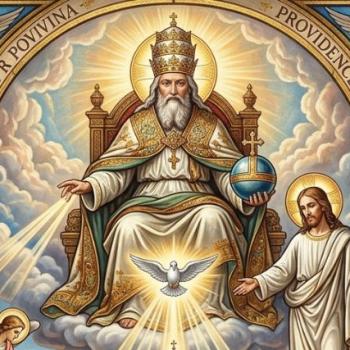
Art by Charlie Vera.
Theological virtues are those virtues that are infused into the soul by God. Among the theological virtues is faith. This fact raises a question. If faith is a product of God’s Grace, can it be rejected? Said differently, if God has disposed the soul to faith, do we really have free will when it comes to belief? This question involves not only the existence of God but also those things that the Catholic Church teaches.
To address this question, it is necessary to not only know what is meant by faith but also the source and content of that faith. This will allow us to see how free will is influenced by Grace with regard to what one believes.
As it relates to Catholicism, faith is that virtue by which one firmly believes all the truths God has revealed based on the understanding that God is not deceived, nor does He deceive others. Faith, within a religious context, is not natural or innate to human beings. The reason why faith is not natural is at least partially due to its object, God, and partially due to the nature of belief.
For one to believe something, one must possess a certain amount of knowledge and be presented with evidence. The amount of knowledge one has, as well as the evidence needed to believe, varies and depends upon the individual as well as the subject matter. Additionally, one must assent to whatever is being proposed. In this case, what one must assent to is not only belief in the existence of God but also those things which the Catholic Church deems necessary, that is to say, the content of the faith. The Church’s teaching is not of its own creation but rather inspired by the Holy Spirit.
Since faith entails belief and trust in a transcendent reality, human nature cannot be the cause of faith in the soul. For that reason, faith is considered a supernatural virtue. As matters of faith are, by nature, beyond human reason, certain truths related to the content of faith can only be disclosed to one by God. Of great import is that God has deemed it necessary to reveal the supernatural content of faith to His Church. It is the Catholic Church’s responsibility to preserve this knowledge and disseminate it as it sees fit.
As with any other subject that the intellect entertains, faith involves an element of intentionality. That is, one does not believe in isolation but believes something. As it pertains to Catholicism, this something is the deposit of faith, to wit, sacred Scripture, tradition, and the Magisterium.
Without expounding greatly, the content of the Catholic faith can be categorized into nine tenants:
1) The belief in a Triune God.
2) The belief in the Incarnation of Jesus Christ, Who is the Son of God.**
3) Belief in the Person and work of the Holy Spirit.
4) The belief that Jesus was Crucified, rose from the dead, and ascended to Heaven.
5) Believe that the Catholic Church is the Mystical Body of Christ.**
6) Belief in the Communion of Saints.
7) Belief that all humankind is subject to Original Sin and requires salvation.
8) Belief in the Second Coming of Christ.
9) The belief in the Real Presence.
It was said above that faith is a supernatural virtue, its existence being predicated upon God’s Grace. However, if Grace is God working in and through His creation (in this case, the human person), and if that Grace creates faith in a person, can that person be said to believe of his own free will?
In order to see the relationship between God’s Grace, free will, and faith, it must be observed that God is the creator of human nature and that human nature encompasses free will. Therefore, when it is said that Grace perfects nature, this perfecting includes free will. Now, the perfecting of human nature involves faith in God. This is so because God is the final cause or purpose for which human beings have been created.
Since the perfecting of human nature must take into account free will, Grace cannot be said to cause faith so much as it engages the will to seek faith. This, in turn, affects knowledge. As Saint Augustine put it, “faith seeks understanding.” The more one “walks by faith,” the more one obtains Grace, and the more Grace one possesses, the more one understands. Saint Paul notes the relationship between Grace and understanding (“revelation”) this way, “Surely you have heard about the administration of God’s grace that was given to me for you, that is, the mystery made known to me by revelation” (Ephesians 3:3-4).
It is Grace that illuminates the intellect to allow one to understand the sacred mysteries, and the sacred mysteries again refer one back to the content of the Catholic faith. The reason that this is so important is that there are many aspects of the Catholic faith that are not accessible to the intellect unless Grace guides it.
To understand why this is the case, it helps to distinguish between natural theology and supernatural theology. Natural theology involves understanding religious truths using reason alone. Examples of natural theology are evident in the works of Socrates, Plato, and Aristotle. The most notable use of natural theology is those used by Thomas Aquinas in arguing for the existence of God.
Whereas natural theology refers to knowledge that is obtainable by reason alone, supernatural theology is principles or truths that can only be known by Divine revelation. A prime example of this is the Holy Trinity.
There is then no conflict between Grace, free will, and faith. Instead, Grace perfects human nature and, in so doing, makes faith possible. The final act, then, is cooperation. In faith, the will desires what God desires. “Not my will, but yours be done.”
Education and Religion
History and Religion
Previous Post

September 17, 2023
The Seeds Of The Church
Next Post

October 1, 2023 Fear Of God
Recent Comments
"Why would it matter if atheism is wrong? The fact that Catholic and Protestant scholars ..."
Beyond the Absence of Belief: The ..."
"Kaiser Member Service Proponents often compare atheism to not collecting stamps—it is the lack of ..."
Beyond the Absence of Belief: The ..."
""these dual denials (objective truth and objective meaning)"This is not accurate. Post-modern thought does not ..."
Defending the Faith in a Post-Truth ..."
"The theologians still haven't received the memo. Your opposition are no longer atheists, but they ..."
Defending the Faith in a Post-Truth ..."
Browse Our Archives
Select a Category Abortion Atheism Catholicism. Catholicism. God. Theophany. Christmas Eschatology Faith and Works. God. Holy Spirit Intelligent Design Jesus Christ Justice Law Politics Protestantism Religion Sabbath Salvation. Soteriology. The Bible Theology Uncategorized
Select a Month October 2026 September 2026 August 2026 July 2026 June 2026 May 2026 April 2026 March 2026 February 2026 January 2026 December 2025 November 2025 October 2025 September 2025 August 2025 July 2025 June 2025 May 2025 April 2025 March 2025 February 2025 January 2025 December 2024 November 2024 October 2024 September 2024 August 2024 July 2024 June 2024 May 2024 April 2024 March 2024 February 2024 January 2024 December 2023 November 2023 October 2023 September 2023 August 2023 July 2023 June 2023 May 2023 April 2023 March 2023 February 2023 January 2023 December 2022 November 2022 October 2022 September 2022 August 2022 July 2022 June 2022 May 2022 April 2022 March 2022 February 2022 January 2022 December 2021
Follow Us!
TAKE THE
Religious Wisdom Quiz
In what city did the disciples first preach to Gentiles and were first called Christians?
Select your answer to see how you score.
Jerusalem Corinth Antioch Ephesus
Related posts from Summa Catholic
Creation, Preservation, and Teleology in Catholic Theology

The Anatomy of Divine Revelation in Catholic Thought

Beyond the Absence of Belief: The Implications of...

Can Catholic Apologetics Survive a Postmodern World?
TRENDING AT PATHEOS Catholic

Creation, Preservation, and Teleology in Catholic Theology
As I write this, it is very early Monday morning. Like millions...

The Parable Of The Sower And The Word...
One of Christ’s most famous parables is that of the sower who...

Rejecting Doom: Christian Hope And Human Action
Christianity is a religion of hope. We are to have hope and...

Why I Choose the Eucharist Over the Sermon
Choose the Eucharist, Not the Sermon What are we supposed to get...

5 Design Elements Found in Spiritually Rooted Homes
Putting Spirituality Into Home Decor Our homes are more than our living...

Credo: A Story of God Told with the...
About 10 years ago, I began to imagine a personal "Credo" that...
view all Catholic blogs
What Are Your Thoughts?leave a comment
Ad-Free & Subscriber Log-In Subscription Support
- About Us
- 2026 Calendar
- Videos
- Podcasts
- Library of World Religions
- Faith In Media Tracker
- Advertise With Us
- Write for Us
- Privacy Policy
- Terms of Service
- Do Not Sell My Data
- Contact Us
- Radiant Digital
- Manage Newsletter Subscriptions
- Unsubscribe From Notifications
- Sitemap
Copyright 2008-2026, Patheos. All rights reserved.
Subscription Support Ad-Free & Subscriber Log-In
Follow Patheos