
BuddhistCatholicContemplativeEvangelicalGeneral ChristianHinduJewishLatter-day SaintMuslimNew VisionsProgressive Christian
Beliefs
- Buddhist
- Catholic
- Contemplative
- Evangelical
- General Christian
- Hindu
- Jewish
- Latter-day Saint
- More Voices
- Muslim
- New Visions
- Pagan
- Progressive Christian
Topics
- Religion News
- Food and Religion
- Sports and Religion
- Religious Art
- Religious Music and Entertainment
- Religious Events
- History and Religion
- Style and Religion
- Politics and Religion
- Women in Religion
- Recreation Outdoors and Religion
- Business Finance and Religion
- Careers Workplace and Religion
- Education and Religion
- Family Parenting and Religion
- Health Fitness and Religion
- Home and Religion
- Relationships and Religion
- Technology and Religion
- Travel and Religion
Columnists
- Buddhist Columnists
- Business Finance and Religion Columnists
- Careers Workplace and Religion Columnists
- Catholic Columnists
- Contemplative Columnists
- Education and Religion Columnists
- Evangelists Columnists
- Family Parenting and Religion Columnists
- General Christian Columnists
- Health Fitness and Religion Columnists
- Hindu Columnists
- History and Religion Columnists
- Home and Religion Columnists
- Jewish Columnists
- More Voices Columnists
- Latter Day Columnists
- Muslim Columnists
- New Visions Columnists
- Nonreligious Columnists
- Pagan Columnists
- Politics and Religion Columnists
- Progressive Columnists
- Recreation Outdoors and Religion Columnists
- Relationships and Religion Columnists
- Religion News Columnists
- Religious Art Columnists
- Religious Events Columnists
- Religious Music and Entertainment Columnists
- Sports and Religion Columnists
- Style and Religion Columnists
- Technology and Religion Columnists
- Travel and Religion Columnists
- Women in Religion Columnists
Resource Library
- 2026 Calendar
- Library of World Religions
- The 100 Most Holy Places on Earth
- Patheos Answers
- Podcasts
- Videos
- Faith Leaders Database
- Anglican Episcopalian
- Bahai
- Baptist
- Buddhism
- Christianity
- Confucianism
- Eastern Orthodoxy
- Hinduism
- Holiness and Pentecostal
- ISKCON
- Islam
- Judaism
- Lutheran
- Methodist
- The Church of Jesus Christ of Latter-day Saints
- New Age
- Paganism
- Presbytarian and Reformed
- Protestantism
- Religion Behind the Scenes
- Roman Catholic
- Scientology
- Shia Islam
- Sikhism
- Sufism
- Sunni Islam
- Taoism
- Zen
- See all religions
Research Tools
 Ad-Free & Subscriber Log-In Subscription Support
Ad-Free & Subscriber Log-In Subscription Support
Follow Patheos 

- Trending:
- Forgiveness
- |
- Marriage
- |
- Consciousness
- |
- Death Penalty
- |
- Election
- |
- Halloween

- Home
- Catholic
- Education and Religion
- On Suffering, Meaning, And Virtue
On Suffering, Meaning, And Virtue
Last updated on: August 13, 2023 at 11:44 am by David Schloss
On Suffering, Meaning, And Virtue 2023-08-13T11:44:02-04:00 David Schloss
Patheos Explore the world's faith through different perspectives on religion and spirituality! Patheos has the views of the prevalent religions and spiritualities of the world.
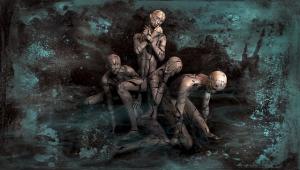
Art by Stefan Keller.
Benjamin Franklin once observed that death and taxes are the only two certainties in this world. Most of us would also add suffering to that list.
It is the existence of suffering that provides atheists and agnostics with some of their more effective arguments against faith. Suffering also presents religion with a dilemma. If God exists, if God is good, and if God is love, why does He permit suffering?
As anyone who has read the Bible (or even just the Book of Job) knows, suffering is a recurring theme in Scripture. Remarkably, Catholicism asserts that God became man and, as the Apostles Creed tells us, suffered and died.
Nevertheless, there is a danger of turning the subject of suffering into an abstract philosophical discussion. Doing so runs the risk of avoiding the “hard” questions. What does it mean to suffer, why does God allow it, and does it serve a purpose? I will endeavor to address these questions and argue that suffering provides an opportunity to practice virtue.
Owing to its subjective nature, defining what constitutes suffering is difficult. Compounding this difficulty is that suffering can come in the forms of physical pain or mental anguish. For my purposes, I will define suffering as the “Experience of the soul that comes with the presence of evil or the privation of some good.” (Hardon, John. Catholic Dictionary. 2013).
Suffering and its corollary, evil, have long been a thorn in the side of the faithful. To paraphrase Thomas Aquinas, if God is good, there would be no suffering, but there is suffering; therefore, God is not good. It is essential to point out that suffering is no argument against the existence of God. For even if atheists are correct and God does not exist, the reality of suffering remains.
The foundational premise for the Catholic response to suffering is to assert that it is a consequence of The Fall. (See Catechism of The Catholic Church, Paragraphs 376-379). No longer illuminated by grace, the intellect easily mistakes lesser goods for higher goods. Instead of realizing that God is the source of happiness, we seek happiness through things like money, sex, or fame. Since these things fail to bring true happiness, we endure suffering. We suffer, too, from the fruits of this broken world. The pain of illness, the immense sorrow of losing a loved one haunts our existence.
Furthermore, because we no longer possess the supernatural grace enjoyed before original sin, “all of creation” is now susceptible to the natural events and conditions of the universe. This includes suffering caused by earthquakes, fires, and sundry other natural disasters.
Still, all is not lost. We are buoyed first by the fact that God has provided a path through our fallen state. (See John 3:16). And, if it is true that “All things work for good for those who love God,” then we may infer that even suffering can have value.
The Bible tells us that not only does God allow suffering, but He experiences it Himself. God gives meaning to suffering by transforming it into the very thing which allows for our redemption. In suffering and dying, Jesus pays the price owed by all of us for the cost of original sin. While we human beings do not have the power to save ourselves, by uniting our suffering to the suffering of Christ, we participate in the act of redemption. Said differently, suffering allows us to conform ourselves to Christ’s death so that we may have hope in our resurrection. (See Philippians 3:8-11).
It follows from what has been said that suffering is vital in sanctification. Sanctification signifies the process whereby one is made holy. Two stages are involved in the process of sanctification. The first occurs when the individual is baptized. The second stage is a lifelong process in which a person already in the state of grace grows in possession of grace and likeness to God by faithfully corresponding with God’s will.
This stage involves the realization that one must depend on God. Saint Paul suggests that suffering serves this purpose. He writes, “And to keep me from being too elated by the abundance of revelations, a thorn was given me in the flesh, a messenger of Satan, to harass me, to keep me from being too elated. Three times I begged the Lord about this, that it should leave me; but he said to me, ‘My grace is sufficient for you, for my power is made perfect in weakness.’…For the sake of Christ, then, I am content with weaknesses, insults, hardships, persecutions, and calamities; for when I am weak, then I am strong” (2 Corinthians 12:6-10). For Saint Paul, suffering provides an opportunity to not only participate in the redemptive suffering of Christ but also an opportunity to admit one’s dependence on God.
So then, suffering has redemptive qualities, but can it help us be virtuous? To show how it is possible, it must be admitted that all creatures tend toward the good to obtain happiness. This is so because happiness is not sought for the sake of anything else. One does not become happy to obtain money, but one obtains money thinking it will make one happy. Since God is the source of all that is good (Psalm 144:15), ultimate happiness is the beatific vision. While that level of happiness is impossible in this life, a certain level is obtainable.
It is obtainable by practicing the cardinal virtues of prudence, temperance, fortitude, and justice. Since happiness (not pleasure) requires perfecting one’s nature, and since human beings are rational creatures, happiness lies in being rational. And being rational includes practicing virtue.
For the suffering person, this may take the form of courage in the face of pain. Doing so is the definition of fortitude. Prudence enables the suffering person to know what must be done, even in the face of despair. Suffering requires temperance to order one’s desires properly. In this context, temperance is not only necessary concerning the care of oneself but also curbs the urge to strike out at the perceived cause of one’s suffering. Finally, seeing suffering in another person should engender compassion, which is a form of justice.
This in no way ought to be interpreted as suggesting that suffering is intrinsically good or that the more one suffers, the more virtuous one becomes. Instead, I hope to have shown that while suffering is a condition of being alive and is frequently beyond our control, it is possible to use suffering to cooperate with Him, Who “Works for good for those who love God.”
Education and Religion
History and Religion
Previous Post

August 6, 2023
Does The Bible Contain Contradictions?
Next Post

August 20, 2023 The Attitude Of Trust
Recent Comments
"Why would it matter if atheism is wrong? The fact that Catholic and Protestant scholars ..."
Beyond the Absence of Belief: The ..."
"Kaiser Member Service Proponents often compare atheism to not collecting stamps—it is the lack of ..."
Beyond the Absence of Belief: The ..."
""these dual denials (objective truth and objective meaning)"This is not accurate. Post-modern thought does not ..."
Defending the Faith in a Post-Truth ..."
"The theologians still haven't received the memo. Your opposition are no longer atheists, but they ..."
Defending the Faith in a Post-Truth ..."
Browse Our Archives
Select a Category Abortion Atheism Catholicism. Catholicism. God. Theophany. Christmas Eschatology Faith and Works. God. Holy Spirit Intelligent Design Jesus Christ Justice Law Politics Protestantism Religion Sabbath Salvation. Soteriology. The Bible Theology Uncategorized
Select a Month October 2026 September 2026 August 2026 July 2026 June 2026 May 2026 April 2026 March 2026 February 2026 January 2026 December 2025 November 2025 October 2025 September 2025 August 2025 July 2025 June 2025 May 2025 April 2025 March 2025 February 2025 January 2025 December 2024 November 2024 October 2024 September 2024 August 2024 July 2024 June 2024 May 2024 April 2024 March 2024 February 2024 January 2024 December 2023 November 2023 October 2023 September 2023 August 2023 July 2023 June 2023 May 2023 April 2023 March 2023 February 2023 January 2023 December 2022 November 2022 October 2022 September 2022 August 2022 July 2022 June 2022 May 2022 April 2022 March 2022 February 2022 January 2022 December 2021
Follow Us!
TAKE THE
Religious Wisdom Quiz
Who urged Esther to approach the king, saying, "For such a time as this"?
Select your answer to see how you score.
Ezra Nehemiah Mordecai Haggai
Related posts from Summa Catholic

The Anatomy of Divine Revelation in Catholic Thought

Beyond the Absence of Belief: The Implications of...

Can Catholic Apologetics Survive a Postmodern World?

From Samaria to Sanctity: Analyzing The Woman At...
TRENDING AT PATHEOS Catholic

Rejecting Doom: Christian Hope And Human Action
Christianity is a religion of hope. We are to have hope and...

It’s What Comes From Within Which Matters
One of the most difficult things for us to understand is why...

Why I Choose the Eucharist Over the Sermon
Choose the Eucharist, Not the Sermon What are we supposed to get...

5 Design Elements Found in Spiritually Rooted Homes
Putting Spirituality Into Home Decor Our homes are more than our living...

Credo: A Story of God Told with the...
About 10 years ago, I began to imagine a personal "Credo" that...

The Anatomy of Divine Revelation in Catholic Thought
The claim that God has made Himself known to human beings is...
view all Catholic blogs
What Are Your Thoughts?leave a comment
Ad-Free & Subscriber Log-In Subscription Support
- About Us
- 2026 Calendar
- Videos
- Podcasts
- Library of World Religions
- Faith In Media Tracker
- Advertise With Us
- Write for Us
- Privacy Policy
- Terms of Service
- Do Not Sell My Data
- Contact Us
- Radiant Digital
- Manage Newsletter Subscriptions
- Unsubscribe From Notifications
- Sitemap
Copyright 2008-2026, Patheos. All rights reserved.
Subscription Support Ad-Free & Subscriber Log-In
Follow Patheos