
BuddhistCatholicContemplativeEvangelicalGeneral ChristianHinduJewishLatter-day SaintMuslimNew VisionsProgressive Christian
Beliefs
- Buddhist
- Catholic
- Contemplative
- Evangelical
- General Christian
- Hindu
- Jewish
- Latter-day Saint
- More Voices
- Muslim
- New Visions
- Pagan
- Progressive Christian
Topics
- Religion News
- Food and Religion
- Sports and Religion
- Religious Art
- Religious Music and Entertainment
- Religious Events
- History and Religion
- Style and Religion
- Politics and Religion
- Women in Religion
- Recreation Outdoors and Religion
- Business Finance and Religion
- Careers Workplace and Religion
- Education and Religion
- Family Parenting and Religion
- Health Fitness and Religion
- Home and Religion
- Relationships and Religion
- Technology and Religion
- Travel and Religion
Columnists
- Buddhist Columnists
- Business Finance and Religion Columnists
- Careers Workplace and Religion Columnists
- Catholic Columnists
- Contemplative Columnists
- Education and Religion Columnists
- Evangelists Columnists
- Family Parenting and Religion Columnists
- General Christian Columnists
- Health Fitness and Religion Columnists
- Hindu Columnists
- History and Religion Columnists
- Home and Religion Columnists
- Jewish Columnists
- More Voices Columnists
- Latter Day Columnists
- Muslim Columnists
- New Visions Columnists
- Nonreligious Columnists
- Pagan Columnists
- Politics and Religion Columnists
- Progressive Columnists
- Recreation Outdoors and Religion Columnists
- Relationships and Religion Columnists
- Religion News Columnists
- Religious Art Columnists
- Religious Events Columnists
- Religious Music and Entertainment Columnists
- Sports and Religion Columnists
- Style and Religion Columnists
- Technology and Religion Columnists
- Travel and Religion Columnists
- Women in Religion Columnists
Resource Library
- 2026 Calendar
- Library of World Religions
- The 100 Most Holy Places on Earth
- Patheos Answers
- Podcasts
- Videos
- Faith Leaders Database
- Anglican Episcopalian
- Bahai
- Baptist
- Buddhism
- Christianity
- Confucianism
- Eastern Orthodoxy
- Hinduism
- Holiness and Pentecostal
- ISKCON
- Islam
- Judaism
- Lutheran
- Methodist
- The Church of Jesus Christ of Latter-day Saints
- New Age
- Paganism
- Presbytarian and Reformed
- Protestantism
- Religion Behind the Scenes
- Roman Catholic
- Scientology
- Shia Islam
- Sikhism
- Sufism
- Sunni Islam
- Taoism
- Zen
- See all religions
Research Tools
 Ad-Free & Subscriber Log-In Subscription Support
Ad-Free & Subscriber Log-In Subscription Support
Follow Patheos 

- Trending:
- Forgiveness
- |
- Marriage
- |
- Consciousness
- |
- Death Penalty
- |
- Election
- |
- Halloween

- Home
- Catholic
- Education and Religion
- The Four Pillars Of Catholicism
The Four Pillars Of Catholicism
Last updated on: July 30, 2023 at 9:51 am by David Schloss
The Four Pillars Of Catholicism 2023-07-30T09:51:20-04:00 David Schloss
Patheos Explore the world's faith through different perspectives on religion and spirituality! Patheos has the views of the prevalent religions and spiritualities of the world.
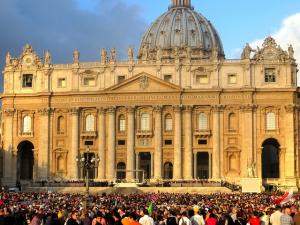
Photo By Günther Simmermacher.
The process of studying a particular thing often entails analysis. To correctly analyze a thing, one seeks to reduce it to its various components. Once this is done, one can study the individual parts more closely.
In analyzing the Catholic Church, it is possible to identify four parts or pillars. These four pillars – theology, morality, public liturgy, and private prayer – comprise the Church’s constituent parts. The four pillars are essential to understanding Catholicism.
Theology
Literally, the science of God, theology within the context of Catholicism, is the “reasoning or discourse about the divinity [God].” (Saint Augustine).
Saint Thomas Aquinas referred to theology as the queen of the sciences, and this lofty view of theology was prevalent for most of human history. Undoubtedly, the concept of theology as a science, let alone the preeminent science, will strike most modern people as strange. The reason why it strikes us moderns as odd is that we have an Enlightenment view of science. Starting with Rene Descartes’ “Discourse on the Method of Rightly Conducting One’s Reason and of Seeking Truth in the Sciences” in 1637, science was limited to the physical or natural world.
However, prior to the Enlightenment, the domain of science encompassed many more diverse subjects. In his Posterior Analytics, Aristotle defined science as “knowledge of a body of organized necessary truths that arise from the study of causes.” (See Aristotle. Aristotle’s Posterior Analytics. 1850).
For Aristotle, as for Aquinas, the study of causes necessarily includes the study of the uncaused first cause, God. Since the first cause is the most important, it is understandable that Aquinas viewed the study of God (theology) as the queen of the sciences.
Finally, theology can be categorized as supernatural and natural. Supernatural theology is primarily concerned with knowledge that is derived from Divine Revelation. It is considered supernatural because the knowledge derived from Divine Revelation cannot be obtained by human reason alone. An example would be knowledge of the Holy Trinity. The fact that God is one Divine essence in three Persons could not be known to humans if not for Divine Revelation.
On the other hand, natural theology is truths about God that can be drawn from reason and experience. An example of natural theology would include the cosmological argument for the existence of God.
Human reason can observe that everything that begins to exist requires an extrinsic cause. We have also come to know that the universe came into existence. Therefore, we can infer that the universe requires an extrinsic cause for its existence. Moreover, there cannot be an infinite regress of causes since that would eliminate a first cause. Without a first cause, there would be no effects. This would mean that nothing exists, which is patently false.
Morality
Catholic moral teaching concerns itself with the conformity of a human act with the moral standard. An act is considered good if it conforms with the standard and wrong (or evil) if it does not.
For morality to be more than an opinion or a dictate of the Government, the standard for right and wrong must be independent of human beings. For this reason, objective morality must be within the purview of God.
This fact leads to the question, if the moral standard exists independently of human beings, how can we know what the moral standard requires? The answer lies in realizing that there are actually three levels or types of law that condition morality.
The highest level is the eternal law which is the mind of God. It is the reason (Logos) which orders all of creation. The second level is natural law. As it pertains to morality, natural law presupposes that God has endowed human beings with certain rights, that these rights are universal, inviolable, and can be discovered using reason. For this reason, Thomas Aquinas asserts that natural law is the manifestation of the eternal law. Said differently, natural law allows humans to know (albeit limitedly) the mind of God. From this knowledge is derived the third type of law, known as positive or man-made law.
Public Liturgy
Liturgy encompasses those practices and rituals performed publicly for the purpose of worship. While it is common to restrict the definition of liturgy to the duties and obligations of priests as they relate to worship, a more accurate definition of liturgy is the people of God doing the work of God. As such, the participation of the laity is of great importance to Catholic public liturgy.
Specifically, within Catholicism, the public liturgy is centered on the Eucharist. Public liturgy extends to the administration of the other sacraments as well, however. As such, sacraments such as baptism and reconciliation are under the umbrella of the definition of the liturgy.
When performing his duties within the context of the liturgy, the priest acts in the person of Christ. From a theological perspective, the liturgy is the exercise on earth of Christ’s priestly office. Christ performs this priestly office as Head of his Mystical Body, so the Head and members offer the sacred liturgy together. In doing so, the liturgy fulfills the function of giving honor and praise to God, which is worship, and to obtain blessings for the human race, which is sanctification.
Private Prayer
The last “pillar” to discuss is private prayer. If prayer is, as the Catechism defines it, the “raising of the heart and mind to God,” then private prayer is foundational to one’s spiritual life.
Private prayers are those recited by the individual that are not a part of the Mass. These are prayers often recited during the course of one’s day. Examples of private prayer and worship include prayers to the Holy Spirit, reciting formal prayers such as the Lord’s Prayer, the Rosary, Scripture readings and reflections, meditation, and contemplation. Additionally, private prayers can involve the creation of a sacred space in one’s home.
The practice of private prayer is strongly advocated in Scripture. Saint Paul advises that we “pray without ceasing.” That is, to consciously seek to do the will of God in our daily lives. And Jesus tells us to go into our room and pray in secret. (See Matthew 6:6).
Conclusion
In seeking to analyze the Catholic Church, I have delineated four “pillars” that are essential. Theology is that discipline concerned with the study of the nature of God. Catholic morality seeks to align human actions with the objective standard made manifest by natural law. Public liturgy is the cooperative work of the clergy and laity in performing the work of God. Finally, private prayer involves the prayers and acts of worship done by individuals outside the domain of the public liturgy.
Education and Religion
History and Religion
Previous Post
July 23, 2023
Of Crutches And Opioids
Next Post

August 6, 2023 Does The Bible Contain Contradictions?
Recent Comments
"Why would it matter if atheism is wrong? The fact that Catholic and Protestant scholars ..."
Beyond the Absence of Belief: The ..."
"Kaiser Member Service Proponents often compare atheism to not collecting stamps—it is the lack of ..."
Beyond the Absence of Belief: The ..."
""these dual denials (objective truth and objective meaning)"This is not accurate. Post-modern thought does not ..."
Defending the Faith in a Post-Truth ..."
"The theologians still haven't received the memo. Your opposition are no longer atheists, but they ..."
Defending the Faith in a Post-Truth ..."
Browse Our Archives
Select a Category Abortion Atheism Catholicism. Catholicism. God. Theophany. Christmas Eschatology Faith and Works. God. Holy Spirit Intelligent Design Jesus Christ Justice Law Politics Protestantism Religion Sabbath Salvation. Soteriology. The Bible Theology Uncategorized
Select a Month October 2026 September 2026 August 2026 July 2026 June 2026 May 2026 April 2026 March 2026 February 2026 January 2026 December 2025 November 2025 October 2025 September 2025 August 2025 July 2025 June 2025 May 2025 April 2025 March 2025 February 2025 January 2025 December 2024 November 2024 October 2024 September 2024 August 2024 July 2024 June 2024 May 2024 April 2024 March 2024 February 2024 January 2024 December 2023 November 2023 October 2023 September 2023 August 2023 July 2023 June 2023 May 2023 April 2023 March 2023 February 2023 January 2023 December 2022 November 2022 October 2022 September 2022 August 2022 July 2022 June 2022 May 2022 April 2022 March 2022 February 2022 January 2022 December 2021
Follow Us!
TAKE THE
Religious Wisdom Quiz
Who was the first woman created?
Select your answer to see how you score.
Esther Sarah Leah Eve
Related posts from Summa Catholic

The Anatomy of Divine Revelation in Catholic Thought

Beyond the Absence of Belief: The Implications of...

Can Catholic Apologetics Survive a Postmodern World?

From Samaria to Sanctity: Analyzing The Woman At...
TRENDING AT PATHEOS Catholic

Rejecting Doom: Christian Hope And Human Action
Christianity is a religion of hope. We are to have hope and...

It’s What Comes From Within Which Matters
One of the most difficult things for us to understand is why...

Why I Choose the Eucharist Over the Sermon
Choose the Eucharist, Not the Sermon What are we supposed to get...

5 Design Elements Found in Spiritually Rooted Homes
Putting Spirituality Into Home Decor Our homes are more than our living...

Credo: A Story of God Told with the...
About 10 years ago, I began to imagine a personal "Credo" that...

The Anatomy of Divine Revelation in Catholic Thought
The claim that God has made Himself known to human beings is...
view all Catholic blogs
What Are Your Thoughts?leave a comment
Ad-Free & Subscriber Log-In Subscription Support
- About Us
- 2026 Calendar
- Videos
- Podcasts
- Library of World Religions
- Faith In Media Tracker
- Advertise With Us
- Write for Us
- Privacy Policy
- Terms of Service
- Do Not Sell My Data
- Contact Us
- Radiant Digital
- Manage Newsletter Subscriptions
- Unsubscribe From Notifications
- Sitemap
Copyright 2008-2026, Patheos. All rights reserved.
Subscription Support Ad-Free & Subscriber Log-In
Follow Patheos