
BuddhistCatholicContemplativeEvangelicalGeneral ChristianHinduJewishLatter-day SaintMuslimNew VisionsProgressive Christian
Beliefs
- Buddhist
- Catholic
- Contemplative
- Evangelical
- General Christian
- Hindu
- Jewish
- Latter-day Saint
- More Voices
- Muslim
- New Visions
- Pagan
- Progressive Christian
Topics
- Religion News
- Food and Religion
- Sports and Religion
- Religious Art
- Religious Music and Entertainment
- Religious Events
- History and Religion
- Style and Religion
- Politics and Religion
- Women in Religion
- Recreation Outdoors and Religion
- Business Finance and Religion
- Careers Workplace and Religion
- Education and Religion
- Family Parenting and Religion
- Health Fitness and Religion
- Home and Religion
- Relationships and Religion
- Technology and Religion
- Travel and Religion
Columnists
- Buddhist Columnists
- Business Finance and Religion Columnists
- Careers Workplace and Religion Columnists
- Catholic Columnists
- Contemplative Columnists
- Education and Religion Columnists
- Evangelists Columnists
- Family Parenting and Religion Columnists
- General Christian Columnists
- Health Fitness and Religion Columnists
- Hindu Columnists
- History and Religion Columnists
- Home and Religion Columnists
- Jewish Columnists
- More Voices Columnists
- Latter Day Columnists
- Muslim Columnists
- New Visions Columnists
- Nonreligious Columnists
- Pagan Columnists
- Politics and Religion Columnists
- Progressive Columnists
- Recreation Outdoors and Religion Columnists
- Relationships and Religion Columnists
- Religion News Columnists
- Religious Art Columnists
- Religious Events Columnists
- Religious Music and Entertainment Columnists
- Sports and Religion Columnists
- Style and Religion Columnists
- Technology and Religion Columnists
- Travel and Religion Columnists
- Women in Religion Columnists
Resource Library
- 2026 Calendar
- Library of World Religions
- The 100 Most Holy Places on Earth
- Patheos Answers
- Podcasts
- Videos
- Faith Leaders Database
- Anglican Episcopalian
- Bahai
- Baptist
- Buddhism
- Christianity
- Confucianism
- Eastern Orthodoxy
- Hinduism
- Holiness and Pentecostal
- ISKCON
- Islam
- Judaism
- Lutheran
- Methodist
- The Church of Jesus Christ of Latter-day Saints
- New Age
- Paganism
- Presbytarian and Reformed
- Protestantism
- Religion Behind the Scenes
- Roman Catholic
- Scientology
- Shia Islam
- Sikhism
- Sufism
- Sunni Islam
- Taoism
- Zen
- See all religions
Research Tools
 Ad-Free & Subscriber Log-In Subscription Support
Ad-Free & Subscriber Log-In Subscription Support
Follow Patheos 

- Trending:
- Forgiveness
- |
- Marriage
- |
- Consciousness
- |
- Death Penalty
- |
- Election
- |
- Halloween

- Home
- Catholic
- Education and Religion
- Is Forgiveness Possible?
Is Forgiveness Possible?
Last updated on: July 2, 2023 at 10:29 am by David Schloss
Is Forgiveness Possible? 2023-07-02T10:29:12-04:00 David Schloss
Patheos Explore the world's faith through different perspectives on religion and spirituality! Patheos has the views of the prevalent religions and spiritualities of the world.
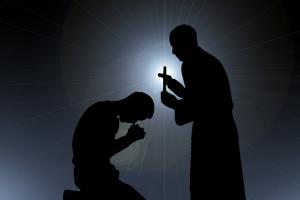
“God forgives somehow; we have yet to learn the same.” – Mary Chapin Carpenter.
A fundamental principle that undergirds the Biblical tradition upon which Catholic theology is predicated is forgiveness. The Catholic faith believes that God so emphasizes forgiveness that He has endowed the Church with the sacrament of reconciliation. To ask God for the forgiveness of one’s sins is a necessary condition for our salvation.
But what exactly does it mean for God to forgive us our sins, and is it possible, or even natural, for human beings to forgive one another?
What Is Forgiveness?
Before examining what forgiveness is, it should be stated that forgiveness presupposes that an individual or group has engaged in an action or omission contrary to the will of another. Said differently, forgiveness presupposes that another person has done something wrong. This action or omission may be trivial, as when one forgets a birthday, or it may be something grave, such as when one unlawfully takes the life of another. It may even take the form of willfully acting against the will of God, which is called sin.
In a sense, forgiveness entails the pardoning or remission of a debt. In the examples above, this may take the form of one ceasing to feel anger at their birthday being forgotten, or it may take the form of a murder victim’s family ceasing to feel animosity toward the murderer.
Regardless of the act, our sense of justice seems to dictate that the wrongdoer provides some form of compensation to “pay for what they have done.”
Nevertheless, forgiveness and justice are not the same. To distinguish forgiveness from justice, we can say that forgiveness is personal and subjective, whereas justice is impersonal and objective. They ought not to be understood as mutually exclusive, however, and both are necessary for human beings to live in a community with one another.
Returning to the Catholic vantage point should allow us to see the relationship between forgiveness and justice. The salvific work of Christ has made it possible for human beings to be reconciled with God. In this context, Christ has satisfied the need for justice as it relates to sin. Still, Catholics are required to go to confession when they have sinned. Catholics confess our sins in hopes of obtaining God’s forgiveness, and we do acts of penance to satisfy (we hope) God’s requirement for justice.
God’s forgiveness cannot be understated. If God is not merciful, we have no hope for our salvation. Fortunately, it is evident that God’s nature is compassionate, and He readily forgives (see Daniel 9:9). Significantly, since God has no need of anything, His forgiveness is unconditional and a manifestation of the Divine love.
This leads to another question, is forgiveness solely the purview of God, or is it possible, or even natural, for human beings to forgive?
Is It Possible To Forgive?
It was said above that forgiveness involves relieving the debt that another owes. Moreover, true forgiveness seeks nothing in return. In this regard, forgiveness is very similar to a gift.
The concept of forgiveness as a gift leads to what the French philosopher Jacques Derrida called the impossibility of the gift. Derrida thought that any gift, in this case, forgiveness, is always reciprocal in nature. If someone is given a gift, the person receiving it is obligated to reciprocate. At the very least, one must thank the other person or even provide his own present or some form of compensation.
If forgiveness is a gift, and gift-giving is reciprocal, is it really possible for someone to forgive another unconditionally?
A Catholic Approach To Forgiveness
It can be argued that true forgiveness is not natural to human beings. In this sense, Jacques Derrida is correct. Because of this, the Catholic approach to forgiveness can be considered radical.
In order to understand why this is so, it is necessary to examine one of the most striking statements made by Christ. “You have heard that it was said, ‘You shall love your neighbor and hate your enemy.’ But I say to you, love your enemies, and pray for those who persecute you, that you may be children of your heavenly Father, for he makes his sun rise on the bad and the good, and causes rain to fall on the just and the unjust.” (Matthew 5:43-48).
I do not think Christ’s exhortation is any less startling to us than it was to a first-century person. Startling because it is counter-intuitive to love what one feels hatred for (i.e., one’s enemies). How, then, can forgiveness be understood in light of Christ’s words?
In order to understand how true forgiveness (that is, forgiveness devoid of reciprocity) is possible, it is necessary to see forgiveness as a form of charity. Charity or caritas means love of one’s neighbors. Love within a theological context means to will the good of another person independently of one’s own interests.
Unfortunately, this type of love is not natural to our fallen state either. It can only be obtained by God’s Grace. For this reason, love – inclusive of forgiveness – is considered a theological virtue. The theological virtues – faith, hope, and charity – are traits supernaturally infused into the soul by God.
As stated above, it is evident that God places great emphasis on forgiving each other, and Saint Paul suggests that forgiveness is necessary for discipleship. He writes, “Be kind to one another, compassionate, forgiving one another as God has forgiven you in Christ.” (Ephesians 4:32).
It might even be argued that our salvation rests in no small part on our ability to forgive one another. “If you forgive others their transgressions, your heavenly Father will forgive you.” (Matthew 6:14).
It seems that to be Catholic requires us to forgive one another unconditionally. Only then, only when we forgive others, will we be forgiven. Only then will we be children of God.
Education and Religion
History and Religion
Previous Post

June 25, 2023
The Mystical Body
Next Post

July 9, 2023 On The Dignity Of The Human Person
Recent Comments
"Why would it matter if atheism is wrong? The fact that Catholic and Protestant scholars ..."
Beyond the Absence of Belief: The ..."
"Kaiser Member Service Proponents often compare atheism to not collecting stamps—it is the lack of ..."
Beyond the Absence of Belief: The ..."
""these dual denials (objective truth and objective meaning)"This is not accurate. Post-modern thought does not ..."
Defending the Faith in a Post-Truth ..."
"The theologians still haven't received the memo. Your opposition are no longer atheists, but they ..."
Defending the Faith in a Post-Truth ..."
Browse Our Archives
Select a Category Abortion Atheism Catholicism. Catholicism. God. Theophany. Christmas Eschatology Faith and Works. God. Holy Spirit Intelligent Design Jesus Christ Justice Law Politics Protestantism Religion Sabbath Salvation. Soteriology. The Bible Theology Uncategorized
Select a Month October 2026 September 2026 August 2026 July 2026 June 2026 May 2026 April 2026 March 2026 February 2026 January 2026 December 2025 November 2025 October 2025 September 2025 August 2025 July 2025 June 2025 May 2025 April 2025 March 2025 February 2025 January 2025 December 2024 November 2024 October 2024 September 2024 August 2024 July 2024 June 2024 May 2024 April 2024 March 2024 February 2024 January 2024 December 2023 November 2023 October 2023 September 2023 August 2023 July 2023 June 2023 May 2023 April 2023 March 2023 February 2023 January 2023 December 2022 November 2022 October 2022 September 2022 August 2022 July 2022 June 2022 May 2022 April 2022 March 2022 February 2022 January 2022 December 2021
Follow Us!
TAKE THE
Religious Wisdom Quiz
What does the Hebrew word 'Shekinah' mean?
Select your answer to see how you score.
God’s Glory Everlasting Light Divine Presence Holy Fire
Related posts from Summa Catholic

The Anatomy of Divine Revelation in Catholic Thought

Beyond the Absence of Belief: The Implications of...

Can Catholic Apologetics Survive a Postmodern World?

From Samaria to Sanctity: Analyzing The Woman At...
TRENDING AT PATHEOS Catholic

Rejecting Doom: Christian Hope And Human Action
Christianity is a religion of hope. We are to have hope and...

It’s What Comes From Within Which Matters
One of the most difficult things for us to understand is why...

Why I Choose the Eucharist Over the Sermon
Choose the Eucharist, Not the Sermon What are we supposed to get...

5 Design Elements Found in Spiritually Rooted Homes
Putting Spirituality Into Home Decor Our homes are more than our living...

Credo: A Story of God Told with the...
About 10 years ago, I began to imagine a personal "Credo" that...

The Anatomy of Divine Revelation in Catholic Thought
The claim that God has made Himself known to human beings is...
view all Catholic blogs
What Are Your Thoughts?leave a comment
Ad-Free & Subscriber Log-In Subscription Support
- About Us
- 2026 Calendar
- Videos
- Podcasts
- Library of World Religions
- Faith In Media Tracker
- Advertise With Us
- Write for Us
- Privacy Policy
- Terms of Service
- Do Not Sell My Data
- Contact Us
- Radiant Digital
- Manage Newsletter Subscriptions
- Unsubscribe From Notifications
- Sitemap
Copyright 2008-2026, Patheos. All rights reserved.
Subscription Support Ad-Free & Subscriber Log-In
Follow Patheos