
BuddhistCatholicContemplativeEvangelicalGeneral ChristianHinduJewishLatter-day SaintMuslimNew VisionsProgressive Christian
Beliefs
- Buddhist
- Catholic
- Contemplative
- Evangelical
- General Christian
- Hindu
- Jewish
- Latter-day Saint
- More Voices
- Muslim
- New Visions
- Pagan
- Progressive Christian
Topics
- Religion News
- Food and Religion
- Sports and Religion
- Religious Art
- Religious Music and Entertainment
- Religious Events
- History and Religion
- Style and Religion
- Politics and Religion
- Women in Religion
- Recreation Outdoors and Religion
- Business Finance and Religion
- Careers Workplace and Religion
- Education and Religion
- Family Parenting and Religion
- Health Fitness and Religion
- Home and Religion
- Relationships and Religion
- Technology and Religion
- Travel and Religion
Columnists
- Buddhist Columnists
- Business Finance and Religion Columnists
- Careers Workplace and Religion Columnists
- Catholic Columnists
- Contemplative Columnists
- Education and Religion Columnists
- Evangelists Columnists
- Family Parenting and Religion Columnists
- General Christian Columnists
- Health Fitness and Religion Columnists
- Hindu Columnists
- History and Religion Columnists
- Home and Religion Columnists
- Jewish Columnists
- More Voices Columnists
- Latter Day Columnists
- Muslim Columnists
- New Visions Columnists
- Nonreligious Columnists
- Pagan Columnists
- Politics and Religion Columnists
- Progressive Columnists
- Recreation Outdoors and Religion Columnists
- Relationships and Religion Columnists
- Religion News Columnists
- Religious Art Columnists
- Religious Events Columnists
- Religious Music and Entertainment Columnists
- Sports and Religion Columnists
- Style and Religion Columnists
- Technology and Religion Columnists
- Travel and Religion Columnists
- Women in Religion Columnists
Resource Library
- 2026 Calendar
- Library of World Religions
- The 100 Most Holy Places on Earth
- Patheos Answers
- Podcasts
- Videos
- Faith Leaders Database
- Anglican Episcopalian
- Bahai
- Baptist
- Buddhism
- Christianity
- Confucianism
- Eastern Orthodoxy
- Hinduism
- Holiness and Pentecostal
- ISKCON
- Islam
- Judaism
- Lutheran
- Methodist
- The Church of Jesus Christ of Latter-day Saints
- New Age
- Paganism
- Presbytarian and Reformed
- Protestantism
- Religion Behind the Scenes
- Roman Catholic
- Scientology
- Shia Islam
- Sikhism
- Sufism
- Sunni Islam
- Taoism
- Zen
- See all religions
Research Tools
 Ad-Free & Subscriber Log-In Subscription Support
Ad-Free & Subscriber Log-In Subscription Support
Follow Patheos 

- Trending:
- Forgiveness
- |
- Marriage
- |
- Consciousness
- |
- Death Penalty
- |
- Election
- |
- Halloween

- Home
- Catholic
- History and Religion
- The Mystical Body
The Mystical Body
Last updated on: June 25, 2023 at 9:49 am by David Schloss
The Mystical Body 2023-06-25T09:49:41-04:00 David Schloss
Patheos Explore the world's faith through different perspectives on religion and spirituality! Patheos has the views of the prevalent religions and spiritualities of the world.
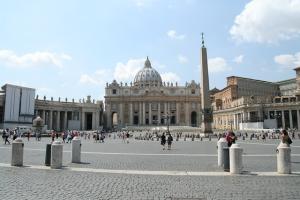
Saint Peter’s Cathedral. Photo by CShin.
When one considers or refers to the Catholic Church, one often intends to connote the Pope, Cardinals, Bishops, or Priests that comprise the hierarchy of the Church. This is entirely proper. It is also too restrictive to capture what the Church encompasses. A more comprehensive understanding of the Church involves perceiving it as a living body composed of members both on earth and in eternity. For this reason, and in following the teachings of the Bible, the Catholic Church is appropriately called the mystical body of Christ.
In this paper, I will endeavor to explain what it means to claim that the Catholic Chuch is the mystical body of Christ. To do so, I will begin by exploring what is known as the communion of saints. I will then examine how the mystical body is composed of three parts; the Church Triumphant, the Church Militant, and the Church Suffering.
The Communion Of Saints
The communion of saints is a term used to refer to the mystical bond uniting Catholics on Earth, in Purgatory, and in Heaven.
An inclusive definition of a saint is one who is (or has) conformed his will to the will of God. For this reason, Catholicism considers anyone in Heaven to be a saint. Still, some are considered more eminently than others. These more eminent souls are distinguished for their holiness and recognized by the Church. This process is known as canonization.
Since all Catholics are, or should be, voyaging toward Heaven, we are all united within this communion of saints. Saint Paul writes of this bond of Christians, “Who shall separate us from the love of Christ? Shall tribulation, or distress, or persecution, or famine, or nakedness, or peril, or sword? No, in all these things, we are more than conquerors through him who loved us. For I am sure that neither death, nor life, nor angels, nor principalities, nor things present, nor things to come, nor powers, nor height, nor depth, nor anything else in all creation, will be able to separate us from the love of God in Christ Jesus our Lord.” (See Romans 8:35-39).
This community of the faithful comprises what is known as the mystical body of Christ.
The Mystical Body
The scriptural basis for referring to the Catholic Church as the mystical body of Christ is derived from the writings of Saint Paul. In his Epistle to the Colossians, Paul refers to Christ as “The head of the body, the Church.” (Colossians 1:18). In 1 Corinthians 12:27, Paul suggests that Christians are now Christ’s body.
Just as a physical body is composed of various organs that serve different functions, the Catholic Church is formed by structurally united parts and various reciprocally dependent members.
In building upon the analogy of the Church as the body of Christ, Pope Pius XII wrote, “If we would define and describe the true Church of Jesus Christ – which is the one, holy, Catholic, apostolic Roman Church – we shall find nothing more noble, more sublime, or more divine than the expression ‘the Mystical Body of Jesus Christ’ – an expression that flows spontaneously from the repeated teaching of the sacred Scriptures and the holy Fathers.” (Mystici Corporis Christi, June 29, 1943).
The Church is called mystical because it is a mystery God has revealed to be true. Moreover, the Catholic Church is the Mystical Body of Christ because it is sacramental. The Church is the great sacrament of the New Law instituted by Christ to communicate invisible grace to the world. Moreover, since the concept of the mystical body cannot be understood apart from Christ, the Catholic Church is rightly understood to be the extension of the Incarnation.
In continuing the analogy of the Church as a body, it is possible to recognize three parts or divisions of that body.
The Church Triumphant
The first division is called the Church Triumphant. The term refers to those souls who have triumphed over their evil inclinations, the world’s seductions, and the evil spirit’s temptations and now see God “face to face,” as Saint Paul writes. (See 1 Corinthians 13:12).
Put differently, the Church Triumphant describes the Catholic Church as it is in Heaven. To be a member of the Church Triumphant is to reside in the Kingdom of God. It is the realm of the Holy Trinity, the angels and saints, and the abode of all those who have reached the fullness of salvation in Christ. These souls enjoy what is known as the beatific vision. It is the direct and immediate knowledge of God that can only be obtained in Heaven.
Placed in an eschatological framework, the Church Triumphant will include all of creation as well as those who have been conformed to Christ.
The Church Militant
The Church Militant is the part of the Church we are most familiar with. It is the Catholic Church as it exists on earth.
The Church, like a nation, must defend herself and the faith. It is the responsibility of Catholicism to illuminate and fight for the truth while working for the salvation of souls. For these reasons as well as for the fact that Catholics are engaged in the struggle against sin, temptation, and the devil, the earthly Church is called militant (Latin for one serving as a soldier).
The Church Suffering
The third division of the Mystical Body is referred to as the Church Suffering or Church Penitent.
The Church Suffering is composed of those faithful who have died in God’s grace and friendship but require additional purification to obtain the holiness needed for entrance into Heaven. Upon completion of the purification process, these souls will become members of the Church Triumphant in Heaven.
Conclusion
Catholicism asserts that the Church is the mystical body of Christ. While the mystical body must include the clergy, Catholicism also recognizes that Christ is the head of the body. Additionally, the mystical body consists of the faithful, whether they are “in the body” on earth, enduring the purification of Purgatory, or seeing God face to face in Heaven.
History and Religion
Previous Post
June 18, 2023
The War Within
Next Post
July 2, 2023 Is Forgiveness Possible?
Recent Comments
"Why would it matter if atheism is wrong? The fact that Catholic and Protestant scholars ..."
Beyond the Absence of Belief: The ..."
"Kaiser Member Service Proponents often compare atheism to not collecting stamps—it is the lack of ..."
Beyond the Absence of Belief: The ..."
""these dual denials (objective truth and objective meaning)"This is not accurate. Post-modern thought does not ..."
Defending the Faith in a Post-Truth ..."
"The theologians still haven't received the memo. Your opposition are no longer atheists, but they ..."
Defending the Faith in a Post-Truth ..."
Browse Our Archives
Select a Category Abortion Atheism Catholicism. Catholicism. God. Theophany. Christmas Eschatology Faith and Works. God. Holy Spirit Intelligent Design Jesus Christ Justice Law Politics Protestantism Religion Sabbath Salvation. Soteriology. The Bible Theology Uncategorized
Select a Month October 2026 September 2026 August 2026 July 2026 June 2026 May 2026 April 2026 March 2026 February 2026 January 2026 December 2025 November 2025 October 2025 September 2025 August 2025 July 2025 June 2025 May 2025 April 2025 March 2025 February 2025 January 2025 December 2024 November 2024 October 2024 September 2024 August 2024 July 2024 June 2024 May 2024 April 2024 March 2024 February 2024 January 2024 December 2023 November 2023 October 2023 September 2023 August 2023 July 2023 June 2023 May 2023 April 2023 March 2023 February 2023 January 2023 December 2022 November 2022 October 2022 September 2022 August 2022 July 2022 June 2022 May 2022 April 2022 March 2022 February 2022 January 2022 December 2021
Follow Us!
TAKE THE
Religious Wisdom Quiz
What are the names of the two witnesses in Revelation who prophesy for 1,260 days?
Select your answer to see how you score.
They are not named Enoch and Elijah Peter and Paul Moses and Elijah
Related posts from Summa Catholic

The Anatomy of Divine Revelation in Catholic Thought

Beyond the Absence of Belief: The Implications of...

Can Catholic Apologetics Survive a Postmodern World?

From Samaria to Sanctity: Analyzing The Woman At...
TRENDING AT PATHEOS Catholic

Rejecting Doom: Christian Hope And Human Action
Christianity is a religion of hope. We are to have hope and...

It’s What Comes From Within Which Matters
One of the most difficult things for us to understand is why...

Why I Choose the Eucharist Over the Sermon
Choose the Eucharist, Not the Sermon What are we supposed to get...

5 Design Elements Found in Spiritually Rooted Homes
Putting Spirituality Into Home Decor Our homes are more than our living...

Credo: A Story of God Told with the...
About 10 years ago, I began to imagine a personal "Credo" that...

The Anatomy of Divine Revelation in Catholic Thought
The claim that God has made Himself known to human beings is...
view all Catholic blogs
What Are Your Thoughts?leave a comment
Ad-Free & Subscriber Log-In Subscription Support
- About Us
- 2026 Calendar
- Videos
- Podcasts
- Library of World Religions
- Faith In Media Tracker
- Advertise With Us
- Write for Us
- Privacy Policy
- Terms of Service
- Do Not Sell My Data
- Contact Us
- Radiant Digital
- Manage Newsletter Subscriptions
- Unsubscribe From Notifications
- Sitemap
Copyright 2008-2026, Patheos. All rights reserved.
Subscription Support Ad-Free & Subscriber Log-In
Follow Patheos