
BuddhistCatholicContemplativeEvangelicalGeneral ChristianHinduJewishLatter-day SaintMuslimNew VisionsProgressive Christian
Beliefs
- Buddhist
- Catholic
- Contemplative
- Evangelical
- General Christian
- Hindu
- Jewish
- Latter-day Saint
- More Voices
- Muslim
- New Visions
- Pagan
- Progressive Christian
Topics
- Religion News
- Food and Religion
- Sports and Religion
- Religious Art
- Religious Music and Entertainment
- Religious Events
- History and Religion
- Style and Religion
- Politics and Religion
- Women in Religion
- Recreation Outdoors and Religion
- Business Finance and Religion
- Careers Workplace and Religion
- Education and Religion
- Family Parenting and Religion
- Health Fitness and Religion
- Home and Religion
- Relationships and Religion
- Technology and Religion
- Travel and Religion
Columnists
- Buddhist Columnists
- Business Finance and Religion Columnists
- Careers Workplace and Religion Columnists
- Catholic Columnists
- Contemplative Columnists
- Education and Religion Columnists
- Evangelists Columnists
- Family Parenting and Religion Columnists
- General Christian Columnists
- Health Fitness and Religion Columnists
- Hindu Columnists
- History and Religion Columnists
- Home and Religion Columnists
- Jewish Columnists
- More Voices Columnists
- Latter Day Columnists
- Muslim Columnists
- New Visions Columnists
- Nonreligious Columnists
- Pagan Columnists
- Politics and Religion Columnists
- Progressive Columnists
- Recreation Outdoors and Religion Columnists
- Relationships and Religion Columnists
- Religion News Columnists
- Religious Art Columnists
- Religious Events Columnists
- Religious Music and Entertainment Columnists
- Sports and Religion Columnists
- Style and Religion Columnists
- Technology and Religion Columnists
- Travel and Religion Columnists
- Women in Religion Columnists
Resource Library
- 2026 Calendar
- Library of World Religions
- The 100 Most Holy Places on Earth
- Patheos Answers
- Podcasts
- Videos
- Faith Leaders Database
- Anglican Episcopalian
- Bahai
- Baptist
- Buddhism
- Christianity
- Confucianism
- Eastern Orthodoxy
- Hinduism
- Holiness and Pentecostal
- ISKCON
- Islam
- Judaism
- Lutheran
- Methodist
- The Church of Jesus Christ of Latter-day Saints
- New Age
- Paganism
- Presbytarian and Reformed
- Protestantism
- Religion Behind the Scenes
- Roman Catholic
- Scientology
- Shia Islam
- Sikhism
- Sufism
- Sunni Islam
- Taoism
- Zen
- See all religions
Research Tools
 Ad-Free & Subscriber Log-In Subscription Support
Ad-Free & Subscriber Log-In Subscription Support
Follow Patheos 

- Trending:
- Forgiveness
- |
- Marriage
- |
- Consciousness
- |
- Death Penalty
- |
- Election
- |
- Halloween

- Home
- Catholic
- History and Religion
- The Seven Last Words
The Seven Last Words
Last updated on: May 7, 2023 at 10:41 am by David Schloss
The Seven Last Words 2023-05-07T10:41:47-04:00 David Schloss
Patheos Explore the world's faith through different perspectives on religion and spirituality! Patheos has the views of the prevalent religions and spiritualities of the world.
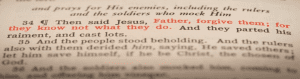
The title of this article may be misleading. A more accurate rendition would be “The seven last phrases (or sayings) of Christ.” Questions of semantics aside, the seven last words refer to the final statements of Christ leading up to His death.
As one would expect, the words spoken by Christ have been the subject of study and speculation for two thousand years, and “the seven last words” are no exception. In this article, I will review each of the sayings and seek to place them within a broader context in accordance with Catholic theology.
“Father, forgive them; they know not what they do.”
In commencing the Jubilee Year of Mercy, Pope Francis issued a Bull of Indiction titled Misericordiae Vultus (the face of mercy). In the document, Pope Francis wrote, “Jesus Christ is the face of the Father’s [i.e., God the Father] mercy.”
This truth is evidenced in Jesus’ words as they are recorded in Luke’s Gospel. “Father, forgive them; for they do not know what they are doing.” (Luke 23:34). The depth and magnitude of Christ’s mercy are underscored when one considers that He is asking God the Father to forgive those who were executing Him.
In a sense, Christ’s prayer for forgiveness can be extended to all humanity. Since all have sinned (Romans 3:23) and since the punishment for sin is death (Romans 6:23), and since Jesus took upon Himself our sins (2 Corinthians 5:21), it must be that all who have sinned share some responsibility for the death of Jesus.
Additionally, Jesus’ words ought to inspire how we treat one another. As God has pity on human misery and desires not to punish human beings for their sins severely, so human beings are to have mercy on their fellow humans.
“Amen, I say to you, today you will be with me in Paradise.”
When this saying of Jesus is taken in isolation, it appears unequivocal and uncomplicated;
however, it is quite layered.
As anyone familiar with the Scriptural accounts of the Crucifixion knows, Jesus was crucified between two criminals. One of the criminals is unrepentant. The other man, however, admits his guilt and seeks pardon from Christ, “Jesus, remember me when you come into your kingdom.” (See Luke 23:39-43).
The saying of Jesus, directed to the “penitent thief,” has been used to attack the Catholic Church’s teaching that baptism is necessary for salvation. While Scripture is silent on the subject, it is thought that the “penitent thief” was not baptized. Yet, Jesus assures him that he will obtain entry into Heaven (“paradise”). How, then, was the “penitent thief” saved?
First, it must be pointed out that the necessity of baptism for salvation is not a Catholic Church creation. Rather, the Church follows Jesus’ teaching, “Amen, amen, I say to you, no one can enter the kingdom of God without being born of water and Spirit.” (See John 3:5). The answer of how the “penitent thief” was saved is found by understanding the various forms that baptism may take.
The Catholic Church recognizes three types of baptism, one of which is called the baptism of desire. Contained within the Second Vatican Council’s Constitution on the Church, baptism of desire is described as inclusive of “Those who through no fault of their own, do not know the Gospel of Christ or His Church, but who nevertheless seek God with a sincere heart, and, moved by grace, try in their actions to do His will as they know it through the dictate of their conscience – those too may achieve eternal salvation.”
In applying the standard provided by the Second Vatican Council to the “penitent thief,” one sees how his salvation was made possible.
“Woman, behold, your son.” Then he said to the disciple, “Behold, your mother.”
Jesus gifts humanity His flesh and blood as spiritual food. He gives His life for our salvation. And He gives His mother to be our mother, the mother of the Church.
If the Catholic Church is the mystical body of Christ and if Mary is the mother of Jesus, then it is no inferential leap to consider Mary as the mother of the Catholic Church.
“My God, my God, why have you forsaken me?”
Of the seven last statements of Christ, this one is perhaps the most complicated and misunderstood. After all, if Jesus is the Son of God and a sharer in the Divine essence, how is it possible that God has forsaken Him?
In a sense, Catholicism is built upon a Jewish foundation, and it is an error to deracinate Jesus from the messianic prophecies of the Old Testament. Therefore, Jesus’ question ought to be examined under two aspects.
First, it should be observed that Jesus is quoting from the first line of Psalm 22. In doing so, He is showing that He is the suffering servant that bore the sins of humanity. Taken in this context, we see Jesus’ words as the fulfillment of prophecy.
The second aspect to consider is the devasting effects of sin. As Saint Paul observed, Jesus became sin. That is to say, Jesus took upon Himself the sins committed by human beings and suffered the punishment for our sins. (See 2 Corinthians 5:21). Since sin separates us from God, so Jesus, in becoming sin, felt that separation in His human nature.
“I thirst.”
While composed of only two words, this saying of Jesus contains some ambiguity. As such, it is subject to several interpretations.
In one sense, one can read this statement in a perfunctory way, dismissing them as words spoken by a dying man. However, a theological reading of the text (John 19:28) suggests other possible interpretations.
One can read Jesus’ words in light of Matthew 26:29, “I tell you, I will not drink from this fruit of the vine from now on until that day when I drink it new with you in my Father’s kingdom.” In this context, Jesus confirms that He is returning to the Father, thus making His words in Matthew 26:29 a prophecy.
Similarly, “I thirst” can be understood as the fulfillment of the messianic prophecy of Psalm 69:21. An interpretation that takes both verses (Psalm 69:21 and Matthew 26:29) together would add evidence to Jesus being the Messiah.
“It is finished.”
This saying suggests the completion of the work Jesus came to complete. Translated from Latin, the statement is indicative of a debt being paid in full. That debt, the cost incurred by humanity for our sins, has been satisfied through the work and death of Christ on the Cross.
“Father, into your hands I commend my spirit.”
With these words, we have the whole of the work of Christ and the purpose of life itself. The ultimate meaning of life is found when we place ourselves in the hands of God.
In giving Himself up for us, Jesus has reconciled man and God. It is through Jesus that we are conformed to the will of God.
Conclusion
Catholicism asserts that God became a human being in the person of Jesus. If that is true, then the words spoken by Jesus are of immense importance.
In this paper, I have sought to examine “The Seven Last Words” of Jesus and explain their significance.
History and Religion
Religious Events
Previous Post
April 30, 2023
Have We Lost What Is Sacred?
Next Post

May 14, 2023 How Does Sin Affect The Soul?
Recent Comments
"Why would it matter if atheism is wrong? The fact that Catholic and Protestant scholars ..."
Beyond the Absence of Belief: The ..."
"Kaiser Member Service Proponents often compare atheism to not collecting stamps—it is the lack of ..."
Beyond the Absence of Belief: The ..."
""these dual denials (objective truth and objective meaning)"This is not accurate. Post-modern thought does not ..."
Defending the Faith in a Post-Truth ..."
"The theologians still haven't received the memo. Your opposition are no longer atheists, but they ..."
Defending the Faith in a Post-Truth ..."
Browse Our Archives
Select a Category Abortion Atheism Catholicism. Catholicism. God. Theophany. Christmas Eschatology Faith and Works. God. Holy Spirit Intelligent Design Jesus Christ Justice Law Politics Protestantism Religion Sabbath Salvation. Soteriology. The Bible Theology Uncategorized
Select a Month October 2026 September 2026 August 2026 July 2026 June 2026 May 2026 April 2026 March 2026 February 2026 January 2026 December 2025 November 2025 October 2025 September 2025 August 2025 July 2025 June 2025 May 2025 April 2025 March 2025 February 2025 January 2025 December 2024 November 2024 October 2024 September 2024 August 2024 July 2024 June 2024 May 2024 April 2024 March 2024 February 2024 January 2024 December 2023 November 2023 October 2023 September 2023 August 2023 July 2023 June 2023 May 2023 April 2023 March 2023 February 2023 January 2023 December 2022 November 2022 October 2022 September 2022 August 2022 July 2022 June 2022 May 2022 April 2022 March 2022 February 2022 January 2022 December 2021
Follow Us!
TAKE THE
Religious Wisdom Quiz
Who said: "If we confess our sins, he is faithful and just and will forgive us our sins"?
Select your answer to see how you score.
John Jesus Peter Paul
Related posts from Summa Catholic

The Anatomy of Divine Revelation in Catholic Thought

Beyond the Absence of Belief: The Implications of...

Can Catholic Apologetics Survive a Postmodern World?

From Samaria to Sanctity: Analyzing The Woman At...
TRENDING AT PATHEOS Catholic

Rejecting Doom: Christian Hope And Human Action
Christianity is a religion of hope. We are to have hope and...

It’s What Comes From Within Which Matters
One of the most difficult things for us to understand is why...

Why I Choose the Eucharist Over the Sermon
Choose the Eucharist, Not the Sermon What are we supposed to get...

5 Design Elements Found in Spiritually Rooted Homes
Putting Spirituality Into Home Decor Our homes are more than our living...

Credo: A Story of God Told with the...
About 10 years ago, I began to imagine a personal "Credo" that...

The Anatomy of Divine Revelation in Catholic Thought
The claim that God has made Himself known to human beings is...
view all Catholic blogs
What Are Your Thoughts?leave a comment
Ad-Free & Subscriber Log-In Subscription Support
- About Us
- 2026 Calendar
- Videos
- Podcasts
- Library of World Religions
- Faith In Media Tracker
- Advertise With Us
- Write for Us
- Privacy Policy
- Terms of Service
- Do Not Sell My Data
- Contact Us
- Radiant Digital
- Manage Newsletter Subscriptions
- Unsubscribe From Notifications
- Sitemap
Copyright 2008-2026, Patheos. All rights reserved.
Subscription Support Ad-Free & Subscriber Log-In
Follow Patheos