
BuddhistCatholicContemplativeEvangelicalGeneral ChristianHinduJewishLatter-day SaintMuslimNew VisionsProgressive Christian
Beliefs
- Buddhist
- Catholic
- Contemplative
- Evangelical
- General Christian
- Hindu
- Jewish
- Latter-day Saint
- More Voices
- Muslim
- New Visions
- Pagan
- Progressive Christian
Topics
- Religion News
- Food and Religion
- Sports and Religion
- Religious Art
- Religious Music and Entertainment
- Religious Events
- History and Religion
- Style and Religion
- Politics and Religion
- Women in Religion
- Recreation Outdoors and Religion
- Business Finance and Religion
- Careers Workplace and Religion
- Education and Religion
- Family Parenting and Religion
- Health Fitness and Religion
- Home and Religion
- Relationships and Religion
- Technology and Religion
- Travel and Religion
Columnists
- Buddhist Columnists
- Business Finance and Religion Columnists
- Careers Workplace and Religion Columnists
- Catholic Columnists
- Contemplative Columnists
- Education and Religion Columnists
- Evangelists Columnists
- Family Parenting and Religion Columnists
- General Christian Columnists
- Health Fitness and Religion Columnists
- Hindu Columnists
- History and Religion Columnists
- Home and Religion Columnists
- Jewish Columnists
- More Voices Columnists
- Latter Day Columnists
- Muslim Columnists
- New Visions Columnists
- Nonreligious Columnists
- Pagan Columnists
- Politics and Religion Columnists
- Progressive Columnists
- Recreation Outdoors and Religion Columnists
- Relationships and Religion Columnists
- Religion News Columnists
- Religious Art Columnists
- Religious Events Columnists
- Religious Music and Entertainment Columnists
- Sports and Religion Columnists
- Style and Religion Columnists
- Technology and Religion Columnists
- Travel and Religion Columnists
- Women in Religion Columnists
Resource Library
- 2026 Calendar
- Library of World Religions
- The 100 Most Holy Places on Earth
- Patheos Answers
- Podcasts
- Videos
- Faith Leaders Database
- Anglican Episcopalian
- Bahai
- Baptist
- Buddhism
- Christianity
- Confucianism
- Eastern Orthodoxy
- Hinduism
- Holiness and Pentecostal
- ISKCON
- Islam
- Judaism
- Lutheran
- Methodist
- The Church of Jesus Christ of Latter-day Saints
- New Age
- Paganism
- Presbytarian and Reformed
- Protestantism
- Religion Behind the Scenes
- Roman Catholic
- Scientology
- Shia Islam
- Sikhism
- Sufism
- Sunni Islam
- Taoism
- Zen
- See all religions
Research Tools
 Ad-Free & Subscriber Log-In Subscription Support
Ad-Free & Subscriber Log-In Subscription Support
Follow Patheos 

- Trending:
- Forgiveness
- |
- Marriage
- |
- Consciousness
- |
- Death Penalty
- |
- Election
- |
- Halloween

- Home
- Catholic
- History and Religion
- From Revelation To Reverence – An Essay On The Development Of Doctrine
From Revelation To Reverence – An Essay On The Development Of Doctrine
Last updated on: January 15, 2023 at 9:44 am by David Schloss
From Revelation To Reverence – An Essay On The Development Of Doctrine 2023-01-15T09:44:41-05:00 David Schloss
Patheos Explore the world's faith through different perspectives on religion and spirituality! Patheos has the views of the prevalent religions and spiritualities of the world.
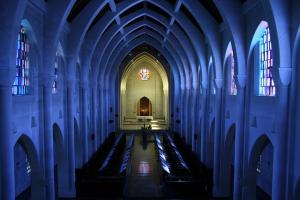
Catholicism asserts that not only does God exist, but that He has revealed Himself within the stream of human history. Divine revelation provides the basis for Catholic doctrine. But what exactly is the relationship between revelation and doctrine? In what way, if any, do revelation and doctrine affect how Catholics worship?
In this paper, I will suggest that revelation acts upon and excites human reason, which in turn develops the doctrines that become the foundation of Catholic worship.
Revelation
The word apocalypse often has a negative connotation, as it is frequently associated with the end of the world. However, apocalypse is a translation from a Greek word meaning to unveil or uncover something. Similarly, revelation is the laying bare or uncovering of something.
In a specific sense, John’s Book of Revelation can be understood this way. However, in a much more general way, the whole of the Bible can be seen to contain strains of revelation.
In whatever sense one interprets it, revelation is generally defined as God disclosing and communicating Himself and His will to the human race. Catholic theology differentiates two types of revelation; natural and supernatural.
Natural revelation refers to knowledge about God gleaned from abstract reasoning (philosophy) and observation (order and sophistication in the natural world). Supernatural revelation involves God communicating truths that are beyond the capacity of the unaided human intellect to comprehend. An example of this type of revelation would be God as a trinity of persons.
Regardless of the form that revelation takes, the truths disclosed are forms of communication. Communication entails a communicator (i.e., God) and the one who receives the communication (human beings). Furthermore, communication – whether issued or received – entails intelligence or reason.
Reason
Depending on one’s philosophy and theology, reason can be defined quite differently. Within philosophy and theology, a definition of reason involves the three acts of the intellect, the ability to apprehend the essence of a thing, the ability to make judgments, and the capacity to make advances in knowledge.
Now it must be that reason acts in response to information obtained from the senses. Put differently, reason responds to data that is communicated to it. If Divine revelation is a form of communication, then the human intellect should be engaged by revelation.
Let us assume that the information provided to human beings by revelation is subjected to the three acts of the mind. In that case, it is certainly likely that fallible human beings will misunderstand no small amount of the data provided. It is a point that I will return to below.
Now if God intended revelation to impart certain truths to human beings, and those truths are subject to be misconstrued, then it is no surprise that Christianity has experience heresy.
To rectify this fact, the Church must develop doctrine.
Doctrine
Doctrine is any truth taught by the Church as necessary for acceptance by the faithful. Within the umbrella of doctrine, the Catholic Church further identified three types of truth. The formally revealed truth is that which has been shown to human beings by God. An example would be the Real Presence of God in the Eucharist. The second type of truth involves a theological determination, such as the canonization of a saint. Finally, there is truth within the domain of natural law. An example of this type of truth would be the sinfulness of homosexuality.
As time allows revelation to be contemplated by numerous minds, the understanding of revelation changes, and that change must be reflected in doctrine.
Ultimately, what makes a truth doctrine is that the Catholic Church teaches that it is to be believed by Catholics. The promulgation of doctrine includes what is known as ex-cathedra pronouncements. These are teachings or statements issued by the Pope. It refers to binding and infallible papal teachings promulgated by the Pope when he officially teaches in his capacity as the universal head of the Church. The teachings involve matters of faith or morals and are addressed to the entire world.
An objection may arise. If God has revealed Himself and His will to human beings, and this revelation is contained in sacred Scripture, why is there any need for doctrine? Is not the Bible sufficient?
A response to this question can be drawn directly from the Bible. In the Book of Acts, we read of Philip the Evangelist’s encounter with an Ethiopian who was reading the Old Testament. Philip asks him, “Do you understand what you are reading?” He replied, “How can I, unless someone guides me?” (Acts of the Apostles 8:29-31). It is the responsibility of the Catholic Church, by virtue of doctrine, to guide all of us.
Perhaps this leads to another question, how can we know that what the Church teaches is what God intended? Here too, Scripture provides an answer. In John 16:13, Jesus foretells Pentecost and the Catholic Church’s creation. “But when he comes, the Spirit of truth, he will guide you to all truth.” This “Spirit of truth” is, of course, the Holy Spirit who does indeed come on Pentecost. (See chapter two of the Acts of the Apostles).
One last point: if God has revealed Himself to transmit truth, it seems illogical that He would do so knowing that the fallible human intellect is likely to fall into error regarding that truth. Put differently, God created the Catholic Church, at least in part, to be the depository of the truth that He intended to be dispensed. Such a depository acts to forestall error.
Hopefully, it has become clear that revelation acts upon the human mind, which seeks to understand. The product of understanding is doctrine. Of course, the purpose of this process of revelation, reason, and doctrine is to allow us to worship God properly.
Worship
Worship, in the theological sense of the word, is giving the proper honor, praise, and respect owed to God as our creator. Divine worship includes three principal acts: adoration (or the recognition of God’s infinite perfection), prayer or asking for divine help, and sacrifice or offering something precious to God. Worship as veneration also has three principal forms: the angels and saints are honored for their sanctity, asked to intercede before the divine Majesty, and imitated in their love and service of God. (See Father John Hardon’s Modern Catholic Dictionary).
If revelation is God showing Himself and revealing His will to human beings, then doctrine is a human response to seeking to understand what God has revealed. Finally, worship is putting that understanding into practice by placing oneself in a proper relationship with God.
Conclusion
In this paper, I have suggested that Divine revelation stirs the human intellect to action. This action, working in and through the Church that God created, results in the development of doctrine. In turn, doctrine makes the proper worship of God possible.
History and Religion
Religion News
Previous Post

January 8, 2023
The Indwelling Of God
Next Post
January 22, 2023 Introduction Into The Sacred Secrets
Recent Comments
"Why would it matter if atheism is wrong? The fact that Catholic and Protestant scholars ..."
Beyond the Absence of Belief: The ..."
"Kaiser Member Service Proponents often compare atheism to not collecting stamps—it is the lack of ..."
Beyond the Absence of Belief: The ..."
""these dual denials (objective truth and objective meaning)"This is not accurate. Post-modern thought does not ..."
Defending the Faith in a Post-Truth ..."
"The theologians still haven't received the memo. Your opposition are no longer atheists, but they ..."
Defending the Faith in a Post-Truth ..."
Browse Our Archives
Select a Category Abortion Atheism Catholicism. Catholicism. God. Theophany. Christmas Eschatology Faith and Works. God. Holy Spirit Intelligent Design Jesus Christ Justice Law Politics Protestantism Religion Sabbath Salvation. Soteriology. The Bible Theology Uncategorized
Select a Month October 2026 September 2026 August 2026 July 2026 June 2026 May 2026 April 2026 March 2026 February 2026 January 2026 December 2025 November 2025 October 2025 September 2025 August 2025 July 2025 June 2025 May 2025 April 2025 March 2025 February 2025 January 2025 December 2024 November 2024 October 2024 September 2024 August 2024 July 2024 June 2024 May 2024 April 2024 March 2024 February 2024 January 2024 December 2023 November 2023 October 2023 September 2023 August 2023 July 2023 June 2023 May 2023 April 2023 March 2023 February 2023 January 2023 December 2022 November 2022 October 2022 September 2022 August 2022 July 2022 June 2022 May 2022 April 2022 March 2022 February 2022 January 2022 December 2021
Follow Us!
TAKE THE
Religious Wisdom Quiz
Which king of Babylon saw the handwriting on the wall?
Select your answer to see how you score.
Cyrus Darius Nebuchadnezzar Belshazzar
Related posts from Summa Catholic

The Anatomy of Divine Revelation in Catholic Thought

Beyond the Absence of Belief: The Implications of...

Can Catholic Apologetics Survive a Postmodern World?

From Samaria to Sanctity: Analyzing The Woman At...
TRENDING AT PATHEOS Catholic

The Parable Of The Sower And The Word...
One of Christ’s most famous parables is that of the sower who...

Rejecting Doom: Christian Hope And Human Action
Christianity is a religion of hope. We are to have hope and...

Why I Choose the Eucharist Over the Sermon
Choose the Eucharist, Not the Sermon What are we supposed to get...

5 Design Elements Found in Spiritually Rooted Homes
Putting Spirituality Into Home Decor Our homes are more than our living...

Credo: A Story of God Told with the...
About 10 years ago, I began to imagine a personal "Credo" that...

The Anatomy of Divine Revelation in Catholic Thought
The claim that God has made Himself known to human beings is...
view all Catholic blogs
What Are Your Thoughts?leave a comment
Ad-Free & Subscriber Log-In Subscription Support
- About Us
- 2026 Calendar
- Videos
- Podcasts
- Library of World Religions
- Faith In Media Tracker
- Advertise With Us
- Write for Us
- Privacy Policy
- Terms of Service
- Do Not Sell My Data
- Contact Us
- Radiant Digital
- Manage Newsletter Subscriptions
- Unsubscribe From Notifications
- Sitemap
Copyright 2008-2026, Patheos. All rights reserved.
Subscription Support Ad-Free & Subscriber Log-In
Follow Patheos