
BuddhistCatholicContemplativeEvangelicalGeneral ChristianHinduJewishLatter-day SaintMuslimNew VisionsProgressive Christian
Beliefs
- Buddhist
- Catholic
- Contemplative
- Evangelical
- General Christian
- Hindu
- Jewish
- Latter-day Saint
- More Voices
- Muslim
- New Visions
- Pagan
- Progressive Christian
Topics
- Religion News
- Food and Religion
- Sports and Religion
- Religious Art
- Religious Music and Entertainment
- Religious Events
- History and Religion
- Style and Religion
- Politics and Religion
- Women in Religion
- Recreation Outdoors and Religion
- Business Finance and Religion
- Careers Workplace and Religion
- Education and Religion
- Family Parenting and Religion
- Health Fitness and Religion
- Home and Religion
- Relationships and Religion
- Technology and Religion
- Travel and Religion
Columnists
- Buddhist Columnists
- Business Finance and Religion Columnists
- Careers Workplace and Religion Columnists
- Catholic Columnists
- Contemplative Columnists
- Education and Religion Columnists
- Evangelists Columnists
- Family Parenting and Religion Columnists
- General Christian Columnists
- Health Fitness and Religion Columnists
- Hindu Columnists
- History and Religion Columnists
- Home and Religion Columnists
- Jewish Columnists
- More Voices Columnists
- Latter Day Columnists
- Muslim Columnists
- New Visions Columnists
- Nonreligious Columnists
- Pagan Columnists
- Politics and Religion Columnists
- Progressive Columnists
- Recreation Outdoors and Religion Columnists
- Relationships and Religion Columnists
- Religion News Columnists
- Religious Art Columnists
- Religious Events Columnists
- Religious Music and Entertainment Columnists
- Sports and Religion Columnists
- Style and Religion Columnists
- Technology and Religion Columnists
- Travel and Religion Columnists
- Women in Religion Columnists
Resource Library
- 2026 Calendar
- Library of World Religions
- The 100 Most Holy Places on Earth
- Patheos Answers
- Podcasts
- Videos
- Faith Leaders Database
- Anglican Episcopalian
- Bahai
- Baptist
- Buddhism
- Christianity
- Confucianism
- Eastern Orthodoxy
- Hinduism
- Holiness and Pentecostal
- ISKCON
- Islam
- Judaism
- Lutheran
- Methodist
- The Church of Jesus Christ of Latter-day Saints
- New Age
- Paganism
- Presbytarian and Reformed
- Protestantism
- Religion Behind the Scenes
- Roman Catholic
- Scientology
- Shia Islam
- Sikhism
- Sufism
- Sunni Islam
- Taoism
- Zen
- See all religions
Research Tools
 Ad-Free & Subscriber Log-In Subscription Support
Ad-Free & Subscriber Log-In Subscription Support
Follow Patheos 

- Trending:
- Forgiveness
- |
- Marriage
- |
- Consciousness
- |
- Death Penalty
- |
- Election
- |
- Halloween

- Home
- Catholic
- Education and Religion
- Procession, Appropriation, And The Life Of God
Procession, Appropriation, And The Life Of God
Last updated on: November 13, 2022 at 9:40 am by David Schloss
Procession, Appropriation, And The Life Of God 2022-11-13T09:40:30-05:00 David Schloss
Patheos Explore the world's faith through different perspectives on religion and spirituality! Patheos has the views of the prevalent religions and spiritualities of the world.
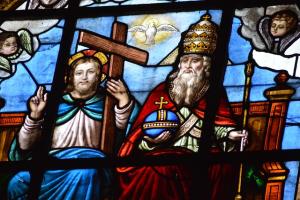
One need not spend time studying Catholicism before coming across the word mystery. Within theology, a mystery is a truth revealed by God that cannot be rationally conceived. Said differently, it is knowledge that human beings could not obtain without it being revealed by God.
One such mystery is the Holy Trinity. In this paper, I will endeavor to shed light on the life of the Trinity by discussing procession and spiration. I will conclude by examining what is known as appropriation.
Procession And Spiration
God is that being that exists necessarily. As such, His nature is eternal. Furthermore, based on Revelation, Catholicism asserts that God is three persons: the Father, the Son, and the Holy Spirit. All three possess a Divine nature; thus, all three are God, yet there is only one God.
In order to understand how this can be, we must distinguish between a nature and a person. The nature of a being is what a thing is; a person is who a thing is. Therefore, when we speak of the Holy Trinity, we can say that the three persons (the who) are all one Divine nature (the what).
This solution to understanding the Trinity leads to another problem. If Jesus is the Son of God (John 16:28 et al.), and God is eternal (John 17:24), then how can God have a Son? Put differently, if Jesus has always existed, then how can He have a Father? In order to address this question, we must understand the concept of the Divine procession.
Divine procession refers to the origination of a Divine person through the communication of the Divine essence. Procession means the origin of one from another. A procession can be either external or internal. The distinction depends on whether the term of the procession goes outside the principle from which it proceeds or remains within it. Creatures are said to proceed from God by an external procession, but the Son and the Holy Spirit proceed by an immanent act of the Most Holy Trinity since they belong to the inner life of God.
Within the Trinity, there are two internal processions. The first is the begetting of the Son from the Father. The second procession, often called spiration, is the origination of the Holy Spirit from the Father and the Son.
Since God exists outside of time, it is inaccurate to suggest a temporal procession. That is to say that it is incorrect to say that the Father had to exist for a period of time before He had a Son. Rather, the Son is eternally generated from the Father, and the Father and the Son eternally spirate the Holy Spirit.
Again, it is necessary to distinguish between God’s nature and the Persons of God. It is the divine persons, not the divine nature, who are the subjects of the internal divine procession. Finally, Jesus proceeds by the generation of the intellect. The Holy Spirit, however, proceeds from the will or mutual love of the Father and the Son from a single principle through spiration.
Having now sought to explain the subject of Divine procession, I turn to the question of appropriation.
Appropriation
Even though the three persons of the Holy Trinity are God, theology distinguishes, however imperfectly, particular attributes and works of each of the persons of the Trinity. This assigning and distinguishing of attributes is called appropriation.
It is important to state that while certain qualities are prescribed to a particular person of the Trinity, it is not to the exclusion of the other members. Said differently, an attribute associated with one member of the Trinity does not mean that the other members do not also possess that particular attribute. However, in following Divine Revelation, Catholic theology specifies certain qualities to specific members of the Trinity.
To God the Father, attributes such as eternity, unity, omnipotence, and efficient causality, are suggested. Eternity is perhaps the most obvious attribute of God since He is the uncaused first cause of creation. Unity refers to the oneness of the Divine nature. It appears that a thing can be limited in one of two ways; by its nature and by extrinsic powers. Since it is God’s nature to exist and since there can be nothing that exists outside of God, the power of omnipotence is attributable to God the Father. Finally, efficient causality (the capacity to create) is appropriated to the Father.
Jesus, as the logos or reason of God, possesses qualities such as beauty, truth, wisdom, as well as the power of ordering the universe. As such, Jesus is understood to be the exemplary cause of creation. Beauty refers not to aesthetics but rather to that which reveals truth and goodness. As Jesus is the ultimate manifestation of God, beauty and truth are attributed to Him. The designation of Jesus as the logos refers to the reason or mind of God. As such, Jesus is seen as the ordering principle of creation.
Philosophically, the will is said to seek the good. Since the Holy Spirit proceeds from the will of God, qualities such as goodness, charity and its works, sanctification, and the conservation and perfecting of creation are attributed to Him. Of great importance to Catholics, it is the Holy Spirit that fortified the apostles at Pentecost – the birth of the Catholic Church – and it is the Holy Spirit that continues to inform and guide the Church to this day.
Conclusion
Many aspects of God are beyond the capacity of the human intellect to fully comprehend. Because of this fact, theology often speaks of mystery in discussing the Divine.
In this paper, I have endeavored to explore the mystery of the Holy Trinity by discussing the procession of Persons within the Trinity and by explaining the various qualities appropriated to each member.
Education and Religion
Relationships and Religion
Religion News
Previous Post

November 6, 2022
Universalism And The Will
Next Post
November 20, 2022 The Epistles
Browse Our Archives
Select a Category Abortion Atheism Catholicism. Catholicism. God. Theophany. Christmas Eschatology Faith and Works. God. Holy Spirit Intelligent Design Jesus Christ Justice Law Politics Protestantism Religion Sabbath Salvation. Soteriology. The Bible Theology Uncategorized
Select a Month October 2026 September 2026 August 2026 July 2026 June 2026 May 2026 April 2026 March 2026 February 2026 January 2026 December 2025 November 2025 October 2025 September 2025 August 2025 July 2025 June 2025 May 2025 April 2025 March 2025 February 2025 January 2025 December 2024 November 2024 October 2024 September 2024 August 2024 July 2024 June 2024 May 2024 April 2024 March 2024 February 2024 January 2024 December 2023 November 2023 October 2023 September 2023 August 2023 July 2023 June 2023 May 2023 April 2023 March 2023 February 2023 January 2023 December 2022 November 2022 October 2022 September 2022 August 2022 July 2022 June 2022 May 2022 April 2022 March 2022 February 2022 January 2022 December 2021
Follow Us!
TAKE THE
Religious Wisdom Quiz
How many verses are in the shortest chapter in the Bible?
Select your answer to see how you score.
10 5 7 2
Related posts from Summa Catholic

The Anatomy of Divine Revelation in Catholic Thought

Beyond the Absence of Belief: The Implications of...

Can Catholic Apologetics Survive a Postmodern World?

From Samaria to Sanctity: Analyzing The Woman At...
TRENDING AT PATHEOS Catholic

The Parable Of The Sower And The Word...
One of Christ’s most famous parables is that of the sower who...

Rejecting Doom: Christian Hope And Human Action
Christianity is a religion of hope. We are to have hope and...

Why I Choose the Eucharist Over the Sermon
Choose the Eucharist, Not the Sermon What are we supposed to get...

5 Design Elements Found in Spiritually Rooted Homes
Putting Spirituality Into Home Decor Our homes are more than our living...

Credo: A Story of God Told with the...
About 10 years ago, I began to imagine a personal "Credo" that...

The Anatomy of Divine Revelation in Catholic Thought
The claim that God has made Himself known to human beings is...
view all Catholic blogs
Ad-Free & Subscriber Log-In Subscription Support
- About Us
- 2026 Calendar
- Videos
- Podcasts
- Library of World Religions
- Faith In Media Tracker
- Advertise With Us
- Write for Us
- Privacy Policy
- Terms of Service
- Do Not Sell My Data
- Contact Us
- Radiant Digital
- Manage Newsletter Subscriptions
- Unsubscribe From Notifications
- Sitemap
Copyright 2008-2026, Patheos. All rights reserved.
Subscription Support Ad-Free & Subscriber Log-In
Follow Patheos