
BuddhistCatholicContemplativeEvangelicalGeneral ChristianHinduJewishLatter-day SaintMuslimNew VisionsProgressive Christian
Beliefs
- Buddhist
- Catholic
- Contemplative
- Evangelical
- General Christian
- Hindu
- Jewish
- Latter-day Saint
- More Voices
- Muslim
- New Visions
- Pagan
- Progressive Christian
Topics
- Religion News
- Food and Religion
- Sports and Religion
- Religious Art
- Religious Music and Entertainment
- Religious Events
- History and Religion
- Style and Religion
- Politics and Religion
- Women in Religion
- Recreation Outdoors and Religion
- Business Finance and Religion
- Careers Workplace and Religion
- Education and Religion
- Family Parenting and Religion
- Health Fitness and Religion
- Home and Religion
- Relationships and Religion
- Technology and Religion
- Travel and Religion
Columnists
- Buddhist Columnists
- Business Finance and Religion Columnists
- Careers Workplace and Religion Columnists
- Catholic Columnists
- Contemplative Columnists
- Education and Religion Columnists
- Evangelists Columnists
- Family Parenting and Religion Columnists
- General Christian Columnists
- Health Fitness and Religion Columnists
- Hindu Columnists
- History and Religion Columnists
- Home and Religion Columnists
- Jewish Columnists
- More Voices Columnists
- Latter Day Columnists
- Muslim Columnists
- New Visions Columnists
- Nonreligious Columnists
- Pagan Columnists
- Politics and Religion Columnists
- Progressive Columnists
- Recreation Outdoors and Religion Columnists
- Relationships and Religion Columnists
- Religion News Columnists
- Religious Art Columnists
- Religious Events Columnists
- Religious Music and Entertainment Columnists
- Sports and Religion Columnists
- Style and Religion Columnists
- Technology and Religion Columnists
- Travel and Religion Columnists
- Women in Religion Columnists
Resource Library
- 2026 Calendar
- Library of World Religions
- The 100 Most Holy Places on Earth
- Patheos Answers
- Podcasts
- Videos
- Faith Leaders Database
- Anglican Episcopalian
- Bahai
- Baptist
- Buddhism
- Christianity
- Confucianism
- Eastern Orthodoxy
- Hinduism
- Holiness and Pentecostal
- ISKCON
- Islam
- Judaism
- Lutheran
- Methodist
- The Church of Jesus Christ of Latter-day Saints
- New Age
- Paganism
- Presbytarian and Reformed
- Protestantism
- Religion Behind the Scenes
- Roman Catholic
- Scientology
- Shia Islam
- Sikhism
- Sufism
- Sunni Islam
- Taoism
- Zen
- See all religions
Research Tools
 Ad-Free & Subscriber Log-In Subscription Support
Ad-Free & Subscriber Log-In Subscription Support
Follow Patheos 

- Trending:
- Forgiveness
- |
- Marriage
- |
- Consciousness
- |
- Death Penalty
- |
- Election
- |
- Halloween

- Home
- Catholic
- History and Religion
- The Catholic Church
The Catholic Church
Last updated on: October 2, 2022 at 9:20 am by David Schloss
The Catholic Church 2022-10-02T09:20:46-04:00 David Schloss
Patheos Explore the world's faith through different perspectives on religion and spirituality! Patheos has the views of the prevalent religions and spiritualities of the world.
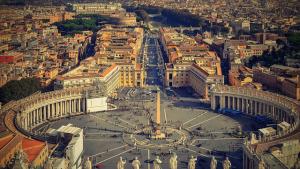
“Upon this rock, I will build my church, and the gates of the netherworld shall not prevail against it.” – Matthew 16:18.
Jesus’ promise to build His Church would be fulfilled on Pentecost, and some two thousand years later, the Catholic Church remains. In this paper, I will seek to provide a brief overview and history of the Church and its structure. I will conclude by examining the purpose of the “mystical body of Christ.”
History
In a very real sense, it is impossible to speak of the history of Western Civilization without speaking of the Catholic Church. The history of the Roman Empire, as well as the history of Europe, is inextricably intertwined with the Catholic Church.
The Catholic Church traces its commencement to Pentecost. It is at Pentecost that the Holy Spirit descends upon the apostles and, in so doing, completes the Paschal mystery.
Based on the words spoken by Jesus (“Upon this rock, I shall build my Church), Peter is considered the first pope. Under Peter’s leadership and strengthened by the Holy Spirit, the apostles formed house churches. Indeed, house churches were essential to Catholicism’s growth and ultimate triumph for the first three centuries after Pentecost. The spread of Catholicism through these house churches allowed the believers to challenge the social order of the day. They became witnesses – through their words, lives, and suffering.
The New Testament provides several references to house churches. These were family homes where Catholics would gather and ponder the life and message of Jesus while growing in their faith. (See Acts of the Apostles 2:46).
Despite opposition and persecution, the disciples spread the Gospel message throughout Asia Minor and the whole of the Roman Empire. In AD. 313, the first Catholic Church, San Giovanni Laterano, was built in Rome.
In AD. 380, the Roman Empire officially declared Christianity as the religion of the Empire. At the height of the Empire, its reaches included much of what today is Western Europe. As such, Catholicism spread into Europe and, eventually, into the new world of the Americas.
The Roman Empire is long gone, but the Basilica at San Giovanni, like Catholicism itself, remains.
Structure
Within the Church, there are six levels of the clergy included within the sacrament of Holy Orders. The Pope is the head of the visible body of the Catholic Church. It is vital to make a distinction here. The Church is the mystical body of Christ, and as such, its head is Jesus. The Pope, as the vicar or representative of Christ, is the head of the Church on earth. Said differently, the Pope is Peter’s successor as the head of the apostles.
Cardinals are the leading bishops as well as members of the College of Cardinals. Their most significant duty is participating in the Papal Conclave, which entails choosing a new Pope. In addition, Cardinals are often involved in the governmental body of the Church, which is known as the Roman Curia.
Below the Cardinals are the Archbishops. Archbishops are critically important bishops. They oversee large areas of churches called archdioceses. Finally, Archbishops are responsible for oversight and management of bishops within their assigned geographical region.
Bishops are ordained ministers who act as the head of a diocese or eparchy (the Eastern Orthodox equivalent of a diocese). Bishops are entrusted to teach and delegate the teachings of the Church to priests, teachers, and catechists. They are also responsible for the training and supplying of priests within their area of responsibility. Finally, Bishops are to ensure that the sacraments of the Church are properly administered.
After the seminary, and after the diaconate, a man undertakes the Rite of Ordination. This ordains them into the priesthood. The priest performs the ceremony of the Eucharist, hears confession, and conducts the Anointing of the Sick. Priests are also able to perform Holy Matrimony. The Catholic Church distinguishes two kinds of priests: religious and diocesan. Diocesan priests lead individual parishes. They serve the people within their parish and are not required to take the same vowels as religious priests. This type of priest is more common in secular countries without a solid traditional Catholic population.
Religious priests, however, vow themselves to a religious order, such as the Dominicans. They wear particular religious garb and take additional vows of poverty and obedience. They typically live in a group house alongside other members of the order.
The last level of the clergy is the deacons. The role of deacons is to assist priests in preaching, the conferral of baptism, the performance of marriage, and the administration of parishes. Frequently, deacons are seminarians studying for the priesthood.
While the Pope is the head of the visible Church, he acts in accord with the curia. The curia is the ensemble of departments or ministries which assist the sovereign pontiff in the government of the Catholic Church. Essentially, the curia is the governing body of the Church.
Yet within the curia, there are divisions or congregations known as dicasteries. Dicasteries concern themselves with various administrative and ecclesiastical duties. For example, the dicastery for the Doctrine of the Faith is responsible for safeguarding the doctrine of faith and morals.
Purpose
In a very real sense, the purpose of the Catholic Church is summed up by the words of Christ. “Go, therefore, and make disciples of all nations, baptizing them in the name of the Father, and of the Son, and of the Holy Spirit, teaching them to observe all that I have commanded you.” (Matthew 28:19-20).
It is the responsibility of the Church to uphold, clarify, and spread the Gospel message. As Jesus’ words indicate, there are certain activities or rituals that the Church has been entrusted with. These activities or rituals are known as sacraments. Without going into the specifics of each sacrament, it will suffice to say that God has entrusted His Church with seven sacraments. “The purpose of the sacraments is to sanctify men, to build up the body of Christ, and finally, to give worship to God.” (Catechism of the Catholic Church, Paragraph 1123).
Therefore, we can say that the purpose of the Catholic Church is to make people holy, to work to bring about the Kingdom of God, and to give the right worship that is owed to God.
Conclusion
In this paper, I have sought to provide an introduction to the history, structure, and purpose of the Catholic Church.
I have delineated the types of clergy and provided an organization outline of the Church. Finally, I have suggested the purpose of the Catholic Church is to work toward bringing about the Kingdom of God. This is done through the administering of the sacraments, and it is done by the proper worship of God.
History and Religion
Previous Post

September 25, 2022
The Cry From The Cross
Next Post
October 9, 2022 Does God Want You To Hate Your Family?
Browse Our Archives
Select a Category Abortion Atheism Catholicism. Catholicism. God. Theophany. Christmas Eschatology Faith and Works. God. Holy Spirit Intelligent Design Jesus Christ Justice Law Politics Protestantism Religion Sabbath Salvation. Soteriology. The Bible Theology Uncategorized
Select a Month October 2026 September 2026 August 2026 July 2026 June 2026 May 2026 April 2026 March 2026 February 2026 January 2026 December 2025 November 2025 October 2025 September 2025 August 2025 July 2025 June 2025 May 2025 April 2025 March 2025 February 2025 January 2025 December 2024 November 2024 October 2024 September 2024 August 2024 July 2024 June 2024 May 2024 April 2024 March 2024 February 2024 January 2024 December 2023 November 2023 October 2023 September 2023 August 2023 July 2023 June 2023 May 2023 April 2023 March 2023 February 2023 January 2023 December 2022 November 2022 October 2022 September 2022 August 2022 July 2022 June 2022 May 2022 April 2022 March 2022 February 2022 January 2022 December 2021
Follow Us!
TAKE THE
Religious Wisdom Quiz
How did Nehemiah show concern for the poor in Jerusalem's community?
Select your answer to see how you score.
He doubled taxes He expelled foreigners He gave up rebuilding He canceled debts and returned land
Related posts from Summa Catholic

The Anatomy of Divine Revelation in Catholic Thought

Beyond the Absence of Belief: The Implications of...

Can Catholic Apologetics Survive a Postmodern World?

From Samaria to Sanctity: Analyzing The Woman At...
TRENDING AT PATHEOS Catholic

The Parable Of The Sower And The Word...
One of Christ’s most famous parables is that of the sower who...

Rejecting Doom: Christian Hope And Human Action
Christianity is a religion of hope. We are to have hope and...

Why I Choose the Eucharist Over the Sermon
Choose the Eucharist, Not the Sermon What are we supposed to get...

5 Design Elements Found in Spiritually Rooted Homes
Putting Spirituality Into Home Decor Our homes are more than our living...

Credo: A Story of God Told with the...
About 10 years ago, I began to imagine a personal "Credo" that...

The Anatomy of Divine Revelation in Catholic Thought
The claim that God has made Himself known to human beings is...
view all Catholic blogs
Ad-Free & Subscriber Log-In Subscription Support
- About Us
- 2026 Calendar
- Videos
- Podcasts
- Library of World Religions
- Faith In Media Tracker
- Advertise With Us
- Write for Us
- Privacy Policy
- Terms of Service
- Do Not Sell My Data
- Contact Us
- Radiant Digital
- Manage Newsletter Subscriptions
- Unsubscribe From Notifications
- Sitemap
Copyright 2008-2026, Patheos. All rights reserved.
Subscription Support Ad-Free & Subscriber Log-In
Follow Patheos