
BuddhistCatholicContemplativeEvangelicalGeneral ChristianHinduJewishLatter-day SaintMuslimNew VisionsProgressive Christian
Beliefs
- Buddhist
- Catholic
- Contemplative
- Evangelical
- General Christian
- Hindu
- Jewish
- Latter-day Saint
- More Voices
- Muslim
- New Visions
- Pagan
- Progressive Christian
Topics
- Religion News
- Food and Religion
- Sports and Religion
- Religious Art
- Religious Music and Entertainment
- Religious Events
- History and Religion
- Style and Religion
- Politics and Religion
- Women in Religion
- Recreation Outdoors and Religion
- Business Finance and Religion
- Careers Workplace and Religion
- Education and Religion
- Family Parenting and Religion
- Health Fitness and Religion
- Home and Religion
- Relationships and Religion
- Technology and Religion
- Travel and Religion
Columnists
- Buddhist Columnists
- Business Finance and Religion Columnists
- Careers Workplace and Religion Columnists
- Catholic Columnists
- Contemplative Columnists
- Education and Religion Columnists
- Evangelists Columnists
- Family Parenting and Religion Columnists
- General Christian Columnists
- Health Fitness and Religion Columnists
- Hindu Columnists
- History and Religion Columnists
- Home and Religion Columnists
- Jewish Columnists
- More Voices Columnists
- Latter Day Columnists
- Muslim Columnists
- New Visions Columnists
- Nonreligious Columnists
- Pagan Columnists
- Politics and Religion Columnists
- Progressive Columnists
- Recreation Outdoors and Religion Columnists
- Relationships and Religion Columnists
- Religion News Columnists
- Religious Art Columnists
- Religious Events Columnists
- Religious Music and Entertainment Columnists
- Sports and Religion Columnists
- Style and Religion Columnists
- Technology and Religion Columnists
- Travel and Religion Columnists
- Women in Religion Columnists
Resource Library
- 2026 Calendar
- Library of World Religions
- The 100 Most Holy Places on Earth
- Patheos Answers
- Podcasts
- Videos
- Faith Leaders Database
- Anglican Episcopalian
- Bahai
- Baptist
- Buddhism
- Christianity
- Confucianism
- Eastern Orthodoxy
- Hinduism
- Holiness and Pentecostal
- ISKCON
- Islam
- Judaism
- Lutheran
- Methodist
- The Church of Jesus Christ of Latter-day Saints
- New Age
- Paganism
- Presbytarian and Reformed
- Protestantism
- Religion Behind the Scenes
- Roman Catholic
- Scientology
- Shia Islam
- Sikhism
- Sufism
- Sunni Islam
- Taoism
- Zen
- See all religions
Research Tools
 Ad-Free & Subscriber Log-In Subscription Support
Ad-Free & Subscriber Log-In Subscription Support
Follow Patheos 

- Trending:
- Forgiveness
- |
- Marriage
- |
- Consciousness
- |
- Death Penalty
- |
- Election
- |
- Halloween

- Home
- Catholic
- Of Angels
Of Angels
Last updated on: August 31, 2022 at 6:20 am by David Schloss
Of Angels 2022-08-31T06:20:28-04:00 David Schloss
Patheos Explore the world's faith through different perspectives on religion and spirituality! Patheos has the views of the prevalent religions and spiritualities of the world.
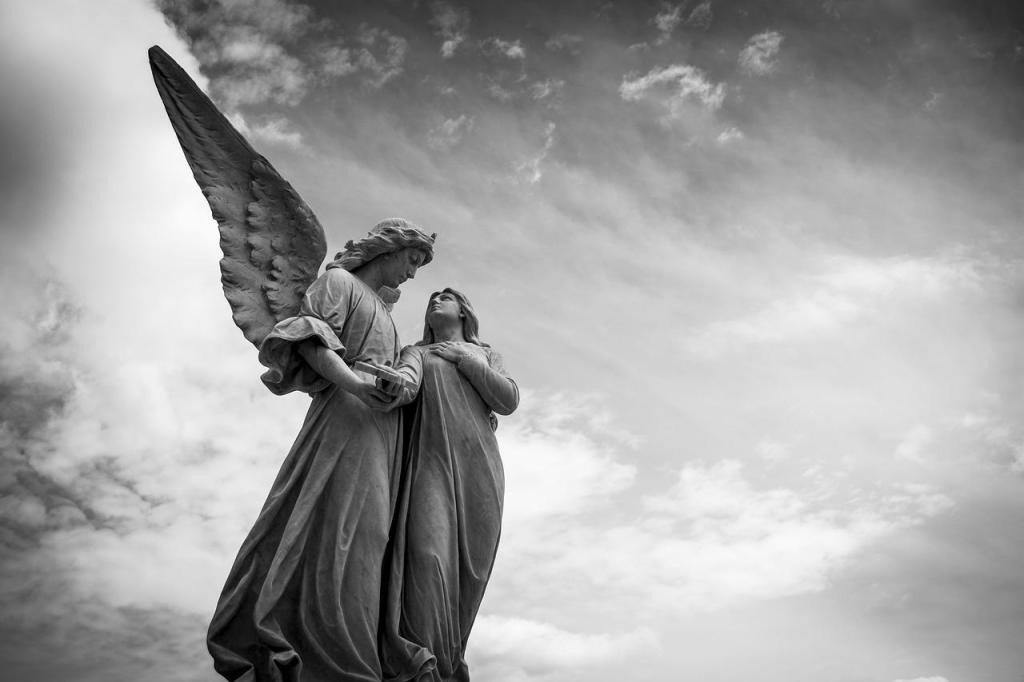
“The name angel belongs to his office, not to his nature. You ask what is the name of his nature. He is a spirit. You ask what is the name of his office. He is an angel.” – Saint Augustine.
The idea of angels has often captivated people through the ages. For most, the word angel conjures up images of Valentine’s Day and of rotund babies with bows and arrows. Yet this image of angels is very far from how they are depicted in the Bible. The appearance of angels to human beings almost always engenders fear and awe.
In this paper, I will explore what angels are and what Catholicism understands about these heavenly creatures. I will also address the question of whether angels are created beings. Finally, I will examine the various types of angels. The first topic, however, is to discuss the evidence for the existence of angels.
Do Angels Exist?
The evidence for the existence of angels begins with the fact that they are depicted throughout the Bible.
Angels waited on Christ when he was tempted in the desert (Matthew 4:11), and angels set Saint Peter free from prison (Acts 12:5-17). And the angel Gabriel came to the Blessed Virgin Mary to announce the birth of Christ (Luke 1:26-38).
Owing to the testimony of Scripture, the Catechism of the Catholic Church says of angels, “The existence of the spiritual, non-corporeal beings that Sacred Scripture usually calls “angels” is a truth of faith. The witness of Scripture is as clear as the unanimity of Tradition.” (Catechism of the Catholic Church, Paragraph 328).
Having thus provided the evidence for the existence of angels, we can turn to what angels are exactly.
What Are Angels?
In order to proceed, it is beneficial to detour briefly into philosophy, specifically ontology. One of the questions that ontology deals with is the types of things that exist in the universe. Catholic philosophy adheres to dualism in this regard, arguing that there are two fundamental substances that make up the universe. These two substances are material and spiritual. It is, of course, conceivable that the substances can be combined. Indeed, human beings are composite creatures, composed of a material body and a spiritual soul. Having set the ontological framework, I can proceed to examine what angels are.
When observing creation, it is clear that there exist causes and effects, and it is further evident that things are more and less perfect. A thing is closer to perfection to the extent that it fulfills its nature and is more like its cause to the extent that it shares the power by which it was created.
Since God creates all things by virtue of His intellect, a thing is more like God the more that its nature is intellectual. And since angels are thought to be purely intellectual beings, they are believed to exist at a higher plane of existence than do human beings. The reason that angels must exist at a higher plane is owing to the purity of their spiritual nature. It must be noted that human beings are composite creatures composed of matter and spirit, whereas the angel is pure spirit.
Further, since the intellect exists over above the material body, angels, as pure spirits, do not, by nature, possess bodies. The fact that angels are composed of a spiritual substance means that they are not restricted by time and space, as are beings that are composed of material bodies. However, it appears from Scripture that angels can and do take the form of a physical body when necessary.
Having provided a brief sketch of what angels are, I turn now to how angels are created and for what purpose.
Creation And Purposes
As a matter of faith and logic, the only being that is not created is God Himself. As such, it must be admitted that angels exist in the order of creation. Yet owing to the fact that angels are spiritual beings and that which is of a spiritual substance cannot be destroyed, it is thought that angels are immortal. Put differently, angels are created by God but are not subject to death by virtue of their nature.
We can contemplate the purpose of angels by being aware of the word’s etymology. Angel comes from the Greek angelos, which is interpreted in English as “messenger.” Furthermore, the Bible contains numerous passages depicting angels as messengers of God. Angels are seen delivering messages of God’s plan of salvation, rendering justice, or providing strength and comfort.
Despite the view that angels are believed to be messengers of God, the Bible and Catholic Tradition identify several types of angels. To that, I turn next.
Types Of Angels
Drawing on Scripture, Catholic Tradition identifies three sets of angels, each containing three types of angels. The first category of angels is those in direct contact with God. They are known as the seraphim, which means “the burning ones,” because they have an intense love for God and comprehend Him with the greatest clarity. The cherubim contemplate God’s divine providence and plan for His creatures. Lastly, the thrones symbolize divine justice and judicial power.
The second set of angels are called dominations or dominions and govern the angels called virtues. This set of angels is concerned with the fulfillment of God’s providential plan for the universe. The virtues implement the orders from the dominions and govern the heavenly bodies. Lastly, the powers confront and fight against any evil forces opposed to God’s providential plan.
The final set of angels is directly involved in human affairs. They are called the principalities, whose responsibilities include the care for earthly nations and cities. Within this set, the archangels deliver God’s most important messages to mankind, while each angel serves as a guardian for each of us.
Conclusion
In this work, I have endeavored to explore the mysterious spiritual creatures known as angels.
Depicted in various forms to express the will of God, angels act as messengers of God, mediators between the earthly and heavenly realms, instruments of God’s justice, and models of worship.
Previous Post

August 28, 2022
Kenosis
Next Post
September 4, 2022 The Memory Of Original Justice
Browse Our Archives
Select a Category Abortion Atheism Catholicism. Catholicism. God. Theophany. Christmas Eschatology Faith and Works. God. Holy Spirit Intelligent Design Jesus Christ Justice Law Politics Protestantism Religion Sabbath Salvation. Soteriology. The Bible Theology Uncategorized
Select a Month October 2026 September 2026 August 2026 July 2026 June 2026 May 2026 April 2026 March 2026 February 2026 January 2026 December 2025 November 2025 October 2025 September 2025 August 2025 July 2025 June 2025 May 2025 April 2025 March 2025 February 2025 January 2025 December 2024 November 2024 October 2024 September 2024 August 2024 July 2024 June 2024 May 2024 April 2024 March 2024 February 2024 January 2024 December 2023 November 2023 October 2023 September 2023 August 2023 July 2023 June 2023 May 2023 April 2023 March 2023 February 2023 January 2023 December 2022 November 2022 October 2022 September 2022 August 2022 July 2022 June 2022 May 2022 April 2022 March 2022 February 2022 January 2022 December 2021
Follow Us!
TAKE THE
Religious Wisdom Quiz
How long did Persian empire rule?
Select your answer to see how you score.
150 years 200 years 180 years 250 years
Related posts from Summa Catholic

The Anatomy of Divine Revelation in Catholic Thought

Beyond the Absence of Belief: The Implications of...

Can Catholic Apologetics Survive a Postmodern World?

From Samaria to Sanctity: Analyzing The Woman At...
TRENDING AT PATHEOS Catholic

The Parable Of The Sower And The Word...
One of Christ’s most famous parables is that of the sower who...

Rejecting Doom: Christian Hope And Human Action
Christianity is a religion of hope. We are to have hope and...

Why I Choose the Eucharist Over the Sermon
Choose the Eucharist, Not the Sermon What are we supposed to get...

5 Design Elements Found in Spiritually Rooted Homes
Putting Spirituality Into Home Decor Our homes are more than our living...

Credo: A Story of God Told with the...
About 10 years ago, I began to imagine a personal "Credo" that...

The Anatomy of Divine Revelation in Catholic Thought
The claim that God has made Himself known to human beings is...
view all Catholic blogs
Ad-Free & Subscriber Log-In Subscription Support
- About Us
- 2026 Calendar
- Videos
- Podcasts
- Library of World Religions
- Faith In Media Tracker
- Advertise With Us
- Write for Us
- Privacy Policy
- Terms of Service
- Do Not Sell My Data
- Contact Us
- Radiant Digital
- Manage Newsletter Subscriptions
- Unsubscribe From Notifications
- Sitemap
Copyright 2008-2026, Patheos. All rights reserved.
Subscription Support Ad-Free & Subscriber Log-In
Follow Patheos