
BuddhistCatholicContemplativeEvangelicalGeneral ChristianHinduJewishLatter-day SaintMuslimNew VisionsProgressive Christian
Beliefs
- Buddhist
- Catholic
- Contemplative
- Evangelical
- General Christian
- Hindu
- Jewish
- Latter-day Saint
- More Voices
- Muslim
- New Visions
- Pagan
- Progressive Christian
Topics
- Religion News
- Food and Religion
- Sports and Religion
- Religious Art
- Religious Music and Entertainment
- Religious Events
- History and Religion
- Style and Religion
- Politics and Religion
- Women in Religion
- Recreation Outdoors and Religion
- Business Finance and Religion
- Careers Workplace and Religion
- Education and Religion
- Family Parenting and Religion
- Health Fitness and Religion
- Home and Religion
- Relationships and Religion
- Technology and Religion
- Travel and Religion
Columnists
- Buddhist Columnists
- Business Finance and Religion Columnists
- Careers Workplace and Religion Columnists
- Catholic Columnists
- Contemplative Columnists
- Education and Religion Columnists
- Evangelists Columnists
- Family Parenting and Religion Columnists
- General Christian Columnists
- Health Fitness and Religion Columnists
- Hindu Columnists
- History and Religion Columnists
- Home and Religion Columnists
- Jewish Columnists
- More Voices Columnists
- Latter Day Columnists
- Muslim Columnists
- New Visions Columnists
- Nonreligious Columnists
- Pagan Columnists
- Politics and Religion Columnists
- Progressive Columnists
- Recreation Outdoors and Religion Columnists
- Relationships and Religion Columnists
- Religion News Columnists
- Religious Art Columnists
- Religious Events Columnists
- Religious Music and Entertainment Columnists
- Sports and Religion Columnists
- Style and Religion Columnists
- Technology and Religion Columnists
- Travel and Religion Columnists
- Women in Religion Columnists
Resource Library
- 2026 Calendar
- Library of World Religions
- The 100 Most Holy Places on Earth
- Patheos Answers
- Podcasts
- Videos
- Faith Leaders Database
- Anglican Episcopalian
- Bahai
- Baptist
- Buddhism
- Christianity
- Confucianism
- Eastern Orthodoxy
- Hinduism
- Holiness and Pentecostal
- ISKCON
- Islam
- Judaism
- Lutheran
- Methodist
- The Church of Jesus Christ of Latter-day Saints
- New Age
- Paganism
- Presbytarian and Reformed
- Protestantism
- Religion Behind the Scenes
- Roman Catholic
- Scientology
- Shia Islam
- Sikhism
- Sufism
- Sunni Islam
- Taoism
- Zen
- See all religions
Research Tools
 Ad-Free & Subscriber Log-In Subscription Support
Ad-Free & Subscriber Log-In Subscription Support
Follow Patheos 

- Trending:
- Forgiveness
- |
- Marriage
- |
- Consciousness
- |
- Death Penalty
- |
- Election
- |
- Halloween

- Home
- Catholic
- The Holy Trinity
The Holy Trinity
Last updated on: June 8, 2022 at 6:22 am by David Schloss
The Holy Trinity 2022-06-08T06:22:01-04:00 David Schloss
Patheos Explore the world's faith through different perspectives on religion and spirituality! Patheos has the views of the prevalent religions and spiritualities of the world.
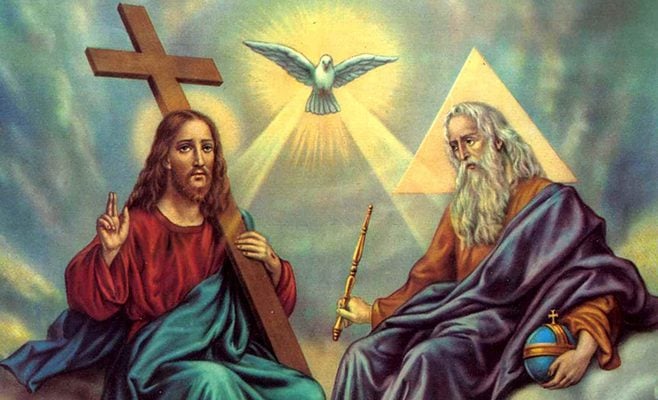
“There is but one unbegotten Being, God, even the Father; and one only-begotten Son, God, the Word and man; and one Comforter, the Spirit of truth.” – Ignatius of Antioch.
Any discussion about God is a discussion about a great mystery. And at the core of this mystery is the rather extraordinary Christian claim that God is a trinity.
In this work, I will endeavor to provide an introduction to this mystery. I will discuss each of the three persons of the Trinity and attempt to explicate their relationship.
Before commencing this work, it is beneficial to explain what Catholicism means by the Trinity. God is one essence (or nature) composed of three persons. Essence or nature is what a thing is. For example, human beings have a human (and thus, rational) nature. God’s essence is Divine. A person is who a thing is. A person can be a male or female, parent, or sibling. In God, the three persons are the Father, the Son, and the Holy Spirit.
The Father
To define something is to limit it. Only then can one make distinctions. This fact leads to an immediate problem in theology. The God of the Bible is infinite. That which is infinite is not confined to time or space. This fact makes an essential definition of God impossible. Because of this fact, any discussion about God often involves the use of analogies. One such analogy is God as Father.
The concept of God as a father is drawn from several sources; I will mention just two. The first is that God is the source of existence itself; God begets creation as a human father begets a child. Still, language fails us. God does not bring the universe into creation as a human father brings a child into the world. Rather, God’s Word is creative, He speaks, and it is done. Evidence of the creative Word of God appears in Genesis, “And God said, ‘let there be light, and there was light.” (Genesis 1:3). This creative Word of God has significant implications with regard to the Son, as we will see below. (Catechism of the Catholic Church, Paragraph 291).
The second source of this comes from Jesus, Who refers to God as the Father (John 5:19-23 and Matthew 6:9).
For Saint Augustine (and later, for Thomas Aquinas), God the Father is the principle without principle. This means that God the Father is not caused or generated by another. This concept of the Father as the principle without principle is essential in understanding the relations between the Father, the Son, and the Holy Spirit. The Trinity is the inner life of God. The Father knows Himself through His reason, and this is Christ. And in knowing Himself, He loves Himself, and this the Holy Spirit.
The Son
The Son of God is, of course, Jesus Christ. The Son is generated by the Father, which constitutes the Person of the Son. As such, Catholicism asserts that Christ is the Second Person of the Holy Trinity.
This is not to suggest that this generation is ontological or temporal. Instead, the Father actively and eternally generates the Son. This is the meaning intended in the prologue of John’s Gospel. “In the beginning was the Word, and the Word was with God, and the Word was God.”
Notice, before the creation, the Son was with the Father. That is to point out that there is no distinction in essence between the Person of the Father and the Son. Furthermore, this relationship between two persons has no beginning in time because it existed before the creation, from all eternity. So, while the Father and the Son are distinct in personhood, they are one with regard to their Divine essence.
The Father and the Son actively spirate the Holy Spirit into the one relation within the inner life of God. Spirated, not generated, because the Father and Son are already constituted as persons concerning each other in the first two relations. For this reason, the Catechism teaches that “The second person of the Blessed Trinity is Son only in relation to his Father.”
The Holy Spirit
The Holy Spirit is the love between the Father (who is the lover) who knows and loves Himself (who is the Son as the beloved). Because of this fact, the Holy Spirit is spirated of the Father and the Son, constituting the Person of the Holy Spirit.
Put differently, the Holy Spirit proceeds from the Father and the Son, but not in a generative sense, but a spiration. “Spiration” comes from the Latin word for “spirit” or “breath.”
In John 20:22, Jesus is said to have “breathed on them, and said to them, ‘Receive the Holy Spirit.’ Scripture reveals the Holy Spirit as pertaining to “God’s love [that] has been poured into our hearts” (Romans 5:5).
As said above, the Holy Spirit is the reciprocating love of the Father for the Son and the Son for the Father (John 15:26). Thus, the Holy Spirit’s procession is not intellectual and generative but has its origin in God’s will and the ultimate act of the will, which is love.
Conclusion
In understanding God (which cannot be completely done), we recognize that the Father is the first principle of life, and the Son is the knowing one who proceeds from the Father. Finally, the Holy Spirit – the willing one – is the bond of love between the Father and Son and therefore proceeds as love from the Father and Son.
It can be helpful to understand the three persons of the Trinity by virtue of their work. For example, the Father in creation, the Son in Salvation, and the Holy Spirit at Pentecost. Once again, however, we cannot divorce the work of one Person of the Trinity from another as they are one in essence. “Because it does not divide the divine unity, the real distinction of the Persons from one another resides solely in the relationships which relate them to one another” (Catechism of the Catholic Church, Paragraph 255). Put another way, the Father reveals the Son, the Son reveals the Father, and the Holy Spirit reveals the Father and the Son.
For this reason, the Catechism states, “The divine Persons are also inseparable in what they do. But within the single divine operation, each shows forth what is proper to him in the Trinity, especially in the divine missions of the Son’s Incarnation and the gift of the Holy Spirit.”
Previous Post

June 5, 2022
Spiritual, But Not Religious?
Next Post
June 12, 2022 I Believe (The Apostles Creed)
Browse Our Archives
Select a Category Abortion Atheism Catholicism. Catholicism. God. Theophany. Christmas Eschatology Faith and Works. God. Holy Spirit Intelligent Design Jesus Christ Justice Law Politics Protestantism Religion Sabbath Salvation. Soteriology. The Bible Theology Uncategorized
Select a Month October 2026 September 2026 August 2026 July 2026 June 2026 May 2026 April 2026 March 2026 February 2026 January 2026 December 2025 November 2025 October 2025 September 2025 August 2025 July 2025 June 2025 May 2025 April 2025 March 2025 February 2025 January 2025 December 2024 November 2024 October 2024 September 2024 August 2024 July 2024 June 2024 May 2024 April 2024 March 2024 February 2024 January 2024 December 2023 November 2023 October 2023 September 2023 August 2023 July 2023 June 2023 May 2023 April 2023 March 2023 February 2023 January 2023 December 2022 November 2022 October 2022 September 2022 August 2022 July 2022 June 2022 May 2022 April 2022 March 2022 February 2022 January 2022 December 2021
Follow Us!
TAKE THE
Religious Wisdom Quiz
Who was longest-serving judge of Israel?
Select your answer to see how you score.
Samuel Gideon Eli Samson
Related posts from Summa Catholic

The Anatomy of Divine Revelation in Catholic Thought

Beyond the Absence of Belief: The Implications of...

Can Catholic Apologetics Survive a Postmodern World?

From Samaria to Sanctity: Analyzing The Woman At...
TRENDING AT PATHEOS Catholic

Rejecting Doom: Christian Hope And Human Action
Christianity is a religion of hope. We are to have hope and...

It’s What Comes From Within Which Matters
One of the most difficult things for us to understand is why...

Why I Choose the Eucharist Over the Sermon
Choose the Eucharist, Not the Sermon What are we supposed to get...

5 Design Elements Found in Spiritually Rooted Homes
Putting Spirituality Into Home Decor Our homes are more than our living...

Credo: A Story of God Told with the...
About 10 years ago, I began to imagine a personal "Credo" that...

The Anatomy of Divine Revelation in Catholic Thought
The claim that God has made Himself known to human beings is...
view all Catholic blogs
Ad-Free & Subscriber Log-In Subscription Support
- About Us
- 2026 Calendar
- Videos
- Podcasts
- Library of World Religions
- Faith In Media Tracker
- Advertise With Us
- Write for Us
- Privacy Policy
- Terms of Service
- Do Not Sell My Data
- Contact Us
- Radiant Digital
- Manage Newsletter Subscriptions
- Unsubscribe From Notifications
- Sitemap
Copyright 2008-2026, Patheos. All rights reserved.
Subscription Support Ad-Free & Subscriber Log-In
Follow Patheos