
BuddhistCatholicContemplativeEvangelicalGeneral ChristianHinduJewishLatter-day SaintMuslimNew VisionsProgressive Christian
Beliefs
- Buddhist
- Catholic
- Contemplative
- Evangelical
- General Christian
- Hindu
- Jewish
- Latter-day Saint
- More Voices
- Muslim
- New Visions
- Pagan
- Progressive Christian
Topics
- Religion News
- Food and Religion
- Sports and Religion
- Religious Art
- Religious Music and Entertainment
- Religious Events
- History and Religion
- Style and Religion
- Politics and Religion
- Women in Religion
- Recreation Outdoors and Religion
- Business Finance and Religion
- Careers Workplace and Religion
- Education and Religion
- Family Parenting and Religion
- Health Fitness and Religion
- Home and Religion
- Relationships and Religion
- Technology and Religion
- Travel and Religion
Columnists
- Buddhist Columnists
- Business Finance and Religion Columnists
- Careers Workplace and Religion Columnists
- Catholic Columnists
- Contemplative Columnists
- Education and Religion Columnists
- Evangelists Columnists
- Family Parenting and Religion Columnists
- General Christian Columnists
- Health Fitness and Religion Columnists
- Hindu Columnists
- History and Religion Columnists
- Home and Religion Columnists
- Jewish Columnists
- More Voices Columnists
- Latter Day Columnists
- Muslim Columnists
- New Visions Columnists
- Nonreligious Columnists
- Pagan Columnists
- Politics and Religion Columnists
- Progressive Columnists
- Recreation Outdoors and Religion Columnists
- Relationships and Religion Columnists
- Religion News Columnists
- Religious Art Columnists
- Religious Events Columnists
- Religious Music and Entertainment Columnists
- Sports and Religion Columnists
- Style and Religion Columnists
- Technology and Religion Columnists
- Travel and Religion Columnists
- Women in Religion Columnists
Resource Library
- 2026 Calendar
- Library of World Religions
- The 100 Most Holy Places on Earth
- Patheos Answers
- Podcasts
- Videos
- Faith Leaders Database
- Anglican Episcopalian
- Bahai
- Baptist
- Buddhism
- Christianity
- Confucianism
- Eastern Orthodoxy
- Hinduism
- Holiness and Pentecostal
- ISKCON
- Islam
- Judaism
- Lutheran
- Methodist
- The Church of Jesus Christ of Latter-day Saints
- New Age
- Paganism
- Presbytarian and Reformed
- Protestantism
- Religion Behind the Scenes
- Roman Catholic
- Scientology
- Shia Islam
- Sikhism
- Sufism
- Sunni Islam
- Taoism
- Zen
- See all religions
Research Tools
 Ad-Free & Subscriber Log-In Subscription Support
Ad-Free & Subscriber Log-In Subscription Support
Follow Patheos 

- Trending:
- Forgiveness
- |
- Marriage
- |
- Consciousness
- |
- Death Penalty
- |
- Election
- |
- Halloween

- Home
- Catholic
- Beauty, Art, and Image in Catholic Thought
Beauty, Art, and Image in Catholic Thought
Last updated on: June 1, 2022 at 6:31 am by David Schloss
Beauty, Art, and Image in Catholic Thought 2022-06-01T06:31:14-04:00 David Schloss
Patheos Explore the world's faith through different perspectives on religion and spirituality! Patheos has the views of the prevalent religions and spiritualities of the world.
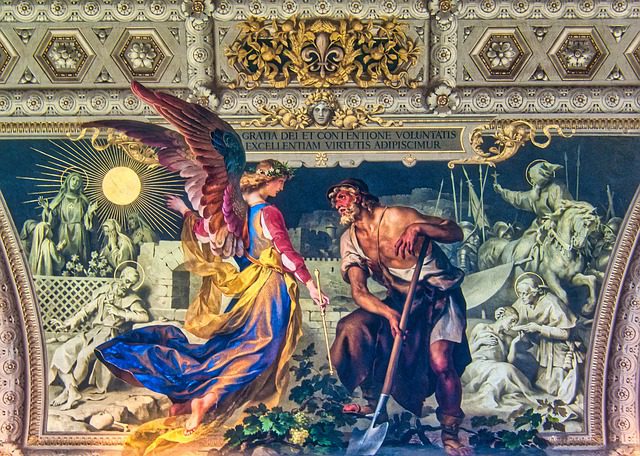
The beauty of the Catholic faith has inspired and created some of the greatest works of art in history. From the art of Michelangelo and Donatello to crucifixes and rosaries, the use of art and symbols are an indispensable part of understanding Catholicism.
Often too, art and images provide a path to bringing people to the Catholic faith as well as disposing individuals to worship. Yet, their use has also been met with criticism and controversy.
In the following exposition, I will explore the various forms of art, symbols, and images used by the Catholic Church and individual Catholics. Finally, I will examine the purposes and benefits of their use and discuss the charge of idolatry in their use.
Art And Images In Catholicism
There have been many definitions of art. For Plato, it was mimetic (imitative) and meant to represent the Forms. For Kant, art was an end in itself. The Aristotelian view saw art as imitating the essence of nature.
For the purposes of this work, I will define art within the context of beauty and beauty within the framework of the transcendentals. Transcendentals express a distinct attribute of every being insofar as it exists, revealing something unique about the nature of all reality. As such, they are foundational to all things. Beauty is the property that makes a thing pleasing to behold. In this sense, beauty becomes objective since a thing is beautiful to its creator, which is God.
Depictions of beauty in the Catholic tradition can take many forms. Beauty can be seen in architecture, as in the Sistine Chapel or Chartres Cathedral, or it can be seen in art, as in Raphael’s Transfiguration or Michangelo’s statue of David. The purposes of this art can also have varied purposes.
The use of images can often predispose one to become open to the religious experience while also acting as aids to instruction and devotion. Moreover, art can communicate the truth of Catholicism through beauty. For this reason, Saint John Damascene wrote, “The beauty of the images moves me to contemplation, as a meadow delights the eyes and subtly infuses the soul with the glory of God.”
As the mystical body of Christ, the Catholic Church is what Cardinal Avery Dulles called a “revelatory symbol.” That is, the Church can be a form by which God reveals Himself to human beings. This is done predominantly through the sacraments. In addition, art can be used to display something of the beauty of the Kingdom of God, thus drawing people to the Church, and by extension, to God.
The use of images and art can be beneficial to the individual Catholic, as well. These can often take the form of crucifixes, rosaries, the Stations of the Cross, and the veneration of relics. While these acts of devotions are not intended to replace the liturgy, they can aid one’s spiritual advancement.
The Value And Purpose Of Images And Art
In response to disputes over the use of religious art, the Council of Nicaea in 787 formalized and consecrated the use of sacred images. The Council determined that the use of art should be afforded the same level of sacredness given to the cross. This meant that Churches had the right to display art and images as objects of veneration.
As established by the Council, sacred images could be painted, made in the form of mosaics, carved, or woven. The veneration of holy images evolved over the centuries in many forms of popular devotion and has undoubtedly contributed significantly to the spread of the Catholic religion.
Art can idealize, glorify, suggest and tell the story of Catholicism. Their use keeps traditions alive and makes it easier for individuals to visualize a concept or event that is otherwise difficult to imagine through mere words. Art and imagery can speak to the minds and hearts of different individuals. Because of this, they are indispensable in worship, prayer, and catechesis.
Despite the benefits that art and beauty can have in bringing people to God as well as aiding in the individual spiritual life, the use of art and images have not been without criticism.
Does The Use Of Art Constitute Idolatry?
One of the most common attacks on the Church is that the use of images amounts to idolatry. Idolatry is worshiping a created thing instead of God (See Catechism of the Catholic Church, Paragraph 2113).
Exodus 20:4-5 is often cited to attack the Church’s use of images. The verse reads: “You shall not make for yourself an idol or a likeness of anything in the heavens above or on the earth below or in the waters beneath the earth; you shall not bow down before them or serve them.”
There are two points to address regarding Exodus 20:4-5. First, the command is not universal. As an example, I will point to Exodus 25. This chapter describes how God instructs the Israelites on the building of a Menorah, as well as how the Ark of the Covenant is to be designed. The instructions include making gold cherubims that are to adorn the Ark of the Covenant. (See Exodus 25:18-19).
Numbers 21:8-9 provide another Biblical example of the use of an image. When snakes plague the Israelites, God tells Moses to “make [a statue of] a fiery serpent, and set it on a pole; and everyone who is bitten, when he sees it shall live. So Moses made a bronze serpent, and set it on a pole; and if a serpent bit any man, he would look at the bronze serpent and live.” As one had to look at the bronze serpent to be healed, it is clear that God allows the ritual use of images (in this case, a statue).
All of this is to point out that the use of art is not illicit. What is forbidden is the worship of anything that is not God. For the ancient Israelites, idolatry often involved worshiping the various pagan gods. Modernity has replaced those pagan gods with things such as money, power, and pleasure. For this reason, the Catholic Church teaches that “An idolater is someone who transfers his indestructible notion of God to anything other than God” (See Catechism of the Catholic Church, Paragraph 2114).
Conclusion
The Catholic faith is breathtakingly beautiful. This beauty is not in vain. The various images, art, and sacramentals have a tremendous effect on bringing people to Catholicism and, by extension, bringing them to God.
In the preceding work, I have sought to examine the purposes and benefits of art and beauty to the Catholic experience. I have also shown why the claim that their use is a form of idolatry is without merit. Indeed, depictions of beauty can bring people to God, and is that not what Catholicism is all about?
Previous Post

May 29, 2022
Theological Virtues And The Soul
Next Post
June 5, 2022 Spiritual, But Not Religious?
Browse Our Archives
Select a Category Abortion Atheism Catholicism. Catholicism. God. Theophany. Christmas Eschatology Faith and Works. God. Holy Spirit Intelligent Design Jesus Christ Justice Law Politics Protestantism Religion Sabbath Salvation. Soteriology. The Bible Theology Uncategorized
Select a Month October 2026 September 2026 August 2026 July 2026 June 2026 May 2026 April 2026 March 2026 February 2026 January 2026 December 2025 November 2025 October 2025 September 2025 August 2025 July 2025 June 2025 May 2025 April 2025 March 2025 February 2025 January 2025 December 2024 November 2024 October 2024 September 2024 August 2024 July 2024 June 2024 May 2024 April 2024 March 2024 February 2024 January 2024 December 2023 November 2023 October 2023 September 2023 August 2023 July 2023 June 2023 May 2023 April 2023 March 2023 February 2023 January 2023 December 2022 November 2022 October 2022 September 2022 August 2022 July 2022 June 2022 May 2022 April 2022 March 2022 February 2022 January 2022 December 2021
Follow Us!
TAKE THE
Religious Wisdom Quiz
What does "Jesus" name mean?
Select your answer to see how you score.
God saves Messiah Savior Anointed one
Related posts from Summa Catholic
Creation, Preservation, and Teleology in Catholic Theology

The Anatomy of Divine Revelation in Catholic Thought

Beyond the Absence of Belief: The Implications of...

Can Catholic Apologetics Survive a Postmodern World?
TRENDING AT PATHEOS Catholic

Creation, Preservation, and Teleology in Catholic Theology
As I write this, it is very early Monday morning. Like millions...

The Parable Of The Sower And The Word...
One of Christ’s most famous parables is that of the sower who...

Rejecting Doom: Christian Hope And Human Action
Christianity is a religion of hope. We are to have hope and...

Why I Choose the Eucharist Over the Sermon
Choose the Eucharist, Not the Sermon What are we supposed to get...

5 Design Elements Found in Spiritually Rooted Homes
Putting Spirituality Into Home Decor Our homes are more than our living...

Credo: A Story of God Told with the...
About 10 years ago, I began to imagine a personal "Credo" that...
view all Catholic blogs
Ad-Free & Subscriber Log-In Subscription Support
- About Us
- 2026 Calendar
- Videos
- Podcasts
- Library of World Religions
- Faith In Media Tracker
- Advertise With Us
- Write for Us
- Privacy Policy
- Terms of Service
- Do Not Sell My Data
- Contact Us
- Radiant Digital
- Manage Newsletter Subscriptions
- Unsubscribe From Notifications
- Sitemap
Copyright 2008-2026, Patheos. All rights reserved.
Subscription Support Ad-Free & Subscriber Log-In
Follow Patheos