
BuddhistCatholicContemplativeEvangelicalGeneral ChristianHinduJewishLatter-day SaintMuslimNew VisionsProgressive Christian
Beliefs
- Buddhist
- Catholic
- Contemplative
- Evangelical
- General Christian
- Hindu
- Jewish
- Latter-day Saint
- More Voices
- Muslim
- New Visions
- Pagan
- Progressive Christian
Topics
- Religion News
- Food and Religion
- Sports and Religion
- Religious Art
- Religious Music and Entertainment
- Religious Events
- History and Religion
- Style and Religion
- Politics and Religion
- Women in Religion
- Recreation Outdoors and Religion
- Business Finance and Religion
- Careers Workplace and Religion
- Education and Religion
- Family Parenting and Religion
- Health Fitness and Religion
- Home and Religion
- Relationships and Religion
- Technology and Religion
- Travel and Religion
Columnists
- Buddhist Columnists
- Business Finance and Religion Columnists
- Careers Workplace and Religion Columnists
- Catholic Columnists
- Contemplative Columnists
- Education and Religion Columnists
- Evangelists Columnists
- Family Parenting and Religion Columnists
- General Christian Columnists
- Health Fitness and Religion Columnists
- Hindu Columnists
- History and Religion Columnists
- Home and Religion Columnists
- Jewish Columnists
- More Voices Columnists
- Latter Day Columnists
- Muslim Columnists
- New Visions Columnists
- Nonreligious Columnists
- Pagan Columnists
- Politics and Religion Columnists
- Progressive Columnists
- Recreation Outdoors and Religion Columnists
- Relationships and Religion Columnists
- Religion News Columnists
- Religious Art Columnists
- Religious Events Columnists
- Religious Music and Entertainment Columnists
- Sports and Religion Columnists
- Style and Religion Columnists
- Technology and Religion Columnists
- Travel and Religion Columnists
- Women in Religion Columnists
Resource Library
- 2026 Calendar
- Library of World Religions
- The 100 Most Holy Places on Earth
- Patheos Answers
- Podcasts
- Videos
- Faith Leaders Database
- Anglican Episcopalian
- Bahai
- Baptist
- Buddhism
- Christianity
- Confucianism
- Eastern Orthodoxy
- Hinduism
- Holiness and Pentecostal
- ISKCON
- Islam
- Judaism
- Lutheran
- Methodist
- The Church of Jesus Christ of Latter-day Saints
- New Age
- Paganism
- Presbytarian and Reformed
- Protestantism
- Religion Behind the Scenes
- Roman Catholic
- Scientology
- Shia Islam
- Sikhism
- Sufism
- Sunni Islam
- Taoism
- Zen
- See all religions
Research Tools
 Ad-Free & Subscriber Log-In Subscription Support
Ad-Free & Subscriber Log-In Subscription Support
Follow Patheos 

- Trending:
- Forgiveness
- |
- Marriage
- |
- Consciousness
- |
- Death Penalty
- |
- Election
- |
- Halloween

- Home
- Catholic
- The Two Risings
The Two Risings
Last updated on: May 11, 2022 at 6:41 am by David Schloss
The Two Risings 2022-05-11T06:41:02-04:00 David Schloss
Patheos Explore the world's faith through different perspectives on religion and spirituality! Patheos has the views of the prevalent religions and spiritualities of the world.
“If then you were raised with Christ, seek what is above, where Christ is seated at the right hand of God.” – Colossians 3:1
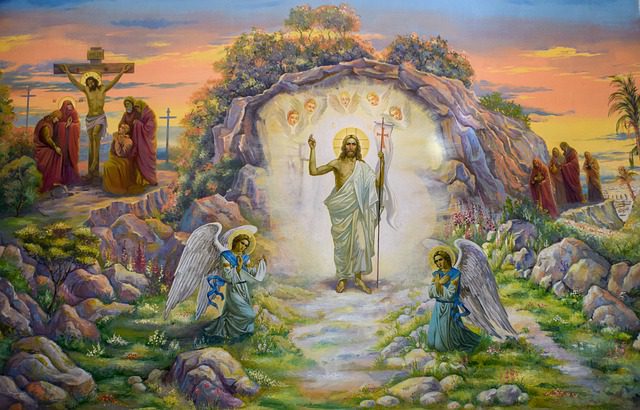
At Catholicism’s theological core are two rather remarkable “risings” and two corresponding feasts. I am speaking, of course, of Christ’s rising from the dead, more popularly known as Easter, and of His Ascension to Heaven. These two events have great significance for the Catholic faith.
In the following exposition, I will discuss both Easter and the Ascension of the Lord. I will explore the meaning and purposes of each of these events. Finally, I will discuss how these two risings of Christ provide the foundation for the Catholic Church.
On Easter
While rabbits and eggs have come to symbolize Easter, a much better symbol is the sun. The word Easter is derived from an Old English word for East, and, just as the sun rises in the East, bringing with it light, so Easter symbolizes the rising Christ, who is the true light of the world.
While frequently reduced to one Sunday in late March or early April, the Easter season is actually fifty days, concluding with the Ascension of the Lord.
In order to truly grasp the meaning of Easter, it is helpful to place it within the broader context of the Holy Triduum. The Triduum (three days) refers to the three days of Good Friday through and including Easter Sunday. The Holy Triduum is characterized by diametrically opposed (if only emotionally) events. The sorrow and violence of Good Friday, when Jesus pays the ultimate price for the sins of all mankind by being crucified, is followed by the vigil of Holy Saturday when Christ descended into Hell to free the righteous dead. Finally, there is the joy of His Resurrection.
There is, of course, great theological significance to these three days. Due to original sin, human beings were estranged from God. By being crucified, Jesus takes onto Himself the sins of the world. Indeed, the Bible says that He became sin (2 Corinthians 5:21). In becoming sin and paying the price for sin, which is death (Romans 6:23), Jesus reconciled God and man. However, if the story had ended there, with Jesus dead, we are still lost. For this reason, Saint Paul writes, “And if Christ has not been raised, then empty [too] is our preaching; empty, too, your faith.” (1 Corinthians 15:14).
The significance of this “first rising” is at the heart of Catholicism. When Jesus rose again on the third day, it signified that God was satisfied with the sacrificial death of his Son. In his Resurrection, Jesus justified humanity. Saint Paul writes that Jesus “was delivered up for our trespasses and raised for our justification” (Romans 4:25). By defeating death, Christ has given us the hope of eternal life (See “What Does it Mean to be Saved“).
There is no Easter without Good Friday. Said differently, there is no Resurrection if there is no Crucifixion. Similarly, there is no Catholic Church if there is no Ascension.
The Ascension of the Lord
The second “rising” is the Ascension of the Lord. Forty days after the Resurrection from the dead, Jesus ascends body and soul into Heaven. (See Denzinger, Heinrich. Ritus Orientalium, Coptorum, Syrorum Et Armenorum in Administrandis Sacramentis… Edidit Henricus Denzinger… Nabu Press, 2013).
Jesus ascended into Heaven by his own power, as God in divine power and as a man in the power of his transfigured soul, which moves his transfigured body as it will. Concerning the human nature of Christ, one can also say, with the Scriptures, that it was taken up or elevated into Heaven by God (Mark 16:19; Luke 24:51; Acts 1:9).
There are two important points to make about the Ascension. First, within Catholic theology, the Ascension means the final elevation of Christ’s human nature into the condition of divine glory. It is the concluding work of redemption. Christ’s Ascension is the archetype or model of our own ascension into Heaven. It expresses the Catholic belief that in Christ’s human nature, the humanity that we all share has entered into the inner life of God in a new way.
The second point is that the Ascension of Christ is that it is the necessary condition for Pentecost. In Jesus’s own words, “The Advocate, the Holy Spirit that the Father will send in my name—he will teach you everything and remind you of all that [I] told you.” (See John 14:26).
The Two Risings
In many ways, these two “risings” provide the foundation of Catholicism. On Good Friday, Jesus paid the price for our sins. On Easter Sunday, He overcame that price by rising from the dead. Moreover, by being grafted onto Jesus by virtue of our baptism, Catholics share in Jesus’s death and Resurrection. (See Catechism of the Catholic Church, Paragraph 1988).
Forty days after rising from the dead, Jesus rises to Heaven. The Feast of the Ascension of the Lord celebrates the reality of Christ’s returning to the Father. The Ascension is the final act of the paschal mystery, consisting of Jesus’ Passion, Crucifixion, Death, Burial, Descent Among the Dead, and Resurrection.
Along with the Resurrection, the Ascension functions as more evidence supporting Jesus’s claim that he was the Messiah. Finally, the Ascension is a blow to Satan’s power. Through Christ’s death, Resurrection, and Ascension, the devil no longer holds mankind hostage to sin.
Therefore the Ascension accomplishes three things. First, it completes Jesus’s work of atonement; second, it allows the saints to enter Heaven. Finally, the Ascension anticipates the second coming. This means that Jesus has restored humankind’s relationship with God and shown Himself to be our Lord and Savior.
Conclusion
In a sense, the existence of the Catholic faith is predicated upon two “risings”; Jesus rising from the dead, and His rising to Heaven.
On Easter Sunday, Christ overcame the penalty for sin and created a new relationship, a new covenant, with God and man. On rising to Heaven, Jesus not only showed Himself to be the beloved Son of God, but He also made possible the coming of the Holy Spirit. It is the arrival of the Holy Spirit, that is, Pentecost, that marks the birth of the Catholic Church.
Previous Post

May 8, 2022
Thou Shall Not Kill
Next Post
May 15, 2022 The Archetypes of Christ
Browse Our Archives
Select a Category Abortion Atheism Catholicism. Catholicism. God. Theophany. Christmas Eschatology Faith and Works. God. Holy Spirit Intelligent Design Jesus Christ Justice Law Politics Protestantism Religion Sabbath Salvation. Soteriology. The Bible Theology Uncategorized
Select a Month October 2026 September 2026 August 2026 July 2026 June 2026 May 2026 April 2026 March 2026 February 2026 January 2026 December 2025 November 2025 October 2025 September 2025 August 2025 July 2025 June 2025 May 2025 April 2025 March 2025 February 2025 January 2025 December 2024 November 2024 October 2024 September 2024 August 2024 July 2024 June 2024 May 2024 April 2024 March 2024 February 2024 January 2024 December 2023 November 2023 October 2023 September 2023 August 2023 July 2023 June 2023 May 2023 April 2023 March 2023 February 2023 January 2023 December 2022 November 2022 October 2022 September 2022 August 2022 July 2022 June 2022 May 2022 April 2022 March 2022 February 2022 January 2022 December 2021
Follow Us!
TAKE THE
Religious Wisdom Quiz
Who was the king of Israel known for his wisdom?
Select your answer to see how you score.
Hezekiah Solomon David Saul
Related posts from Summa Catholic

The Anatomy of Divine Revelation in Catholic Thought

Beyond the Absence of Belief: The Implications of...

Reclaiming Objective Faith in an Individualistic World

Soul and Species: Catholic Theology Meets Evolution
TRENDING AT PATHEOS Catholic

Rejecting Doom: Christian Hope And Human Action
Christianity is a religion of hope. We are to have hope and...

It’s What Comes From Within Which Matters
One of the most difficult things for us to understand is why...

Why I Choose the Eucharist Over the Sermon
Choose the Eucharist, Not the Sermon What are we supposed to get...

5 Design Elements Found in Spiritually Rooted Homes
Putting Spirituality Into Home Decor Our homes are more than our living...

Credo: A Story of God Told with the...
About 10 years ago, I began to imagine a personal "Credo" that...

The Anatomy of Divine Revelation in Catholic Thought
The claim that God has made Himself known to human beings is...
view all Catholic blogs
Ad-Free & Subscriber Log-In Subscription Support
- About Us
- 2026 Calendar
- Videos
- Podcasts
- Library of World Religions
- Faith In Media Tracker
- Advertise With Us
- Write for Us
- Privacy Policy
- Terms of Service
- Do Not Sell My Data
- Contact Us
- Radiant Digital
- Manage Newsletter Subscriptions
- Unsubscribe From Notifications
- Sitemap
Copyright 2008-2026, Patheos. All rights reserved.
Subscription Support Ad-Free & Subscriber Log-In
Follow Patheos