
BuddhistCatholicContemplativeEvangelicalGeneral ChristianHinduJewishLatter-day SaintMuslimNew VisionsProgressive Christian
Beliefs
- Buddhist
- Catholic
- Contemplative
- Evangelical
- General Christian
- Hindu
- Jewish
- Latter-day Saint
- More Voices
- Muslim
- New Visions
- Pagan
- Progressive Christian
Topics
- Religion News
- Food and Religion
- Sports and Religion
- Religious Art
- Religious Music and Entertainment
- Religious Events
- History and Religion
- Style and Religion
- Politics and Religion
- Women in Religion
- Recreation Outdoors and Religion
- Business Finance and Religion
- Careers Workplace and Religion
- Education and Religion
- Family Parenting and Religion
- Health Fitness and Religion
- Home and Religion
- Relationships and Religion
- Technology and Religion
- Travel and Religion
Columnists
- Buddhist Columnists
- Business Finance and Religion Columnists
- Careers Workplace and Religion Columnists
- Catholic Columnists
- Contemplative Columnists
- Education and Religion Columnists
- Evangelists Columnists
- Family Parenting and Religion Columnists
- General Christian Columnists
- Health Fitness and Religion Columnists
- Hindu Columnists
- History and Religion Columnists
- Home and Religion Columnists
- Jewish Columnists
- More Voices Columnists
- Latter Day Columnists
- Muslim Columnists
- New Visions Columnists
- Nonreligious Columnists
- Pagan Columnists
- Politics and Religion Columnists
- Progressive Columnists
- Recreation Outdoors and Religion Columnists
- Relationships and Religion Columnists
- Religion News Columnists
- Religious Art Columnists
- Religious Events Columnists
- Religious Music and Entertainment Columnists
- Sports and Religion Columnists
- Style and Religion Columnists
- Technology and Religion Columnists
- Travel and Religion Columnists
- Women in Religion Columnists
Resource Library
- 2026 Calendar
- Library of World Religions
- The 100 Most Holy Places on Earth
- Patheos Answers
- Podcasts
- Videos
- Faith Leaders Database
- Anglican Episcopalian
- Bahai
- Baptist
- Buddhism
- Christianity
- Confucianism
- Eastern Orthodoxy
- Hinduism
- Holiness and Pentecostal
- ISKCON
- Islam
- Judaism
- Lutheran
- Methodist
- The Church of Jesus Christ of Latter-day Saints
- New Age
- Paganism
- Presbytarian and Reformed
- Protestantism
- Religion Behind the Scenes
- Roman Catholic
- Scientology
- Shia Islam
- Sikhism
- Sufism
- Sunni Islam
- Taoism
- Zen
- See all religions
Research Tools
 Ad-Free & Subscriber Log-In Subscription Support
Ad-Free & Subscriber Log-In Subscription Support
Follow Patheos 

- Trending:
- Forgiveness
- |
- Marriage
- |
- Consciousness
- |
- Death Penalty
- |
- Election
- |
- Halloween

- Home
- Catholic
- The Four Last Things
The Four Last Things
Last updated on: May 22, 2022 at 9:02 am by David Schloss
The Four Last Things 2022-05-22T09:02:24-04:00 David Schloss
Patheos Explore the world's faith through different perspectives on religion and spirituality! Patheos has the views of the prevalent religions and spiritualities of the world.
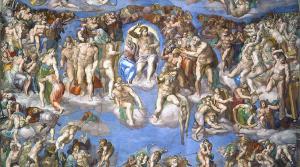
“The Last Judgment” (Il Giudizio Universale) by Michelangelo [1536–1541]
“There is no greater, no more important art upon earth than the art of dying a good death. Upon this thy whole eternity depends; an eternity of surpassing felicity or of unutterable torment.”- Martin Von Cochem
One of the subsets contained within the vast universe of Catholic theology is eschatology. Eschatology is a Greek word that refers to the study of last things. Catholic eschatology categorizes these last things as death, judgment, Heaven, and Hell.
As is often the case in matters religious, these four things are not without mystery. Since faith is suprarational, mystery in the sense that it is used in theology refers to a divinely revealed truth whose very possibility cannot be rationally conceived by the human mind. Conceived is not the same as understood, however. While it is true that human reason cannot have devised or designed these mysteries of faith, it does not mean that they cannot be understood, albeit limitedly, by human reason.
Proof of this capacity to have a limited understanding of the ways of God is evident by the fact that God has made Himself known to us. This knowledge is called Revelation. Revelation occurs in natural and special forms. Natural Revelation is knowledge of God by way of His creation. As the psalmist writes, “The heavens declare the glory of God; the skies proclaim the work of his hands.” Special Revelation refers to knowledge of God that cannot be obtained by human reason alone, for example, knowledge of what happens when we die, how we will be judged, and the final state of our souls, in other words, the four last things.
Death
Is there any subject more likely to induce fear and fascination than death? It is an event that each of us will almost certainly experience, and yet we know very little of what exactly death is.
Interestingly, there are various definitions of death. A definition in accord with biology would describe death as “The irreversible loss of functioning of the organism as a whole.” (See Becker 1975; Bernat, Culver, and Gert 1981). A philosophical and theological definition would certainly define death as the event whereby the non-material soul is separated from the material body. (See Plato’s Phaedo. Oxford Paperbacks. 2009).
From the perspective of the Bible and Catholicism, Plato’s definition is more comprehensive and thought-provoking. Moreover, this interpretation of death appears congruent with the Biblical views of death. Within the Biblical meaning of death, it is possible to identify two forms. The first is the one already discussed, to wit, the separation of body and soul. The second form (and, indeed, the Bible refers to it as the second death) refers to a state of the soul after judgment (see below).
What is often the cause of the greatest consternation surrounding death is what occurs after. It is to this subject that I turn to next.
Judgment
Catholic theology recognizes two separate judgments that the soul experiences after death. The first judgment, referred to as the particular judgment, occurs immediately upon death. (See Hebrews 9:27). At the particular judgment, God determines the eternal state of one’s soul.
It is possible to identify three outcomes of the particular judgment. Those whose love for God has been perfected in this life are taken straight to Heaven. Those who die in God’s love but whose love of Him is not perfect will be purified in the intermediate state of purgatory. Those, however, who reject God’s love by mortal sin and die without repenting are condemned to Hell.
The general judgment occurs upon the Second Coming of Christ. “When the Son of Man comes in His glory, escorted by all the angels of Heaven, He will sit upon His royal throne and all the nations will be assembled before Him. Then He will separate them into two groups, as a shepherd separated sheep from goats” (Matthew 25:31-32).
Those who have already experienced the particular judgment will have that judgment confirmed. However, those alive at the Second Coming will receive judgment.
Heaven
The goal of all Catholics is entry into Heaven, to be eternally in the presence of God.
Now, the soul is not composed of matter; instead, it is a spiritual substance. Since that which is not composed of matter is not subject to time and place, Heaven is a state of being or a state of the soul after death, rather than a physical location.
A useful analogy is that of a baby. To be in the world is akin to a baby in its mother’s womb, while to be in Heaven is to be outside the womb. The dimensions, the confines, and the experiences are radically different inside and outside the womb. Saint Paul writes, “What eye has not seen and ear has not heard, and what has not entered the human heart, what God has prepared for those who love him.” (1 Corinthians 2:9).
To be in the presence of God is called the beatific vision. The beatific vision occurs when one “See[s] the divine essence [i.e., God] by an intuitive vision and face to face, so that the divine essence is known immediately, showing itself plainly, clearly and openly, and not immediately through any creature.” (See Denzinger, Heinrich. Ritus Orientalium, Coptorum, Syrorum Et Armenorum in Administrandis Sacramentis… Edidit Henricus Denzinger… Nabu Press, 2013).
Hell
If Heaven is spending eternity in the presence of God, Hell is spending eternity separated from God. As such, the Bible speaks of a “second death” (Revelation 2:11). Where physical death is the separation of the soul from the body, the second death is the eternal separation of the soul from God. The Catechism states it this way, “To die in mortal sin without repenting and accepting God’s merciful love means remaining separated from him forever by our own free choice.”
A question may arise as to why a loving God would send someone to Hell. The answer is that He does not. Human beings choose to go to Hell by rejecting God. For this reason, C.S. Lewis writes that the doors of Hell are locked from the inside. Those who, of their own free will, have rejected God’s grace and love, have locked themselves into eternal torment.
Conclusion
In the preceding work, I have endeavored to provide an introduction to that branch of theology known as eschatology. Specifically, I delineated what are called the four last things, death, judgment, Heaven, and Hell.
Catholic theology identified two types of death, physical death (the separation of the soul from the body) and the second death (the eternal separation of the soul from God). Similarly, there are two judgments, the particular judgment, which occurs at the time of death, and the general judgment, which will occur when Jesus comes again. The final two “things” represent the final or ultimate state of the soul. In Heaven, the soul enjoys eternity in the presence of God. In Hell, the soul suffers eternal separation from God.
Previous Post

May 18, 2022
Detachment in the Spiritual Life
Next Post
May 25, 2022 Only the Blind See
Browse Our Archives
Select a Category Abortion Atheism Catholicism. Catholicism. God. Theophany. Christmas Eschatology Faith and Works. God. Holy Spirit Intelligent Design Jesus Christ Justice Law Politics Protestantism Religion Sabbath Salvation. Soteriology. The Bible Theology Uncategorized
Select a Month October 2026 September 2026 August 2026 July 2026 June 2026 May 2026 April 2026 March 2026 February 2026 January 2026 December 2025 November 2025 October 2025 September 2025 August 2025 July 2025 June 2025 May 2025 April 2025 March 2025 February 2025 January 2025 December 2024 November 2024 October 2024 September 2024 August 2024 July 2024 June 2024 May 2024 April 2024 March 2024 February 2024 January 2024 December 2023 November 2023 October 2023 September 2023 August 2023 July 2023 June 2023 May 2023 April 2023 March 2023 February 2023 January 2023 December 2022 November 2022 October 2022 September 2022 August 2022 July 2022 June 2022 May 2022 April 2022 March 2022 February 2022 January 2022 December 2021
Follow Us!
TAKE THE
Religious Wisdom Quiz
What does the name "Isaac" mean?
Select your answer to see how you score.
He prays He fights He rules He laughs
Related posts from Summa Catholic

The Anatomy of Divine Revelation in Catholic Thought

Beyond the Absence of Belief: The Implications of...

Reclaiming Objective Faith in an Individualistic World

Soul and Species: Catholic Theology Meets Evolution
TRENDING AT PATHEOS Catholic

Rejecting Doom: Christian Hope And Human Action
Christianity is a religion of hope. We are to have hope and...

It’s What Comes From Within Which Matters
One of the most difficult things for us to understand is why...

Why I Choose the Eucharist Over the Sermon
Choose the Eucharist, Not the Sermon What are we supposed to get...

5 Design Elements Found in Spiritually Rooted Homes
Putting Spirituality Into Home Decor Our homes are more than our living...

Credo: A Story of God Told with the...
About 10 years ago, I began to imagine a personal "Credo" that...

The Anatomy of Divine Revelation in Catholic Thought
The claim that God has made Himself known to human beings is...
view all Catholic blogs
Ad-Free & Subscriber Log-In Subscription Support
- About Us
- 2026 Calendar
- Videos
- Podcasts
- Library of World Religions
- Faith In Media Tracker
- Advertise With Us
- Write for Us
- Privacy Policy
- Terms of Service
- Do Not Sell My Data
- Contact Us
- Radiant Digital
- Manage Newsletter Subscriptions
- Unsubscribe From Notifications
- Sitemap
Copyright 2008-2026, Patheos. All rights reserved.
Subscription Support Ad-Free & Subscriber Log-In
Follow Patheos