
BuddhistCatholicContemplativeEvangelicalGeneral ChristianHinduJewishLatter-day SaintMuslimNew VisionsProgressive Christian
Beliefs
- Buddhist
- Catholic
- Contemplative
- Evangelical
- General Christian
- Hindu
- Jewish
- Latter-day Saint
- More Voices
- Muslim
- New Visions
- Pagan
- Progressive Christian
Topics
- Religion News
- Food and Religion
- Sports and Religion
- Religious Art
- Religious Music and Entertainment
- Religious Events
- History and Religion
- Style and Religion
- Politics and Religion
- Women in Religion
- Recreation Outdoors and Religion
- Business Finance and Religion
- Careers Workplace and Religion
- Education and Religion
- Family Parenting and Religion
- Health Fitness and Religion
- Home and Religion
- Relationships and Religion
- Technology and Religion
- Travel and Religion
Columnists
- Buddhist Columnists
- Business Finance and Religion Columnists
- Careers Workplace and Religion Columnists
- Catholic Columnists
- Contemplative Columnists
- Education and Religion Columnists
- Evangelists Columnists
- Family Parenting and Religion Columnists
- General Christian Columnists
- Health Fitness and Religion Columnists
- Hindu Columnists
- History and Religion Columnists
- Home and Religion Columnists
- Jewish Columnists
- More Voices Columnists
- Latter Day Columnists
- Muslim Columnists
- New Visions Columnists
- Nonreligious Columnists
- Pagan Columnists
- Politics and Religion Columnists
- Progressive Columnists
- Recreation Outdoors and Religion Columnists
- Relationships and Religion Columnists
- Religion News Columnists
- Religious Art Columnists
- Religious Events Columnists
- Religious Music and Entertainment Columnists
- Sports and Religion Columnists
- Style and Religion Columnists
- Technology and Religion Columnists
- Travel and Religion Columnists
- Women in Religion Columnists
Resource Library
- 2026 Calendar
- Library of World Religions
- The 100 Most Holy Places on Earth
- Patheos Answers
- Podcasts
- Videos
- Faith Leaders Database
- Anglican Episcopalian
- Bahai
- Baptist
- Buddhism
- Christianity
- Confucianism
- Eastern Orthodoxy
- Hinduism
- Holiness and Pentecostal
- ISKCON
- Islam
- Judaism
- Lutheran
- Methodist
- The Church of Jesus Christ of Latter-day Saints
- New Age
- Paganism
- Presbytarian and Reformed
- Protestantism
- Religion Behind the Scenes
- Roman Catholic
- Scientology
- Shia Islam
- Sikhism
- Sufism
- Sunni Islam
- Taoism
- Zen
- See all religions
Research Tools
 Ad-Free & Subscriber Log-In Subscription Support
Ad-Free & Subscriber Log-In Subscription Support
Follow Patheos 

- Trending:
- Forgiveness
- |
- Marriage
- |
- Consciousness
- |
- Death Penalty
- |
- Election
- |
- Halloween

- Home
- Catholic
- A Happy Death
A Happy Death
Last updated on: April 3, 2022 at 9:59 am by David Schloss
A Happy Death 2022-04-03T09:59:14-04:00 David Schloss
Patheos Explore the world's faith through different perspectives on religion and spirituality! Patheos has the views of the prevalent religions and spiritualities of the world.
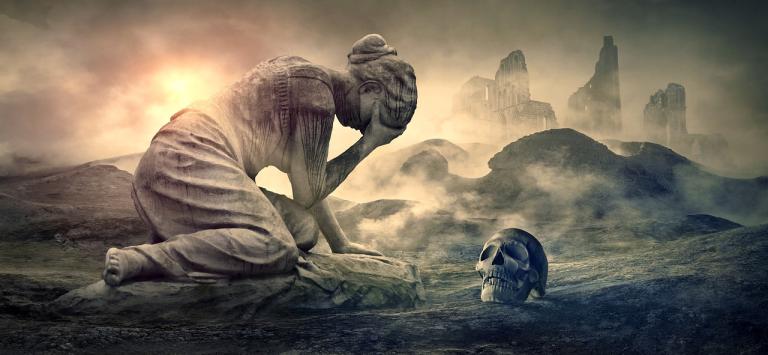
Death. “The undiscovered country from whose bourn no traveler returns.” – Hamlet by William Shakespeare.
No one wishes to ponder it or discuss it, but death is something we all must do. The occasion of our death cannot be avoided, but can that occasion be made good? And, if so, what constitutes a good death?
The following discourse will explore whether God intended human beings to experience death and how the Bible treats the subject. What, if any effect, does the salvation made possible by Christ have on death? Finally, I will discuss what is meant by a happy death.
Why Death?
A close reading of the Book of Genesis suggests that death did not originally taint human nature. Genesis 2:17 states that God told Adam and Eve that they would only die if they “eat from the tree of the knowledge of good and evil.” Yet, Genesis also informs us that man was formed from “dust,” that is to say, human beings have a physical body composed of natural elements that are subject to decay and death. The implication is that Adam and Eve were “preserved” from death by God’s grace. That grace was removed as a result of original sin, and “death entered the world.”
Saint Paul gives voice to the belief that death is a result of original sin when he writes, “just as sin entered the world through one man, and death through sin, and in this way death came to all people.” (Romans 5:12).
It seems, however, that we come to a dilemma. If, as Catholics, we believe in Jesus Christ, and if it is true that everyone who believes in Jesus has eternal life, why do those who have faith in Jesus still experience death? While figures like Mary, Elijah, and Enoch suggest exceptions to the rule, the fact remains that death is all but inevitable for believers and non-believers alike.
I suggest that the answer lies in understanding that human beings are composite creatures, made up of a physical body and a spiritual soul. It is self-evident that the body dies. The destruction of the soul is the eternal separation from God. For this reason, Jesus tells us to fear the One (that is, God) “who can destroy both soul and body.” (Matthew 10:28).
As the body is an organic substance (formed from dust), it naturally is subject to decay and death. It was only through the special grace present in Adam and Eve before the Fall that the death of the body was prevented. Once human nature was corrupted by original sin, the grace that prevented physical death was removed.
This leaves in place Jesus’ statement that those who believe in Him have eternal life, which is the soul being eternally in the presence of God. Death, then, is “the dust [the body] returning to the ground it came from, and the spirit returning to God who gave it.” Put another way; death occurs when the immortal soul separates from the mortal body. (Ecclesiastes 12:7).
Having addressed death itself, I turn now to what is meant as a “happy death.”
The Happy Death
So that I can address what constitutes a happy death (if such a thing is possible), it is beneficial to articulate the Church’s teaching on what happens to the soul at death. “Each man receives his eternal retribution in his immortal soul at the very moment of his death, in a particular judgment that refers his life to Christ: either entrance into the blessedness of Heaven—through a purification or immediately—or immediate and everlasting damnation. (Catechism of the Catholic Church, 1022).”
The Catechism summarizes what the Bible teaches on particular judgment. In the epistle to the Hebrews, Saint Paul writes, “It is appointed to men to die once, and after that comes the judgment.” (Hebrews 9:27).
It is possible to identify three possible outcomes for each soul at the particular judgment. Those whose love for God is perfect in this life are taken straight to Heaven. Those who die in God’s love but love God imperfectly must be purified in the intermediate state of purgatory. Finally, those souls who have rejected God are condemned to Hell.
As it must be that the goal of believers is to enter Heaven, it should be clear that a happy death occurs when the individual passes directly from this life into Heaven. Since entry into Heaven requires one to be in a state of grace, we can define a happy death as one where one is free from mortal sin.
By virtue of the practice of anointing of the sick and the sacrament of extreme unction, the Church provides the Catholic with access to the grace necessary to experience a happy death.
Yet, the time and occasion of our death are a mystery for many of us. Because of this, it must be the object of every Catholic to live our lives in such a way that we persist in a state of grace.
A State of Grace
As was said above, to be in a state of grace means to be free of mortal sin. However, that is a minimalist definition. A wider definition of a state of grace would include being a friend of God, that is, to be a saint.
A happy death is, in a sense, a continuation of a happy life. And a happy life is a virtuous one, and a virtuous life is one that is lived according to the will of God.
Conclusion
We all must experience death. Yet this experience need not be met with sorrow or trepidation.
While living, the Catholic should concern himself with obtaining eternal life for his soul. By being friends of God during this life, we hope to be saints in the presence of God in the life to come. This friendship requires us to live in accordance with the will of God.
Finally, as in life, Jesus provides our guidance in death. For to rise with Christ, we must die with Christ. Put another way, when we die in obedience to Christ, we participate in His death. And, by so doing, we hope to participate in His Resurrection. A happy death then is to be away from the body so that we may be home with the Lord. (2 Corinthians and the Catechism of the Catholic Church, paragraphs 1005, 1006, and 1009).
Previous Post

March 30, 2022
The Appearances of God
Next Post
April 6, 2022 What Does It Mean To Be Saved?
Browse Our Archives
Select a Category Abortion Atheism Catholicism. Catholicism. God. Theophany. Christmas Eschatology Faith and Works. God. Holy Spirit Intelligent Design Jesus Christ Justice Law Politics Protestantism Religion Sabbath Salvation. Soteriology. The Bible Theology Uncategorized
Select a Month October 2026 September 2026 August 2026 July 2026 June 2026 May 2026 April 2026 March 2026 February 2026 January 2026 December 2025 November 2025 October 2025 September 2025 August 2025 July 2025 June 2025 May 2025 April 2025 March 2025 February 2025 January 2025 December 2024 November 2024 October 2024 September 2024 August 2024 July 2024 June 2024 May 2024 April 2024 March 2024 February 2024 January 2024 December 2023 November 2023 October 2023 September 2023 August 2023 July 2023 June 2023 May 2023 April 2023 March 2023 February 2023 January 2023 December 2022 November 2022 October 2022 September 2022 August 2022 July 2022 June 2022 May 2022 April 2022 March 2022 February 2022 January 2022 December 2021
Follow Us!
TAKE THE
Religious Wisdom Quiz
What did the Israelites eat in the wilderness?
Select your answer to see how you score.
Fish Bread Manna Corn
Related posts from Summa Catholic
Why Didn’t God Just Destroy Satan? A Theological...
Does Heaven Exist? Examining the Arguments.
The Incarnation: Why Only Christ Took Human Form
The Grammar of Faith: Why Catholicism Needs Metaphysics
TRENDING AT PATHEOS Catholic

Rejecting Doom: Christian Hope And Human Action
Christianity is a religion of hope. We are to have hope and...

It’s What Comes From Within Which Matters
One of the most difficult things for us to understand is why...

Why I Choose the Eucharist Over the Sermon
Choose the Eucharist, Not the Sermon What are we supposed to get...

5 Design Elements Found in Spiritually Rooted Homes
Putting Spirituality Into Home Decor Our homes are more than our living...

Credo: A Story of God Told with the...
About 10 years ago, I began to imagine a personal "Credo" that...

The Anatomy of Divine Revelation in Catholic Thought
The claim that God has made Himself known to human beings is...
view all Catholic blogs
Ad-Free & Subscriber Log-In Subscription Support
- About Us
- 2026 Calendar
- Videos
- Podcasts
- Library of World Religions
- Faith In Media Tracker
- Advertise With Us
- Write for Us
- Privacy Policy
- Terms of Service
- Do Not Sell My Data
- Contact Us
- Radiant Digital
- Manage Newsletter Subscriptions
- Unsubscribe From Notifications
- Sitemap
Copyright 2008-2026, Patheos. All rights reserved.
Subscription Support Ad-Free & Subscriber Log-In
Follow Patheos