
BuddhistCatholicContemplativeEvangelicalGeneral ChristianHinduJewishLatter-day SaintMuslimNew VisionsProgressive Christian
Beliefs
- Buddhist
- Catholic
- Contemplative
- Evangelical
- General Christian
- Hindu
- Jewish
- Latter-day Saint
- More Voices
- Muslim
- New Visions
- Pagan
- Progressive Christian
Topics
- Religion News
- Food and Religion
- Sports and Religion
- Religious Art
- Religious Music and Entertainment
- Religious Events
- History and Religion
- Style and Religion
- Politics and Religion
- Women in Religion
- Recreation Outdoors and Religion
- Business Finance and Religion
- Careers Workplace and Religion
- Education and Religion
- Family Parenting and Religion
- Health Fitness and Religion
- Home and Religion
- Relationships and Religion
- Technology and Religion
- Travel and Religion
Columnists
- Buddhist Columnists
- Business Finance and Religion Columnists
- Careers Workplace and Religion Columnists
- Catholic Columnists
- Contemplative Columnists
- Education and Religion Columnists
- Evangelists Columnists
- Family Parenting and Religion Columnists
- General Christian Columnists
- Health Fitness and Religion Columnists
- Hindu Columnists
- History and Religion Columnists
- Home and Religion Columnists
- Jewish Columnists
- More Voices Columnists
- Latter Day Columnists
- Muslim Columnists
- New Visions Columnists
- Nonreligious Columnists
- Pagan Columnists
- Politics and Religion Columnists
- Progressive Columnists
- Recreation Outdoors and Religion Columnists
- Relationships and Religion Columnists
- Religion News Columnists
- Religious Art Columnists
- Religious Events Columnists
- Religious Music and Entertainment Columnists
- Sports and Religion Columnists
- Style and Religion Columnists
- Technology and Religion Columnists
- Travel and Religion Columnists
- Women in Religion Columnists
Resource Library
- 2026 Calendar
- Library of World Religions
- The 100 Most Holy Places on Earth
- Patheos Answers
- Podcasts
- Videos
- Faith Leaders Database
- Anglican Episcopalian
- Bahai
- Baptist
- Buddhism
- Christianity
- Confucianism
- Eastern Orthodoxy
- Hinduism
- Holiness and Pentecostal
- ISKCON
- Islam
- Judaism
- Lutheran
- Methodist
- The Church of Jesus Christ of Latter-day Saints
- New Age
- Paganism
- Presbytarian and Reformed
- Protestantism
- Religion Behind the Scenes
- Roman Catholic
- Scientology
- Shia Islam
- Sikhism
- Sufism
- Sunni Islam
- Taoism
- Zen
- See all religions
Research Tools
 Ad-Free & Subscriber Log-In Subscription Support
Ad-Free & Subscriber Log-In Subscription Support
Follow Patheos 

- Trending:
- Forgiveness
- |
- Marriage
- |
- Consciousness
- |
- Death Penalty
- |
- Election
- |
- Halloween

- Home
- Catholic
- Does God Exist? Part Four
Does God Exist? Part Four
Last updated on: March 6, 2022 at 10:42 am by David Schloss
Does God Exist? Part Four 2022-03-06T10:42:02-05:00 David Schloss
Patheos Explore the world's faith through different perspectives on religion and spirituality! Patheos has the views of the prevalent religions and spiritualities of the world.
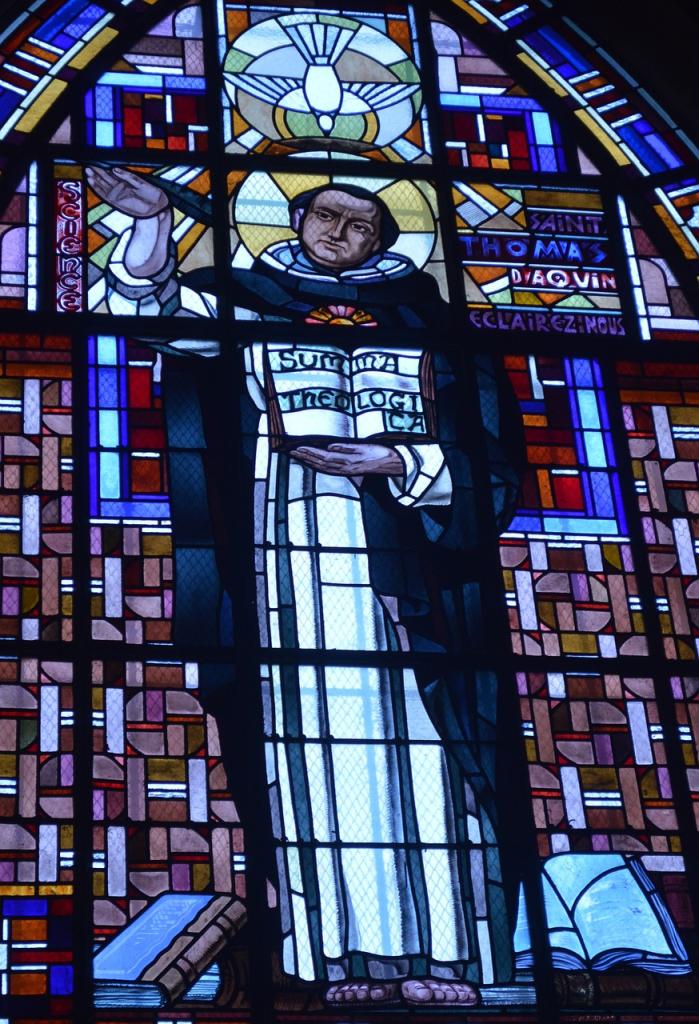
I continue my series on Thomas Aquinas’s Five Ways for the existence of God by discussing the fourth way.
The fourth way is an argument from the grades of perfection in created things. In this sense, the fourth way is perhaps the most philosophical of Aquinas’s five ways. Because of this, it is often considered the most difficult to comprehend.
I will begin by introducing the argument before providing the actual proof as framed by Aquinas. Finally, I will analyze the fourth way and suggest that the transcendentals are the best framework for understanding Aquinas’s argument.
The Fourth Way
While the argument is a posteriori in nature, for it begins by observation, it is also much more philosophical and less scientific than Aquinas’s previous three ways.
Here is how Aquinas articulates the fourth way:
“Among beings there are some more and some less good, true, noble and the like. But “more” and “less” are predicated of different things, according as they resemble in their different ways something which is the maximum, as a thing is said to be hotter according as it more nearly resembles that which is hottest; so that there is something which is truest, something best, something noblest and, consequently, something which is uttermost being; for those things that are greatest in truth are greatest in being. Now the maximum in any genus is the cause of all in that genus; as fire, which is the maximum heat, is the cause of all hot things. Therefore there must also be something which is to all beings the cause of their being, goodness, and every other perfection; and this we call God.” (Aquinas, Thomas. Summa Theologica Complete in a Single Volume. 2018).
Analyzing the Fourth Way
At first glance, it appears that Aquinas is drawing much of this argument from Plato’s theory of forms. While Plato’s philosophy is beyond the scope of this work, I will provide a very basic interpretation of his theory of forms.
Plato argues that there are two “worlds or realms.” The first world, the one of our experiences, is the physical realm. This world contains all the physical objects and beings that are imperfect and changeable. For Plato, the world of our existence is not the “real” world. Instead, the “real” world is the spiritual world or the realm of the forms. This world contains the perfect and immutable objects that are only imitated at in the physical world. For example, the color blue in our world is only a representation of blue in the realm of forms. Where blue exists in something in our world, it is a subsistent and perfect thing in the world of forms.
While Aquinas was undoubtedly familiar with Plato’s philosophy, he was not a Platonist. Therefore, I think Aquinas is not arguing from Plato’s theory of forms but basing the fourth way on the transcendentals.
The transcendentals are properties of being and existence that are common to everything that exists. While the number of transcendentals may vary according to the philosopher, three are considered fundamental; One, True, and Good.
Everything that exists is one, for it is one thing; one person, one cat, and so on. Everything that exists is true in that it is intelligible; it is known, if only to its creator. Finally, a thing is good in the way that it conforms to the will of its creator, that is, the thing does what it is intended to do.
Applying the transcendentals to Aquinas’s fourth way, we can see that Aquinas is pointing out that there are gradations or degrees of perfection in these properties of being. If some things are greater or lesser than others, there must be a hierarchy within these degrees; otherwise, no comparison could be possible.
More specifically, beings manifest gradations of perfections. For Aquinas, “perfection” is a specific way something is actual and something is actual to the extent that it exists. Yet, there is a hierarchy of perfection even within those things that exist. That is, the more something actualizes its existence, the more perfect it is. For example, a plant possesses specific attributes such as nourishment and growth. Animals also have the characteristics of a plant as well as powers such as reproduction, emotion, and levels of consciousness. Finally, a human being also possesses those qualities of the “lower” animals but adds to those qualities attributes like rationality and will.
Within this hierarchy of living things, it is judged that human beings are “more perfect” than animals and plants for the reasons indicated. Human beings are closer to the perfection of being than a plant. Yet, human beings are themselves fallible and contingent. Therefore, human beings cannot be the ultimate perfection of being.
The point is that in living things as well as with non-living things, there are degrees of perfection. However, there can be no comparisons between things or gradations of existence unless a reference can be made to a perfect being. It is this being that is called God.
As with Aquinas’s other ways, there cannot be an infinite regress of gradations of being. If there is no perfect being (i.e., God), we must deny any hierarchy of existence. Thus, any framework for comparing different beings is artificial. As such, there is no objective reason to argue that a human being is superior to a rock. Such an argument is absurd, of course. Therefore, it must be admitted that there is a hierarchy of existence. Since nothing created exists necessarily, the hierarchy must begin with a being whose essence it is to exist, and that is God.
Conclusion
In this article, I have introduced Thomas Aquinas’s fourth way for the existence of God. I have provided the argument itself as well as an analysis of it. Finally, I have suggested that the fourth way is best understood in light of the transcendentals.
Previous Post

March 2, 2022
Does God Exist, Part Three
Next Post
March 9, 2022 Does God Exist? Part Five
Browse Our Archives
Select a Category Abortion Atheism Catholicism. Catholicism. God. Theophany. Christmas Eschatology Faith and Works. God. Holy Spirit Intelligent Design Jesus Christ Justice Law Politics Protestantism Religion Sabbath Salvation. Soteriology. The Bible Theology Uncategorized
Select a Month October 2026 September 2026 August 2026 July 2026 June 2026 May 2026 April 2026 March 2026 February 2026 January 2026 December 2025 November 2025 October 2025 September 2025 August 2025 July 2025 June 2025 May 2025 April 2025 March 2025 February 2025 January 2025 December 2024 November 2024 October 2024 September 2024 August 2024 July 2024 June 2024 May 2024 April 2024 March 2024 February 2024 January 2024 December 2023 November 2023 October 2023 September 2023 August 2023 July 2023 June 2023 May 2023 April 2023 March 2023 February 2023 January 2023 December 2022 November 2022 October 2022 September 2022 August 2022 July 2022 June 2022 May 2022 April 2022 March 2022 February 2022 January 2022 December 2021
Follow Us!
TAKE THE
Religious Wisdom Quiz
What is written on Jesus’ robe in Revelation 19:16?
Select your answer to see how you score.
The Lamb of God The Alpha and Omega King of Kings and Lord of Lords The Lion of Judah
Related posts from Summa Catholic

The Anatomy of Divine Revelation in Catholic Thought

Beyond the Absence of Belief: The Implications of...

Reclaiming Objective Faith in an Individualistic World

Soul and Species: Catholic Theology Meets Evolution
TRENDING AT PATHEOS Catholic

Rejecting Doom: Christian Hope And Human Action
Christianity is a religion of hope. We are to have hope and...

It’s What Comes From Within Which Matters
One of the most difficult things for us to understand is why...

Why I Choose the Eucharist Over the Sermon
Choose the Eucharist, Not the Sermon What are we supposed to get...

5 Design Elements Found in Spiritually Rooted Homes
Putting Spirituality Into Home Decor Our homes are more than our living...

Credo: A Story of God Told with the...
About 10 years ago, I began to imagine a personal "Credo" that...

The Anatomy of Divine Revelation in Catholic Thought
The claim that God has made Himself known to human beings is...
view all Catholic blogs
Ad-Free & Subscriber Log-In Subscription Support
- About Us
- 2026 Calendar
- Videos
- Podcasts
- Library of World Religions
- Faith In Media Tracker
- Advertise With Us
- Write for Us
- Privacy Policy
- Terms of Service
- Do Not Sell My Data
- Contact Us
- Radiant Digital
- Manage Newsletter Subscriptions
- Unsubscribe From Notifications
- Sitemap
Copyright 2008-2026, Patheos. All rights reserved.
Subscription Support Ad-Free & Subscriber Log-In
Follow Patheos