
BuddhistCatholicContemplativeEvangelicalGeneral ChristianHinduJewishLatter-day SaintMuslimNew VisionsProgressive Christian
Beliefs
- Buddhist
- Catholic
- Contemplative
- Evangelical
- General Christian
- Hindu
- Jewish
- Latter-day Saint
- More Voices
- Muslim
- New Visions
- Pagan
- Progressive Christian
Topics
- Religion News
- Food and Religion
- Sports and Religion
- Religious Art
- Religious Music and Entertainment
- Religious Events
- History and Religion
- Style and Religion
- Politics and Religion
- Women in Religion
- Recreation Outdoors and Religion
- Business Finance and Religion
- Careers Workplace and Religion
- Education and Religion
- Family Parenting and Religion
- Health Fitness and Religion
- Home and Religion
- Relationships and Religion
- Technology and Religion
- Travel and Religion
Columnists
- Buddhist Columnists
- Business Finance and Religion Columnists
- Careers Workplace and Religion Columnists
- Catholic Columnists
- Contemplative Columnists
- Education and Religion Columnists
- Evangelists Columnists
- Family Parenting and Religion Columnists
- General Christian Columnists
- Health Fitness and Religion Columnists
- Hindu Columnists
- History and Religion Columnists
- Home and Religion Columnists
- Jewish Columnists
- More Voices Columnists
- Latter Day Columnists
- Muslim Columnists
- New Visions Columnists
- Nonreligious Columnists
- Pagan Columnists
- Politics and Religion Columnists
- Progressive Columnists
- Recreation Outdoors and Religion Columnists
- Relationships and Religion Columnists
- Religion News Columnists
- Religious Art Columnists
- Religious Events Columnists
- Religious Music and Entertainment Columnists
- Sports and Religion Columnists
- Style and Religion Columnists
- Technology and Religion Columnists
- Travel and Religion Columnists
- Women in Religion Columnists
Resource Library
- 2026 Calendar
- Library of World Religions
- The 100 Most Holy Places on Earth
- Patheos Answers
- Podcasts
- Videos
- Faith Leaders Database
- Anglican Episcopalian
- Bahai
- Baptist
- Buddhism
- Christianity
- Confucianism
- Eastern Orthodoxy
- Hinduism
- Holiness and Pentecostal
- ISKCON
- Islam
- Judaism
- Lutheran
- Methodist
- The Church of Jesus Christ of Latter-day Saints
- New Age
- Paganism
- Presbytarian and Reformed
- Protestantism
- Religion Behind the Scenes
- Roman Catholic
- Scientology
- Shia Islam
- Sikhism
- Sufism
- Sunni Islam
- Taoism
- Zen
- See all religions
Research Tools
 Ad-Free & Subscriber Log-In Subscription Support
Ad-Free & Subscriber Log-In Subscription Support
Follow Patheos 

- Trending:
- Forgiveness
- |
- Marriage
- |
- Consciousness
- |
- Death Penalty
- |
- Election
- |
- Halloween

- Home
- Catholic
- Does God Exist? Part Five
Does God Exist? Part Five
Last updated on: March 9, 2022 at 6:53 am by David Schloss
Does God Exist? Part Five 2022-03-09T06:53:20-05:00 David Schloss
Patheos Explore the world's faith through different perspectives on religion and spirituality! Patheos has the views of the prevalent religions and spiritualities of the world.
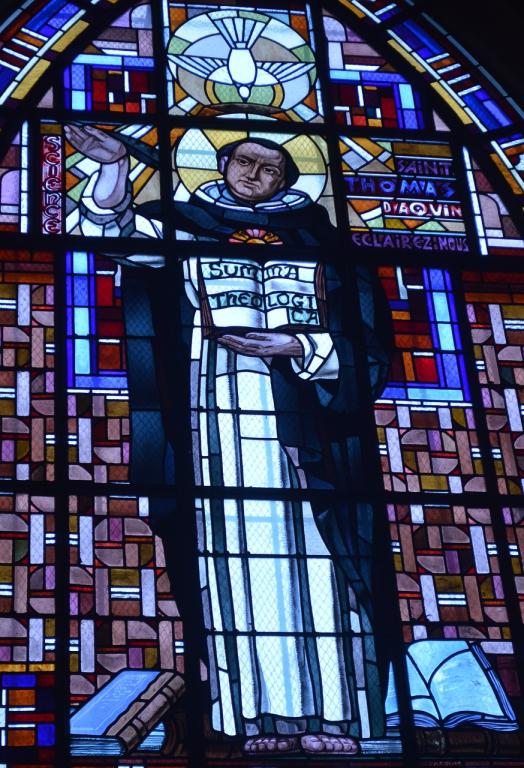
This article concludes my series on Aquinas’s Five Ways for the existence of God. Thus far, I have sought to explain Aquinas’s arguments from motion or change (the First Way), his argument from causation (the Second Way), the argument from contingency (the Third Way), and the argument from degree (the Fourth Way).
The Fifth Way is an argument from the design or intelligibility of the universe. As I have done with Aquinas’s previous proofs, I will introduce the Fifth Way before providing Aquinas’s argument. Finally, I will furnish an analysis of the Fifth Way.
The Fifth Way
It is a rare phenomenon indeed when the disciplines of theology, philosophy, and science agree. Yet, regarding the universe’s intelligibility, all three fields presuppose two things; one that the universe is ordered, and two, that the human intellect is capable of understanding it. If the universe was not ordered, there would be no laws of nature and no predictability. A random universe would make science impossible. It would also render disciplines like philosophy and theology untenable.
Moreover, there would be no reason to trust our judgments if the human intellect is the result of blind and random processes. That is to say, if the human mind was not appropriately ordered, there would be no method of knowing if our thoughts accurately represented reality. Once again, randomness, in this case at the level of the intellect, would make science, theology, and philosophy impossible.
Aquinas’s Fifth Way is argued in the vein of just this view of intelligibility. Here is how Aquinas makes his argument:
“The fifth way is taken from the governance of the world. We see that things which lack intelligence, such as natural bodies, act for an end, and this is evident from their acting always, or nearly always, in the same way, so as to obtain the best result. Hence it is plain that not fortuitously, but designedly, do they achieve their end. Now whatever lacks intelligence cannot move towards an end, unless it be directed by some being endowed with knowledge and intelligence; as the arrow is shot to its mark by the archer. Therefore some intelligent being exists by whom all natural things are directed to their end; and this being we call God.” (Aquinas, Thomas. Summa Theologica Complete in a Single Volume. 2018).
Analysis of the Fifth Way
Aquinas’s Fifth Way is known as a teleological argument. Telos is a Greek word meaning “end” or “goal.”
Within the concept of design, there are two approaches to consider. The first method is to argue that the remarkable complexity that exists in the universe cannot be the result of random processes. If the complexity is not random, it must, by definition, be designed. Therefore, we can infer the existence of a designer. It is this approach that the philosopher William Paley suggested, and it is this view that has given rise to the intelligent design arguments.
While it is possible to incorporate this approach with Aquinas’s Fifth Way, Aquinas is not arguing that evidence of complexity is evidence for the existence of God. Instead, Aquinas argument can be understood at two levels.
First, everything that is caused (i.e., contingent) is designed for a purpose. The evidence for this design is manifest in the natural world. Beginning with the human body, we see that organs are designed for a purpose; the eyes for sight, the heart for circulating blood, and so on. The fact that these organs act toward a goal is evident when we consider their failures. We say of one who is blind that the person’s eyes have failed. That is, the person’s eyes have failed to act in the manner which they are intended.
This design is evident, too, in the universe. We live on a planet that supports life and the requirements of the nature of living things. The universe exists only in the way that it does due to minutely tuned constants. The slightest deviation from those constants would make life on earth impossible.
It is important to note that Aquinas Fifth Way follows from Aristotle’s four causes, specifically the efficient cause and the final cause. As indicated in Aquinas’s other ways, the efficient cause is the agent that causes an effect. The final cause is the purpose that a thing naturally tends toward. The final cause of the eye is to provide sight.
It is the final cause that is at the heart of the Fifth Way. Aquinas makes the argument that even inanimate matter acts toward a particular end. Evidence for this can be inferred from the laws of nature, i.e., gravitation, electromagnetism, strong interactions, and weak interactions. Since the laws of science are descriptive, it suffices to say that these laws describe the order in the universe. Order suggests that things move or act toward an end or goal. This is true even of non-living things (things lacking intelligence). If non-intelligent things regularly act toward an end, it must be that they were designed for and guided to that end by something extrinsic. Now that which is designed necessitates a designer. To design something requires rationality, and rationality involves intelligence. Therefore, we may infer that non-intelligent things are created for and guided to their end by an intelligent being.
Finally, as we have seen in Aquinas’s other arguments, there cannot be an infinite regress involved in the Fifth Way. Any chain of beings that designed the universe and guides things to their goal must ultimately come to an end at a first designer who exists necessarily. Aquinas concludes that this first designer is that which everyone calls God.
Conclusion
In the preceding work, I have endeavored to explain Thomas Aquinas’s Fifth Way for the existence of God.
I have shown that this proof is predicated on evidence for design and intelligibility. It has been shown that the Fifth Way suggests that the order in the universe requires a design and that ultimately this design requires a designer who exists necessarily.
Previous Post

March 6, 2022
Does God Exist? Part Four
Next Post
March 13, 2022 Lent in the Desert
Browse Our Archives
Select a Category Abortion Atheism Catholicism. Catholicism. God. Theophany. Christmas Eschatology Faith and Works. God. Holy Spirit Intelligent Design Jesus Christ Justice Law Politics Protestantism Religion Sabbath Salvation. Soteriology. The Bible Theology Uncategorized
Select a Month October 2026 September 2026 August 2026 July 2026 June 2026 May 2026 April 2026 March 2026 February 2026 January 2026 December 2025 November 2025 October 2025 September 2025 August 2025 July 2025 June 2025 May 2025 April 2025 March 2025 February 2025 January 2025 December 2024 November 2024 October 2024 September 2024 August 2024 July 2024 June 2024 May 2024 April 2024 March 2024 February 2024 January 2024 December 2023 November 2023 October 2023 September 2023 August 2023 July 2023 June 2023 May 2023 April 2023 March 2023 February 2023 January 2023 December 2022 November 2022 October 2022 September 2022 August 2022 July 2022 June 2022 May 2022 April 2022 March 2022 February 2022 January 2022 December 2021
Follow Us!
TAKE THE
Religious Wisdom Quiz
Who sat at the Beautiful Gate begging before Peter healed him?
Select your answer to see how you score.
A Roman centurion A lame man A rich ruler A blind man
Related posts from Summa Catholic

The Anatomy of Divine Revelation in Catholic Thought

Beyond the Absence of Belief: The Implications of...

Reclaiming Objective Faith in an Individualistic World

Soul and Species: Catholic Theology Meets Evolution
TRENDING AT PATHEOS Catholic

Rejecting Doom: Christian Hope And Human Action
Christianity is a religion of hope. We are to have hope and...

It’s What Comes From Within Which Matters
One of the most difficult things for us to understand is why...

Why I Choose the Eucharist Over the Sermon
Choose the Eucharist, Not the Sermon What are we supposed to get...

5 Design Elements Found in Spiritually Rooted Homes
Putting Spirituality Into Home Decor Our homes are more than our living...

Credo: A Story of God Told with the...
About 10 years ago, I began to imagine a personal "Credo" that...

The Anatomy of Divine Revelation in Catholic Thought
The claim that God has made Himself known to human beings is...
view all Catholic blogs
Ad-Free & Subscriber Log-In Subscription Support
- About Us
- 2026 Calendar
- Videos
- Podcasts
- Library of World Religions
- Faith In Media Tracker
- Advertise With Us
- Write for Us
- Privacy Policy
- Terms of Service
- Do Not Sell My Data
- Contact Us
- Radiant Digital
- Manage Newsletter Subscriptions
- Unsubscribe From Notifications
- Sitemap
Copyright 2008-2026, Patheos. All rights reserved.
Subscription Support Ad-Free & Subscriber Log-In
Follow Patheos