
BuddhistCatholicContemplativeEvangelicalGeneral ChristianHinduJewishLatter-day SaintMuslimNew VisionsProgressive Christian
Beliefs
- Buddhist
- Catholic
- Contemplative
- Evangelical
- General Christian
- Hindu
- Jewish
- Latter-day Saint
- More Voices
- Muslim
- New Visions
- Pagan
- Progressive Christian
Topics
- Religion News
- Food and Religion
- Sports and Religion
- Religious Art
- Religious Music and Entertainment
- Religious Events
- History and Religion
- Style and Religion
- Politics and Religion
- Women in Religion
- Recreation Outdoors and Religion
- Business Finance and Religion
- Careers Workplace and Religion
- Education and Religion
- Family Parenting and Religion
- Health Fitness and Religion
- Home and Religion
- Relationships and Religion
- Technology and Religion
- Travel and Religion
Columnists
- Buddhist Columnists
- Business Finance and Religion Columnists
- Careers Workplace and Religion Columnists
- Catholic Columnists
- Contemplative Columnists
- Education and Religion Columnists
- Evangelists Columnists
- Family Parenting and Religion Columnists
- General Christian Columnists
- Health Fitness and Religion Columnists
- Hindu Columnists
- History and Religion Columnists
- Home and Religion Columnists
- Jewish Columnists
- More Voices Columnists
- Latter Day Columnists
- Muslim Columnists
- New Visions Columnists
- Nonreligious Columnists
- Pagan Columnists
- Politics and Religion Columnists
- Progressive Columnists
- Recreation Outdoors and Religion Columnists
- Relationships and Religion Columnists
- Religion News Columnists
- Religious Art Columnists
- Religious Events Columnists
- Religious Music and Entertainment Columnists
- Sports and Religion Columnists
- Style and Religion Columnists
- Technology and Religion Columnists
- Travel and Religion Columnists
- Women in Religion Columnists
Resource Library
- 2026 Calendar
- Library of World Religions
- The 100 Most Holy Places on Earth
- Patheos Answers
- Podcasts
- Videos
- Faith Leaders Database
- Anglican Episcopalian
- Bahai
- Baptist
- Buddhism
- Christianity
- Confucianism
- Eastern Orthodoxy
- Hinduism
- Holiness and Pentecostal
- ISKCON
- Islam
- Judaism
- Lutheran
- Methodist
- The Church of Jesus Christ of Latter-day Saints
- New Age
- Paganism
- Presbytarian and Reformed
- Protestantism
- Religion Behind the Scenes
- Roman Catholic
- Scientology
- Shia Islam
- Sikhism
- Sufism
- Sunni Islam
- Taoism
- Zen
- See all religions
Research Tools
 Ad-Free & Subscriber Log-In Subscription Support
Ad-Free & Subscriber Log-In Subscription Support
Follow Patheos 

- Trending:
- Forgiveness
- |
- Marriage
- |
- Consciousness
- |
- Death Penalty
- |
- Election
- |
- Halloween

- Home
- Catholic
- Does God Exist? Thomas Aquinas’s Five Ways, Part One
Does God Exist? Thomas Aquinas’s Five Ways, Part One
Last updated on: February 26, 2022 at 3:14 pm by David Schloss
Does God Exist? Thomas Aquinas’s Five Ways, Part One 2022-02-26T15:14:24-05:00 David Schloss
Patheos Explore the world's faith through different perspectives on religion and spirituality! Patheos has the views of the prevalent religions and spiritualities of the world.
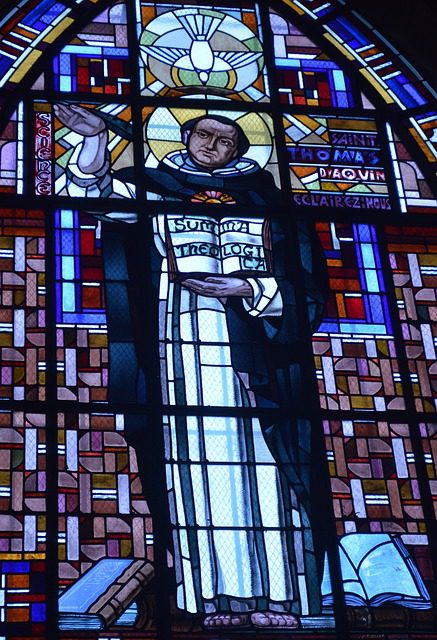
As both a saint and a doctor of the Church, Thomas Aquinas is arguably the most significant figure in Catholic theology. No less significant are Aquinas’s contributions to philosophy and science.
Aquinas’s opus is the Summa Theologica (Summary of Theology). It is a compendium of Catholic theology and philosophy. While the Summa contains several arguments for the existence of God, the most enduring of these are the quinque viae or five ways. The five ways are logical arguments, and, as such, are as much philosophical as theological.
In order to possess a complete understanding of Aquinas’s philosophy and theology, it is necessary to have a firm understanding of Aristotelian philosophy. Despite this, in the following series, I will provide an introduction to Aquinas’s five ways.
The First Way
Aquinas’s first way is called an argument from motion. Unfortunately, what Aquinas means by motion has been frequently misinterpreted. For Aquinas, as for Aristotle, motion included how a thing may change, not just its movement from one place to another.
For now, I will provide Aquinas’s formulation of the argument.
“It is evident by observing the universe that some things are in motion in the world. Now whatever is in motion is put in motion by another, for nothing can be in motion except as it is in potentiality to that towards that which it is in motion, whereas a thing moves since it is in act.
Motion is nothing else than reducing something from potentiality to actuality. But nothing can be reduced from potentiality to actuality, except by something in a state of actuality. Thus, which is actually hot, as fire, makes wood, which is potentially hot, to be actually hot, moving and changing it.
It is not possible that the same thing should be in actuality and in potentiality in the same respect and time, but only in different respects. What is actually hot cannot simultaneously be potentially hot, but it is simultaneously potentially cold. Therefore, it is impossible that a thing should be both mover and moved in the same respect and in the same way. That is to say that nothing moves itself.
Consequently, whatever is in motion must be put in motion by another.
If the agent that puts another into motion, is itself in motion, it too must be put in motion by another. Yet there cannot be an infinite regress because then there would be no first mover and, consequently, no other mover, seeing that subsequent movers move only after they are put in motion by the first mover. Therefore it is necessary to arrive at a first mover, set in motion by no other, which everyone understands to be God.”
Analyzing the First Way
As one can see, the argument is, at least partially, a posteriori in nature. That is, it is based on experience and observation. Still, Aquinas’s first way is somewhat complex and requires some unpacking. In particular, we need to understand three terms often used in metaphysics.
The first word is motion. As indicated above, for Aristotle and Aquinas, the word motion includes change within its definition. The second and third words are often used in conjunction; potency and act.
Potency refers to the possibility or capacity for a thing to complete or fulfill its nature. Act refers to the completion or fulfillment of a thing’s nature. For example, a seed exists potentially as a tree. The tree exists in actuality in relation to the seed.
Moreover, the tree exists only because of the seed. The seed exists only because of another tree. Yet even the tree exists in potency. For example, a tree is potentially a table or a chair if one uses the wood from the tree for that purpose.
Understood this way, we can formulate Aquinas’s first way: Whenever something changes, it is caused to change by something else (a seed causes a tree). Nothing can cause its own change since something cannot have a quality of both potentially and actually at the same time (the seed can’t both be a seed and a tree simultaneously and in the same way). Therefore, whenever something changes, this change must have been brought about by an extrinsic cause. Moreover, that cause must already be in act (the seed can only form from an existing tree).
All of this leads to the question of whether there can be an infinite regress of causes. To address the question of an infinite regress, we need to understand what an efficient cause is. For a definition, we turn to Aristotle, “An efficient cause is the primary source of the change or rest.” (Aristotle. Aristotle’s Physics. Oxford University Press, 1983). Put another way, an efficient cause is an agent that causes a change in another. For example, an artist is the efficient cause of a painting.
Aquinas builds upon Aristotle’s definition by categorizing efficient causes into essential and accidental. An example of an accidental efficient cause would be a father begetting a son. While the accidental efficient cause brings an effect into existence, it does not sustain the effect. A child does not cease to exist if his parents die. Therefore, Aquinas thought it theoretically possible that an accidental efficient causal chain could be infinite since each accidental efficient cause possess causal power (the child can later become a parent).
Because Aquinas concludes that an infinite regress of accidental efficient causes is possible, the first way does not rule out the possibility of an eternal universe. Ultimately, however, Aquinas accepts the biblical cosmology that describes a contingent, and, therefore, temporal (not eternal) universe.
We will see in Aquinas’s second way that he argues that an infinite regress of essential efficient causes is impossible.
What Caused God?
A point about potency and act as it relates to God. One could (as some have) argue that if all things are subject to change, then God too, must be in potency or subject to change.
However, such a claim is to misunderstand an important aspect of Aquinas’s argument. Aquinas does not argue that everything moves from potency to act, but only those things that do not exist necessarily (i.e., created things). Because of this, God is “defined” (one cannot properly define that which is infinite) as actus purus (pure act). What is pure act does not change since its nature has been perfected. Put another way, God exists necessarily, and therefore, must exist. Here Aquinas is drawing on Aristotle’s “unmoved mover”, that which is the ground or cause of change, but which itself does not change. This is not just a philosophical claim, but a theological one as well, for we read in scripture that “Jesus Christ [i.e., God] is the same yesterday and today and forever.” (Hebrews 13:8).
Conclusion
In this paper, I have provided an introduction to Aquinas’s five ways or arguments for the existence of God. I have furnished Aquinas’s formulation of the first way and explained the metaphysics that provide the foundation for Aquinas’s arguments.
In the following exposition, I will discuss the second way.
Previous Post

February 20, 2022
The Senses of Scripture
Next Post
February 27, 2022 Does God Exist, Part Two
Browse Our Archives
Select a Category Abortion Atheism Catholicism. Catholicism. God. Theophany. Christmas Eschatology Faith and Works. God. Holy Spirit Intelligent Design Jesus Christ Justice Law Politics Protestantism Religion Sabbath Salvation. Soteriology. The Bible Theology Uncategorized
Select a Month October 2026 September 2026 August 2026 July 2026 June 2026 May 2026 April 2026 March 2026 February 2026 January 2026 December 2025 November 2025 October 2025 September 2025 August 2025 July 2025 June 2025 May 2025 April 2025 March 2025 February 2025 January 2025 December 2024 November 2024 October 2024 September 2024 August 2024 July 2024 June 2024 May 2024 April 2024 March 2024 February 2024 January 2024 December 2023 November 2023 October 2023 September 2023 August 2023 July 2023 June 2023 May 2023 April 2023 March 2023 February 2023 January 2023 December 2022 November 2022 October 2022 September 2022 August 2022 July 2022 June 2022 May 2022 April 2022 March 2022 February 2022 January 2022 December 2021
Follow Us!
TAKE THE
Religious Wisdom Quiz
In Hebrews, who is described as "king of righteousness" and "king of peace"?
Select your answer to see how you score.
Solomon Melchizedek Josiah David
Related posts from Summa Catholic

The Anatomy of Divine Revelation in Catholic Thought

Beyond the Absence of Belief: The Implications of...

Reclaiming Objective Faith in an Individualistic World

Soul and Species: Catholic Theology Meets Evolution
TRENDING AT PATHEOS Catholic

The Parable Of The Sower And The Word...
One of Christ’s most famous parables is that of the sower who...

Rejecting Doom: Christian Hope And Human Action
Christianity is a religion of hope. We are to have hope and...

Why I Choose the Eucharist Over the Sermon
Choose the Eucharist, Not the Sermon What are we supposed to get...

5 Design Elements Found in Spiritually Rooted Homes
Putting Spirituality Into Home Decor Our homes are more than our living...

Credo: A Story of God Told with the...
About 10 years ago, I began to imagine a personal "Credo" that...

The Anatomy of Divine Revelation in Catholic Thought
The claim that God has made Himself known to human beings is...
view all Catholic blogs
Ad-Free & Subscriber Log-In Subscription Support
- About Us
- 2026 Calendar
- Videos
- Podcasts
- Library of World Religions
- Faith In Media Tracker
- Advertise With Us
- Write for Us
- Privacy Policy
- Terms of Service
- Do Not Sell My Data
- Contact Us
- Radiant Digital
- Manage Newsletter Subscriptions
- Unsubscribe From Notifications
- Sitemap
Copyright 2008-2026, Patheos. All rights reserved.
Subscription Support Ad-Free & Subscriber Log-In
Follow Patheos