
BuddhistCatholicContemplativeEvangelicalGeneral ChristianHinduJewishLatter-day SaintMuslimNew VisionsProgressive Christian
Beliefs
- Buddhist
- Catholic
- Contemplative
- Evangelical
- General Christian
- Hindu
- Jewish
- Latter-day Saint
- More Voices
- Muslim
- New Visions
- Pagan
- Progressive Christian
Topics
- Religion News
- Food and Religion
- Sports and Religion
- Religious Art
- Religious Music and Entertainment
- Religious Events
- History and Religion
- Style and Religion
- Politics and Religion
- Women in Religion
- Recreation Outdoors and Religion
- Business Finance and Religion
- Careers Workplace and Religion
- Education and Religion
- Family Parenting and Religion
- Health Fitness and Religion
- Home and Religion
- Relationships and Religion
- Technology and Religion
- Travel and Religion
Columnists
- Buddhist Columnists
- Business Finance and Religion Columnists
- Careers Workplace and Religion Columnists
- Catholic Columnists
- Contemplative Columnists
- Education and Religion Columnists
- Evangelists Columnists
- Family Parenting and Religion Columnists
- General Christian Columnists
- Health Fitness and Religion Columnists
- Hindu Columnists
- History and Religion Columnists
- Home and Religion Columnists
- Jewish Columnists
- More Voices Columnists
- Latter Day Columnists
- Muslim Columnists
- New Visions Columnists
- Nonreligious Columnists
- Pagan Columnists
- Politics and Religion Columnists
- Progressive Columnists
- Recreation Outdoors and Religion Columnists
- Relationships and Religion Columnists
- Religion News Columnists
- Religious Art Columnists
- Religious Events Columnists
- Religious Music and Entertainment Columnists
- Sports and Religion Columnists
- Style and Religion Columnists
- Technology and Religion Columnists
- Travel and Religion Columnists
- Women in Religion Columnists
Resource Library
- 2026 Calendar
- Library of World Religions
- The 100 Most Holy Places on Earth
- Patheos Answers
- Podcasts
- Videos
- Faith Leaders Database
- Anglican Episcopalian
- Bahai
- Baptist
- Buddhism
- Christianity
- Confucianism
- Eastern Orthodoxy
- Hinduism
- Holiness and Pentecostal
- ISKCON
- Islam
- Judaism
- Lutheran
- Methodist
- The Church of Jesus Christ of Latter-day Saints
- New Age
- Paganism
- Presbytarian and Reformed
- Protestantism
- Religion Behind the Scenes
- Roman Catholic
- Scientology
- Shia Islam
- Sikhism
- Sufism
- Sunni Islam
- Taoism
- Zen
- See all religions
Research Tools
 Ad-Free & Subscriber Log-In Subscription Support
Ad-Free & Subscriber Log-In Subscription Support
Follow Patheos 

- Trending:
- Forgiveness
- |
- Marriage
- |
- Consciousness
- |
- Death Penalty
- |
- Election
- |
- Halloween

- Home
- Catholic
- The Four Dogmas of Mary
The Four Dogmas of Mary
Last updated on: January 30, 2022 at 10:51 am by David Schloss
The Four Dogmas of Mary 2022-01-30T10:51:19-05:00 David Schloss
Patheos Explore the world's faith through different perspectives on religion and spirituality! Patheos has the views of the prevalent religions and spiritualities of the world.
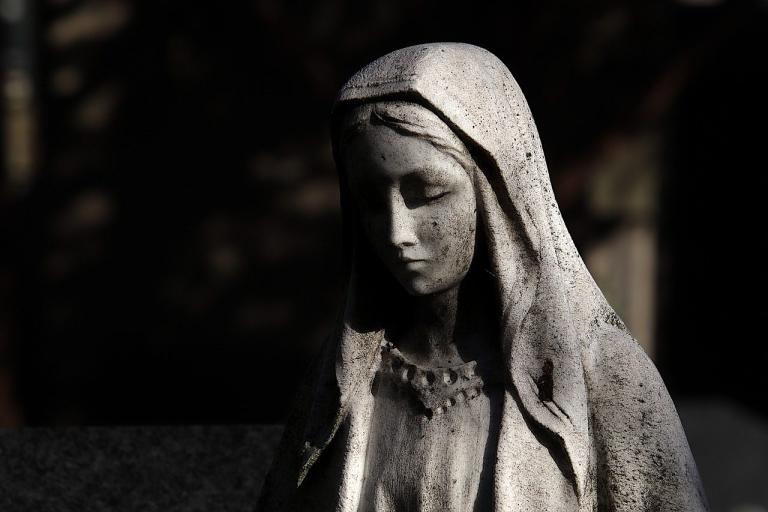
“Behold your mother.”
What follows is an introduction to Mary. I will review the four dogmas of the Catholic Church concerning Mary and seek to address some criticisms of Mariology in Catholic theology. Finally, I will show how Mary remains a model for Catholics.
Mary of Nazareth
Approximately fifteen miles west of the Sea of Galilee, in the northern district of present-day Israel, lies the City of Nazareth. At the time of Mary’s birth, around 18 BC, Nazareth had a population of no more than four hundred people. Mary’s parents (Saints Joachim and Anne) were so devout that at the age of three Mary was dedicated to God.
Mary was likely only around twelve or thirteen when she became engaged to Joseph, a carpenter, and devout Jew. This betrothment would begin one of the most remarkable events in history.
The Annunciation
In the first chapter of Luke’s Gospel, we read of the angel Gabriel visiting Mary and greeting her with the now well-known verse, “Hail, full of grace, the Lord is with thee.”
While this event gives rise to the Incarnation of Christ, it is worth examining what is meant by Gabriel’s greeting. A succinct definition of grace is that it is the presence of God. Thus, the angel is acknowledging that God is present in Mary. Please note that this does not suggest that Mary is God, only that God is working in Mary.
Moreover, Mary is “full of grace,” full of the presence of God. And where God is present, there can be no sin. This fact leads to a significant theological doctrine in Catholicism.
The Immaculate Conception
Immaculate conception refers to the doctrine that Mary was born without original sin. The basis for this doctrine comes from the meaning of grace. If Mary was “full of grace,” she did not suffer from the privation that is sin. This sinlessness is significant since original sin is transmitted by one’s parents. The fact that Mary was without sin allowed her to be the perfect vessel for giving birth to the Messiah. Indeed, it is Mary’s sinless nature that allows her to become the Ark of the New Covenant.
The Ark of the (Old) Covenant was a chest containing, among other things, the Ten Commandments. (See Exodus 25:22 and Numbers 10:33). The Ten Commandments were at the heart of the law of the Old Covenant. Since Jesus is the bearer of the New Covenant, it is proper to view Mary as the Ark of the New Covenant.
More commonly, however, Mary is known as the mother of God. It is to that title that I turn next.
Can God Have a Mother?
It is not the purpose of the exposition to defend the existence of God or even that Jesus is God. Yet, a question arises. If God is the eternal first cause of creation, how can Mary be called the mother of God?
To treat this topic properly, we must delve into Christology. More specifically, we need to understand the hypostatic union. While a rich subject in its own right, hypostatic union refers to the doctrine that Jesus possessed two natures, one Divine and one human. Jesus, as God, took to Himself a human nature while maintaining His divine nature.
Though Jesus exists eternally, in giving birth to Jesus, Mary is appropriately called the Theotokos or “God-bearer” in Greek. Theotokos is translated into Latin as Mater Dei. The English translation of Mater Dei is “mother of God.”
Ever-Virgin
The Catholic Church holds that Mary was a virgin before and after Christ’s birth. This dogma is intended to bring into stark relief the uniqueness of the Incarnation. Vatican II reiterated the teaching about Mary by stating that Christ’s birth did not diminish Mary’s virginal integrity but sanctified it (See Lumen Gentium 57).
There are two aspects of the virgin birth that I will address here. The first is the effect of original sin on giving birth. In Genesis 3:16, God informs Eve of the punishment for original sin, “I will intensify the pangs of your childbearing; in pain shall you bring forth children.” Yet, if Mary is “full of grace,” she is exempted from original sin and its effects, including the pains of childbirth.
The second aspect of this dogma is the actual birth of Jesus. If the conception of Jesus was miraculous, so too must be Jesus’ birth. Analogically, Jesus came into the world in the same way that He entered the upper room after the Ressurection (See Luke 24:36). Just as Jesus entered into the upper room in a remarkable way, so too does He enter the world.
The Assumption
The assumption of Mary refers to the belief that Mary was taken body and soul into Heaven. Similar to the virgin birth, the assumption is predicated on the belief that Mary was kept from the stain of original sin.
Since death is an effect of original sin (Romans 5:12) and since Mary was kept from sin, it is believed that Mary was assumed into Heaven upon the end of her life. This leads to the question of whether Mary experienced death or was taken into Heaven while alive. The consensus in Catholic theology is that she did die, but not as a result of original sin. Rather, Mary chose death in order to be conformed to her Son. (See Thomas Aquinas and Duns Scotus).
Do Catholics worship Mary?
A relatively common criticism of Catholics is that they place Mary on par with God. This objection predominantly occurs when prayer is mistaken for worship.
Worship is an act of adoration owed to God alone. On the other hand, prayer is a form of communication, often as a petition or thanksgiving. Thus, prayer may be directed to created creatures as well as the creator. (See Summa Theologiae (II-II, q. 103, a. 4; III, q. 25, a. 5).
The purpose of praying to Mary often involves seeking her guidance and assistance. Often too, Catholics pray to Mary to intercede with God on our behalf. (See “Raising the Heart to Heaven”)
A model for humanity
To be a Catholic is to be a follower of Christ. No human has ever exemplified this more than Mary. For this reason, Mary models the ways of the consecrated life. To be consecrated to God is to eschew worldly possessions, to be pure of heart, and to obey God. Mary provides us with examples of each.
As evidenced by her giving birth in a stable, Mary’s poverty reminds us that we are only sojourners in this world.
In a world obsessed with sexuality, chastity is that virtue that makes one pure of heart. Purity of heart is concerned with our motives. Are we prayerful and generous because we love God, or are we prayerful and generous because we want to impress others? To be Catholic is to love others with a heart pure from the corrosive effects of sin.
Finally, Mary’s obedience to God is epitomized in Luke 1:38, “Behold, I am the handmaid of the Lord; let it be to me according to your word.” To be obedient is to surrender one’s will to the will of God. Again, Mary provides us with the quintessential example of this virtue.
Mariology is the study of the person of Mary of Nazareth in Catholic theology. The above exposition has provided a summary of the four Marian dogmas of the Catholic Church. I have also addressed the criticism that Mary is worshipped. Finally, I have suggested that Mary provides Catholics with a template for holiness.
Previous Post

January 26, 2022
Raising the Heart to Heaven
Next Post
February 2, 2022 Violence and Scripture
Browse Our Archives
Select a Category Abortion Atheism Catholicism. Catholicism. God. Theophany. Christmas Eschatology Faith and Works. God. Holy Spirit Intelligent Design Jesus Christ Justice Law Politics Protestantism Religion Sabbath Salvation. Soteriology. The Bible Theology Uncategorized
Select a Month October 2026 September 2026 August 2026 July 2026 June 2026 May 2026 April 2026 March 2026 February 2026 January 2026 December 2025 November 2025 October 2025 September 2025 August 2025 July 2025 June 2025 May 2025 April 2025 March 2025 February 2025 January 2025 December 2024 November 2024 October 2024 September 2024 August 2024 July 2024 June 2024 May 2024 April 2024 March 2024 February 2024 January 2024 December 2023 November 2023 October 2023 September 2023 August 2023 July 2023 June 2023 May 2023 April 2023 March 2023 February 2023 January 2023 December 2022 November 2022 October 2022 September 2022 August 2022 July 2022 June 2022 May 2022 April 2022 March 2022 February 2022 January 2022 December 2021
Follow Us!
TAKE THE
Religious Wisdom Quiz
Who said, "Can anything good come from Nazareth?"
Select your answer to see how you score.
John the Baptist Nathanael Pilate Peter
Related posts from Summa Catholic

The Anatomy of Divine Revelation in Catholic Thought

Beyond the Absence of Belief: The Implications of...

Reclaiming Objective Faith in an Individualistic World

Soul and Species: Catholic Theology Meets Evolution
TRENDING AT PATHEOS Catholic

The Parable Of The Sower And The Word...
One of Christ’s most famous parables is that of the sower who...

Rejecting Doom: Christian Hope And Human Action
Christianity is a religion of hope. We are to have hope and...

Why I Choose the Eucharist Over the Sermon
Choose the Eucharist, Not the Sermon What are we supposed to get...

5 Design Elements Found in Spiritually Rooted Homes
Putting Spirituality Into Home Decor Our homes are more than our living...

Credo: A Story of God Told with the...
About 10 years ago, I began to imagine a personal "Credo" that...

The Anatomy of Divine Revelation in Catholic Thought
The claim that God has made Himself known to human beings is...
view all Catholic blogs
Ad-Free & Subscriber Log-In Subscription Support
- About Us
- 2026 Calendar
- Videos
- Podcasts
- Library of World Religions
- Faith In Media Tracker
- Advertise With Us
- Write for Us
- Privacy Policy
- Terms of Service
- Do Not Sell My Data
- Contact Us
- Radiant Digital
- Manage Newsletter Subscriptions
- Unsubscribe From Notifications
- Sitemap
Copyright 2008-2026, Patheos. All rights reserved.
Subscription Support Ad-Free & Subscriber Log-In
Follow Patheos