
BuddhistCatholicContemplativeEvangelicalGeneral ChristianHinduJewishLatter-day SaintMuslimNew VisionsProgressive Christian
Beliefs
- Buddhist
- Catholic
- Contemplative
- Evangelical
- General Christian
- Hindu
- Jewish
- Latter-day Saint
- More Voices
- Muslim
- New Visions
- Pagan
- Progressive Christian
Topics
- Religion News
- Food and Religion
- Sports and Religion
- Religious Art
- Religious Music and Entertainment
- Religious Events
- History and Religion
- Style and Religion
- Politics and Religion
- Women in Religion
- Recreation Outdoors and Religion
- Business Finance and Religion
- Careers Workplace and Religion
- Education and Religion
- Family Parenting and Religion
- Health Fitness and Religion
- Home and Religion
- Relationships and Religion
- Technology and Religion
- Travel and Religion
Columnists
- Buddhist Columnists
- Business Finance and Religion Columnists
- Careers Workplace and Religion Columnists
- Catholic Columnists
- Contemplative Columnists
- Education and Religion Columnists
- Evangelists Columnists
- Family Parenting and Religion Columnists
- General Christian Columnists
- Health Fitness and Religion Columnists
- Hindu Columnists
- History and Religion Columnists
- Home and Religion Columnists
- Jewish Columnists
- More Voices Columnists
- Latter Day Columnists
- Muslim Columnists
- New Visions Columnists
- Nonreligious Columnists
- Pagan Columnists
- Politics and Religion Columnists
- Progressive Columnists
- Recreation Outdoors and Religion Columnists
- Relationships and Religion Columnists
- Religion News Columnists
- Religious Art Columnists
- Religious Events Columnists
- Religious Music and Entertainment Columnists
- Sports and Religion Columnists
- Style and Religion Columnists
- Technology and Religion Columnists
- Travel and Religion Columnists
- Women in Religion Columnists
Resource Library
- 2026 Calendar
- Library of World Religions
- The 100 Most Holy Places on Earth
- Patheos Answers
- Podcasts
- Videos
- Faith Leaders Database
- Anglican Episcopalian
- Bahai
- Baptist
- Buddhism
- Christianity
- Confucianism
- Eastern Orthodoxy
- Hinduism
- Holiness and Pentecostal
- ISKCON
- Islam
- Judaism
- Lutheran
- Methodist
- The Church of Jesus Christ of Latter-day Saints
- New Age
- Paganism
- Presbytarian and Reformed
- Protestantism
- Religion Behind the Scenes
- Roman Catholic
- Scientology
- Shia Islam
- Sikhism
- Sufism
- Sunni Islam
- Taoism
- Zen
- See all religions
Research Tools
 Ad-Free & Subscriber Log-In Subscription Support
Ad-Free & Subscriber Log-In Subscription Support
Follow Patheos 

- Trending:
- Forgiveness
- |
- Marriage
- |
- Consciousness
- |
- Death Penalty
- |
- Election
- |
- Halloween

- Home
- Catholic
- The Fountain of God’s Mercy
The Fountain of God’s Mercy
Last updated on: December 21, 2021 at 7:03 am by David Schloss
The Fountain of God’s Mercy 2021-12-21T07:03:53-05:00 David Schloss
Patheos Explore the world's faith through different perspectives on religion and spirituality! Patheos has the views of the prevalent religions and spiritualities of the world.
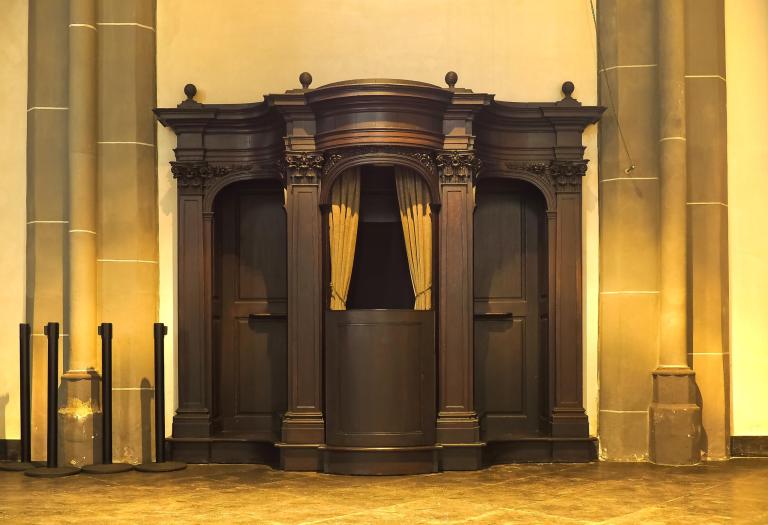
The light over the confessional turned green, and I took a deep breath to calm myself as I stepped into the confessional. Though I was forty-three years old, this was to be my first confession, having recently converted to Catholicism. As countless Catholics have done before me, I made the sign of the Cross as I knelt in the confessional, “Bless me father, for I have sinned.”
There are two distinct events in which a Catholic may experience the forgiveness of sins: the first, at baptism, and the second in the sacrament of confession. The original sin that stains human nature is cleansed in the first instance. In the second instance, those sins we commit after baptism are forgiven. It is this second instance that I wish to address.
The sacrament of reconciliation, more commonly known as confession, is one of two considered by the Catholic Church to be a sacrament of healing, the other being the anointing of the sick. This most personal of sacraments is also one of some mystery and misunderstanding to many. After all, what is more intimate and terrifying than to stand before God and admit your faults?
The exposition that follows is intended to shed some light on the mystery of confession and dispel some of the misunderstandings that have plagued it. I intend to discuss the effect of sin, what the Bible has to say about sin, and the need to repent. I will also address why it is necessary to confess our sins to a priest and the need to examine one’s conscience before confession. Lastly, the elements of the sacrament will be discussed.
THE EFFECTS OF SIN
First, we must understand how sin damages our relationships with ourselves and others and, most importantly, how sin damages our relationship with God.
The Church categorizes sin according to its seriousness, or, more accurately, how great a chasm our sin creates between God and ourselves. A venial sin strains the bonds of friendship and charity between God and man but does not break that bond. Those bonds are broken, however, when one commits a mortal sin.
Regardless of the type of sin involved, its effect damages our friendship with God. This damage creates a barrier between God and us and blocks the Grace of God in our lives. Moreover, as “All have sinned and fallen short of the glory of God” (Romans 3:23), it is clear of the need to reconcile ourselves with God. For this to occur, we must confess and repent of our sins as a means of being forgiven (see Matthew 3:2). In His infinite mercy, God has provided the vehicle for confession and repentance in the sacrament of reconciliation.
CONFESSION AND THE BIBLE
The confessing and repenting of one’s sins have taken various forms throughout the Bible. What is significant is that it is God who facilitates the process of reconciliation. This is on display very early in the Bible. After Adam and Eve had eaten of the forbidden tree, God asks them, “Where are you?” As God is omniscient, this question is not about a physical location, but rather God presenting Adam and Eve with an opportunity to confess what they had done. A similar event occurs later when God asks Cain about the location of Abel after Cain had killed his brother.
This motif of God calling people to repent, to confess, and to do penance is replete in the Old Testament. It also becomes increasingly ritualized. In Leviticus, the Israelites are commanded to “confess the sin he has incurred, and as his sin offering for the sin he has committed he shall bring to the Lord a female animal from the flock…The priest shall then make atonement for his sin.”
What is noteworthy here is that reconciliation involves a confession, penance, and the involvement of a priest. All of this creates the framework for Jesus Christ and the sacrament of reconciliation.
DO I NEED TO CONFESS TO A PRIEST?
In order to understand the need to confess one’s sins to a priest, it is necessary to touch briefly on another topic worthy of much more consideration than I have space for here. That is apostolic succession. Succinctly put, apostolic succession refers to the lineage of bishops going back to the twelve apostles of Jesus. At the Last Supper, Jesus made the twelve apostles priests (see Luke 22:19), and the twelve apostles later formed bishops and priests.
This process of priestly formation continues to the present time. Of note to the sacrament of reconciliation is the fact that Jesus gave the apostles the power to forgive sins (see John 20:23), a power passed down through apostolic succession. This power to forgive sins is predicated on the fact that priests act in persona Christi (in the person of Christ) as articulated in the Catechism, “It is the same priest, Christ Jesus, whose sacred person his minister truly represents. Now the minister, by reason of the sacerdotal consecration which he has received, is truly made like to the high priest and possesses the authority to act in the power and place of the person of Christ himself.” The power given to the apostles to forgive sins is the very same power possessed by contemporary priests.
EXAMINATION OF CONSCIENCE AND THE ELEMENTS OF CONFESSION
It is very beneficial to examine one’s conscience in preparation for confession. This examination may take several different forms. The United States Conference of Catholic Bishops lists six forms of examining one’s conscience. These forms may vary depending on one’s situation, for example, there are examinations based on being single or married, examinations based on the Ten Commandments, or even the age of the person. No matter the form of the examination, the overarching purpose of an examination of conscience is to review the times that we have failed to conform our thoughts and deeds to the will of God. This lays the ground, if you will, for partaking of the sacrament of confession.
Lastly, I would like to review the four elements that make up the sacrament.
The first is contrition, or the regret or sorrows one naturally feels for sin. This element often takes place immediately after one has committed a sin but can also become apparent to us during our examination of conscience.
The second element is confessing our sins to God through His priest. This involves reciting both venial and mortal sins.
Third, the sacrament of reconciliation involves satisfaction. This will often take the form of penance, which the priest will ask the penitent to do. In some cases, satisfaction may involve correcting the sin to the extent that this is possible, such as apologizing to someone offended. It is important to remember that sin often involves injury to another person as well as an offense against God.
Finally, the last element of the sacrament is absolution. This involves Jesus forgiving our sins through His priest. This includes the physical act of the priest blessing the individual confessing and reciting the prayer of absolution, “God, the Father of mercies, through the death and resurrection of his Son has reconciled the world to himself and sent the Holy Spirit among us for the forgiveness of sins; through the ministry of the Church may God give you pardon and peace, and I absolve you from your sins in the name of the Father, and of the Son, and of the Holy Spirit.” (See section 1449 of the Catechism).
Confession is to the soul what medicine is to the body. If taking medicine is a tool to heal our bodies, confessing our sins is a tool to heal our souls and reconcile ourselves to God.
Previous Post

December 17, 2021
GOD IN OUR MIDST.
Next Post
December 25, 2021 Marriage and Sacrament
Browse Our Archives
Select a Category Abortion Atheism Catholicism. Catholicism. God. Theophany. Christmas Eschatology Faith and Works. God. Holy Spirit Intelligent Design Jesus Christ Justice Law Politics Protestantism Religion Sabbath Salvation. Soteriology. The Bible Theology Uncategorized
Select a Month October 2026 September 2026 August 2026 July 2026 June 2026 May 2026 April 2026 March 2026 February 2026 January 2026 December 2025 November 2025 October 2025 September 2025 August 2025 July 2025 June 2025 May 2025 April 2025 March 2025 February 2025 January 2025 December 2024 November 2024 October 2024 September 2024 August 2024 July 2024 June 2024 May 2024 April 2024 March 2024 February 2024 January 2024 December 2023 November 2023 October 2023 September 2023 August 2023 July 2023 June 2023 May 2023 April 2023 March 2023 February 2023 January 2023 December 2022 November 2022 October 2022 September 2022 August 2022 July 2022 June 2022 May 2022 April 2022 March 2022 February 2022 January 2022 December 2021
Follow Us!
TAKE THE
Religious Wisdom Quiz
What does 1 John say the world and its desires are doing?
Select your answer to see how you score.
Passing away Being judged Coming to an end Growing darker
Related posts from Summa Catholic

The Anatomy of Divine Revelation in Catholic Thought

Beyond the Absence of Belief: The Implications of...

Reclaiming Objective Faith in an Individualistic World

Soul and Species: Catholic Theology Meets Evolution
TRENDING AT PATHEOS Catholic

Creation, Preservation, and Teleology in Catholic Theology
As I write this, it is very early Monday morning. Like millions...

The Parable Of The Sower And The Word...
One of Christ’s most famous parables is that of the sower who...

Rejecting Doom: Christian Hope And Human Action
Christianity is a religion of hope. We are to have hope and...

Why I Choose the Eucharist Over the Sermon
Choose the Eucharist, Not the Sermon What are we supposed to get...

5 Design Elements Found in Spiritually Rooted Homes
Putting Spirituality Into Home Decor Our homes are more than our living...

Credo: A Story of God Told with the...
About 10 years ago, I began to imagine a personal "Credo" that...
view all Catholic blogs
Ad-Free & Subscriber Log-In Subscription Support
- About Us
- 2026 Calendar
- Videos
- Podcasts
- Library of World Religions
- Faith In Media Tracker
- Advertise With Us
- Write for Us
- Privacy Policy
- Terms of Service
- Do Not Sell My Data
- Contact Us
- Radiant Digital
- Manage Newsletter Subscriptions
- Unsubscribe From Notifications
- Sitemap
Copyright 2008-2026, Patheos. All rights reserved.
Subscription Support Ad-Free & Subscriber Log-In
Follow Patheos