
BuddhistCatholicContemplativeEvangelicalGeneral ChristianHinduJewishLatter-day SaintMuslimNew VisionsProgressive Christian
Beliefs
- Buddhist
- Catholic
- Contemplative
- Evangelical
- General Christian
- Hindu
- Jewish
- Latter-day Saint
- More Voices
- Muslim
- New Visions
- Pagan
- Progressive Christian
Topics
- Religion News
- Food and Religion
- Sports and Religion
- Religious Art
- Religious Music and Entertainment
- Religious Events
- History and Religion
- Style and Religion
- Politics and Religion
- Women in Religion
- Recreation Outdoors and Religion
- Business Finance and Religion
- Careers Workplace and Religion
- Education and Religion
- Family Parenting and Religion
- Health Fitness and Religion
- Home and Religion
- Relationships and Religion
- Technology and Religion
- Travel and Religion
Columnists
- Buddhist Columnists
- Business Finance and Religion Columnists
- Careers Workplace and Religion Columnists
- Catholic Columnists
- Contemplative Columnists
- Education and Religion Columnists
- Evangelists Columnists
- Family Parenting and Religion Columnists
- General Christian Columnists
- Health Fitness and Religion Columnists
- Hindu Columnists
- History and Religion Columnists
- Home and Religion Columnists
- Jewish Columnists
- More Voices Columnists
- Latter Day Columnists
- Muslim Columnists
- New Visions Columnists
- Nonreligious Columnists
- Pagan Columnists
- Politics and Religion Columnists
- Progressive Columnists
- Recreation Outdoors and Religion Columnists
- Relationships and Religion Columnists
- Religion News Columnists
- Religious Art Columnists
- Religious Events Columnists
- Religious Music and Entertainment Columnists
- Sports and Religion Columnists
- Style and Religion Columnists
- Technology and Religion Columnists
- Travel and Religion Columnists
- Women in Religion Columnists
Resource Library
- 2026 Calendar
- Library of World Religions
- The 100 Most Holy Places on Earth
- Patheos Answers
- Podcasts
- Videos
- Faith Leaders Database
- Anglican Episcopalian
- Bahai
- Baptist
- Buddhism
- Christianity
- Confucianism
- Eastern Orthodoxy
- Hinduism
- Holiness and Pentecostal
- ISKCON
- Islam
- Judaism
- Lutheran
- Methodist
- The Church of Jesus Christ of Latter-day Saints
- New Age
- Paganism
- Presbytarian and Reformed
- Protestantism
- Religion Behind the Scenes
- Roman Catholic
- Scientology
- Shia Islam
- Sikhism
- Sufism
- Sunni Islam
- Taoism
- Zen
- See all religions
Research Tools
 Ad-Free & Subscriber Log-In Subscription Support
Ad-Free & Subscriber Log-In Subscription Support
Follow Patheos 

- Trending:
- Forgiveness
- |
- Marriage
- |
- Consciousness
- |
- Death Penalty
- |
- Election
- |
- Halloween

- Home
- Catholic
- GOD IN OUR MIDST.
GOD IN OUR MIDST.
Last updated on: December 17, 2021 at 6:55 am by David Schloss
GOD IN OUR MIDST. 2021-12-17T06:55:30-05:00 David Schloss
Patheos Explore the world's faith through different perspectives on religion and spirituality! Patheos has the views of the prevalent religions and spiritualities of the world.
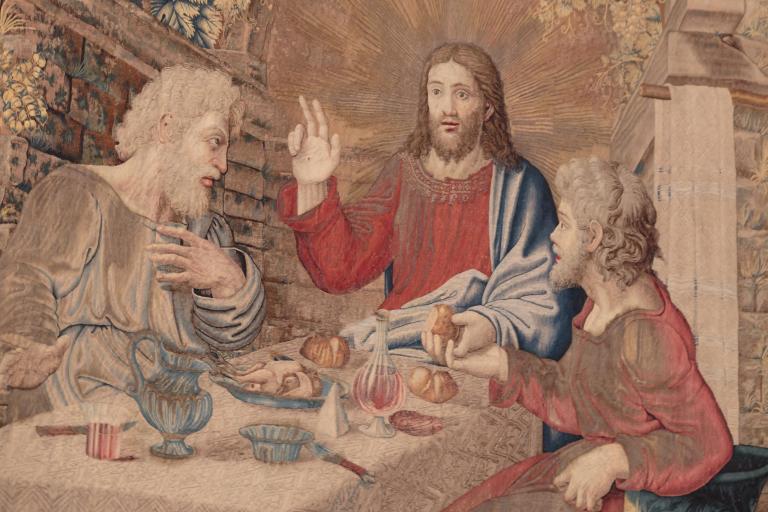
“Well, if it’s a symbol, to hell with it.” This was Flannery O’Connor’s flustered response to the claim that the Eucharist is only symbolic.
At the very heart of the Catholic faith is the belief, as set forth at the Council of Trent, that Jesus is “really, truly, and substantially present” in the Eucharist.
The Catholic Church is the steward of seven sacraments, but the sacrament par excellence is the Eucharist. It is “the fount and apex of the whole Christian life” (Lumen Gentium, no. 11). In many ways, what was begun in baptism, strengthened in confirmation, comes to completion in the Eucharist, where we are blessed to partake of the “bread of life” (John 6:35).
Giving Thanks
It is telling that the word Eucharist comes from the Greek word “eucharisteo” which means to give thanks. We do not so much go to Mass to receive as to give thanks to the One who has given us so much. This understanding of the Eucharist originates, at least partially, from the Didache, also known as the Teachings of the Twelve Apostles, written near the end of the first century.
The Eucharist is recognized within the context of the Jewish Passover and the Seder meal as thanksgiving. The Passover celebrates the Israelites’ escape from slavery in Egypt. More specifically, Passover refers to when God spared or “passed over” the homes of the Israelites as the firstborn sons of the Egyptians were put to death.
This annual celebration of giving thanks to God includes the Seder meal that Jesus refers to in Matthew 26:18, “My appointed time draws near; in your house I shall celebrate the Passover with my disciples.” This meal is the Last Supper, and it is re-presented in the Mass.
Still, to understand the fullness of the Eucharist we must understand the significance and necessity of sacrifice for the forgiveness of sins.
Sin and Atonement
Sins violate the covenant between God and man, for they are actions against the will of God. Moreover, they fracture man’s relationship with God. To repair this relationship in a world made broken and fallen by original sin requires sacrifice.
The Old Testament is replete with sacrifices conducted for expiation or the atonement for sins. These sacrifices almost always involved the spilling of blood. Leviticus 17:11 gives us the reason for this: “since the life of the flesh is in the blood, and I have given it to you to make atonement on the altar for yourselves because it is the blood as life that makes atonement.”
Often, atonement involved sacrificing a substitute for the one guilty of sin—the more blameless or blemish-free, the greater the atonement value. Since sin brings death (Romans 6:23), the death of a scapegoat was payment for sin. It wrung life from death. Divine forgiveness became possible through this process.
It is helpful to view atonement as occurring in two ways. First, it can atone in a particular way, for a particular person or group, for example, the atonement one seeks in the sacrament of confession. In a second way, atonement is accomplished universally, as was done by Jesus on the Cross. (See Council of Trent, Session twenty-three).
The practices of sacrifices depicted in the Old Testament were always particular and thus had to be repeated.
Christ’s Sacrifice
The sacrifice of Jesus on the Cross is quantifiably different, however. Christ’s sacrifice sanctified all of mankind definitively, as we read in Hebrews 10:8-10: “First he says, “Sacrifices and offerings, holocausts and sin offerings, you neither desired nor delighted in. These are offered according to the law. Then he says, “Behold, I come to do your will.” He takes away the first to establish the second. By this “will,” we have been consecrated through the offering of the body of Jesus Christ once for all.”
What was temporal and inadequate in the sacrifices of fallen man are made eternal and perfect in Christ. Only in the God/man of Christ could a perfect atonement be made. If Jesus was only a man, he could not have made a perfect atonement. Similarly, if Jesus was God and not a man, He could not have provided the perfect sacrifice necessary for atonement. In Jesus as both man and God, such atonement is possible.
While the sacrifice of Jesus is at the heart of the Eucharist, we should not interpret the sacrament as a re-sacrifice of Jesus or a re-crucifixion of Christ. Rather, the Eucharist is a re-presentation. The Catechism articulates it this way, “This [Institution of the Eucharist] he did in order to perpetuate the sacrifice of the cross throughout the ages until he should come again” (Catechism of the Catholic Church, Part Two, Section Two, Chapter One, Article Three, Paragraph 1323). This is true because Jesus is as present in the Eucharist as He was to the Apostles at the Last Supper. To understand how this is possible, we must delve into an important and complicated subject – transubstantiation.
The Real Presence
Transubstantiation is a subject so complex that it cannot be fully treated here. Nevertheless, borrowing a concept from Aristotelian metaphysics – form and matter – helps in explaining transubstantiation to some extent.
Form is what the particular thing is, so form must always be present when talking about any type being. On the other hand, matter is a trait or characteristic that is present with a thing, but not essential to it. For example, a person has a soul, which Aristotle would call the form of a human being. The matter of a person may be height. A person’s height is present with every person, but it is not essential to who that person is as a human being. (See “The Physics” by Aristotle).
In the context of the Eucharist, transubstantiation is the changing of the form of the bread into the body of Jesus and the form of wine into the blood of Jesus. This process is done without changing the matter of either the bread or the wine. That is to say that during the Eucharistic Prayer, the bread and the wine become the body and blood of Jesus while still retaining the appearance of bread and wine.
While this is a complex subject, the Catholic Church simply takes Jesus at His word when He says, “This is my body that is for you. Do this in remembrance of me.” In the same way also the cup, after supper, saying, “This cup is the new covenant in my blood. Do this, as often as you drink it, in remembrance of me” (1 Corinthians 11:24-25).
The Eucharist occurs within the context of the Mass, which is composed of two distinct liturgies, the Liturgy of the Word and the Liturgy of the Eucharist.
The Liturgy of the Word involves hearing readings from the Old and New Testaments and responses from the laity. Perhaps it is helpful to view the Liturgy of the Word as God calling His people to prayer and His people answering that call.
The second part of the Mass is the Liturgy of the Eucharist, which commences with the gifts of bread and water being brought to the altar. Again, this is a topic of much complexity and depth. However, it is during the Liturgy of the Eucharist that Jesus offers Himself to God the Father as a perfect sacrifice for our sins.
Perhaps if experience had not dulled our sensitivities, we would be amazed and humbled by the fact that a God who needs nothing from us saw fit to send His Son into our midst to save us, and He remains physically in our midst through the great sacrament of the Eucharist.
Previous Post

December 13, 2021
Confirmation
Next Post
December 21, 2021 The Fountain of God's Mercy
Browse Our Archives
Select a Category Abortion Atheism Catholicism. Catholicism. God. Theophany. Christmas Eschatology Faith and Works. God. Holy Spirit Intelligent Design Jesus Christ Justice Law Politics Protestantism Religion Sabbath Salvation. Soteriology. The Bible Theology Uncategorized
Select a Month October 2026 September 2026 August 2026 July 2026 June 2026 May 2026 April 2026 March 2026 February 2026 January 2026 December 2025 November 2025 October 2025 September 2025 August 2025 July 2025 June 2025 May 2025 April 2025 March 2025 February 2025 January 2025 December 2024 November 2024 October 2024 September 2024 August 2024 July 2024 June 2024 May 2024 April 2024 March 2024 February 2024 January 2024 December 2023 November 2023 October 2023 September 2023 August 2023 July 2023 June 2023 May 2023 April 2023 March 2023 February 2023 January 2023 December 2022 November 2022 October 2022 September 2022 August 2022 July 2022 June 2022 May 2022 April 2022 March 2022 February 2022 January 2022 December 2021
Follow Us!
TAKE THE
Religious Wisdom Quiz
What city was known as the City of David?
Select your answer to see how you score.
Jerusalem Jericho Nazareth Bethlehem
Related posts from Summa Catholic

The Anatomy of Divine Revelation in Catholic Thought

Beyond the Absence of Belief: The Implications of...

Reclaiming Objective Faith in an Individualistic World

Soul and Species: Catholic Theology Meets Evolution
TRENDING AT PATHEOS Catholic

Creation, Preservation, and Teleology in Catholic Theology
As I write this, it is very early Monday morning. Like millions...

The Parable Of The Sower And The Word...
One of Christ’s most famous parables is that of the sower who...

Rejecting Doom: Christian Hope And Human Action
Christianity is a religion of hope. We are to have hope and...

Why I Choose the Eucharist Over the Sermon
Choose the Eucharist, Not the Sermon What are we supposed to get...

5 Design Elements Found in Spiritually Rooted Homes
Putting Spirituality Into Home Decor Our homes are more than our living...

Credo: A Story of God Told with the...
About 10 years ago, I began to imagine a personal "Credo" that...
view all Catholic blogs
Ad-Free & Subscriber Log-In Subscription Support
- About Us
- 2026 Calendar
- Videos
- Podcasts
- Library of World Religions
- Faith In Media Tracker
- Advertise With Us
- Write for Us
- Privacy Policy
- Terms of Service
- Do Not Sell My Data
- Contact Us
- Radiant Digital
- Manage Newsletter Subscriptions
- Unsubscribe From Notifications
- Sitemap
Copyright 2008-2026, Patheos. All rights reserved.
Subscription Support Ad-Free & Subscriber Log-In
Follow Patheos