
BuddhistCatholicContemplativeEvangelicalGeneral ChristianHinduJewishLatter-day SaintMuslimNew VisionsProgressive Christian
Beliefs
- Buddhist
- Catholic
- Contemplative
- Evangelical
- General Christian
- Hindu
- Jewish
- Latter-day Saint
- More Voices
- Muslim
- New Visions
- Pagan
- Progressive Christian
Topics
- Religion News
- Food and Religion
- Sports and Religion
- Religious Art
- Religious Music and Entertainment
- Religious Events
- History and Religion
- Style and Religion
- Politics and Religion
- Women in Religion
- Recreation Outdoors and Religion
- Business Finance and Religion
- Careers Workplace and Religion
- Education and Religion
- Family Parenting and Religion
- Health Fitness and Religion
- Home and Religion
- Relationships and Religion
- Technology and Religion
- Travel and Religion
Columnists
- Buddhist Columnists
- Business Finance and Religion Columnists
- Careers Workplace and Religion Columnists
- Catholic Columnists
- Contemplative Columnists
- Education and Religion Columnists
- Evangelists Columnists
- Family Parenting and Religion Columnists
- General Christian Columnists
- Health Fitness and Religion Columnists
- Hindu Columnists
- History and Religion Columnists
- Home and Religion Columnists
- Jewish Columnists
- More Voices Columnists
- Latter Day Columnists
- Muslim Columnists
- New Visions Columnists
- Nonreligious Columnists
- Pagan Columnists
- Politics and Religion Columnists
- Progressive Columnists
- Recreation Outdoors and Religion Columnists
- Relationships and Religion Columnists
- Religion News Columnists
- Religious Art Columnists
- Religious Events Columnists
- Religious Music and Entertainment Columnists
- Sports and Religion Columnists
- Style and Religion Columnists
- Technology and Religion Columnists
- Travel and Religion Columnists
- Women in Religion Columnists
Resource Library
- 2026 Calendar
- Library of World Religions
- The 100 Most Holy Places on Earth
- Patheos Answers
- Podcasts
- Videos
- Faith Leaders Database
- Anglican Episcopalian
- Bahai
- Baptist
- Buddhism
- Christianity
- Confucianism
- Eastern Orthodoxy
- Hinduism
- Holiness and Pentecostal
- ISKCON
- Islam
- Judaism
- Lutheran
- Methodist
- The Church of Jesus Christ of Latter-day Saints
- New Age
- Paganism
- Presbytarian and Reformed
- Protestantism
- Religion Behind the Scenes
- Roman Catholic
- Scientology
- Shia Islam
- Sikhism
- Sufism
- Sunni Islam
- Taoism
- Zen
- See all religions
Research Tools
 Ad-Free & Subscriber Log-In Subscription Support
Follow Patheos 

- Trending:
- Advent
- |
- Forgiveness
- |
- Thanksgiving
- |
- Election
- |
- Seasonal Holidays
- |
- Marriage
 Summa
- Home
- Catholic
- Why Sola Scriptura Honestly Scares Me
Why Sola Scriptura Honestly Scares Me
Last updated on: February 11, 2025 at 12:22 pm by Summa Dan
Why Sola Scriptura Honestly Scares Me 2025-02-11T12:22:12-08:00 Summa Dan
Patheos Explore the world's faith through different perspectives on religion and spirituality! Patheos has the views of the prevalent religions and spiritualities of the world.
Being raised in a Protestant home, the Scriptures were (and in many ways still are) the end-all-be-all of the faith for me. However, there is a reason I am no longer a Protestant. This reason has many branches but all points back to one thing, context. Given the necessity of context, I find the whole idea of “Scripture Alone” horrifying.
What it is:
Sola Scriptura is the idea that Christianity ought to be based off of “Scripture Alone” (which is the English translation of “Sola Scriptura”), that is to say, it should be without ritual, or the teaching authority of anyone. And that each of us is obligated to read the Scriptures and form ourselves through them, on our own.
It Can’t Really Exist:
Many of the things we are afraid of do not exist. Zombies, Armageddon cults (the kind who bring on the end of the world via some long-forgotten Egyptian deity), Cthulhu, and so on, are all prime examples of thing which are scary, but don’t really exist.
This is how I feel about Sola Scriptura. It’s frightening, but in reality it doesn’t exist.
It would seem a little ridiculous to say that it doesn’t exist; being that it’s the staple doctrine of nearly all Protestants. However, that’s just the point… it’s a doctrine. It’s already going against itself, erasing itself from the realm of possibility by its own action. A doctrine (not scripture) which proclaims that all doctrine are to be rejected is ludicrous (A harkening back to the, now terribly clichéd, argument against relativism). It simply isn’t possible to have Scripture alone, since you didn’t receive Scripture alone. Instead, all of us were taught about Scripture by someone else. It didn’t just fall out of the sky and land on us. And even if it did, it’s still given to us by someone, the authors who had lives, cultures, rituals, and all number of things which provide a context for the Scriptures. And context means that Scripture is by no means “alone.”
If It Does Exist, It’s an Autobiography:
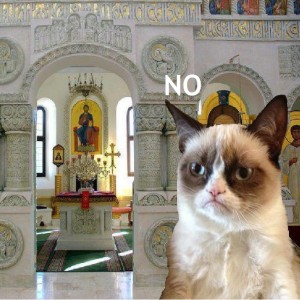
All this talk of texts, context, authorship and interpretation reminds me of a certain Frenchman…
“Did someone say, ‘context’?”
Anyways, there’s a serious problem which arises from the relentlessly individualistic model of Biblical interpretation. Whenever anyone begins their own interpretation of anything, without direction, they form a sort of autobiography in their interpretation. Interpretation of this sort reflects nothing but oneself.
This is a main idea of that certain Frenchman (philosopher Jacques Derrida), that whenever one interprets a text without context, one is simply painting a self-portrait with the colors of the text they are interpreting. This is because pure ideas do not simply pass from one person to another, instead they must pass through the filtration of language, which is passed further through the schema of one’s consciousness which allows one to make sense of things. This schema is built, in part, by the social, historical, political, etc, context in which we live, making it impossible to avoid unless we allow our understanding to be mapped by another context. If this contextual misreading and subsequent autobiography is turned upon the Scriptures, then I can think of no more grievous blasphemy than to make the Scriptures, which are supposed to be the image and fulfillment, the Word of God, into nothing more than an autobiography.
To deform God into an image of yourself is idolatry itself; a golden calf of proudly defended misinterpretation.
It Isn’t Biblical:
Nowhere in the Bible will you find any discussion of the Bible or how to interpret the Bible. Both the New and Old Testament will make reference to “the Scriptures,” but this does not refer to the Bible as a whole, only the Old Testament.
2 Thessalonians 2:15 makes it clear that there is a decisively important element of tradition and that much was taught by word of mouth. The separation between what has been taught by word of mouth and what has been relayed by the epistles (which are letters by bishops/Apostles) means that not everything which was important to know was recorded in the epistles.
Furthermore, the New Testament makes it clear that the Apostles (and in the First Letter to Timothy, bishops) are the bearers of the teaching of Christ, and that it is their duty to protect those teachings, and to instruct those of the faith in these teachings. Also made abundantly clear is the fact that anyone’s interpretation of the teachings of Christ is not as good as anyone else’s, were this true, there would have been no need for Paul’s letters, or really any of the New Testament aside from the Gospels.
What About History(?):
As I’ve already mentioned, the concept of Scripture Alone rejects a basic fact of the Scriptures; that they were written by men. While I do believe that they were inspired by the Holy Spirit, and kept free of error by the Holy Spirit, it doesn’t change the fact that people wrote these books, and as such, they are full of context (historical situation, cultural practices, societal expectations, and (perhaps most importantly) language and idiom). Without knowledge of the history and culture of the human authors of the Scriptures, one can have no hope of understanding what they are trying to communicate.
This is not even to mention the fact that the Bible itself (especially the New Testament) is a book with a lot of historical movement. The early Church (in the time of the Apostles) did not have the books of the New Testament (mostly since they were still being written), and it wasn’t until many generations later that these books were codified and the canon was created. The Church spent the bulk of its early life without these New Testament scriptures, thus, Sola Scriptura is historically speaking a fairly new idea (it’s hard to preach “Scripture Alone” when you don’t yet have Scriptures…).
What’s more is that this ideal of “Scripture Alone” rejects the whole of Christianity which has come before the individual Christian. It rejects the history of the Church and the great teachers of the faith (and when it doesn’t, it doesn’t uphold its own values.)
Pride:
All of this culminates in my reason for rejecting Sola Scriptura (and thus Protestantism); pride.
I am perhaps one of the worst offenders when it comes to this particular sin, so I place no judgment on those who fall into it; however this doesn’t mean that even I, the worst among the prideful, should sit by and allow my pride to become dogma. Rather, we should always struggle against our sins.
The pride of Sola Scriptura, if it is even possible, is in its rejection of those who have taught us: our parents, our preachers/priests/teachers, the history of the Church (the saints, the councils, the Fathers), and through this, even the Apostles, those who learned everything directly from the mouth of Christ himself; in favor of a vain autobiography of self-interpretation. A self-portrait painted with the colors of the Gospel.
This is obvious the worst case scenario of the doctrine, but this is the result of it’s actually being followed. Even the most well-meaning person who takes the “Scripture Alone” seriously will be nothing more than an arm chair theologian, someone who is completely ignorant of the period and context of the texts written and so instead is forced to put their own context and period in as a stand in. Thus the self-portrait appears again, even when the believer is well-meaning and pious in their practice. In this, Scripture Alone is again found impossible, as it’s no longer “Scripture Alone,” but rather it is “Scripture and Me.”
This is why Sola Scriptura frightens me. I am full of sin: failings and misgivings and bias. As such I much prefer “Scripture and Tradition,” to “Scripture and Me.”
Previous Post

July 19, 2013
Upholding the Sabbath
Next Post
July 29, 2013 Saved from Sin or From God
Browse Our Archives
Select a Category Art Atheism Catholicism Christmas Death Despair Femininity Icons Introductions Judaism Manhood Masturbation Moral Relativism Nature Orthodoxy Paganism Pascha Philosophy Planned Parenthood Protestantism Reformation Resurrection Scripture Secularization Society Spiritualism Spring Superpowers Tradition Uncategorized Women's Health
Select a Month December 2013 November 2013 October 2013 August 2013 July 2013 June 2013 May 2013 March 2013 February 2013 January 2013 December 2012 October 2012 September 2012 July 2012 June 2012 May 2012 February 2012 January 2012 December 2011
Follow Us!
TAKE THE
Religious Wisdom Quiz
Who was the oldest man recorded in Genesis?
Select your answer to see how you score.
Methuselah Noah Jared Enoch
Related posts from Summa

Metropolitan Jonah on Dispassion
4 Things That Are Not Reasons I Became...


On the Many Kinds of Temptation
TRENDING AT PATHEOS Catholic

Bad Survey Questions Distort Eucharistic Theology
It seems to be the newest thing: someone conducts a bad survey...

If Baptism Washes Away Sin, Why Do Catholics...
The seven sacraments stand as the foundation of Catholic ecclesial life. The...

Far from promoting indifference, inaction, or quietism, Paul consistently tells us to...

The Power of Setting a Good Example
Remember last August when the Chicago White Sox hosted a "Pope Hat...

A Catholic Critique of Biblical Unitarianism
If the statistics are to be believed, Unitarianism is rising worldwide. Although...

How Grandma Tourism Helps Grandparents Live Their Vocation
Grandma, The New Travel Influencer What started as a nostalgia-inspired social media...
view all Catholic blogs
Ad-Free & Subscriber Log-In Subscription Support
- About Us
- 2026 Calendar
- Videos
- Podcasts
- Library of World Religions
- Faith In Media Tracker
- Advertise With Us
- Write for Us
- Privacy Policy
- Terms of Service
- Do Not Sell My Data
- Contact Us
- Radiant Digital
- Manage Newsletter Subscriptions
- Unsubscribe From Notifications
- Sitemap
Copyright 2008-2026, Patheos, part of the Radiant Digital network of media brands. All rights reserved.
Subscription Support Ad-Free & Subscriber Log-In
Follow Patheos