
BuddhistCatholicContemplativeEvangelicalGeneral ChristianHinduJewishLatter-day SaintMuslimNew VisionsProgressive Christian
Beliefs
- Buddhist
- Catholic
- Contemplative
- Evangelical
- General Christian
- Hindu
- Jewish
- Latter-day Saint
- More Voices
- Muslim
- New Visions
- Pagan
- Progressive Christian
Topics
- Religion News
- Food and Religion
- Sports and Religion
- Religious Art
- Religious Music and Entertainment
- Religious Events
- History and Religion
- Style and Religion
- Politics and Religion
- Women in Religion
- Recreation Outdoors and Religion
- Business Finance and Religion
- Careers Workplace and Religion
- Education and Religion
- Family Parenting and Religion
- Health Fitness and Religion
- Home and Religion
- Relationships and Religion
- Technology and Religion
- Travel and Religion
Columnists
- Buddhist Columnists
- Business Finance and Religion Columnists
- Careers Workplace and Religion Columnists
- Catholic Columnists
- Contemplative Columnists
- Education and Religion Columnists
- Evangelists Columnists
- Family Parenting and Religion Columnists
- General Christian Columnists
- Health Fitness and Religion Columnists
- Hindu Columnists
- History and Religion Columnists
- Home and Religion Columnists
- Jewish Columnists
- More Voices Columnists
- Latter Day Columnists
- Muslim Columnists
- New Visions Columnists
- Nonreligious Columnists
- Pagan Columnists
- Politics and Religion Columnists
- Progressive Columnists
- Recreation Outdoors and Religion Columnists
- Relationships and Religion Columnists
- Religion News Columnists
- Religious Art Columnists
- Religious Events Columnists
- Religious Music and Entertainment Columnists
- Sports and Religion Columnists
- Style and Religion Columnists
- Technology and Religion Columnists
- Travel and Religion Columnists
- Women in Religion Columnists
Resource Library
- 2026 Calendar
- Library of World Religions
- The 100 Most Holy Places on Earth
- Patheos Answers
- Podcasts
- Videos
- Faith Leaders Database
- Anglican Episcopalian
- Bahai
- Baptist
- Buddhism
- Christianity
- Confucianism
- Eastern Orthodoxy
- Hinduism
- Holiness and Pentecostal
- ISKCON
- Islam
- Judaism
- Lutheran
- Methodist
- The Church of Jesus Christ of Latter-day Saints
- New Age
- Paganism
- Presbytarian and Reformed
- Protestantism
- Religion Behind the Scenes
- Roman Catholic
- Scientology
- Shia Islam
- Sikhism
- Sufism
- Sunni Islam
- Taoism
- Zen
- See all religions
Research Tools
 Ad-Free & Subscriber Log-In Subscription Support
Ad-Free & Subscriber Log-In Subscription Support
Follow Patheos 

- Trending:
- Forgiveness
- |
- Marriage
- |
- Consciousness
- |
- Death Penalty
- |
- Election
- |
- Halloween
 Strategic Monk
-
About
-
Services
- Home
- Contemplative
- Careers, Workplace and Religion
- Following the Example of Ebenezer Scrooge
Following the Example of Ebenezer Scrooge
Last updated on: January 8, 2024 at 5:39 pm by Greg Richardson
Following the Example of Ebenezer Scrooge 2024-01-08T17:39:53-08:00 Greg Richardson
Patheos Explore the world's faith through different perspectives on religion and spirituality! Patheos has the views of the prevalent religions and spiritualities of the world.
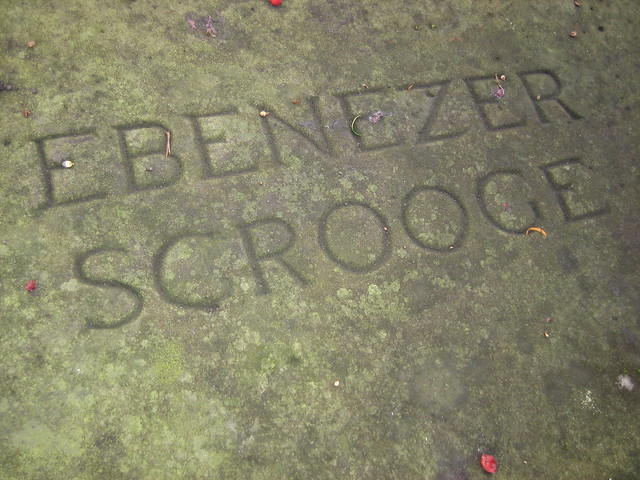
[Image by HowardLake]
Following the Example of Ebenezer Scrooge
For some reason, Ebenezer Scrooge has been on my mind lately. It could be because we have been inundated with versions of A Christmas Carol this month. Whether in writing or on film, the story captures our attention and our emotions.
A movie called The Man Who Invented Christmas describes how Charles Dickens sparked Victorian holiday celebrations. Many of the practices in his story have become our familiar holiday traditions. We feel nostalgia for his ideas whether we have ever practiced them or not.
The most compelling character in a story full of fascinating people is Ebenezer Scrooge.
He may capture our attention simply because of his name. There are also the words so closely identified with him, “Bah! Humbug!”
We may like to think we identify with Bob and Emily Cratchit or Scrooge’s nephew Fred, or maybe Jacob Marley or Tiny Tim. It comforts us to believe we are more diplomatic than Scrooge and understand Christmas more deeply.
The fact is we are probably more like Ebenezer Scrooge than any other character in the story. Even today we are following Scrooge’s example.
What Ebenezer Scrooge Believes
Ebenezer Scrooge has found values in which he believes and which work for him.
He has fully committed his life to one idea. Scrooge trusts the power of financial security. He believes life is about making a profit and that is how he evaluates his life.
Scrooge distrusts other values because he is so focused on financial independence.
Ebenezer Scrooge also believes in telling the truth, being authentic, being honest. He tells people exactly what he thinks and exactly how he feels. Scrooge values financial security and has no trouble putting his values into words.
He has no patience with people who pretend to be nice when they are seeking a profit.
Scrooge has committed his life to financial independence. He is certain he deserves to decide where his money goes without interference from anyone.
Ebenezer Scrooge believes people receive what they have earned, as he has. He sees himself as someone who has worked hard and made sacrifices to get where he is in life.
If other people want to make a good living, as he does, they need to do what he has done.
Scrooge sees himself as independent even though his financial success depends on others. Victorian England is an empire with financial strength based on colonies and cheap labor around the world. The original story includes sailors, miners, and servants who make Scrooge’s success possible.
What Do We Believe?
One of Ebenezer Scrooge’s examples we still follow today is how we see ourselves in the world.
We believe life is practical. Life needs to make a profit, make a difference.
It can be frustrating when we think we see people trying to take advantage of our efforts. We like to think we are independent, responsible for ourselves.
It is a challenge for us to see the vast network of people whose work makes our lives possible.
Like Victorian England, our financial strength depends on inexpensive labor in distant countries. We are used to taking what we want and paying little for it.
It is as if we believe we have earned what we have and it is only fair for us to have it.
We expect life to treat us fairly. If other people want what we have they should do as we have done.
Our actions, like Scrooge’s, describe what we believe.
How Scrooge Changes
Ebenezer Scrooge also gives us another, distinct example. He is transformed overnight through the intervention of four spirits.
With the help of these spirits Scrooge looks at his life in a new way. Their guidance leads him to reflect on his own experience and what he sees around him. Scrooge takes time to contemplate his own actions and their results.
As the story unfolds, Scrooge gains insight into the way he experiences the world. He recognizes the consequences of his own behavior. As he reflects his understanding of the world begins to deepen.
Scrooge experiences a literal awakening on Christmas morning. What the spirits have shown him inspires him to change his actions. Scrooge takes tangible steps to restore and strengthen neglected relationships. His way of seeing the world and his ways of living in it are transformed.
Scrooge’s new ways of behaving have measurable effects in the world around him.
Can We Change?
Is it possible for us to follow Ebenezar Scrooge’s example of changing his behavior as well? In what ways can we take meaningful steps to restore and strengthen our relationships?
First, we need to follow Scrooge’s example of reflection and contemplation. Even without the direct help of Jacob Marley and the other spirits, we can take a fresh look at our experiences.
How can we see the past, the present, and our expectations of the future with new eyes? Are we willing to spend the time it takes to see things even if it does not happen overnight?
Second, as we wake up to new questions and insights are we willing to make changes? It will take us time and effort to put what we see in our reflection into practice. Are we able to be patient with ourselves as we get tired and discouraged? How will we respond when we make mistakes?
It is one thing to change our lives overnight, in a few pages. There is more of a challenge with real people.
It is also important for us to recognize even Scrooge did not change the entire system immediately. He chose to do what he could within his own circle of relationships.
Scrooge’s story and example have many lessons to teach us.
We have a great deal to learn from the example of Ebenezer Scrooge. Some lessons have already worked their way into the fabric of our culture and society. There are some very valuable lessons still waiting for us.
How are we following the example of Ebenezer Scrooge this week?
What can we do to follow his example today?
Greg Richardson is a spiritual director in Southern California. He is a recovering assistant district attorney and associate university professor and is a lay Oblate with New Camaldoli Hermitage near Big Sur, California. Greg’s website is http://StrategicMonk.com and his email address is [email protected].
Careers, Workplace and Religion
Business, Finance and Religion
Previous Post

December 12, 2023
Desolation and Consolation
Next Post

December 19, 2023 Christmas Book Flood
Recent Comments
"Thus wrote Mahatma Gandhi: "Each night, when I go to sleep, I die. And the ..."
A Matter of Life and Death: ..."
"It's a Gandhian model of on-going-ness and togetherness. Day after day, week after week, month ..."
Practicing Community: How Do We Connect?
"Human beings love to experience uninterrupted and unending on-going-ness and togetherness. Easter offers that and ..."
"Friday in Holy Week is known as Good Friday. On Good Friday we remember the ..."
Is This a Particularly Holy Week?
Browse Our Archives
Select a Category Blog Book Reviews Everything Else Guest Posts Leadership Monastic Strategies Neighborhood Pilgrimages Sacred Stillness Spiritual Direction Spiritual Practices Work
Select a Month May 2024 April 2024 March 2024 February 2024 January 2024 December 2023 November 2023 October 2023 September 2023 August 2023 July 2023 June 2023 May 2023 April 2023 March 2023 February 2023 January 2023 December 2022 November 2022 October 2022 September 2022 August 2022 July 2022 June 2022 May 2022 April 2022 March 2022 February 2022 January 2022 December 2021 November 2021 October 2021 September 2021 August 2021 July 2021 June 2021 May 2021 April 2021 March 2021 February 2021 January 2021 December 2020 November 2020 October 2020 April 2020 March 2020 February 2020 January 2020 December 2019 November 2019 October 2019 September 2019 August 2019 July 2019 June 2019 May 2019 April 2019 March 2019 February 2019 January 2019 December 2018 November 2018 October 2018 September 2018 August 2018 July 2018 June 2018 May 2018 April 2018 March 2018 February 2018 January 2018 December 2017 November 2017 October 2017 September 2017 August 2017 July 2017 June 2017 May 2017 April 2017 March 2017 February 2017 January 2017 December 2016 November 2016 October 2016 September 2016 August 2016 July 2016 June 2016 May 2016 April 2016 March 2016 February 2016 January 2016 December 2015 November 2015 October 2015 September 2015 August 2015 July 2015 June 2015 May 2015 April 2015 March 2015 February 2015 January 2015 December 2014 November 2014 October 2014 September 2014 August 2014 July 2014 June 2014 May 2014 April 2014 March 2014 February 2014 January 2014 December 2013 November 2013 October 2013 September 2013 August 2013 July 2013 June 2013 May 2013 April 2013 March 2013 February 2013 January 2013 December 2012 November 2012 October 2012 September 2012 August 2012 July 2012 June 2012 May 2012 April 2012 March 2012 February 2012 January 2012 December 2011 November 2011 October 2011 September 2011 August 2011 July 2011 June 2011 May 2011 April 2011 March 2011 February 2011 January 2011 December 2010
Follow Us!
TAKE THE
Religious Wisdom Quiz
Dry bones in a valley came together, received sinews and flesh, then breath entered them. What did this valley represent?
Select your answer to see how you score.
God's army The house of Israel The dead The resurrection
Related posts from Strategic Monk

How Are We Called to Live?: More About...

A Spiritual Practice of Reading: Join Us Online

Taking a Deep Breath, and Another: Finding Time...

Listening to Our Own Rhythms: When Will We...
TRENDING AT PATHEOS Contemplative

Handy Contemplative Practices for Political Spaces
A Spiritually Grounded Presence In order to bring a spiritually grounded presence...

Halloween: The Holiday of Loving Your Neighbor
All Hallows Eve Is Halloween the least Christian holiday in America, or...

Can Love Be Saved? Some Thoughts on the...
Happy Valentine's Day! I recently published a post on Patreon called Can...

"This Loving, Uniting Embrace": the Holy Ordinary
Today's guest post is by Mark Longhurst, author of The Holy Ordinary:...

How Are We Called to Live?: More About...
How Are We Called to Live? Many of us struggle with discerning...

A Spiritual Practice of Reading: Join Us Online
A Spiritual Practice of Reading A healthy spiritual practice of reading is...
view all Contemplative blogs
Ad-Free & Subscriber Log-In Subscription Support
- About Us
- 2026 Calendar
- Videos
- Podcasts
- Library of World Religions
- Faith In Media Tracker
- Advertise With Us
- Write for Us
- Privacy Policy
- Terms of Service
- Do Not Sell My Data
- Contact Us
- Radiant Digital
- Manage Newsletter Subscriptions
- Unsubscribe From Notifications
- Sitemap
Copyright 2008-2026, Patheos. All rights reserved.
Subscription Support Ad-Free & Subscriber Log-In
Follow Patheos