
BuddhistCatholicContemplativeEvangelicalGeneral ChristianHinduJewishLatter-day SaintMuslimNew VisionsProgressive Christian
Beliefs
- Buddhist
- Catholic
- Contemplative
- Evangelical
- General Christian
- Hindu
- Jewish
- Latter-day Saint
- More Voices
- Muslim
- New Visions
- Pagan
- Progressive Christian
Topics
- Religion News
- Food and Religion
- Sports and Religion
- Religious Art
- Religious Music and Entertainment
- Religious Events
- History and Religion
- Style and Religion
- Politics and Religion
- Women in Religion
- Recreation Outdoors and Religion
- Business Finance and Religion
- Careers Workplace and Religion
- Education and Religion
- Family Parenting and Religion
- Health Fitness and Religion
- Home and Religion
- Relationships and Religion
- Technology and Religion
- Travel and Religion
Columnists
- Buddhist Columnists
- Business Finance and Religion Columnists
- Careers Workplace and Religion Columnists
- Catholic Columnists
- Contemplative Columnists
- Education and Religion Columnists
- Evangelists Columnists
- Family Parenting and Religion Columnists
- General Christian Columnists
- Health Fitness and Religion Columnists
- Hindu Columnists
- History and Religion Columnists
- Home and Religion Columnists
- Jewish Columnists
- More Voices Columnists
- Latter Day Columnists
- Muslim Columnists
- New Visions Columnists
- Nonreligious Columnists
- Pagan Columnists
- Politics and Religion Columnists
- Progressive Columnists
- Recreation Outdoors and Religion Columnists
- Relationships and Religion Columnists
- Religion News Columnists
- Religious Art Columnists
- Religious Events Columnists
- Religious Music and Entertainment Columnists
- Sports and Religion Columnists
- Style and Religion Columnists
- Technology and Religion Columnists
- Travel and Religion Columnists
- Women in Religion Columnists
Resource Library
- 2026 Calendar
- Library of World Religions
- The 100 Most Holy Places on Earth
- Patheos Answers
- Podcasts
- Videos
- Faith Leaders Database
- Anglican Episcopalian
- Bahai
- Baptist
- Buddhism
- Christianity
- Confucianism
- Eastern Orthodoxy
- Hinduism
- Holiness and Pentecostal
- ISKCON
- Islam
- Judaism
- Lutheran
- Methodist
- The Church of Jesus Christ of Latter-day Saints
- New Age
- Paganism
- Presbytarian and Reformed
- Protestantism
- Religion Behind the Scenes
- Roman Catholic
- Scientology
- Shia Islam
- Sikhism
- Sufism
- Sunni Islam
- Taoism
- Zen
- See all religions
Research Tools
 Ad-Free & Subscriber Log-In Subscription Support
Ad-Free & Subscriber Log-In Subscription Support
Follow Patheos 

- Trending:
- Forgiveness
- |
- Marriage
- |
- Consciousness
- |
- Death Penalty
- |
- Election
- |
- Halloween
 Strategic Monk
-
About
-
Services
- Home
- Contemplative
- Leading Like a Monk: Mindfulness in the Present Moment
Leading Like a Monk: Mindfulness in the Present Moment
Last updated on: May 4, 2017 at 2:09 pm by Greg Richardson
Leading Like a Monk: Mindfulness in the Present Moment 2017-05-04T14:09:58-08:00 Greg Richardson
Patheos Explore the world's faith through different perspectives on religion and spirituality! Patheos has the views of the prevalent religions and spiritualities of the world.
Past, Present, and Future
Many people see monks as historical figures, people out of the past. There is something decidedly Medieval about monks and monasteries. Whether it is wearing habits or the sound of chanting, going to a monastery can feel like a step back in time. Part of it is monastic life stretching back in an unbroken line for hundreds of years.
There is a timeless quality to life in a monastery which seems to defy change. People have been following the same practices for so long in ways rooted in the past.
In contrast, we tend to see leaders reaching into the future. We value leaders who have a vision and plans for what comes next. Leaders inspire us to step into tomorrow. We are drawn to follow leaders who, finding themselves at a turning point, lean into change.
Our assessments of leaders develop over time. We are not able to evaluate the quality of leadership until we have an opportunity to see what happens. Leadership plays out in the context of future events and unforeseen consequences.
At first glance, it may seem impossible to appreciate the idea of monastic leadership. It is a challenge for us to understand how these two could possibly fit together.
Connecting in the Present
The past meets the future in the present. The rich history of monastic life undergirds the present moment. Leadership which will guide us beyond ourselves is rooted in our present circumstances. The intersection of monastic tradition and insightful guidance is in here and now.
We can do nothing to change the past. Only our perceptions, our nostalgia, our regrets, the lessons we take from the past can change now. We cannot change what has already happened, only how we understand our past.
The future, likewise, is beyond our immediate control. Our fears, our fantasies, our hopes and dreams, may never exist in reality. Despite all our best intentions, we are ultimately powerless to determine what will happen next.
The present is all we really have.
The Power of the Present
Many people spend their lives trying to heal the past or fix the future. The primary significance of their efforts is what happens in each present moment.
We say, “There is no time like the present,” and it is literally true. There is actually no time other than the present.
We believe we remember our trip to the Grand Canyon, or Paris, or a movie we saw. The fact is our memories are based entirely on our perceptions rather than what happened. Our minds reinterpret our experiences in light of more recent insights and reflection. Our memories, even of emotionally dramatic events, do not accurately recall what happened.
If our memories are not an accurate account of the past, how could our fantasies predict the future? The truth is the only clear events we have to think about are in the present moment.
The present is a very powerful place. Our experiences and insights in the present change our memories of the past and expectations of the future. The present is the only time we have a say in our perceptive, reflective processes.
How can monastic life and our own leadership help us in the present?
Mindfulness in the Present Moment
The idea of mindfulness is about how we relate to the past, the present, and the future.
Our minds are complicated and function on many levels at the same time. Some of our attention focuses on our past experiences and some on our future expectations. We distract ourselves unintentionally and unconsciously.
Practicing mindfulness is a way to tune out the background noise of our brain activity. It is a way to open ourselves to the present and let go of other considerations.
People use many methods to explore and practice mindfulness. The various methods tend to share an intention to stop or slow down our analytical thinking. We pause our thinking to allow our minds time to reflect and listen.
My mind loves solving problems. The absence of problems to solve makes my analytical mind very anxious. When I try to spend some time being mindful and not solving a problem, my mind sees that as a problem. It kicks into high gear trying to solve the problem of not having a problem to solve. As I intend to quiet down for listening and reflection my mind generates more and more problems to be solved.
Practicing mindfulness relies on methods of reassuring our minds we are not solving problems right now.
Monastic Life and Leadership
Monastic life, though part of a long tradition, is not limited to the past. The monks I know are learning to live in the present moment. They practice mindfulness, openness, and listening in the present. They seek deep, Sacred truth here and now, in the world around them and within themselves.
The leaders who inspire me are not visionaries living with their heads in the clouds. Leadership is about finding steps to take us from where we are to where we want to go. Leaders listen and are open, mindful of each moment. They are aware we must begin in the present to create our future.
Monks and leaders have important lessons to teach each other as they meet in the present. Contemplation and mindfulness are essential elements of discernment and wisdom. Insight and application are crucial aspects of our reflection.
There are no boundaries between past, present, and future. We do not experience the passing of time, but only ever the present moment. Each of us perceives the past and the future in our own present. We are each our own monks and our own leaders.
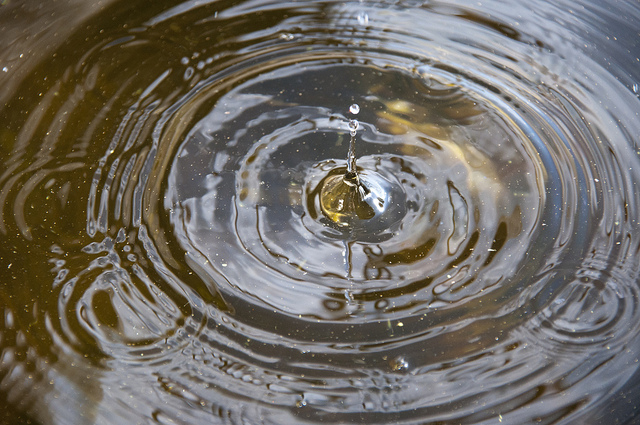
Our life is like the surface of a pond. No matter how smooth the surface has been or will be, the ripples spread out in the present.
When will you practice mindfulness today?
How do monastic reflection and leadership fit together for you?
[Image by Riebart]
Greg Richardson is a spiritual life mentor and leadership coach in Southern California. He is a recovering attorney and university professor, and a lay Oblate with New Camaldoli Hermitage near Big Sur, California. Greg’s website is StrategicMonk.com, and his email address is [email protected].
Previous Post

May 2, 2017
Practicing From the Inside Out: The Intricate Simplicity of Spiritual Life
Next Post

May 6, 2017 Practicing From the Inside Out: Balancing Our Working Life
Browse Our Archives
Select a Category Blog Book Reviews Everything Else Guest Posts Leadership Monastic Strategies Neighborhood Pilgrimages Sacred Stillness Spiritual Direction Spiritual Practices Work
Select a Month May 2024 April 2024 March 2024 February 2024 January 2024 December 2023 November 2023 October 2023 September 2023 August 2023 July 2023 June 2023 May 2023 April 2023 March 2023 February 2023 January 2023 December 2022 November 2022 October 2022 September 2022 August 2022 July 2022 June 2022 May 2022 April 2022 March 2022 February 2022 January 2022 December 2021 November 2021 October 2021 September 2021 August 2021 July 2021 June 2021 May 2021 April 2021 March 2021 February 2021 January 2021 December 2020 November 2020 October 2020 April 2020 March 2020 February 2020 January 2020 December 2019 November 2019 October 2019 September 2019 August 2019 July 2019 June 2019 May 2019 April 2019 March 2019 February 2019 January 2019 December 2018 November 2018 October 2018 September 2018 August 2018 July 2018 June 2018 May 2018 April 2018 March 2018 February 2018 January 2018 December 2017 November 2017 October 2017 September 2017 August 2017 July 2017 June 2017 May 2017 April 2017 March 2017 February 2017 January 2017 December 2016 November 2016 October 2016 September 2016 August 2016 July 2016 June 2016 May 2016 April 2016 March 2016 February 2016 January 2016 December 2015 November 2015 October 2015 September 2015 August 2015 July 2015 June 2015 May 2015 April 2015 March 2015 February 2015 January 2015 December 2014 November 2014 October 2014 September 2014 August 2014 July 2014 June 2014 May 2014 April 2014 March 2014 February 2014 January 2014 December 2013 November 2013 October 2013 September 2013 August 2013 July 2013 June 2013 May 2013 April 2013 March 2013 February 2013 January 2013 December 2012 November 2012 October 2012 September 2012 August 2012 July 2012 June 2012 May 2012 April 2012 March 2012 February 2012 January 2012 December 2011 November 2011 October 2011 September 2011 August 2011 July 2011 June 2011 May 2011 April 2011 March 2011 February 2011 January 2011 December 2010
Follow Us!
TAKE THE
Religious Wisdom Quiz
True or False: Balaam's donkey spoke to him.
Select your answer to see how you score.
FALSE TRUE
Related posts from Strategic Monk

How Are We Called to Live?: More About...

A Spiritual Practice of Reading: Join Us Online

Taking a Deep Breath, and Another: Finding Time...

Listening to Our Own Rhythms: When Will We...
TRENDING AT PATHEOS Contemplative

Handy Contemplative Practices for Political Spaces
A Spiritually Grounded Presence In order to bring a spiritually grounded presence...

Halloween: The Holiday of Loving Your Neighbor
All Hallows Eve Is Halloween the least Christian holiday in America, or...

Can Love Be Saved? Some Thoughts on the...
Happy Valentine's Day! I recently published a post on Patreon called Can...

"This Loving, Uniting Embrace": the Holy Ordinary
Today's guest post is by Mark Longhurst, author of The Holy Ordinary:...

How Are We Called to Live?: More About...
How Are We Called to Live? Many of us struggle with discerning...

A Spiritual Practice of Reading: Join Us Online
A Spiritual Practice of Reading A healthy spiritual practice of reading is...
view all Contemplative blogs
Ad-Free & Subscriber Log-In Subscription Support
- About Us
- 2026 Calendar
- Videos
- Podcasts
- Library of World Religions
- Faith In Media Tracker
- Advertise With Us
- Write for Us
- Privacy Policy
- Terms of Service
- Do Not Sell My Data
- Contact Us
- Radiant Digital
- Manage Newsletter Subscriptions
- Unsubscribe From Notifications
- Sitemap
Copyright 2008-2026, Patheos. All rights reserved.
Subscription Support Ad-Free & Subscriber Log-In
Follow Patheos