
BuddhistCatholicContemplativeEvangelicalGeneral ChristianHinduJewishLatter-day SaintMuslimNew VisionsProgressive Christian
Beliefs
- Buddhist
- Catholic
- Contemplative
- Evangelical
- General Christian
- Hindu
- Jewish
- Latter-day Saint
- More Voices
- Muslim
- New Visions
- Pagan
- Progressive Christian
Topics
- Religion News
- Food and Religion
- Sports and Religion
- Religious Art
- Religious Music and Entertainment
- Religious Events
- History and Religion
- Style and Religion
- Politics and Religion
- Women in Religion
- Recreation Outdoors and Religion
- Business Finance and Religion
- Careers Workplace and Religion
- Education and Religion
- Family Parenting and Religion
- Health Fitness and Religion
- Home and Religion
- Relationships and Religion
- Technology and Religion
- Travel and Religion
Columnists
- Buddhist Columnists
- Business Finance and Religion Columnists
- Careers Workplace and Religion Columnists
- Catholic Columnists
- Contemplative Columnists
- Education and Religion Columnists
- Evangelists Columnists
- Family Parenting and Religion Columnists
- General Christian Columnists
- Health Fitness and Religion Columnists
- Hindu Columnists
- History and Religion Columnists
- Home and Religion Columnists
- Jewish Columnists
- More Voices Columnists
- Latter Day Columnists
- Muslim Columnists
- New Visions Columnists
- Nonreligious Columnists
- Pagan Columnists
- Politics and Religion Columnists
- Progressive Columnists
- Recreation Outdoors and Religion Columnists
- Relationships and Religion Columnists
- Religion News Columnists
- Religious Art Columnists
- Religious Events Columnists
- Religious Music and Entertainment Columnists
- Sports and Religion Columnists
- Style and Religion Columnists
- Technology and Religion Columnists
- Travel and Religion Columnists
- Women in Religion Columnists
Resource Library
- 2026 Calendar
- Library of World Religions
- The 100 Most Holy Places on Earth
- Patheos Answers
- Podcasts
- Videos
- Faith Leaders Database
- Anglican Episcopalian
- Bahai
- Baptist
- Buddhism
- Christianity
- Confucianism
- Eastern Orthodoxy
- Hinduism
- Holiness and Pentecostal
- ISKCON
- Islam
- Judaism
- Lutheran
- Methodist
- The Church of Jesus Christ of Latter-day Saints
- New Age
- Paganism
- Presbytarian and Reformed
- Protestantism
- Religion Behind the Scenes
- Roman Catholic
- Scientology
- Shia Islam
- Sikhism
- Sufism
- Sunni Islam
- Taoism
- Zen
- See all religions
Research Tools
 Ad-Free & Subscriber Log-In Subscription Support
Ad-Free & Subscriber Log-In Subscription Support
Follow Patheos 

- Trending:
- Forgiveness
- |
- Marriage
- |
- Consciousness
- |
- Death Penalty
- |
- Election
- |
- Halloween
 Storied Theology
- Home
- Progressive Christian
- Light to See Political Light
Light to See Political Light
Last updated on: February 13, 2017 at 7:26 am by J. R. Daniel Kirk
Light to See Political Light 2017-02-13T07:26:17-08:00 J. R. Daniel Kirk
Patheos Explore the world's faith through different perspectives on religion and spirituality! Patheos has the views of the prevalent religions and spiritualities of the world.
As a character in the biblical story, God takes on the role of life-giver day by day because God gave life in the beginning.
Life is a many-faceted thing. Like its counterpart shalom, “peace,” which encompasses a holistic picture of human flourishing (and not just absence of conflict), chayyim (“life”) is much more than a body alive. Life is humanity as it was created to be. It is humanity loving and being loved by God. It is humanity loving and being loved by one another. It is humanity receiving the bounty of the earth.
The psalmist celebrates the divine provision of life:
How precious is your steadfast love, O God!
All people may take refuge in the shadow of your wings.
They feast on the abundance of your house,
and you give them drink from the river of your delights.
For with you is the fountain of life;
in your light we see light. (Psalm 36:7-10, NRSV)
The metaphor at the end is strange: “by your light we see light.” Typically, a brighter light will drown out lesser lights, not make them known. Perhaps the life-giving love of God is being depicted more like the sun: that which illumines other spaces.
In the final, climactic line of his lecture, “Is Theology Poetry?” C.S. Lewis famously said:
I believe in Christianity as I believe that the Sun has risen, not only because I see it, but because by it I see everything else.
In your light, we see light.
I’ve been thinking about this a good deal in relation to politics.
Bible People in the Secular Sphere
I have wrestled extensively with the question of how to be a Christian in the political arena. We can add political participation in a representative democracy to the list of critical things our lives consist of that the Bible gives us no direct guidance on.
Complicate matters a bit by throwing this into the mix: we are a pluralistic state, religiously. The state’s role in religion is to ensure free exercise without establishing any one over another. This means that faithfulness in this arena means preserving for others the right to practice and believe in ways that I might think are ultimately harmful or even offensive to God. 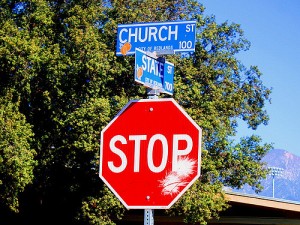
Roman Catholics have a done a better job at finding their way forward on this than Protestants have. It’s no accident that there are five Catholics and no Protestants on the Supreme Court. A rich tradition of “natural law” has made it much easier for a Catholic to engage in a broader conversation about law and ethics than it is for us “Bible alone” Protestants.
If my theology had its own Facebook page: it would stoke the ire of many in its family by saying that it is in a relationship with politics, but its relationship status would read, “Its complicated.”
Judgments of Light
Several years ago the seeds of my Christian political philosophy were sown by Miroslav Volf. He suggested that there was a very Christian way to think through politics and policies that would never be specifically Christian. We judge them by the golden rule and the command of love: Do to others what you want done to or for yourself, and Love your neighbor as yourself.
Mind-blowingly simple.
And yet the implementation is a lifetime of struggle and difficulty. It is all too easy to substitute “What I want for myself” for “What I’d want someone else to do for me.”
Volf gave me a start. But as I’ve wrestled with issues and parties and moments and people I have come to a couple of additional insights: (1) I will never be a “natural law” person, able to claim that there is some divine order anyone should be able to see; relatedly, (2) I’m never going to have a political philosophy that offers a set of values that is not ultimately judged by my Christian faith; and (3) not just the commands of love but the whole biblical story provides me with a range of sensibilities by which I judge political options.
It is in the light of what we have been given that I know light when I see it in the world of politics.
Limitations of Light
There are a few critical limitations to being able to sniff out Jesus in a political moment.
The kingdom of God is not a nation state. States can only do things that look more or less on earth like God’s will being done. We should never conflate the two.
More specifically, there are things a nation state must do that will never look like Jesus. A state will have to go to war. There is nothing more antithetical to the gospel story. There is nothing that looks less like life.
Additionally, we face the challenge of trying to walk a minefield of positions and parties and persons which one moment might look more like Jesus and another might look more like the Pharisee (i.e., the person who knows all the right answers and is the best reader of the sacred text but cannot see when the new moment requires a new way of understanding who we are) or more like the Roman soldier (i.e. the person who has no interest in religion except as fuel for the military-industrial complex).
Dangers and Perseverance
The moral ambiguities of this enterprise have led many Christians throughout the ages to withdraw from politics. I can only imagine the untold number of Americans who wish we’d do it en mass today.
But as long as our neighbors need love I cannot believe that this is a faithful Christian option.
The “golden rule” is not completely unique to Christianity. However, in the other iterations I have seen it acts as a guard rather than a source of positive initiative. As I’ve seen it elsewhere it has been phrased, “Do not do to others what you would not want done to you.” I can fulfill such a command by sitting alone in my room and never seeing another human being.
But the imperative to do unto others as I would have done to me demands that I act. When there is injustice, where there is death of any sort, it is an imperative to be an agent of life. As people given access to the power of the political system, this means participating in what governs our lives and the lives of our neighbors.
Moving Forward
It is not surprising that people who can’t agree on what their religion requires in the religious sphere also differ with each other in the political. But I want to host an extended conversation here about faith and politics, and I’d love to hear from you.
- What sort of rubric do you use for engaging politics as a person of faith?
- Is there really any point in participating in the system we’ve been given?
- Are you more actively engaging now than you did a year ago, if so what’s new?
- What are the points at which Christians should be changing the conversation rather than simply taking up the flag for one side or the other in the political maelstrom?
I’ve heard from so many people who want a better conversation. Maybe we can start one here.
Photo Credit: “Stop the Intersection of Church and State” | © Chuck Coker | flickr | CC 2.0
Previous Post

February 11, 2017
Love Your Enemy: Thoughts on Donald Trump
Next Post
February 14, 2017 Love Your Enemy: LectioCast Edition
Browse Our Archives
Select a Category American Culture Bible Book Reviews Church Culture Conferences LectioCast Newbigin House Pop Culture Uncategorized
Select a Month October 2017 March 2017 February 2017 January 2017 November 2016 October 2016 September 2016 August 2016 July 2016 June 2016 May 2016 April 2016 March 2016 February 2016 January 2016
Follow Us!
TAKE THE
Religious Wisdom Quiz
How did God speak to Moses at the burning bush?
Select your answer to see how you score.
Through wind Through lightning Symbols from the fire By name
Related posts from Storied Theology


"God Made Me Like This"? Sexuality & Culture
Love Your Enemy: LectioCast Edition
Love Your Enemy: Thoughts on Donald Trump
TRENDING AT PATHEOS Progressive Christian

What Being a Modern-Day Apostle Means to Me
In my last column, I discussed the ins and outs of modern-day...

Did Ancient China Once Worship the God of...
Across human history, a common thread weaves through the origins of the...

Love Your Neighbor – Including Earth-Kin: Lev. 19,...
God’s command to love your neighbor means acting in an ethical and...

Lead a Church Study of “Jesus and Lao...
Guest writer Jack Thomas (The Irreverent Reverend) reflects on leading his church...

Pastoral Wisdom for Responding to Sermon Pushback
Getting sermon pushback on your social justice sermon? Learn practical, Proverbs-based strategies...

Principles for Understanding the Apostolic Ministry Today
Whenever people discover that my formal ministry title is "apostle," as in...
view all Progressive Christian blogs
Ad-Free & Subscriber Log-In Subscription Support
- About Us
- 2026 Calendar
- Videos
- Podcasts
- Library of World Religions
- Faith In Media Tracker
- Advertise With Us
- Write for Us
- Privacy Policy
- Terms of Service
- Do Not Sell My Data
- Contact Us
- Radiant Digital
- Manage Newsletter Subscriptions
- Unsubscribe From Notifications
- Sitemap
Copyright 2008-2026, Patheos. All rights reserved.
Subscription Support Ad-Free & Subscriber Log-In
Follow Patheos