
BuddhistCatholicContemplativeEvangelicalGeneral ChristianHinduJewishLatter-day SaintMuslimNew VisionsProgressive Christian
Beliefs
- Buddhist
- Catholic
- Contemplative
- Evangelical
- General Christian
- Hindu
- Jewish
- Latter-day Saint
- More Voices
- Muslim
- New Visions
- Pagan
- Progressive Christian
Topics
- Religion News
- Food and Religion
- Sports and Religion
- Religious Art
- Religious Music and Entertainment
- Religious Events
- History and Religion
- Style and Religion
- Politics and Religion
- Women in Religion
- Recreation Outdoors and Religion
- Business Finance and Religion
- Careers Workplace and Religion
- Education and Religion
- Family Parenting and Religion
- Health Fitness and Religion
- Home and Religion
- Relationships and Religion
- Technology and Religion
- Travel and Religion
Columnists
- Buddhist Columnists
- Business Finance and Religion Columnists
- Careers Workplace and Religion Columnists
- Catholic Columnists
- Contemplative Columnists
- Education and Religion Columnists
- Evangelists Columnists
- Family Parenting and Religion Columnists
- General Christian Columnists
- Health Fitness and Religion Columnists
- Hindu Columnists
- History and Religion Columnists
- Home and Religion Columnists
- Jewish Columnists
- More Voices Columnists
- Latter Day Columnists
- Muslim Columnists
- New Visions Columnists
- Nonreligious Columnists
- Pagan Columnists
- Politics and Religion Columnists
- Progressive Columnists
- Recreation Outdoors and Religion Columnists
- Relationships and Religion Columnists
- Religion News Columnists
- Religious Art Columnists
- Religious Events Columnists
- Religious Music and Entertainment Columnists
- Sports and Religion Columnists
- Style and Religion Columnists
- Technology and Religion Columnists
- Travel and Religion Columnists
- Women in Religion Columnists
Resource Library
- 2026 Calendar
- Library of World Religions
- The 100 Most Holy Places on Earth
- Patheos Answers
- Podcasts
- Videos
- Faith Leaders Database
- Anglican Episcopalian
- Bahai
- Baptist
- Buddhism
- Christianity
- Confucianism
- Eastern Orthodoxy
- Hinduism
- Holiness and Pentecostal
- ISKCON
- Islam
- Judaism
- Lutheran
- Methodist
- The Church of Jesus Christ of Latter-day Saints
- New Age
- Paganism
- Presbytarian and Reformed
- Protestantism
- Religion Behind the Scenes
- Roman Catholic
- Scientology
- Shia Islam
- Sikhism
- Sufism
- Sunni Islam
- Taoism
- Zen
- See all religions
Research Tools
 Ad-Free & Subscriber Log-In Subscription Support
Ad-Free & Subscriber Log-In Subscription Support
Follow Patheos 

- Trending:
- Forgiveness
- |
- Marriage
- |
- Consciousness
- |
- Death Penalty
- |
- Election
- |
- Halloween
 Storied Theology
- Home
- Progressive Christian
- The “T” Word
The “T” Word
Last updated on: September 30, 2016 at 8:30 am by J. R. Daniel Kirk
The “T” Word 2016-09-30T08:30:52-08:00 J. R. Daniel Kirk
Patheos Explore the world's faith through different perspectives on religion and spirituality! Patheos has the views of the prevalent religions and spiritualities of the world.
This academic year I am serving as Pastoral Director for the Newbigin House of Studies Fellows Program. This is the first in a year-long series of posts in which I will be blogging about the reading that the Fellows are engaging together. You can read more about the Fellows Program here.
The “T” word. Truth. It’s probably second to the “S” word (“sin”) in terms of words that you try not to drop with too much conviction in polite society—and sometimes not even in church.
Lesslie Newbigin saw this coming, and set out his case that the good news the church has to proclaim is nothing less than public truth which addresses its claim to every sphere of life. This happens across three short chapters (originally lectures) in his book, Truth to Tell: The Gospel as Public Truth.
This idea, that the gospel is public truth with ramifications for every sphere of life lies at the heart of the missional calling of the church: its need and its ability to demonstrate that the gospel makes sense of and enables us best to cope with the actual world in which we find ourselves.
Threading the Needle
Newbigin is trying to thread the needle between liberalism and fundamentalism in the 1990s. Both, he claims (and I think he has a fair point) think about truth in terms of verifiable fact. Fundamentalists, therefore, create lengthy apologetics, articulating a truth based on whatever the assumptions of some purported question are. They thereby leave aside the self-involving nature of biblical faith as truth observed and articulated and embraced by an active subject.
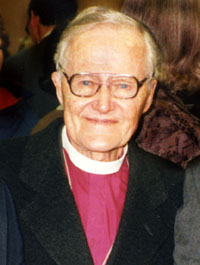
Leslie Newbigin. Photo Alastair Cutting, public domain
Liberals, on the other hand, leave aside the question of truth, mired as it is in what did or didn’t happen in a two-thousand year old Galilee to which we have little to no access, and offer a message of social justice that proclaims no good news at all. News would require something true to have happened.
Newbigin wants us to throw off the idea that unlimited pluralism is the only option open to us. He wants us to reclaim the idea that human life has purpose and we can know what that purpose is. We can know because God has revealed it to is in Christ.
The most basic claim that ties together Christians across the ages is, “Jesus is Lord.” This is not an invitation. It is a statement about world-wide, cosmic reality. So Newbigin wants us to leave aside trying to shore up an apologetics of a perfect Bible, and he wants us to leave aside denial of objective truth, and to reassert that we are who we are because there is a publicly testable claim to which we have given our allegiance.
What’s True?
Newbigin does not spend a lot of time in this short book telling us, exactly, what’s supposed to be “True” in this good news we proclaim. But he does give a couple of hints.
One criterion of truth seems to be simply this: does it make better sense of the world? And does it make us better, more highly flourishing people within that world?
…its reliability will be shown not by validating it against some external criteria, but by the way in which it enables the community that uses it to make sense of the whole complex world of things and happenings which human beings have to face—and by “making sense” I mean both understanding and coping with.
I really like that “coping with” piece. Newbigin’s plan isn’t one of mental explanations, but lived trust. Newbigin wants us to put our money where our mouth is. Christianity should, on its own grounds and not those of an external philosophy, show itself to make sense and to have the power to better integrate us as people, and better integrate us into the world.
But there’s a more basic claim in play for him, I think. Throughout he talks about how this is really about Christ, and Christ being Lord. The transformative moment that does not allow us to continue seeing the world as we used to is Jesus’s resurrection. Resurrection shows us that creation has a purpose even as the idea of creation shows us that it has an origin.
Previous Post

September 27, 2016
Swing States: We Need You to Save Us from Trump
Next Post

October 4, 2016 Theological Interpretation and the Problem of Whiteness
Browse Our Archives
Select a Category American Culture Bible Book Reviews Church Culture Conferences LectioCast Newbigin House Pop Culture Uncategorized
Select a Month October 2017 March 2017 February 2017 January 2017 November 2016 October 2016 September 2016 August 2016 July 2016 June 2016 May 2016 April 2016 March 2016 February 2016 January 2016
Follow Us!
TAKE THE
Religious Wisdom Quiz
What does the rider of the Black Horse in Revelation hold in his hand?
Select your answer to see how you score.
A bow A sword A book A pair of scales
Related posts from Storied Theology

A Man Attested by God: Response to Hurtado

"God Made Me Like This"? Sexuality & Culture

Love Your Enemy: Thoughts on Donald Trump
TRENDING AT PATHEOS Progressive Christian

What Being a Modern-Day Apostle Means to Me
In my last column, I discussed the ins and outs of modern-day...

Did Ancient China Once Worship the God of...
Across human history, a common thread weaves through the origins of the...

Love Your Neighbor – Including Earth-Kin: Lev. 19,...
God’s command to love your neighbor means acting in an ethical and...

Lead a Church Study of “Jesus and Lao...
Guest writer Jack Thomas (The Irreverent Reverend) reflects on leading his church...

Pastoral Wisdom for Responding to Sermon Pushback
Getting sermon pushback on your social justice sermon? Learn practical, Proverbs-based strategies...

Principles for Understanding the Apostolic Ministry Today
Whenever people discover that my formal ministry title is "apostle," as in...
view all Progressive Christian blogs
Ad-Free & Subscriber Log-In Subscription Support
- About Us
- 2026 Calendar
- Videos
- Podcasts
- Library of World Religions
- Faith In Media Tracker
- Advertise With Us
- Write for Us
- Privacy Policy
- Terms of Service
- Do Not Sell My Data
- Contact Us
- Radiant Digital
- Manage Newsletter Subscriptions
- Unsubscribe From Notifications
- Sitemap
Copyright 2008-2026, Patheos. All rights reserved.
Subscription Support Ad-Free & Subscriber Log-In
Follow Patheos