
BuddhistCatholicContemplativeEvangelicalGeneral ChristianHinduJewishLatter-day SaintMuslimNew VisionsProgressive Christian
Beliefs
- Buddhist
- Catholic
- Contemplative
- Evangelical
- General Christian
- Hindu
- Jewish
- Latter-day Saint
- More Voices
- Muslim
- New Visions
- Pagan
- Progressive Christian
Topics
- Religion News
- Food and Religion
- Sports and Religion
- Religious Art
- Religious Music and Entertainment
- Religious Events
- History and Religion
- Style and Religion
- Politics and Religion
- Women in Religion
- Recreation Outdoors and Religion
- Business Finance and Religion
- Careers Workplace and Religion
- Education and Religion
- Family Parenting and Religion
- Health Fitness and Religion
- Home and Religion
- Relationships and Religion
- Technology and Religion
- Travel and Religion
Columnists
- Buddhist Columnists
- Business Finance and Religion Columnists
- Careers Workplace and Religion Columnists
- Catholic Columnists
- Contemplative Columnists
- Education and Religion Columnists
- Evangelists Columnists
- Family Parenting and Religion Columnists
- General Christian Columnists
- Health Fitness and Religion Columnists
- Hindu Columnists
- History and Religion Columnists
- Home and Religion Columnists
- Jewish Columnists
- More Voices Columnists
- Latter Day Columnists
- Muslim Columnists
- New Visions Columnists
- Nonreligious Columnists
- Pagan Columnists
- Politics and Religion Columnists
- Progressive Columnists
- Recreation Outdoors and Religion Columnists
- Relationships and Religion Columnists
- Religion News Columnists
- Religious Art Columnists
- Religious Events Columnists
- Religious Music and Entertainment Columnists
- Sports and Religion Columnists
- Style and Religion Columnists
- Technology and Religion Columnists
- Travel and Religion Columnists
- Women in Religion Columnists
Resource Library
- 2026 Calendar
- Library of World Religions
- The 100 Most Holy Places on Earth
- Patheos Answers
- Podcasts
- Videos
- Faith Leaders Database
- Anglican Episcopalian
- Bahai
- Baptist
- Buddhism
- Christianity
- Confucianism
- Eastern Orthodoxy
- Hinduism
- Holiness and Pentecostal
- ISKCON
- Islam
- Judaism
- Lutheran
- Methodist
- The Church of Jesus Christ of Latter-day Saints
- New Age
- Paganism
- Presbytarian and Reformed
- Protestantism
- Religion Behind the Scenes
- Roman Catholic
- Scientology
- Shia Islam
- Sikhism
- Sufism
- Sunni Islam
- Taoism
- Zen
- See all religions
Research Tools
 Ad-Free & Subscriber Log-In Subscription Support
Ad-Free & Subscriber Log-In Subscription Support
Follow Patheos 

- Trending:
- Forgiveness
- |
- Marriage
- |
- Consciousness
- |
- Death Penalty
- |
- Election
- |
- Halloween
 Storied Theology
- Home
- Progressive Christian
- Called to Community
Called to Community
Last updated on: June 4, 2016 at 11:29 am by J. R. Daniel Kirk
Called to Community 2016-06-04T11:29:28-08:00 J. R. Daniel Kirk
Patheos Explore the world's faith through different perspectives on religion and spirituality! Patheos has the views of the prevalent religions and spiritualities of the world.
The following is my contribution to the Patheos Book Club conversation on Called to Community: the Life Jesus Wants for His People, edited by Charles E. Moore. See the other contributions here.
If you think Christianity is something you can live out on your own, if your measure of fidelity to the Christian story is taken in private practices of piety, Called to Community has a timely, if stark, word of warning: you’re doing it wrong. 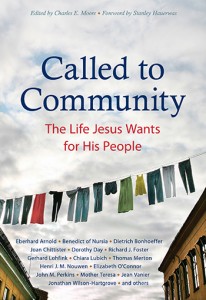
Called to Community contains fifty two chapters culled from the likes of Jean Vanier, Dietrich Bonhoeffer, Dorothy Day, John Perkins, Richard Foster, Henri Nouwen, and John Alexander. The format is intended to provide a year-long, weekly set of engagements to be read and discussed (wait for it…) in community.
As someone who read the book on my own in order to write a review of it here, I want to affirm the wisdom of reading the book in accordance with its intention. The book is about living in community. You can’t read it without the overwhelming sense that the only way to be transformed by what you’re reading is to be enabling others to live up to its vision and to be enabled, likewise, by others.
Challenging our Normal
Even if you have no desire to live in Christian community, this is a book you should read. The reason is this: it relentlessly calls our normal into question. We have been socialized into an individualistic way of being in such a complete and pervasive fashion that we don’t even realize where and how there are options for living differently. Called to Community puts these on the table in front of us.
In a provocative chapter entitled “Christian Communism” José Miranda argues that Acts depicts the early church as a communist counter-culture. When Peter tells Ananaias that the land he sold had belonged to him to do with as he wished, he was not opening up an opportunity for private ownership within the community. Miranda says that what was voluntary was joining the Jesus community. Yes, communism is optional–you don’t have to follow Jesus if you don’t want to.
But perhaps the most important challenges the book brings are not at those places where it tries to convince us to embrace something we are wary of, but where it opens our eyes to a new way of imagining something we think we already know. Jean Vanier breaks open the ideas of communion and love in this paragraph:
Communion means accepting people just as they are, with all their limits and inner pain, but also with their gifts and their beauty and their capacity to grow: to see the beauty inside of all the pain. To love someone is not first of all to do things for them, but to reveal to them their beauty and value, to say to them through your attitude, “You are beautiful. You are important. I trust you. You can trust yourself.”
That is the wisdom of someone who has been loving people in community for a lifetime. It is rich with the insight that the greatest act of love is often helping a person learn to truly love himself through the reality of the brokenness and pain that drive our self-protection and defensiveness.
But the thread that keep catching my attention throughout the book was the fact that the life Jesus calls us to, and promises us, is only possible if we are willing to be community for each other in ways that most Christians have dared not embrace.
Giving away our goods for the sake of the poor requires a people who can help make life possible after we have renounced trying to build our own little self-sufficient financial ecosystems.
Leaving father or mother or sister or brother for the sake of the gospel is only the life-giving way of Jesus when there are tenfold brothers and sisters waiting to embrace you into the new family.
The body is only really a body if we really depend on it to live day by day.
The Death of Idealism
For all of its high calling, this book is also sober about the realities of life in community. Idealism might draw us together, but it must be replaced by something far more enduring if the community is not going to whither and die as an ill-fated if noble experiment.
The reality is that community can guarantee only one thing: conflict. This is the context in which we begin to discover if we are pursuing a love that is truly life-giving to our neighbor. This is the context in which we learn whether we are in community in hopes of creating a utopian vision or in commitment to dying to ourselves, our egos, our plans, our visions along the way of the cross.
- “Innumerable times a whole Christian community has broken down because it has sprung from a wish dream… God’s grace speedily shatters such dreams.” –Dietrich Bonhoeffer
- “If everybody wants to be right, or even if only one person wants to be right, it is impossible to live in community.”–Eberhard Arnold
- “Community is a place of pain, of the death of ego.” –Jean Vanier
- “One of the main hindrances to doing God’s will is our unwillingness to give up self, our constant desire to have our own way.” –Arthur Gish
Community will only work if we realize that the frustrations we feel directed toward others are actually mirrors showing us what needs to be changed in ourselves. Idealistic notions of the community have to run aground and be sunk on the reality of who we are and the fact that we are bound to real people.
Not Quite Convinced
At times, the book reflects idealisms of its own that I did not find compelling.
I am not interested in propagating the mistaken decisions of the church long ago, for instance, in its forbidding of a man who opened an acting school to be a member. This is not the kind of “no compromise” that I really want to read about in any sort of normative fashion. Yes, they provided for his material needs. Good. But I don’t want anyone getting excited by the story of Cyprian and Marcus.
I also found John Alexander’s denigration of work to be a disappointing mixture of clarifying wisdom and parochial insularity. On the one hand, he is certainly correct that we have, to our own hurt, taken the language of “calling” and “vocation” and turned it from its roots in being called to the people and mission of God to a description of our jobs. Without a doubt this both reflects and facilitates our capitalistic idolatry of work.
But to take this to the extreme of saying that “those who are not part of a local church can scarcely be doing anything substantial for God” simply rehearses the mistake of the disciples who wanted to forbid the outsider exorcist from casting out demons because he wasn’t part of their little club. Yes, the kingdom of God works in surprising ways, on the fringes, in the margins, from apparent nothingness. But the idea that the church is the given place where power will burst forth is as mistaken as the idea that the workplace is where we’ll wield the power to manifest God’s kingdom. And, to deny that the church is the place is the equal and opposite error as denying that the workplace might be the locale.
My hope for Alexander’s insights would be that they would free us from a false tyranny of hearing God’s voice when it comes to finding a job (a problem that has beset humanity for very little of its history), without enslaving us in the tyranny of wrongly despising our jobs in order to be shackled to an insular view of the church.
Conversations We Need to Have
Yes, you should read this book with your people. Because it will stimulate the conversations we need to have. It can open our eyes to ways that our individualistic ways of life are the wrong sorts of containers to hold the life that Christ promises to pour into His people. It can provide us with a glimpse of how we need to walk with each other in more intimate communion if we are to be the blessing for the world that God wants God’s people to be.
Disclosure: In accordance with Federal law I hereby reveal to you, the otherwise trusting reader, that I received a free copy of this book in exchange for posting my review. I was under no obligation to say nice things, however, so take my grain of salt with a grain of salt.
Previous Post

June 2, 2016
The Gift of Bad Candidates
Next Post

June 8, 2016 The Stories We Tell
Browse Our Archives
Select a Category American Culture Bible Book Reviews Church Culture Conferences LectioCast Newbigin House Pop Culture Uncategorized
Select a Month October 2017 March 2017 February 2017 January 2017 November 2016 October 2016 September 2016 August 2016 July 2016 June 2016 May 2016 April 2016 March 2016 February 2016 January 2016
Follow Us!
TAKE THE
Religious Wisdom Quiz
True or False: In 2 Corinthians, Paul describes himself as having a thorn in the flesh.
Select your answer to see how you score.
TRUE FALSE
Related posts from Storied Theology

A Man Attested by God: Response to Hurtado


On Making a REALLY Big Deal About Jesus's...
From C. S. Lewis to the Synoptic Jesus
TRENDING AT PATHEOS Progressive Christian

What Being a Modern-Day Apostle Means to Me
In my last column, I discussed the ins and outs of modern-day...

Did Ancient China Once Worship the God of...
Across human history, a common thread weaves through the origins of the...

Love Your Neighbor – Including Earth-Kin: Lev. 19,...
God’s command to love your neighbor means acting in an ethical and...

Lead a Church Study of “Jesus and Lao...
Guest writer Jack Thomas (The Irreverent Reverend) reflects on leading his church...

Pastoral Wisdom for Responding to Sermon Pushback
Getting sermon pushback on your social justice sermon? Learn practical, Proverbs-based strategies...

Principles for Understanding the Apostolic Ministry Today
Whenever people discover that my formal ministry title is "apostle," as in...
view all Progressive Christian blogs
Ad-Free & Subscriber Log-In Subscription Support
- About Us
- 2026 Calendar
- Videos
- Podcasts
- Library of World Religions
- Faith In Media Tracker
- Advertise With Us
- Write for Us
- Privacy Policy
- Terms of Service
- Do Not Sell My Data
- Contact Us
- Radiant Digital
- Manage Newsletter Subscriptions
- Unsubscribe From Notifications
- Sitemap
Copyright 2008-2026, Patheos. All rights reserved.
Subscription Support Ad-Free & Subscriber Log-In
Follow Patheos