
BuddhistCatholicContemplativeEvangelicalGeneral ChristianHinduJewishLatter-day SaintMuslimNew VisionsProgressive Christian
Beliefs
- Buddhist
- Catholic
- Contemplative
- Evangelical
- General Christian
- Hindu
- Jewish
- Latter-day Saint
- More Voices
- Muslim
- New Visions
- Pagan
- Progressive Christian
Topics
- Religion News
- Food and Religion
- Sports and Religion
- Religious Art
- Religious Music and Entertainment
- Religious Events
- History and Religion
- Style and Religion
- Politics and Religion
- Women in Religion
- Recreation Outdoors and Religion
- Business Finance and Religion
- Careers Workplace and Religion
- Education and Religion
- Family Parenting and Religion
- Health Fitness and Religion
- Home and Religion
- Relationships and Religion
- Technology and Religion
- Travel and Religion
Columnists
- Buddhist Columnists
- Business Finance and Religion Columnists
- Careers Workplace and Religion Columnists
- Catholic Columnists
- Contemplative Columnists
- Education and Religion Columnists
- Evangelists Columnists
- Family Parenting and Religion Columnists
- General Christian Columnists
- Health Fitness and Religion Columnists
- Hindu Columnists
- History and Religion Columnists
- Home and Religion Columnists
- Jewish Columnists
- More Voices Columnists
- Latter Day Columnists
- Muslim Columnists
- New Visions Columnists
- Nonreligious Columnists
- Pagan Columnists
- Politics and Religion Columnists
- Progressive Columnists
- Recreation Outdoors and Religion Columnists
- Relationships and Religion Columnists
- Religion News Columnists
- Religious Art Columnists
- Religious Events Columnists
- Religious Music and Entertainment Columnists
- Sports and Religion Columnists
- Style and Religion Columnists
- Technology and Religion Columnists
- Travel and Religion Columnists
- Women in Religion Columnists
Resource Library
- 2026 Calendar
- Library of World Religions
- The 100 Most Holy Places on Earth
- Patheos Answers
- Podcasts
- Videos
- Faith Leaders Database
- Anglican Episcopalian
- Bahai
- Baptist
- Buddhism
- Christianity
- Confucianism
- Eastern Orthodoxy
- Hinduism
- Holiness and Pentecostal
- ISKCON
- Islam
- Judaism
- Lutheran
- Methodist
- The Church of Jesus Christ of Latter-day Saints
- New Age
- Paganism
- Presbytarian and Reformed
- Protestantism
- Religion Behind the Scenes
- Roman Catholic
- Scientology
- Shia Islam
- Sikhism
- Sufism
- Sunni Islam
- Taoism
- Zen
- See all religions
Research Tools
 Ad-Free & Subscriber Log-In Subscription Support
Ad-Free & Subscriber Log-In Subscription Support
Follow Patheos 

- Trending:
- Forgiveness
- |
- Marriage
- |
- Consciousness
- |
- Death Penalty
- |
- Election
- |
- Halloween
 Storied Theology
- Home
- Progressive Christian
- Hunger Games: Paying Attention
Hunger Games: Paying Attention
Last updated on: April 4, 2016 at 4:06 pm by J. R. Daniel Kirk
Hunger Games: Paying Attention 2016-04-04T16:06:22-08:00 J. R. Daniel Kirk
Patheos Explore the world's faith through different perspectives on religion and spirituality! Patheos has the views of the prevalent religions and spiritualities of the world.
Being an overly permissive parent, I just finished watching The Hunger Games with my kids. Frankly, it was a movie series I didn’t want to watch because the books left me with such a vacant pit in my stomach.
If there’s one problem with this series of movies it is that we will watch it in order to be entertained. And in so doing, we will fail to pay attention. As David Dark would say, this one deserves to be part of your attention collection.
A Mirror, Not a Screen
We haven’t really read or watched The Hunger Games until we have realized that we’re looking at a mirror and not a screen. The Capital of Panem is a place of luxury, entertainment, and consumption–upheld by the literal and figurative enslavement of the Districts and the Capital’s “peace keepers.” 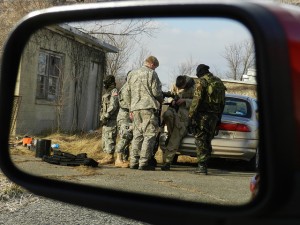
If there’s a flaw in the writing, perhaps it’s in making us so clearly identify with the Districts that we don’t realize we are cheering against ourselves.
The Hunger Games is largely about the brutality of war. It also provides a glimpse into its causes. Here are a few take-home points to linger over:
- Inequality creates an instability that raw power cannot keep in check forever
- War always destroys people—even the winners lose
- Caging people creates the violence we fear
- Conquered people will most likely attempt to exercise power using the same means by which they were conquered
These dynamics are playing out in big and small ways, and in some places are bubbling just underneath the surface preparing to explode.
The problems of inequality are showing themselves in dozens of ways in North America. The feeling of lower- to middle-class, working white people that America is leaving them behind is buoying the candidacy of Donald Trump.
We are being relentlessly exposed to the ways that the criminal justice system has been crafted for the purpose of maintaining and exacerbating the inequality between whites and blacks in America. We are being confronted with the damage we have done by caging people who should not be caged, leaving them no options within the law of contributing to society.
The past sixty years have shown us that when people are cordoned off in camps, helpless as their land and liberty is taken away, that these cages create extremists. It is happening in Palestine. It happened in Afghanistan. It has happened in Guantanamo Bay.
We’re surprised, offended, when the Districts rise up in revolt? We’re offended?
Listen to the Peacemakers
I would like to be a pacifist. If the past seventy years have shown us anything it’s that it is much easier to ensnare ourselves in evil uses of military force than to judiciously exercise it in a just manner.
But humanity needed the Civil War to rescue our own. And humanity needed World War 2 to rescue our own.
Nonetheless, the peacemakers (not the “peace keepers”) have something to teach us. This is what The Hunger Games has to teach us by way of contrast. 
The peacemakers have been reminding us that peace without justice is, at best, an illusion of peace for the comfort of the powerful. It is easy to nod gravely at the comment that Rome made a desert and called it peace, but harder to take the log out of our own eye.
The peacemakers have been reminding us that peace without equality is, at best, an illusion of peace for the comfort of the powerful. It is easy to look to our past and put ourselves on the right side of the debates over slavery, women’s rights, and integration, but harder to take the log out of our own eye when confronted with the staggering inequality between whites and blacks in 21st-century America.
The newspapers have been reminding us that conquering a people with bombs and expecting to institute democracy is an idle fantasy. The peacemakers have been reminding us that we have lent arms to the violent uprisings when the people have spoken against our will. We have created instability and stand surprised that the nations of the world do not simply rally to our side.
Not the Peacekeepers
Over the past couple of days my son has randomly said to me, “The peace keepers don’t keep peace.” He’s right. And he has put his finger on a glaring danger that The Hunger Games tries to lay bare.
The phrase “peace keepers” depends on the hegemonic narrative in which the world living under one group’s power is, by definition, peace. It presumes the existence of peace where there is none to be had.
This is our danger.
This is the trap we can fall into as we fall into the routine of living in the neighborhoods with “good schools” (read: with few poor or [non-Asian] minority kids), “send” our kids to college (read: we both have some money to help them out and every assurance that they will get into a school that will set them on the path they want to go), buy chocolate bars and bananas for $0.50 (read: reap the benefits of child slavery on farms in the developing world), and self-righteously condemn “extremist violence” around the world (read: reap the fruit of western military interventions and map-drawing).
Maybe what we should be hearing is that there is no peace.
Maybe what we should be hearing is that the world desperately needs peacemakers.
Maybe this is another call to those of us who call ourselves Christians to wake up to the fact that we have too long tried to play the game of achieving and participating in the world we’re in through playing by the same rules.
Maybe it’s time for us to realize that we have a different narrative with a different script. It is the script of the blessed peacemakers. It is the script that knows there is no “peace” until there is justice for those who cannot secure it for themselves in the corridors of power. Maybe it’s time for, together, to say no to the war that destroys and will always leave an empty pit in humanity’s soul.
Maybe it’s time for us to truly believe that to be a victor in these particular games of power and control is to continue being consumed by them–if not from the inside out then, eventually, from the outside in.
Photo © #1 Airsoft Mom | flickr | CC 2.0
Map of Panem © Stormfront81 | WikiCommons | CCAttribution Share-Alike 3.0
Previous Post

April 2, 2016
Not All Silence is Golden
Next Post
April 5, 2016 It's Still Easter
Browse Our Archives
Select a Category American Culture Bible Book Reviews Church Culture Conferences LectioCast Newbigin House Pop Culture Uncategorized
Select a Month October 2017 March 2017 February 2017 January 2017 November 2016 October 2016 September 2016 August 2016 July 2016 June 2016 May 2016 April 2016 March 2016 February 2016 January 2016
Follow Us!
TAKE THE
Religious Wisdom Quiz
What did David use to calm Saul when Saul was troubled by a harmful spirit?
Select your answer to see how you score.
Flute Drum Trumpet Harp
Related posts from Storied Theology



"God Made Me Like This"? Sexuality & Culture

TRENDING AT PATHEOS Progressive Christian

Why Christians Have a Sacred Duty to Vote:...
The Bible offers strong support for the sacred duty to vote. Here...

What Being a Modern-Day Apostle Means to Me
In my last column, I discussed the ins and outs of modern-day...

Did Ancient China Once Worship the God of...
Across human history, a common thread weaves through the origins of the...

Love Your Neighbor – Including Earth-Kin: Lev. 19,...
God’s command to love your neighbor means acting in an ethical and...

Lead a Church Study of “Jesus and Lao...
Guest writer Jack Thomas (The Irreverent Reverend) reflects on leading his church...

Principles for Understanding the Apostolic Ministry Today
Whenever people discover that my formal ministry title is "apostle," as in...
view all Progressive Christian blogs
Ad-Free & Subscriber Log-In Subscription Support
- About Us
- 2026 Calendar
- Videos
- Podcasts
- Library of World Religions
- Faith In Media Tracker
- Advertise With Us
- Write for Us
- Privacy Policy
- Terms of Service
- Do Not Sell My Data
- Contact Us
- Radiant Digital
- Manage Newsletter Subscriptions
- Unsubscribe From Notifications
- Sitemap
Copyright 2008-2026, Patheos. All rights reserved.
Subscription Support Ad-Free & Subscriber Log-In
Follow Patheos