
BuddhistCatholicContemplativeEvangelicalGeneral ChristianHinduJewishLatter-day SaintMuslimNew VisionsProgressive Christian
Beliefs
- Buddhist
- Catholic
- Contemplative
- Evangelical
- General Christian
- Hindu
- Jewish
- Latter-day Saint
- More Voices
- Muslim
- New Visions
- Pagan
- Progressive Christian
Topics
- Religion News
- Food and Religion
- Sports and Religion
- Religious Art
- Religious Music and Entertainment
- Religious Events
- History and Religion
- Style and Religion
- Politics and Religion
- Women in Religion
- Recreation Outdoors and Religion
- Business Finance and Religion
- Careers Workplace and Religion
- Education and Religion
- Family Parenting and Religion
- Health Fitness and Religion
- Home and Religion
- Relationships and Religion
- Technology and Religion
- Travel and Religion
Columnists
- Buddhist Columnists
- Business Finance and Religion Columnists
- Careers Workplace and Religion Columnists
- Catholic Columnists
- Contemplative Columnists
- Education and Religion Columnists
- Evangelists Columnists
- Family Parenting and Religion Columnists
- General Christian Columnists
- Health Fitness and Religion Columnists
- Hindu Columnists
- History and Religion Columnists
- Home and Religion Columnists
- Jewish Columnists
- More Voices Columnists
- Latter Day Columnists
- Muslim Columnists
- New Visions Columnists
- Nonreligious Columnists
- Pagan Columnists
- Politics and Religion Columnists
- Progressive Columnists
- Recreation Outdoors and Religion Columnists
- Relationships and Religion Columnists
- Religion News Columnists
- Religious Art Columnists
- Religious Events Columnists
- Religious Music and Entertainment Columnists
- Sports and Religion Columnists
- Style and Religion Columnists
- Technology and Religion Columnists
- Travel and Religion Columnists
- Women in Religion Columnists
Resource Library
- 2026 Calendar
- Library of World Religions
- The 100 Most Holy Places on Earth
- Patheos Answers
- Podcasts
- Videos
- Faith Leaders Database
- Anglican Episcopalian
- Bahai
- Baptist
- Buddhism
- Christianity
- Confucianism
- Eastern Orthodoxy
- Hinduism
- Holiness and Pentecostal
- ISKCON
- Islam
- Judaism
- Lutheran
- Methodist
- The Church of Jesus Christ of Latter-day Saints
- New Age
- Paganism
- Presbytarian and Reformed
- Protestantism
- Religion Behind the Scenes
- Roman Catholic
- Scientology
- Shia Islam
- Sikhism
- Sufism
- Sunni Islam
- Taoism
- Zen
- See all religions
Research Tools
 Ad-Free & Subscriber Log-In Subscription Support
Ad-Free & Subscriber Log-In Subscription Support
Follow Patheos 

- Trending:
- Forgiveness
- |
- Marriage
- |
- Consciousness
- |
- Death Penalty
- |
- Election
- |
- Halloween
 Storied Theology
- Home
- Progressive Christian
- Abortion: Is a Better Conversation Possible?
Abortion: Is a Better Conversation Possible?
Last updated on: March 31, 2016 at 7:08 am by J. R. Daniel Kirk
Abortion: Is a Better Conversation Possible? 2016-03-31T07:08:52-08:00 J. R. Daniel Kirk
Patheos Explore the world's faith through different perspectives on religion and spirituality! Patheos has the views of the prevalent religions and spiritualities of the world.
Yesterday Donald Trump made headlines (again) by saying something that struck him as common sense (again) and which manage to alienate the vast majority of America (again). Riffing (as he does) on the issue of abortion, he said that there should be some form of punishment for women who have abortions.
His team later backtracked on his behalf, saying that the doctors (not the women) should be held responsible. The bi-partisan backlash opens up an interesting window into what we really do (and don’t) want to say about abortion.
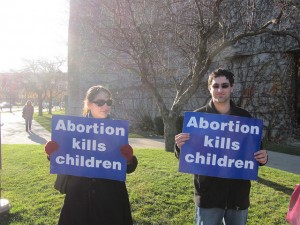
Univ. of Toronto Students for Life
I remember earlier this century, probably in other presidential election cycles, there was talk of the hope that the movement of especially younger and evangelical Christians toward Democratic politics due to social justice concerns would help change the Democratic Party’s platform of carte blanche abortion availability. I haven’t heard those hopes expressed recently. I think it’s at least worth asking if those of us who lean Democrat have become institutionalized, unwilling to ask a hard question for fear of alienating our new friends.
So with fear and trembling (I really don’t like conflict as much as it might sometimes seem like I do) I want to ask if a better conversation is possible. And by “better,” I mean, can we have one? Where are the strengths and weaknesses of both positions as they find current expression? What is the good that each side is trying to maintain? Is it possible that there’s a middle ground in this issue between unfettered access and nearly unlimited restriction?
The Right to Privacy
In his off-the-cuff comment yesterday Trump demonstrated that he is tone deaf to the dynamics of power. This might come as a surprise, since his whole campaign is built on the power of bullying and machismo. But like so many others who have leveraged patriarchy to their advantage, he is unaware that there are actual human beings being trod underfoot each time he exalts himself by stepping on someone else. Or, he doesn’t care.
But the backlash yesterday shows that most of us do care.
Republicans as well as Democrats came out saying that punishment of the woman is punishment misdirected. Both sides care about the woman.
The abortion rights movement cares about the power dynamics that kept women subservient to their husbands and under his control with regard to all her life’s doings—including what a woman does with her body. This was the heart of Roe v. Wade.
The fundamental right that was upheld in that case was not the right to have an abortion. Beneath that, as I understand it (and folks who know the law feel free to jump in and correct me here), was the more fundamental “right to privacy.” That is to say, this woman did not have to ask her husband whether or not it was ok to get an abortion. 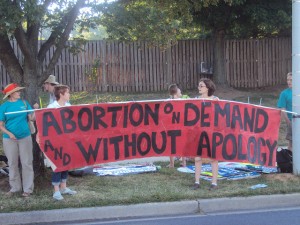
The court was dismantling an expression of patriarchy, a notion or law that was keeping women subservient to their husbands. That’s why in its modern incarnation this is a “women’s rights” issue.
Privacy and Secrecy
When decoupled from the issue of patriarchy, and giving women the right to function as autonomous human beings without the permission of the men who have authority over them, I find the “right to privacy” to be a shaky idea, only as strong as the action it’s protecting.
Pro-life advocates will often equate abortion with killing. If you go with that logic for a minute then the problem with “privacy” becomes apparent. There are times when what I do in private become public business, as when my actions cost someone else their life or possessions.
We have a right to privacy, sure. But we don’t have a right to (absolute) secrecy.
Here’s an idea I have been playing with for a long time: privacy protects the weak and vulnerable, secrecy protects the strong.
I think that this takes us to the heart of the abortion debate:
- Advocates of women’s rights are dialed into women as those who have to continue to find their way in a world where men have more power (take a look at Washington: out of a hundred U.S. Senators only twenty are currently women). The right to privacy is essential for women’s protection, including healthcare decisions, in a world that tilts toward women’s being subject to men.
- Pro-Life advocates are dialed into the unborn child as the one who has less power, even, than the woman who is carrying it. If the lack of power a woman has, compared to a man, is relatively little, the lacking power that a baby has compared to its carrying mother is absolute.
Have I fairly articulated the driving positive concerns of both sides? I think that both groups are looking to use legislative means to protect those who otherwise would not have the power to protect themselves.
Questions
Articulating the problems with the other side’s position is where we often work ourselves out of conversation and into a heat that blocks out the light. Even asking questions often feels like a rhetorical exercise, designed simply to make the point about how the other side is wrong. But, maybe can we just ask question as questions this time around and listen to honest responses?
Here are a few:
- If you are generally in favor of abortion rights, is there some point in time prior to delivery when you think that the fetus growing inside the mother is a baby human worthy of legal protection?
- If you are generally in favor of protecting the physical life of the child, what do you make of the need to protect the holistic life of the mother (including social and economic well-being, in addition to physical survival)?
- If you are generally in favor of abortion rights, are you concerned at all that the wide availability of procedures has tended toward elimination of fetuses with genetic abnormalities?
- If you are generally pro-life, does the splitting of cells that begins with fertilization constitute human life? Why? Does this mean that we should avoid IUDs and, perhaps birth control pills, that might cause a fertilized egg to not be able to implant on a uterine wall? Is a miscarriage at any point in the 9-month gestation period the same as the death of a child?
- Should a fetus’s ability to feel pain at some point be one of the markers of when an abortion procedure should be off limits?
- If you are generally in favor of abortion rights, how do you think about abortion? A “good” that’s available to us safely because of modern medical technology? A sometimes “necessary evil” due to a certain confluence of life circumstances? Something in between such as an “important tool” for giving women the opportunity to make the most out of their lives?
- If you are generally pro-life, how do you consider the women’s health issues involved? If we are talking about punishing providers, not the women, with our laws, what are the ramifications for creating only illegal means of being a provider? What will this mean for poor women who seek out an abortion in contrast to rich women who seek one out?
- How does your Christian faith influence you on this issue? Do you think that scripture indicates that life begins at some point? Do you think that scripture is completely equivocal such that we have to use other means of deciding? What strand of the Christian narrative energizes your position?
Crossing Lines
When I was in college I had two friends. I know, that’s hard to believe. But it’s true. I had two.
My friend Rodney was a yellow dog Democrat from North Carolina. He was pro-life as a matter of consistency with his Democratic values of government intervention to take care of the most vulnerable.
My friend Ana was a conservative Republican who was pro-choice as a matter of consistency with her Republican values of minimal government involvement and the freedom of the people (and states) to make decisions that they deemed to be in their best interest.
1992 was a different era in politics. But it was still a time when many Christians were one-issue, and therefore one-party voters. Abortion was everything.
Is it possible to have a better conversation? Is it possible to reimagine the abortion conversation such that we at least see in the folks on the “other side” that there is a genuine concern to protect the vulnerable and powerless? Is it possible to reimagine an abortion position that charts a third way between the poles we’ve been given?
Let’s find out.
Photos:
© University of Toronto Students for Life | flickr | CC 2.0
© Deborah Sweet | flickr | CC 2.0
Featured Image © Elvert Barnes | flickr | CC 2.0 (photo cropped)
Previous Post

March 28, 2016
North Carolina: A Microcosm of American Fear
Next Post

April 2, 2016 Not All Silence is Golden
Browse Our Archives
Select a Category American Culture Bible Book Reviews Church Culture Conferences LectioCast Newbigin House Pop Culture Uncategorized
Select a Month October 2017 March 2017 February 2017 January 2017 November 2016 October 2016 September 2016 August 2016 July 2016 June 2016 May 2016 April 2016 March 2016 February 2016 January 2016
Follow Us!
TAKE THE
Religious Wisdom Quiz
What was a "phylactery," criticized by Jesus in Matthew 23?
Select your answer to see how you score.
A fishing net A robe A small box with Scripture A lamp
Related posts from Storied Theology


"God Made Me Like This"? Sexuality & Culture


Love Your Enemy: Thoughts on Donald Trump
TRENDING AT PATHEOS Progressive Christian

What Being a Modern-Day Apostle Means to Me
In my last column, I discussed the ins and outs of modern-day...

Did Ancient China Once Worship the God of...
Across human history, a common thread weaves through the origins of the...

Love Your Neighbor – Including Earth-Kin: Lev. 19,...
God’s command to love your neighbor means acting in an ethical and...

Lead a Church Study of “Jesus and Lao...
Guest writer Jack Thomas (The Irreverent Reverend) reflects on leading his church...

Pastoral Wisdom for Responding to Sermon Pushback
Getting sermon pushback on your social justice sermon? Learn practical, Proverbs-based strategies...

Principles for Understanding the Apostolic Ministry Today
Whenever people discover that my formal ministry title is "apostle," as in...
view all Progressive Christian blogs
Ad-Free & Subscriber Log-In Subscription Support
- About Us
- 2026 Calendar
- Videos
- Podcasts
- Library of World Religions
- Faith In Media Tracker
- Advertise With Us
- Write for Us
- Privacy Policy
- Terms of Service
- Do Not Sell My Data
- Contact Us
- Radiant Digital
- Manage Newsletter Subscriptions
- Unsubscribe From Notifications
- Sitemap
Copyright 2008-2026, Patheos. All rights reserved.
Subscription Support Ad-Free & Subscriber Log-In
Follow Patheos