
BuddhistCatholicContemplativeEvangelicalGeneral ChristianHinduJewishLatter-day SaintMuslimNew VisionsProgressive Christian
Beliefs
- Buddhist
- Catholic
- Contemplative
- Evangelical
- General Christian
- Hindu
- Jewish
- Latter-day Saint
- More Voices
- Muslim
- New Visions
- Pagan
- Progressive Christian
Topics
- Religion News
- Food and Religion
- Sports and Religion
- Religious Art
- Religious Music and Entertainment
- Religious Events
- History and Religion
- Style and Religion
- Politics and Religion
- Women in Religion
- Recreation Outdoors and Religion
- Business Finance and Religion
- Careers Workplace and Religion
- Education and Religion
- Family Parenting and Religion
- Health Fitness and Religion
- Home and Religion
- Relationships and Religion
- Technology and Religion
- Travel and Religion
Columnists
- Buddhist Columnists
- Business Finance and Religion Columnists
- Careers Workplace and Religion Columnists
- Catholic Columnists
- Contemplative Columnists
- Education and Religion Columnists
- Evangelists Columnists
- Family Parenting and Religion Columnists
- General Christian Columnists
- Health Fitness and Religion Columnists
- Hindu Columnists
- History and Religion Columnists
- Home and Religion Columnists
- Jewish Columnists
- More Voices Columnists
- Latter Day Columnists
- Muslim Columnists
- New Visions Columnists
- Nonreligious Columnists
- Pagan Columnists
- Politics and Religion Columnists
- Progressive Columnists
- Recreation Outdoors and Religion Columnists
- Relationships and Religion Columnists
- Religion News Columnists
- Religious Art Columnists
- Religious Events Columnists
- Religious Music and Entertainment Columnists
- Sports and Religion Columnists
- Style and Religion Columnists
- Technology and Religion Columnists
- Travel and Religion Columnists
- Women in Religion Columnists
Resource Library
- 2026 Calendar
- Library of World Religions
- The 100 Most Holy Places on Earth
- Patheos Answers
- Podcasts
- Videos
- Faith Leaders Database
- Anglican Episcopalian
- Bahai
- Baptist
- Buddhism
- Christianity
- Confucianism
- Eastern Orthodoxy
- Hinduism
- Holiness and Pentecostal
- ISKCON
- Islam
- Judaism
- Lutheran
- Methodist
- The Church of Jesus Christ of Latter-day Saints
- New Age
- Paganism
- Presbytarian and Reformed
- Protestantism
- Religion Behind the Scenes
- Roman Catholic
- Scientology
- Shia Islam
- Sikhism
- Sufism
- Sunni Islam
- Taoism
- Zen
- See all religions
Research Tools
 Ad-Free & Subscriber Log-In Subscription Support
Ad-Free & Subscriber Log-In Subscription Support
Follow Patheos 

- Trending:
- Forgiveness
- |
- Marriage
- |
- Consciousness
- |
- Death Penalty
- |
- Election
- |
- Halloween
 Storied Theology
- Home
- Progressive Christian
- Holy Week: the Penultimate Supper
Holy Week: the Penultimate Supper
Last updated on: March 23, 2016 at 5:32 am by J. R. Daniel Kirk
Holy Week: the Penultimate Supper 2016-03-23T05:32:14-08:00 J. R. Daniel Kirk
Patheos Explore the world's faith through different perspectives on religion and spirituality! Patheos has the views of the prevalent religions and spiritualities of the world.
So there’s the famous “last supper” of Jesus, complete with famous paintings and weekly remembrances. “Do this in remembrance of me.”
And then there’s the next-to-last supper. We don’t imitate it every week. But it, too, is a marked with words of remembrance: not a command that we imitate in order to remember Jesus, but a promise that what went down will be told in remembrance of her.
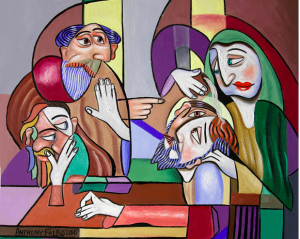
Anthony Falbo, “Jesus Anointed at Bethany”
Her.
The final appearance of the most faithful character-type in the Gospel of Mark: the unnamed women. These are the ones who have been willing to serve rather than be served, who have exercised great faith in contrast to the fear of the disciples, who have given their very lives.
And now there comes a deed that will be told wherever the gospel is proclaimed. A deed that captures the very aspect of the gospel that the disciples continually reject.
Death Becomes Him
Mark has set this story in the middle of the plot to seize and kill Jesus. They want to seize Jesus secretly. This is the intro.
When the story of this woman’s act of lavish generosity is over, we read that Judas goes to find the religious leaders and agrees to hand over Jesus for money.
The stories mingle and diverge.
The religious leaders are afraid that if they seize Jesus publicly the crowd will riot. The crowd has hailed him as coming king. They would not have their king seized and locked up and killed.
Of course, the paradox of Jesus’ kingship is that it can only be his if, in fact, he is obedient to the point of death.
When this nameless woman pours oil over Jesus’s head, the people standing by become indignant at the waste. But Jesus says it is a good work, done to prepare his body for burial.
The same hearts that would be stirred to a riotous rage should Jesus be seized before them are stirred with indignation at a display that honors him as the very kind of king he must be–a cruciform king.
Royalty
The mystery of Jesus and of his mission in this story is that as Christ, as Son of God, Jesus is the suffering Human One. This is the disclosure that Jesus repeatedly tries to make, the reworking of his followers’ understanding that he strives for.
Yes, he is the Christ.
No, his enthronement not going to happen like that.
When the woman pours this oil on Jesus’ head the most obvious symbolism is that it is an anointing. In this room, through this action, Jesus is the anointed one. The oil is poured over his head as though he is a king or a priest.
But Jesus does not say that she has honored him by recognizing his royal standing. He offers a surprising interpretation. This good deed has prepared his body beforehand for burial.
This is not a case of either/or. It is both/and.
This is a moment of clarity in the story. It’s the only time prior to Jesus’ death itself that any human character does anything to affirm that Jesus is Messiah only if he takes his kingdom by obeying his calling to rejection, suffering, and death.
This is why he makes his promise. This act will be told wherever he gospel is proclaimed, in memory of her. It will be told because that conjunction is, itself, the embodiment of the gospel mystery: in order to be the king, Jesus must be the crucified.
(In)Dignity
There is no kingdom without the cross. This is what creates the confusions and indignities that beset Jesus’ followers.
They want a kingdom with dignity. They want a kingdom with glory. It is here that we catch a glimpse of our own hearts, reflected as in a mirror.
The quintessential failure of discipleship is to think that the world’s way of attaining power, of exercising power, of rising in glory is all a given, and that Jesus’s job is simply to allow us to play the part of the powerful in the script.
But something happens with this embrace of death. Up becomes down and down becomes up.
Humility becomes a word of glory for the first time. The cross becomes a symbol of honor for the first time. The weakness of death becomes the playground for the power of God.
To “remember her” is to remember him rightly. It is to remember what we should be reminded of in our weekly remembrance of the body given and blood spilled.
It is to remember that the ongoing challenge to discipleship is to entrust ourselves to an economy that our eyes cannot see. It is to entrust ourselves to the God who makes honor out of the dust of shame, who creates abundance out of the crumbs of lack, who makes kings out of those dead in their graves.
Image: Anthony Falbo, “Jesus Anointed at Bethany“
Previous Post
March 22, 2016
Holy Week: Alex Nieto and the Power of Death
Next Post
March 24, 2016 Holy Week: Table Service
Browse Our Archives
Select a Category American Culture Bible Book Reviews Church Culture Conferences LectioCast Newbigin House Pop Culture Uncategorized
Select a Month October 2017 March 2017 February 2017 January 2017 November 2016 October 2016 September 2016 August 2016 July 2016 June 2016 May 2016 April 2016 March 2016 February 2016 January 2016
Follow Us!
TAKE THE
Religious Wisdom Quiz
Which disciple brought his brother to Jesus, saying, 'We have found the Messiah'?
Select your answer to see how you score.
Andrew John James Peter
Related posts from Storied Theology



Love Your Enemy: Thoughts on Donald Trump

Today, the Human Jesus Matters
TRENDING AT PATHEOS Progressive Christian

What Being a Modern-Day Apostle Means to Me
In my last column, I discussed the ins and outs of modern-day...

Did Ancient China Once Worship the God of...
Across human history, a common thread weaves through the origins of the...

Love Your Neighbor – Including Earth-Kin: Lev. 19,...
God’s command to love your neighbor means acting in an ethical and...

Lead a Church Study of “Jesus and Lao...
Guest writer Jack Thomas (The Irreverent Reverend) reflects on leading his church...

Pastoral Wisdom for Responding to Sermon Pushback
Getting sermon pushback on your social justice sermon? Learn practical, Proverbs-based strategies...

Principles for Understanding the Apostolic Ministry Today
Whenever people discover that my formal ministry title is "apostle," as in...
view all Progressive Christian blogs
Ad-Free & Subscriber Log-In Subscription Support
- About Us
- 2026 Calendar
- Videos
- Podcasts
- Library of World Religions
- Faith In Media Tracker
- Advertise With Us
- Write for Us
- Privacy Policy
- Terms of Service
- Do Not Sell My Data
- Contact Us
- Radiant Digital
- Manage Newsletter Subscriptions
- Unsubscribe From Notifications
- Sitemap
Copyright 2008-2026, Patheos. All rights reserved.
Subscription Support Ad-Free & Subscriber Log-In
Follow Patheos