
BuddhistCatholicContemplativeEvangelicalGeneral ChristianHinduJewishLatter-day SaintMuslimNew VisionsProgressive Christian
Beliefs
- Buddhist
- Catholic
- Contemplative
- Evangelical
- General Christian
- Hindu
- Jewish
- Latter-day Saint
- More Voices
- Muslim
- New Visions
- Pagan
- Progressive Christian
Topics
- Religion News
- Food and Religion
- Sports and Religion
- Religious Art
- Religious Music and Entertainment
- Religious Events
- History and Religion
- Style and Religion
- Politics and Religion
- Women in Religion
- Recreation Outdoors and Religion
- Business Finance and Religion
- Careers Workplace and Religion
- Education and Religion
- Family Parenting and Religion
- Health Fitness and Religion
- Home and Religion
- Relationships and Religion
- Technology and Religion
- Travel and Religion
Columnists
- Buddhist Columnists
- Business Finance and Religion Columnists
- Careers Workplace and Religion Columnists
- Catholic Columnists
- Contemplative Columnists
- Education and Religion Columnists
- Evangelists Columnists
- Family Parenting and Religion Columnists
- General Christian Columnists
- Health Fitness and Religion Columnists
- Hindu Columnists
- History and Religion Columnists
- Home and Religion Columnists
- Jewish Columnists
- More Voices Columnists
- Latter Day Columnists
- Muslim Columnists
- New Visions Columnists
- Nonreligious Columnists
- Pagan Columnists
- Politics and Religion Columnists
- Progressive Columnists
- Recreation Outdoors and Religion Columnists
- Relationships and Religion Columnists
- Religion News Columnists
- Religious Art Columnists
- Religious Events Columnists
- Religious Music and Entertainment Columnists
- Sports and Religion Columnists
- Style and Religion Columnists
- Technology and Religion Columnists
- Travel and Religion Columnists
- Women in Religion Columnists
Resource Library
- 2026 Calendar
- Library of World Religions
- The 100 Most Holy Places on Earth
- Patheos Answers
- Podcasts
- Videos
- Faith Leaders Database
- Anglican Episcopalian
- Bahai
- Baptist
- Buddhism
- Christianity
- Confucianism
- Eastern Orthodoxy
- Hinduism
- Holiness and Pentecostal
- ISKCON
- Islam
- Judaism
- Lutheran
- Methodist
- The Church of Jesus Christ of Latter-day Saints
- New Age
- Paganism
- Presbytarian and Reformed
- Protestantism
- Religion Behind the Scenes
- Roman Catholic
- Scientology
- Shia Islam
- Sikhism
- Sufism
- Sunni Islam
- Taoism
- Zen
- See all religions
Research Tools
 Ad-Free & Subscriber Log-In Subscription Support
Ad-Free & Subscriber Log-In Subscription Support
Follow Patheos 

- Trending:
- Forgiveness
- |
- Marriage
- |
- Consciousness
- |
- Death Penalty
- |
- Election
- |
- Halloween
 Storied Theology
- Home
- Progressive Christian
- Life’s Too Short to Not Read David Dark
Life’s Too Short to Not Read David Dark
Last updated on: February 19, 2016 at 9:49 am by J. R. Daniel Kirk
Life’s Too Short to Not Read David Dark 2016-02-19T09:49:34-08:00 J. R. Daniel Kirk
Patheos Explore the world's faith through different perspectives on religion and spirituality! Patheos has the views of the prevalent religions and spiritualities of the world.
Tour de Awesome
Blogsphere confessional: I have a total, complete, 100% man-crush on David Dark. From the time I first took in hand Everyday Apocalypse and read about the epiphany he experienced while watching Raising Arizona, I knew that I was in the presence of someone through whose eyes I wanted to see the world.
That snippet summarizes what I loved, cover to cover, in Dark’s latest book, Life’s Too Short to Pretend You’re Not Religious.
I would not call Dark a religionist so much as I would call him a cultural critic. But I wouldn’t call him a critic so much as I would call him a lover and, perhaps more to the point, an inveterate interpreter of culture.
It seems that everything upon which David Dark sets his eyes, or everything that reaches his ears simply explodes with the kind of meaning that most of us would strain to hear. To take up Life’s Too Short is be, in turn, taken by the hand and led through an exhilarating tour of the world we occupy together and what it tells us about ourselves.
Religious?
So now that you know how deeply my heart is stirred, I can now risk my single, pervasive, and agonizing critique of the book. It’s the word “religious.”
The title of the book might make you think that it’s a sort of apologetics book. Maybe the nice guy kind. But still. The kind of book that you’d read for the purpose of handing to your agnostic or atheist friend in hopes of getting them to see that they, too, are worshiping G/god in some form or another.
But the truth of the matter is that if there is any conversion to be had from this book’s pages it’s the conversion of the religious who think that their religious forms are the way in which true religion is practiced.
“Religion” in this book is about being enmeshed in relationships–with each other as much as anything else. It is about being perpetual meaning-making and story-telling creatures. 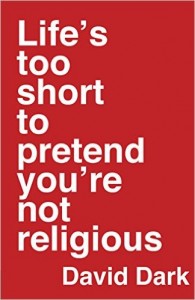
In other words, it’s not what most people mean by religious.
Which is all fine and good. It’s nice to have our categories subverted from time to time. But the insistence on naming as religion these things that most wouldn’t call religious is a significant liability. It has made me hesitate to recommend the book to the people with whom I would most like to discuss it–a few friends who are, like Dark, insatiable interpreters of the world but who, unlike Dark, no longer self-identify as religious in any significant sense.
Yes, I found myself thinking, “Life’s too short to pretend this book’s religious!”
For the Beauty
“I’m in it for the beauty.” That’s the heartbeat Dark ascribes to his work. He goes on to articulate a vision for life in which we do not use convictions to divide from other people, but instead cultivate convictions that all people are worth knowing:
As I see it, to refuse the possibility of finding another person interesting, complex and as complicated as oneself is a form of violence. At bottom, this is a refusal of nuance, and I wish to posit that nuance is sacred… nuance also delivers us out of the deadly habit of cutting people out of our own imaginations. This opens us up to the possibility of at least occasionally finding one another beautiful, the possibility of communion.
Can I get an “Amen”?
He also works with a category of narrative / story that resonates deeply with my own “storied theology” approach to scripture and to faith. Speaking of the Bible, Dark says,
Weirdly enough, committing myself to it, in spirit and in truth, means to hold fast to movement, to receptivity, to new and unforeseen goodness on the horizon, to what the Spirit of the Lord might be saying to us in our contemporary context.
Listening to scripture means entering the story as an on-going story that might still surprise.
It turns out that my admiration for Dark’s ability to notice meaning in everything is no accident. He talks about the importance, the centrality, of paying attention. What we choose to pay attention to shows who we are, what we are, as it bears its fruit in our lives. Be careful what you pay attention to.
Making Me a Better Human
I hate to make two confessions in one post, but… well… it’s that kind of day. So here goes: what I read doesn’t often make me a better person. Despite my academic credentials, I learn much better in relationships with real humans than through my books.
But Life’s Too Short to Pretend You’re Not Religious got under my skin. I paid attention to it. And it helped me.
Here’s the story: for a few months I had been needing to have a somewhat dreaded conversation. I am in the process of leaving my job at Fuller, and there are a few loose ends I really want to tie up (get those library books in, get coffee with that one colleague, clean out my office). One of these loose ends is a difficult conversation with someone.
So I finally did it. I reached out by email: Hey, can you let me know when you have 10 minutes for a phone call?
The reply came quickly: No.
No? Really? Are you kidding me?
I went from grief at the realization of the loss of a relationship that had deteriorated worse than I thought to raging bull mad. Oh, the number of email replies I wrote in my head!
But then, something happened. I was reading. I was reading LTSTPYNR and the streams crossed.
This person with whom I was angry is, also, human. A human who, like every other human, naturally takes the sides of his dear friends when they are in conflict. A human who, like every other human, wants to avoid confrontation. A human who, like most of us, prefers a veneer of peace even if it’s covering quite a tempest. A human who has a right to be forgiven without asking for it.
It turned out that there was something deeply religious in the “chothering” (“each other-ing”) that Dark was depicting as so beautiful and full of life. There was something as religious as the blessing of allowing another who had wronged me in some small way to be seen as fully human. There was something as religious as the blessing of forgiveness that turns its blessing back on the one who gives it–unasked for and even unknown.
So maybe my churlish grumpiness about the title needs to be revoked. Or maybe the call to see my fellow frail human was religious for me because I am so embedded in religious narratives myself.
Either way, my personal epiphany in the midst of conflict—an epiphany about humanity and beauty and listening and being related—confirmed for me forever: I want to keep seeing the world through the eyes of David Dark.
Previous Post

February 17, 2016
Why I Am Still a Christian
Next Post
February 20, 2016 Abomination and God's Embrace
Browse Our Archives
Select a Category American Culture Bible Book Reviews Church Culture Conferences LectioCast Newbigin House Pop Culture Uncategorized
Select a Month October 2017 March 2017 February 2017 January 2017 November 2016 October 2016 September 2016 August 2016 July 2016 June 2016 May 2016 April 2016 March 2016 February 2016 January 2016
Follow Us!
TAKE THE
Religious Wisdom Quiz
In what parable does a father run to greet his lost son?
Select your answer to see how you score.
The Two Sons The Rich Man and Lazarus The Prodigal Son The Lost Sheep
Related posts from Storied Theology


A Man Attested by God: Response to Hurtado


"God Made Me Like This"? Sexuality & Culture
TRENDING AT PATHEOS Progressive Christian

Why Christians Have a Sacred Duty to Vote:...
The Bible offers strong support for the sacred duty to vote. Here...

What Being a Modern-Day Apostle Means to Me
In my last column, I discussed the ins and outs of modern-day...

Did Ancient China Once Worship the God of...
Across human history, a common thread weaves through the origins of the...

Love Your Neighbor – Including Earth-Kin: Lev. 19,...
God’s command to love your neighbor means acting in an ethical and...

Lead a Church Study of “Jesus and Lao...
Guest writer Jack Thomas (The Irreverent Reverend) reflects on leading his church...

Principles for Understanding the Apostolic Ministry Today
Whenever people discover that my formal ministry title is "apostle," as in...
view all Progressive Christian blogs
Ad-Free & Subscriber Log-In Subscription Support
- About Us
- 2026 Calendar
- Videos
- Podcasts
- Library of World Religions
- Faith In Media Tracker
- Advertise With Us
- Write for Us
- Privacy Policy
- Terms of Service
- Do Not Sell My Data
- Contact Us
- Radiant Digital
- Manage Newsletter Subscriptions
- Unsubscribe From Notifications
- Sitemap
Copyright 2008-2026, Patheos. All rights reserved.
Subscription Support Ad-Free & Subscriber Log-In
Follow Patheos