
BuddhistCatholicContemplativeEvangelicalGeneral ChristianHinduJewishLatter-day SaintMuslimNew VisionsProgressive Christian
Beliefs
- Buddhist
- Catholic
- Contemplative
- Evangelical
- General Christian
- Hindu
- Jewish
- Latter-day Saint
- More Voices
- Muslim
- New Visions
- Pagan
- Progressive Christian
Topics
- Religion News
- Food and Religion
- Sports and Religion
- Religious Art
- Religious Music and Entertainment
- Religious Events
- History and Religion
- Style and Religion
- Politics and Religion
- Women in Religion
- Recreation Outdoors and Religion
- Business Finance and Religion
- Careers Workplace and Religion
- Education and Religion
- Family Parenting and Religion
- Health Fitness and Religion
- Home and Religion
- Relationships and Religion
- Technology and Religion
- Travel and Religion
Columnists
- Buddhist Columnists
- Business Finance and Religion Columnists
- Careers Workplace and Religion Columnists
- Catholic Columnists
- Contemplative Columnists
- Education and Religion Columnists
- Evangelists Columnists
- Family Parenting and Religion Columnists
- General Christian Columnists
- Health Fitness and Religion Columnists
- Hindu Columnists
- History and Religion Columnists
- Home and Religion Columnists
- Jewish Columnists
- More Voices Columnists
- Latter Day Columnists
- Muslim Columnists
- New Visions Columnists
- Nonreligious Columnists
- Pagan Columnists
- Politics and Religion Columnists
- Progressive Columnists
- Recreation Outdoors and Religion Columnists
- Relationships and Religion Columnists
- Religion News Columnists
- Religious Art Columnists
- Religious Events Columnists
- Religious Music and Entertainment Columnists
- Sports and Religion Columnists
- Style and Religion Columnists
- Technology and Religion Columnists
- Travel and Religion Columnists
- Women in Religion Columnists
Resource Library
- 2026 Calendar
- Library of World Religions
- The 100 Most Holy Places on Earth
- Patheos Answers
- Podcasts
- Videos
- Faith Leaders Database
- Anglican Episcopalian
- Bahai
- Baptist
- Buddhism
- Christianity
- Confucianism
- Eastern Orthodoxy
- Hinduism
- Holiness and Pentecostal
- ISKCON
- Islam
- Judaism
- Lutheran
- Methodist
- The Church of Jesus Christ of Latter-day Saints
- New Age
- Paganism
- Presbytarian and Reformed
- Protestantism
- Religion Behind the Scenes
- Roman Catholic
- Scientology
- Shia Islam
- Sikhism
- Sufism
- Sunni Islam
- Taoism
- Zen
- See all religions
Research Tools
 Ad-Free & Subscriber Log-In Subscription Support
Ad-Free & Subscriber Log-In Subscription Support
Follow Patheos 

- Trending:
- Forgiveness
- |
- Marriage
- |
- Consciousness
- |
- Death Penalty
- |
- Election
- |
- Halloween
 Storied Theology
- Home
- Progressive Christian
- Justice Scalia and Justice Upheld
Justice Scalia and Justice Upheld
Last updated on: February 15, 2016 at 8:29 am by J. R. Daniel Kirk
Justice Scalia and Justice Upheld 2016-02-15T08:29:26-08:00 J. R. Daniel Kirk
Patheos Explore the world's faith through different perspectives on religion and spirituality! Patheos has the views of the prevalent religions and spiritualities of the world.
The Chaos We Created
Just when we thought that the presidential primaries were an opportunity for us to take a good long look in the mirror to ask who on earth we are that we have created such viable political candidates, Justice Anton Scalia died and turned the floodlights on.
Surely nobody was surprised that Donal Trump said that the senate should not confirm an Obama appointment to replace Scalia. “Delay. Delay. Delay,” was his advice at Saturday night’s debate.
But to hear this echoed from the Senate Majority Leader Mitch McConnell was much more disturbing. He asserted that we the people should have a voice in filling the vacancy–therefore it should not be done before a new president is elected. 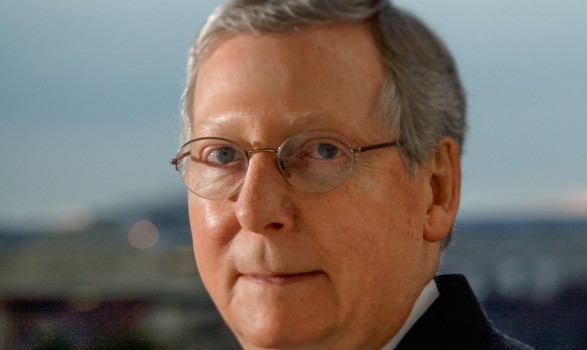
What was surprising to me (naïve fool that I am) was that people agreed. This is the right thing to do. We should wait, Constitution be damned!
Of course, such a response was met with some wondering aloud as to where the Democrats’ commitment to the Constitution was when Obama pulled his, “I’ve got a pen” maneuver to legislate from the White House.
The Politics We Serve, the Justice We Desire
Somewhere in the midst of all this, I decided that for many of us, perhaps most of us, our political philosophy is quite simple, and it aligns with our sense of justice.
No, it’s not about whether power should be located in the federal government or distributed more to the states. No, it’s not about whether we should be strict constructionists of the Constitution or allow it to speak differently in different times and places. No, it’s not about whether the branches should more narrowly do the jobs they were assigned.
For most of us, I dare say, and I include myself in this number, it comes down to this: there are some outcomes we want, and we support the people and processes that will produce those outcomes. The ends determine what means are just or unjust, fair or unfair.
Democrats aren’t willing to follow their “protect and help” philosophy to helpless babies at almost any point in a pregnancy. Nor are Republicans willing to follow their “minimal government intrusion” philosophy to advocating for abortion rights.
Republicans aren’t willing to follow their “small government, fiscal conservatism” to a minimalist use of our military. Nor are Democrats willing to follow their “compassion and justice” values to the grounding of drone strikes.
We are not guided by philosophy or principles or abstract notions of justice. We are guided by particular desires that strike us as right. (And, of course, those particular desires are often handed to us in clusters by tribes whom we wish to identify with and stand over against the tribe(s) that we would not be caught dead with.)
Thinking Backwards and the Lens of the Cross
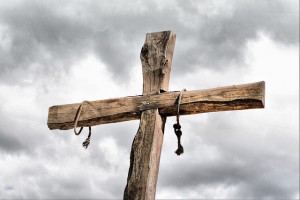 This Lent the church I attend is doing a cluster of practice around viewing life through the lens of the cross. Yesterday we were in 1 Corinthians [One Corinthians!] 1, where Paul talks about how the end of the story that God is writing transforms our vision of the story we are living in and the means by which we strive to faithfully follow.
If you’ve studied the New Testament much at all, you’ll know that the significance of eschatology (The End) cannot be overstated. It’s not just that the New Testament writers were waiting for something more, a final End and final Judgment that was going to set all things to rights. It’s that they believed the Jesus story itself to be the story of the End, its inauguration. The in-breaking of the age to come and the story of the End in the person of Jesus.
It’s almost as if God understands that as humans beings we will always use the end to justify the means. And so he showed us the end. And he showed us the means that are required to bring it about.
God showed us the end: the union of God with humanity.
God showed us the end: the dispossessing of every power arrayed against human flourishing.
God showed us the end: the forgiveness of our sins.
God showed us the end: the death of God’s faithful in courageous, selfless acts of self-giving love.
God showed us the end: those who did not cling to their own lives, their own agendas, their own politics, even to the point of death, raised by God to newness of life.
And with that beautiful picture of the end, the way (the only way) to get there: reconciliation between humanity and God. Reconciliation of people with each other. Aligning ourselves against the powers that squelch human flourishing. Forgiving ourselves and forgiving one another as God has forgiven us. Laying down our lives for the sake of our friends. Entrusting ourselves, our reputations, our fears, our yearnings, our hopes, our dreams, into the hands of God.
Cruciform Politics?
I’m not sure that a nation state can ever have a viable cruciform politics. Maybe this is a good reason for us to step back and remember that our politics will never create the righteous life that God desires.
Or perhaps the viability of such a politics eludes us because we ourselves have defined our Christianity and its aims without this lens of the cross.
You see, in the end, I don’t think it’s a bad idea to judge things by the ends we are after. Yes, this has led to cynical deployments of power across human history.
But not all paths lead to the same ends. The ends we seek are only available along certain corridors.
For Christians, the perennial, most central thing to remember, the most difficult thing to believe, is that those corridors are never and can never be the corridors of power. They will always be the corridors of weakness.
The power of God that invades and transforms and brings about justice that stands up to the cosmic canon is the power that reaches down to give life to the dead and call into being what does not exist.
That is our beginning. That is our ending.
And there’s only one path that walks between the two. It’s the path that Jesus showed us.
It’s the way of the cross.
Cross Photo: Claudio Ungari | flickr | CC 2.0
Previous Post
February 13, 2016
Christian Ed: Not Quite Dead?
Next Post

February 17, 2016 Why I Am Still a Christian
Browse Our Archives
Select a Category American Culture Bible Book Reviews Church Culture Conferences LectioCast Newbigin House Pop Culture Uncategorized
Select a Month October 2017 March 2017 February 2017 January 2017 November 2016 October 2016 September 2016 August 2016 July 2016 June 2016 May 2016 April 2016 March 2016 February 2016 January 2016
Follow Us!
TAKE THE
Religious Wisdom Quiz
Which Genesis figure "walked with God and was no more, for God took him"?
Select your answer to see how you score.
Abraham Lamech Seth Enoch
Related posts from Storied Theology



"God Made Me Like This"? Sexuality & Culture

TRENDING AT PATHEOS Progressive Christian

Why Christians Have a Sacred Duty to Vote:...
The Bible offers strong support for the sacred duty to vote. Here...

What Being a Modern-Day Apostle Means to Me
In my last column, I discussed the ins and outs of modern-day...

Did Ancient China Once Worship the God of...
Across human history, a common thread weaves through the origins of the...

Love Your Neighbor – Including Earth-Kin: Lev. 19,...
God’s command to love your neighbor means acting in an ethical and...

Lead a Church Study of “Jesus and Lao...
Guest writer Jack Thomas (The Irreverent Reverend) reflects on leading his church...

Principles for Understanding the Apostolic Ministry Today
Whenever people discover that my formal ministry title is "apostle," as in...
view all Progressive Christian blogs
Ad-Free & Subscriber Log-In Subscription Support
- About Us
- 2026 Calendar
- Videos
- Podcasts
- Library of World Religions
- Faith In Media Tracker
- Advertise With Us
- Write for Us
- Privacy Policy
- Terms of Service
- Do Not Sell My Data
- Contact Us
- Radiant Digital
- Manage Newsletter Subscriptions
- Unsubscribe From Notifications
- Sitemap
Copyright 2008-2026, Patheos. All rights reserved.
Subscription Support Ad-Free & Subscriber Log-In
Follow Patheos