
BuddhistCatholicContemplativeEvangelicalGeneral ChristianHinduJewishLatter-day SaintMuslimNew VisionsProgressive Christian
Beliefs
- Buddhist
- Catholic
- Contemplative
- Evangelical
- General Christian
- Hindu
- Jewish
- Latter-day Saint
- More Voices
- Muslim
- New Visions
- Pagan
- Progressive Christian
Topics
- Religion News
- Food and Religion
- Sports and Religion
- Religious Art
- Religious Music and Entertainment
- Religious Events
- History and Religion
- Style and Religion
- Politics and Religion
- Women in Religion
- Recreation Outdoors and Religion
- Business Finance and Religion
- Careers Workplace and Religion
- Education and Religion
- Family Parenting and Religion
- Health Fitness and Religion
- Home and Religion
- Relationships and Religion
- Technology and Religion
- Travel and Religion
Columnists
- Buddhist Columnists
- Business Finance and Religion Columnists
- Careers Workplace and Religion Columnists
- Catholic Columnists
- Contemplative Columnists
- Education and Religion Columnists
- Evangelists Columnists
- Family Parenting and Religion Columnists
- General Christian Columnists
- Health Fitness and Religion Columnists
- Hindu Columnists
- History and Religion Columnists
- Home and Religion Columnists
- Jewish Columnists
- More Voices Columnists
- Latter Day Columnists
- Muslim Columnists
- New Visions Columnists
- Nonreligious Columnists
- Pagan Columnists
- Politics and Religion Columnists
- Progressive Columnists
- Recreation Outdoors and Religion Columnists
- Relationships and Religion Columnists
- Religion News Columnists
- Religious Art Columnists
- Religious Events Columnists
- Religious Music and Entertainment Columnists
- Sports and Religion Columnists
- Style and Religion Columnists
- Technology and Religion Columnists
- Travel and Religion Columnists
- Women in Religion Columnists
Resource Library
- 2026 Calendar
- Library of World Religions
- The 100 Most Holy Places on Earth
- Patheos Answers
- Podcasts
- Videos
- Faith Leaders Database
- Anglican Episcopalian
- Bahai
- Baptist
- Buddhism
- Christianity
- Confucianism
- Eastern Orthodoxy
- Hinduism
- Holiness and Pentecostal
- ISKCON
- Islam
- Judaism
- Lutheran
- Methodist
- The Church of Jesus Christ of Latter-day Saints
- New Age
- Paganism
- Presbytarian and Reformed
- Protestantism
- Religion Behind the Scenes
- Roman Catholic
- Scientology
- Shia Islam
- Sikhism
- Sufism
- Sunni Islam
- Taoism
- Zen
- See all religions
Research Tools
 Ad-Free & Subscriber Log-In Subscription Support
Follow Patheos 

- Trending:
- Advent
- |
- Forgiveness
- |
- Thanksgiving
- |
- Election
- |
- Seasonal Holidays
- |
- Marriage
 Storied Theology
- Home
- Progressive Christian
- Giving Up On Faith
Giving Up On Faith
Last updated on: January 20, 2016 at 6:24 am by J. R. Daniel Kirk
Giving Up On Faith 2016-01-20T06:24:47-08:00 J. R. Daniel Kirk
Patheos Explore the world's faith through different perspectives on religion and spirituality! Patheos has the views of the prevalent religions and spiritualities of the world.
Scrambling the Evangelical Egg
On Saturday I laid out some thoughts about being a progressive evangelical. Over the past week or so I have been working through some of my reading backlog by going through Phyllis Tickle’s The Great Emergence.
The book is reminding me that my own journey toward what seems to some to be a scrambled identity did not happen in a vacuum. The information age we’re in has propelled a seismic shift that has scrambled people’s alignments: evangelicals adore the liturgy, Catholics speak in tongues, mainliners read the Bible through the old lenses of the creeds.
My progressive evangelicalism is a scrambling of what used to be true of just conservatives with what used to be true of just mainliners. And a crucial component in my journey away from being a conservative evangelical was when I gave up on faith.
Ok, I didn’t give up on faith entirely. But I started to understand differently what saving faith looks like. In short, it comes down to this: thinking the right things does not save anyone.
“Thinking the right thing” is my interpretation of “believing the right thing.” Because in practice, they are equivalent. And the dangerous posture that has taken deep root in Protestantism is that the wholesale systems of belief we have constructed are the things that demand our allegiance if we are to find ultimate favor with God.
From Faith to Faithfulness
In my personal narrative, the first move away from faith was to “faithfulness.”
What I have to say next might come as a shock to some people, so if you’re standing and reading this on an iPhone or something, have a seat. I don’t want anyone getting hurt.
The one who led me from “faith” to “faithfulness” was Paul. What is it that saves us, in Paul’s estimation?
Yes, of course there is our response to the gospel message. But this is not, ultimately, what saves us. The saving work is Jesus’ death and resurrection. And when Paul talks about saving faith, it’s Jesus’ saving faithfulness that takes pride of place:
However, we know that a person isn’t made righteous by the works of the Law but rather through the faithfulness of Jesus Christ. We ourselves believed in Christ Jesus so that we could be made righteous by the faithfulness of Christ and not by the works of the Law—because no one will be made righteous by the works of the Law. (Galatians 2:16, CEB)
One of the most important dynamics of the biblical story that they hammer into your head in seminary is that “indicative” precedes “imperative.” That is to say, what God does for us always comes before what God asks of us.
But it’s more specific than this. The indicative not only precedes, it also sets the trajectory for the content of what is to follow. It becomes the narrative that people expect to see repeated.
The saving story of the cross writes the script for subsequent generations of disciples: “take up your cross and follow me.”
In Paul’s letters it is no different. Paul does not write to the churches about the death and resurrection of Jesus in order to get them to think the right things. He writes these letters to get them to be faithful to the God and Father of Jesus in the same way that Jesus himself was: a crucifixion of the flesh with its passions and desires, laying down their lives so that the people around them might find life.
When Paul expresses the goal of his discipleship, he says that it is to bring about, not faith [full stop], but “the obedience of faith” (Rom 1:5). Christ saved by faithfulness, and we are called to a lifelong fidelity to God.
From Faith to Trust
The sharper image that has developed over the past several years has been to move from thinking of “faith” as “belief” to thinking of faith as “trust.”
The impetus for this particular rendering of our Christian vocation came from Romans 3. There, Paul is starting to get into the weeds a bit about the implications of Israel’s failure to respond to Jesus as Messiah. Here Paul plays with the Greek word pistis. We typically translate this “faith,” but it won’t quite work here. Take a look:
First, they were entrusted (episteuthesan) with the oracles of God. What then? If some of them failed in their trust (episteusan, or “were faithless”) their failure of trust (apistia, “faithlessness“) will not nullify God’s trustworthiness (pistis, “faithfulness”), will it?
The question Paul is wrestling with here is, Can God be trusted? Is God trustworthy? Alternatively, we might see this as, Is God faithful?
God’s own mission in the Gospel is to find a people whose willingness to entrust themselves to God matches God’s willing to entrust himself to them.
(I know that this is true because at the end of that last sentence my word count was 777.)
From Reformed to Reforming
The Reformation was built on “justification by faith alone” as one of its key rallying cries.
I’ve always had an ambivalent relationship with the Reformation. I have been more committed to its mode of theologizing than its theological results. Give me the Bible and Jesus and my brain and my understanding of history and my community. But don’t think I’ll “honor” the Reformers by saying what they said, thereby setting them up as the very sorts of ecclesiastical authorities they worked so hard to throw off.
In fact, what I have found is that the dangerous game of defining ourselves by “thinking the right things about God,” a temptation that has haunted the church almost from its inception, has been deadly (literally and figuratively) across the centuries. It is the mistaken understanding of the gospel that leads to such lethal mistakes as the Wheaton College Larycia Hawkins fiasco.
Going back to the Paul whose writings sowed the seed for “faith alone,” I have discovered that the heart of the human response to the message of Jesus is not believing that it happened, but entrusting ourselves to that story, to that God, to that God’s way of saving, to that savior’s way of being fully human.
So when I stand up on Sunday mornings and recite the Creeds, I do a little translation in my head. While everyone else is saying, “I believe…” I am saying by my words, “I entrust myself to God the Father Almighty… and to Jesus Christ his only Son our Lord… I entrust myself to the Holy Spirit…”
Because, in the end, thinking the right things is not what God is after.
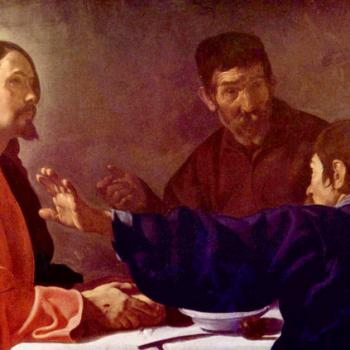
Featured Image: © vagwi 2009, Flickr, CC 2.0
Previous Post

January 19, 2016
Being the Social Gospel of Jesus
Next Post

January 22, 2016 Coopted Christianity
Browse Our Archives
Select a Category American Culture Bible Book Reviews Church Culture Conferences LectioCast Newbigin House Pop Culture Uncategorized
Select a Month October 2017 March 2017 February 2017 January 2017 November 2016 October 2016 September 2016 August 2016 July 2016 June 2016 May 2016 April 2016 March 2016 February 2016 January 2016
Follow Us!
TAKE THE
Religious Wisdom Quiz
What four things does the Pale Horse in Revelations bring upon the earth?
Select your answer to see how you score.
Storms, earthquakes, floods, and darkness Sword, famine, plague, and wild beasts Wrath, power, redemption, and judgment Silence, fire, blood, and pestilence
Related posts from Storied Theology


"God Made Me Like This"? Sexuality & Culture

TRENDING AT PATHEOS Progressive Christian

The Secret behind A Charlie Brown Thanksgiving
Do you know the secret behind A Charlie Brown Thanksgiving? Sparky was...

Bridging the Gap Between God and Man
From Far Off to the Ultimate Embrace “God is a Spirit: and...

Let Matthew 25 Guide You to a Greater...
With the crisp feel of fall in the air, our minds quickly...

Can a Chatbot Touch Your Soul?
Can a chatbot offer genuine spiritual counsel? One conversation brought me to...

Religion and Politics: How Should We Then Live?
Two cultural axioms get repeated in polite company. Don't mix religion and...

7 Things We Get Wrong About Giving Thanks
It's a time of year when many of us turn to the...
view all Progressive Christian blogs
Ad-Free & Subscriber Log-In Subscription Support
- About Us
- 2026 Calendar
- Videos
- Podcasts
- Library of World Religions
- Faith In Media Tracker
- Advertise With Us
- Write for Us
- Privacy Policy
- Terms of Service
- Do Not Sell My Data
- Contact Us
- Radiant Digital
- Manage Newsletter Subscriptions
- Unsubscribe From Notifications
- Sitemap
Copyright 2008-2026, Patheos, part of the Radiant Digital network of media brands. All rights reserved.
Subscription Support Ad-Free & Subscriber Log-In
Follow Patheos