
BuddhistCatholicContemplativeEvangelicalGeneral ChristianHinduJewishLatter-day SaintMuslimNew VisionsProgressive Christian
Beliefs
- Buddhist
- Catholic
- Contemplative
- Evangelical
- General Christian
- Hindu
- Jewish
- Latter-day Saint
- More Voices
- Muslim
- New Visions
- Pagan
- Progressive Christian
Topics
- Religion News
- Food and Religion
- Sports and Religion
- Religious Art
- Religious Music and Entertainment
- Religious Events
- History and Religion
- Style and Religion
- Politics and Religion
- Women in Religion
- Recreation Outdoors and Religion
- Business Finance and Religion
- Careers Workplace and Religion
- Education and Religion
- Family Parenting and Religion
- Health Fitness and Religion
- Home and Religion
- Relationships and Religion
- Technology and Religion
- Travel and Religion
Columnists
- Buddhist Columnists
- Business Finance and Religion Columnists
- Careers Workplace and Religion Columnists
- Catholic Columnists
- Contemplative Columnists
- Education and Religion Columnists
- Evangelists Columnists
- Family Parenting and Religion Columnists
- General Christian Columnists
- Health Fitness and Religion Columnists
- Hindu Columnists
- History and Religion Columnists
- Home and Religion Columnists
- Jewish Columnists
- More Voices Columnists
- Latter Day Columnists
- Muslim Columnists
- New Visions Columnists
- Nonreligious Columnists
- Pagan Columnists
- Politics and Religion Columnists
- Progressive Columnists
- Recreation Outdoors and Religion Columnists
- Relationships and Religion Columnists
- Religion News Columnists
- Religious Art Columnists
- Religious Events Columnists
- Religious Music and Entertainment Columnists
- Sports and Religion Columnists
- Style and Religion Columnists
- Technology and Religion Columnists
- Travel and Religion Columnists
- Women in Religion Columnists
Resource Library
- 2026 Calendar
- Library of World Religions
- The 100 Most Holy Places on Earth
- Patheos Answers
- Podcasts
- Videos
- Faith Leaders Database
- Anglican Episcopalian
- Bahai
- Baptist
- Buddhism
- Christianity
- Confucianism
- Eastern Orthodoxy
- Hinduism
- Holiness and Pentecostal
- ISKCON
- Islam
- Judaism
- Lutheran
- Methodist
- The Church of Jesus Christ of Latter-day Saints
- New Age
- Paganism
- Presbytarian and Reformed
- Protestantism
- Religion Behind the Scenes
- Roman Catholic
- Scientology
- Shia Islam
- Sikhism
- Sufism
- Sunni Islam
- Taoism
- Zen
- See all religions
Research Tools
 Ad-Free & Subscriber Log-In Subscription Support
Ad-Free & Subscriber Log-In Subscription Support
Follow Patheos 

- Trending:
- Forgiveness
- |
- Marriage
- |
- Consciousness
- |
- Death Penalty
- |
- Election
- |
- Halloween

- Home
- Catholic
- Instruct the Ignorant: An Excerpt from Stumbling into Grace
Instruct the Ignorant: An Excerpt from Stumbling into Grace
Last updated on: July 13, 2021 at 11:05 pm by Mary Pezzulo
Instruct the Ignorant: An Excerpt from Stumbling into Grace 2021-07-13T23:05:12-04:00 Mary Pezzulo
Patheos Explore the world's faith through different perspectives on religion and spirituality! Patheos has the views of the prevalent religions and spiritualities of the world.
The following is a sample chapter from my book, Stumbling into Grace: How We Meet God in Tiny Works of Mercy. I’ve chosen to show you one of the chapters on the spiritual works of mercy since I talk about the corporal works of mercy so often on the blog. If you’d like to hear me talk for an hour about the corporal works of mercy, with some more excerpts from the book, I recently gave a talk on that topic for Ave Maria Press, and the whole thing was posted to YouTube.
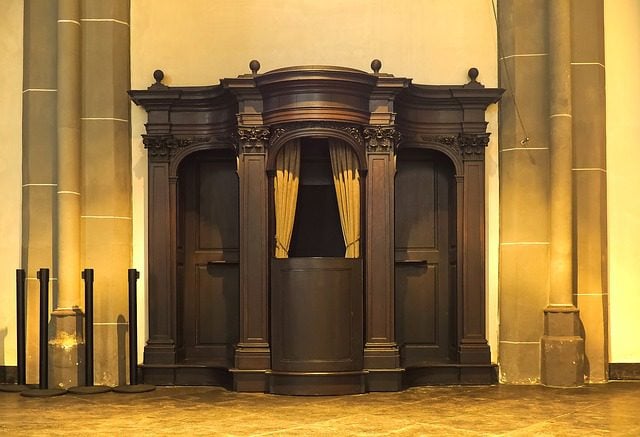
I learned about the beauty of the Sacrament of Penance when I was sitting in the ugliest confessional in the ugliest Catholic church I’d ever seen.
Franciscan University’s Christ the King Chapel is an architectural nightmare, if you ask me. It’s set up in a series of concentric squashed ovals, like the layers of a deformed onion. The outermost layer has a good number of windows to let in the light, and it’s where the eucharistic chapel, a foyer, and the offices are. The second layer is just a skinny hallway with two rows of metal coat hooks lining its walls. This is where people stand for Mass if they’re late and the seats are all taken up; it means that latecomers spend the entire Mass in a chamber of ill ease where they can’t lean on the walls for fear of being impaled. The center is the actual chapel. It’s a dark place with only one window of tacky stained glass. The walls are drab, itchy stucco. The benches are black, arranged in two-thirds of a circle facing a dank sanctuary and altar. The lighting is yellow and dim; it makes the priest’s vestments look dirty no matter the liturgical season.
Against the back wall of Christ the King Chapel, in that dark middle layer, is a door to what looks like a broom closet but is actually a confessional. Most of the confessions at Franciscan University are whispered face to face in the black pews, but this confessional has a free-standing screen in it, with a chair for the priest on one side and a chair for the penitent on the other. It also has a third chair, inches from the priest’s eyebrows, if you change your mind at the last minute and want to go face to face. Other than that, it’s just a drab, musty, itchy-walled room with a triangular floor and a nauseating pink fluorescent light. Aesthetically speaking, it would make a better interrogation room than a confessional. It seems designed to make penitents nervous.
I didn’t want to be in that confessional for any longer than I could help it. I didn’t want to go to Christ the King Chapel at all. I had many bad memories of crying in that place after I’d first come to Steubenville. The living situation I’d gotten away from in my hometown wasn’t a good one. I came from a community I loved but that taught a lot of superstition and cruelty along with their catechism, and I wasn’t on speaking terms with many of my relatives for that reason as well as other things. I had found out the hard way that a lot of the fervent Catholics at Franciscan University start blaming victims and being downright abusive when a person finds herself poor, chronically ill, and without relatives to go home to. And besides, I’d had a horrible experience with one of the priests there—one I’ll write about in a future chapter.
But it was Sunday, and we didn’t have a car or a friend to give us a ride, and I was the closest to healthy I’d been in weeks. I had had a miserable time sick at home, unable to go out; the flare-up had just subsided that weekend. I walked to Mass with Michael, pushing Rosie in the stroller. I got to sing hymns and listen to the readings and receive Holy Communion for the first time in a long while.
I was glad to see that the priest saying Mass was not the bully I’d encountered– he was one of the kindly older priests, not the younger, usually nastier ones. It was Michael who suggested that we wait awhile after Mass was over and talk to him when he came out of the sacristy. And we did.
Michael explained to the priest that I was chronically ill and we didn’t have a car, so I’d been trapped at home. I hadn’t been to Confession or received the Anointing of the Sick for an embarrassingly long time. We didn’t have a priest friend we could ask, or anyone to bring us to campus during scheduled Confession times. Could he help?
The priest ran to the office to get oil, and then he came back and welcomed me into the ugly confessional. “You’ve already received Communion. Now, I’ll hear your confession and then we’ll let Michael in to pray with us while I anoint you. Then you’ll have all three!”
I usually go to Confession behind the screen, but I didn’t see the point when I’d already been talking to the priest face to face. I sat across from him in the ugly room and recited the list of my transgressions of the past few months. And there was something else that was gnawing at my peace of mind.
When I meet a priest for Confession, I’m not the kind of person who randomly volunteers information unrelated to my sins. Some people seem to like to talk to the priest about whatever’s on their mind. I rattle off a list of all my sins as best I can and get out of there quickly. But that day, I kept feeling as though I should mention to the priest something that wasn’t a sin. I knew that this priest was a theology professor who was said to know his field very well. I knew he’d be able to give me a straight answer if I confessed to something that wasn’t exactly a sin but was a worrying preoccupation of mine.
“I want to offer my suffering to Jesus,” I said. “It gives me a lot of peace to do that. But I’m also afraid. Because when I was growing up . . . well, they taught me that if you volunteer to offer your sufferings to Jesus, he sends you more suffering and makes things as bad as they can, so you can offer it up. He makes you his victim soul and tortures you to trade your suffering for other souls. And that makes me afraid to offer it up.”
The priest smiled gently. “Nope,” he said, with absolute certainty. “That’s definitely not how it works.”
At one level I’d already known that. A God who was Love couldn’t possibly be a sadist tormenting random chronically ill people in order to satisfy his anger with somebody else. That would make him a cosmic abusive boyfriend rather than pure Love. The eccentricities I’d been raised with were somebody’s pet superstitions and not Catholicism. Michael and I had talked about this dozens of times. But still, the fear remained. I never felt safe saying any kind of prayer that united my suffering to Christ’s, even though I obediently recited prayers to that effect all the time. But when that priest said “Nope,” a weight fell off of my shoulders. I felt calm and protected. It seemed as though, somehow, everything was going to be all right.
It wasn’t just that the priest was a knowledgeable man who had studied theology. It was also that he was absolutely confident and perfectly gentle when he said it. His confidence was contagious, and his gentleness was soothing. I felt able to accept what he said because of the way that he said it.
The priest gave me absolution and opened the door for Michael. Michael sat in the extra chair as the priest gave me the Anointing of the Sick. I know that great graces were conferred in both of those sacraments, but I’d felt the healing happen when the priest said “Nope. It definitely doesn’t work like that.” Just at that moment, the ugly confessional in the ugliest church in town seemed like the most beautiful place in the world.
It seems to me that it’s a little more delicate to talk about the spiritual Works of Mercy than the corporal ones, because there’s a different kind of trouble a person can get into when they try to perform the spiritual works. If you give food to the hungry and drink to the thirsty badly, at worst you leave a person still hungry or thirsty or sick from your terrible cooking. You shouldn’t do that. But if you are careless or don’t know what you’re doing when you attempt a spiritual Work of Mercy, you might end up hurting someone in a deeper way.
The soul is the deepest, closest, most intimate part of a person. The soul is the enclosed garden where Christ always dwells within a human being, whether they can feel him there or not. In the most real way, nobody can hurt another person’s soul; only you can hurt your own soul by deliberately committing a sin. But in another very real way, a person can feel their soul to be hurt and can find that relationship with Christ damaged at the level of their personal experience. That person can feel too ashamed of themselves to be comfortable speaking to God; they can feel that God must not love them and that they are unworthy. They can conclude that God must not be real at all, because he has been represented to them in a foolish or abusive way that doesn’t match with their experience of anything good or loving.
A person can become traumatized by their religious experience when people they ought to have been able to rely on for friendship, counsel, and spiritual advice were cruel to them instead of being good and loving. This cruelty runs the gamut from unkind words and bad advice to gossip that ruins somebody’s reputation to shunning and even to physical or sexual abuse presented to the victim as having something to do with religious practice. Think of a child badly beaten by an abusive parent who thought they were “training them up in the fear of the Lord.” Think of all the horrible cases we’ve learned about in recent years where a priest abused somebody sexually and claimed it was God’s will or the victim’s sin that made it happen.
Spiritual abuse is the term for abuse of any kind that damages a person’s experienced relationship with God. It’s a particularly toxic and traumatic type of abuse because it meddles with a person’s experience of the deepest part of their own self. And especially in this era in our Church, with so much terrible abuse committed by our shepherds coming to light, we have to be absolutely clear and honest about the prevalence of spiritual abuse and how damaging it really is. Spiritual abuse can be committed by anybody in a community of believers. It’s painful, damaging, and traumatic to be a victim of spiritual abuse. Although the victim feels and might be told that they are shameful and dirty for having suffered, it’s never the victim’s fault.
One of the common ways I’ve found in which a person can commit spiritual abuse, without even knowing they’re doing so, is by attempting to perform a spiritual Work of Mercy but getting it terribly wrong. Fortunately for us, a spiritual Work of Mercy that’s performed correctly is one of the ways in which God heals the effects of spiritual abuse—not all at once, not without the more specialized help of a counselor or a psychiatrist, but as part of a victim’s journey of healing. And so every time I talk about a spiritual Work of Mercy in this book, I am going to mention some ways in which a person might be abusing somebody by performing something that looks like a Work of Mercy but isn’t. And I’m going to try to show how the Work of Mercy performed in the right way can be healing.
The people who catechized me—my parents and teachers, and the people who taught my parents the faith—abused me when they taught me that Jesus was abusive. They didn’t mean to do that. They were teaching me what they thought was Catholic teaching, but it wasn’t. It’s true that in the Catholic faith we believe that our suffering is redeemed through Christ. Christ comes to suffer with everyone who suffers, uniting them to his own Passion on Calvary so our suffering becomes an intercession on behalf of all and for each without our even having to consciously intend it at every moment. In doing so, Christ turns a bad thing that he doesn’t intend—suffering—into a source of great grace.
Saints who suffered especially badly found immense grace in that suffering and thanked the Lord for it. But their words are often misused by unscrupulous teachers who tell people that God wants us to suffer and that suffering itself, rather than the redemption of suffering, is a gift from God.
I was traumatized and more than a little scared of Jesus when I was told the untruth about him—that he would make me his victim soul and torture me to trade my suffering for other souls. But I was healed when I was told the real truth—“Nope. That’s definitely not how it works.”—by a good and compassionate priest in an ugly confessional.
This is one example of how performing the Work of Mercy to instruct the ignorant in the wrong way is abusive, but done in the right way, it’s beautifully healing.
Notice how the priest who reassured me was in the middle of doing everything else he could to be helpful—he wasn’t just setting out to find an ignorant person to lecture. He was gentle, which was why I had the courage to ask him in the first place. He was well informed and confident, two reasons why I trusted his answer. And he was glad to tell me the truth, and that gladness was contagious. Helpfulness, gentleness, being informed, speaking with confidence, and joy in telling the Good News are all necessary for performing this Work of Mercy.
How to Instruct the Ignorant
1. No one expects you to go stand on a box and shout the Gospel at strangers or walk door to door and try to get someone to talk to you. Some people seem to think that’s what “instruct the ignorant” means, so I have to get that out of the way first. Shouting at strangers about Jesus or knocking on their door uninvited is an off-putting and scary way to teach others, and being scary doesn’t work. There are much better ways to teach.
2. Be sure you’re being as loving and helpful as you know how to be to your neighbor in the first place. No living human you’ll meet is just a disembodied soul; they’re a whole person with a mind, a soul, and a body, and all of these are loved by God and important. Besides the fact that it’s not charitable, it’s disingenuous and off-putting to preach at someone with whom you have no relationship at all. Be active in helping people. Form good relationships just because people are worth knowing. This will cultivate relationships in which questions of faith might come up naturally. And then when they do come up, you can be a trustworthy person to help them understand the faith. That’s usually the best way to go about it. Never pretend to be somebody’s friend just for the purpose of preaching at them, because that’s not honest or respectful of them. It’s also an impractical way to teach the Gospel. Love people because they’re worth it, and conversations about what you believe will come up in time.
3. Your church probably has a catechetical program for children or an RCIA program for adults to teach them about our faith. This is a big undertaking and they could surely use extra help. See if you can help out as a volunteer teacher if that’s your gift or an assistant who makes sure that the classrooms are organized and welcoming and can help to keep order with children. If you don’t feel that you could help as a teacher or an assistant, you might be able to help by providing drinks or snacks for the meetings, by watching the teacher’s children, or by offering some other help to free them to focus more on teaching. Everyone who helps to teach or hand on our faith in any capacity is performing this Work of Mercy, even if they’re not the ones doing the teaching.
4. When you teach, remember to be gentle! Nobody likes to be treated harshly, and harshness doesn’t help a person learn. Harshness hurts people, which is bad in itself, and it makes people less likely to listen to you. Always approach a teaching moment in the gentlest, most compassionate way you can. This way you teach not only with words.
5. Don’t patronize. Nobody is ever completely ignorant, and nobody on this earth knows everything. Assume that the person you’re talking with is a real human being with a whole lifetime of experience to share. Engage them in mutual respect.
6. Be informed. Our faith is an enormous, challenging thing to learn. In one way, it’s all so beautifully simple; but in another, there are so many different teachings that it can seem overwhelmingly complicated. No one knows it all, not even the best-trained theologians. Read the Bible and the Catechism of the Catholic Church, and read them prayerfully, asking the Holy Ghost for wisdom instead of just reading them through like a textbook. Take advantage of any Bible studies or adult education courses your parish might offer, but remember to do your own research. Nobody knows it all, and often teachers bring their own experience and prejudices to the lessons.
7. Have confidence and be joyful when you tell the Gospel. Remember: Gospel means “Good News.” Sharing our faith isn’t a morose, scary thing. We’re not running around yelling at people that they’re going to hell. We’re telling them something wonderful that should be a relief to know. Jesus is here to heal us and set us free. If you don’t feel confident or joyful about the faith, that doesn’t mean you’re a bad Catholic. Everybody goes through periods of doubt and difficulty in their spiritual journey; the greatest saints did and so will you from time to time. Just take some more time to study and pray about your difficulties, and perhaps consult with a trusted spiritual director about them. Keep praying and informing yourself so that you can inform others.
8. If you’re a victim of spiritual abuse, you may find the thought of sharing and teaching the faith daunting. That’s normal and not your fault. Don’t be afraid to focus on your own healing, if that’s what you need in this season of your life. No one can do everything.
We need to teach the truth joyfully and not manipulatively, in a way that respects and loves the whole person. We need to make sure that we ourselves are informed of the truth and that our relationship with God is on strong footing as we approach this spiritual Work of Mercy.
O Jesus, teacher and healer of my soul,
Thank you for the beauty of the faith!
Please help me to learn the truths you have revealed,
so that I may be your instrument by instructing
and healing my neighbors, ever sharing with them your love.
I ask this in your holy name. Amen.
Franciscan University of Steubenville
Previous Post

July 12, 2021
The Billionaire, the Rocket, and the Tedium of Greed
Next Post

July 14, 2021 Driving Miss Rosie
Browse Our Archives
Select a Category abortion Abuse Advent America American Christianity angel angels Annunciation Appalachia apparition apparition chaser apparition chasers apparition culture art art review babies baby baby Jesus Bad Lip Reading bad statue contest bath beauty Bible story blog blogkeeping blood book review Brandon Sanderson breastfeeding bus Catholic catholic conspiracy alarmism Catholic Oppositional Disorder Charismatic Renewal Charlie the Cat chastity Christ Christian idenitity Christianity and Judaism Chronic Illness clean clothing COD piece comedy compassion conscience conspiracy theory conversion cop-on-black violence Crucifixion cry of the poor culture Daesh Daily Saints death death penalty devotional diaconate diaper diapers dirty disability Donald Trump Dorothy Day dream drugs Eastern Catholicism Eastern Christianity education election election update Elsewhere on Patheos empathy environment Fear feminism film review fish flashback fluffy buns food Franciscan University of Steubenville Friendship Room fun Gabriel gardening gospel hair-splitting Heaven hell heresy Hillary Clinton history Holly the Witch Holy Spirit holy war Homeschooling homosexuality horror human dignity humor Icon idol immigrants infection inter-religious dialogue Interpretation of Scripture Islam Jesus Jihad Joseph joy laity and lay vocations lamb dinner laundry lent lgbtq literature love manners Mary Medicine and Science Meditation mercy mess milk misogyny Missouri monasticism monster motherhood mourn with those mourn movies movis music mystery nature neurodiversity New Pro-Life Movement news nonsense nostalgia O antiphons obituary objectification Ohio Valley Ordinary Time ordination Ordo Amoris parable paradox Passover peanut butter personal beliefs pets philosophy Planet Charismatic poetry politics polls poop Pope Francis Pope Leo power in the Church prayer prayer request prayers preferential option for non-violence president presidential election priest primary private revelation pro-life prophecy Public face of Catholicism Pure Flix Q and A race racism random rape rape. sexuality reader's request Reckoners refugee religious trauma ressurrection Right to life Saints saints and celebrations same-sex same-sex marriage satire scandal secular feasts seder Seven Joys Seven Last Words sex sexual ethics sexuality silencing six months skid row slavery social justice Speculative fiction spiritual abuse spoon stain story suffering suffrage suffragette Sunday Gospel temple Tenebrae Responsories Terror the exorcist The Friendship Room The New Pro-Life Movement Things I Learned on the Internet tin cup traffic true story tv review Uncategorized USCCB vice and temptation violence Virtue virtue and vice war Way of the Cross whimsy whole life women's ordination work of mercy Year A
Select a Month October 2026 September 2026 August 2026 July 2026 June 2026 May 2026 April 2026 March 2026 February 2026 January 2026 December 2025 November 2025 October 2025 September 2025 August 2025 July 2025 June 2025 May 2025 April 2025 March 2025 February 2025 January 2025 December 2024 November 2024 October 2024 September 2024 August 2024 July 2024 June 2024 May 2024 April 2024 March 2024 February 2024 January 2024 December 2023 November 2023 October 2023 September 2023 August 2023 July 2023 June 2023 May 2023 April 2023 March 2023 February 2023 January 2023 December 2022 November 2022 October 2022 September 2022 August 2022 July 2022 June 2022 May 2022 April 2022 March 2022 February 2022 January 2022 December 2021 November 2021 October 2021 September 2021 August 2021 July 2021 June 2021 May 2021 April 2021 March 2021 February 2021 January 2021 December 2020 November 2020 October 2020 September 2020 August 2020 July 2020 June 2020 May 2020 April 2020 March 2020 February 2020 January 2020 December 2019 November 2019 October 2019 September 2019 August 2019 July 2019 June 2019 May 2019 April 2019 March 2019 February 2019 January 2019 December 2018 November 2018 October 2018 September 2018 August 2018 July 2018 June 2018 May 2018 April 2018 March 2018 February 2018 January 2018 December 2017 November 2017 October 2017 September 2017 August 2017 July 2017 June 2017 May 2017 April 2017 March 2017 February 2017 January 2017 December 2016 November 2016 October 2016 September 2016 August 2016 July 2016 June 2016 May 2016 April 2016 March 2016
Follow Us!
TAKE THE
Religious Wisdom Quiz
Who was the first appointed deacon?
Select your answer to see how you score.
Nicolas Stephen Philip Barnabas
Related posts from Steel Magnificat

The American Pro-Life Movement Lied. Now What?
A New Series on the Abuse at Franciscan...

When I Learned to Forgive Myself

The Difference a Name Can Make
TRENDING AT PATHEOS Catholic

Janie Learns the Way of the Cross: A...
Teaching children about Jesus' Passion can be challenging. Many parents and educators...

Looking For Good Catholic Writing - October 2026
He alone extends the heavens, and he walks upon the waves of...

In "Irreplaceable," our book on vocation and technology, Trevor Sutton and I...

I was strolling through the top floor of the brand new Parthenon...

What Does Gêvâh Mean For Kimberley Guifoyle &...
This week, a lot of the news is focused on Kimberly Guilfoyle....

INNER CIRCLE: Profound Mystery (Of Christ In All...
Ephesians 5:31-32 “For this reason, a man will leave his father and...
view all Catholic blogs
Ad-Free & Subscriber Log-In Subscription Support
- About Us
- 2026 Calendar
- Videos
- Podcasts
- Library of World Religions
- Faith In Media Tracker
- Advertise With Us
- Write for Us
- Privacy Policy
- Terms of Service
- Do Not Sell My Data
- Contact Us
- Radiant Digital
- Manage Newsletter Subscriptions
- Unsubscribe From Notifications
- Sitemap
Copyright 2008-2026, Patheos. All rights reserved.
Subscription Support Ad-Free & Subscriber Log-In
Follow Patheos