
BuddhistCatholicContemplativeEvangelicalGeneral ChristianHinduJewishLatter-day SaintMuslimNew VisionsProgressive Christian
Beliefs
- Buddhist
- Catholic
- Contemplative
- Evangelical
- General Christian
- Hindu
- Jewish
- Latter-day Saint
- More Voices
- Muslim
- New Visions
- Pagan
- Progressive Christian
Topics
- Religion News
- Food and Religion
- Sports and Religion
- Religious Art
- Religious Music and Entertainment
- Religious Events
- History and Religion
- Style and Religion
- Politics and Religion
- Women in Religion
- Recreation Outdoors and Religion
- Business Finance and Religion
- Careers Workplace and Religion
- Education and Religion
- Family Parenting and Religion
- Health Fitness and Religion
- Home and Religion
- Relationships and Religion
- Technology and Religion
- Travel and Religion
Columnists
- Buddhist Columnists
- Business Finance and Religion Columnists
- Careers Workplace and Religion Columnists
- Catholic Columnists
- Contemplative Columnists
- Education and Religion Columnists
- Evangelists Columnists
- Family Parenting and Religion Columnists
- General Christian Columnists
- Health Fitness and Religion Columnists
- Hindu Columnists
- History and Religion Columnists
- Home and Religion Columnists
- Jewish Columnists
- More Voices Columnists
- Latter Day Columnists
- Muslim Columnists
- New Visions Columnists
- Nonreligious Columnists
- Pagan Columnists
- Politics and Religion Columnists
- Progressive Columnists
- Recreation Outdoors and Religion Columnists
- Relationships and Religion Columnists
- Religion News Columnists
- Religious Art Columnists
- Religious Events Columnists
- Religious Music and Entertainment Columnists
- Sports and Religion Columnists
- Style and Religion Columnists
- Technology and Religion Columnists
- Travel and Religion Columnists
- Women in Religion Columnists
Resource Library
- 2026 Calendar
- Library of World Religions
- The 100 Most Holy Places on Earth
- Patheos Answers
- Podcasts
- Videos
- Faith Leaders Database
- Anglican Episcopalian
- Bahai
- Baptist
- Buddhism
- Christianity
- Confucianism
- Eastern Orthodoxy
- Hinduism
- Holiness and Pentecostal
- ISKCON
- Islam
- Judaism
- Lutheran
- Methodist
- The Church of Jesus Christ of Latter-day Saints
- New Age
- Paganism
- Presbytarian and Reformed
- Protestantism
- Religion Behind the Scenes
- Roman Catholic
- Scientology
- Shia Islam
- Sikhism
- Sufism
- Sunni Islam
- Taoism
- Zen
- See all religions
Research Tools
 Ad-Free & Subscriber Log-In Subscription Support
Ad-Free & Subscriber Log-In Subscription Support
Follow Patheos 

- Trending:
- Forgiveness
- |
- Marriage
- |
- Consciousness
- |
- Death Penalty
- |
- Election
- |
- Halloween

- Home
- Catholic
- To Touch the Unclean
To Touch the Unclean
Last updated on: June 27, 2021 at 1:07 am by Mary Pezzulo
To Touch the Unclean 2021-06-27T01:07:16-04:00 Mary Pezzulo
Patheos Explore the world's faith through different perspectives on religion and spirituality! Patheos has the views of the prevalent religions and spiritualities of the world.
When Jesus had crossed again in the boat
to the other side,
a large crowd gathered around him, and he stayed close to the sea.
One of the synagogue officials, named Jairus, came forward.
Seeing him he fell at his feet and pleaded earnestly with him, saying,
“My daughter is at the point of death.
Please, come lay your hands on her
that she may get well and live.”
He went off with him,
and a large crowd followed him and pressed upon him.
There was a woman afflicted with hemorrhages for twelve years.
She had suffered greatly at the hands of many doctors
and had spent all that she had.
Yet she was not helped but only grew worse.
She had heard about Jesus and came up behind him in the crowd
and touched his cloak.
She said, “If I but touch his clothes, I shall be cured.”
Immediately her flow of blood dried up.
She felt in her body that she was healed of her affliction.
Jesus, aware at once that power had gone out from him,
turned around in the crowd and asked, “Who has touched my clothes?”
But his disciples said to Jesus,
“You see how the crowd is pressing upon you,
and yet you ask, ‘Who touched me?’”
And he looked around to see who had done it.
The woman, realizing what had happened to her,
approached in fear and trembling.
She fell down before Jesus and told him the whole truth.
He said to her, “Daughter, your faith has saved you.
Go in peace and be cured of your affliction.”
While he was still speaking,
people from the synagogue official’s house arrived and said,
“Your daughter has died; why trouble the teacher any longer?”
Disregarding the message that was reported,
Jesus said to the synagogue official,
“Do not be afraid; just have faith.”
He did not allow anyone to accompany him inside
except Peter, James, and John, the brother of James.
When they arrived at the house of the synagogue official,
he caught sight of a commotion,
people weeping and wailing loudly.
So he went in and said to them,
“Why this commotion and weeping?
The child is not dead but asleep.”
And they ridiculed him.
Then he put them all out.
He took along the child’s father and mother
and those who were with him
and entered the room where the child was.
He took the child by the hand and said to her, “Talitha koum,”
which means, “Little girl, I say to you, arise!”
The girl, a child of twelve, arose immediately and walked around.
At that they were utterly astounded.
He gave strict orders that no one should know this
and said that she should be given something to eat.
There are two women.
Well, the first one is not quite a woman yet; she’s a girl. That means she must be under twelve, because if you get much older than twelve, you’re not a girl anymore according to that culture’s rules. Womanhood is something that creeps up on a girl awfully fast: one day they’re a child and the next they’re not. Marriages get arranged soon after a girl is capable of having a baby. Girls get their periods and next thing you know, they get swapped to a man in exchange for a bride price so they can run a home and give birth to the next generation, all in the blink of an eye. That’s the way things work around here.
This girl is not going to live to be swapped or have a baby. She’s about to die.
The second woman is unclean.
That’s how it worked when a woman was bleeding. Women on their periods were unclean. They were people who must not be touched. They weren’t supposed to sit or lie down on anything that couldn’t be washed or thrown away, because anything they sat or laid down on was also unclean. Anyone who touched them, or touched the thing they had sat or laid down on, would become unclean. A person who touched a bleeding woman was required to take a ritual bath and then still be unclean until nightfall. During that time, anything the person touched would be as unclean as they were. That’s how contagious menstrual blood was thought to be. And this woman had been on her period for twelve years straight.
For twelve years, anyone who touched that woman was a pariah until dusk, even after that person took a bath. Anyone who touched a thing she’d sat or laid down on was treated in the same way.
Imagine that kind of isolation.
Imagine that degree of humiliation, for twelve years.
Twelve years of enforced social distancing. Twelve years without any chance at having a baby, in a culture where a woman’s worthiness was judged by how many babies they squeezed out. Twelve years without intercourse with her own husband. Twelve years without hugging or kissing or even holding hands with anybody. Twelve years without praying in a group of people. Twelve years of neighbors shrinking back and holding their clothes clear as she walked by. Twelve years where anybody who accidentally brushes up against her is horrified and disgusted, complaining that now they have to take a bath and stay away from everyone because of her. Because that’s how contagious the blood flowing out of her is thought to be.
That girl and that woman live walking distance from one another. That girl has been alive for something less than the number of days that that woman has been bleeding. That girl has been growing up, playing, learning her prayers, learning to run a home and care for the babies she’s going to have, for something less than the number of years that that woman has been unable to have a baby, unable even to be with her husband, unable to pray in the synagogue, a pariah who mustn’t be touched.
That girl is about to die, having accomplished none of the things that her culture demands a woman accomplish.
That woman is at her wits’ end, and she decides to do something reckless.
That woman decides to walk out of her house and right into a crowd: a crowd of people who hate her and presume God hates her. A crowd of people who, if they notice her, will glare at her for being so inconsiderate as to put them in danger of being unclean like she is. They will shrink away and hold back their garments. Just seeing her will ruin their walk. Touching her will spoil any plans they had for the whole afternoon.
She walks right up to Jesus as He’s coming by, on His way to heal the little girl who is dying down the street.
Thanks to Jesus, nobody notices her. They’re all squashed together to be near Him, to get His attention, to touch Him so that they can receive some of that wondrous healing power He wields. They’re not looking around or minding what they’re doing, so they don’t see the most contagious person in town come up behind them. She touches Jesus’s cloak.
Now Jesus is unclean.
Uncleanness is a thing that spreads like wildfire, and everyone in town is struggling to touch an unclean Man. Everyone trying to grab hold of Him is now unclean. Everyone who bumps up against the people trying to grab hold of Him is unclean as well. Everybody’s day is ruined because of that woman and her dreaded flow of blood. Except that the blood is gone. For the first time in twelve years, she feels it stop. She isn’t bleeding. She isn’t an unclean woman anymore. She has until sunset and then she can take a bath, and go to see the priest, and this ordeal will be over.
Jesus knows exactly what happened. He doesn’t hide His uncleanness. He insists, “Who touched me?” and she falls on her knees– to thank Him or to apologize, which one I can’t say. Perhaps it’s both.
“Daughter,” He says, as if she’s a girl and not a woman. “Your faith has saved you. Go in peace.”
Now everyone knows what happened.
Everyone realizes they’re unclean too.
Jesus moves on to the house where the little girl is dying.
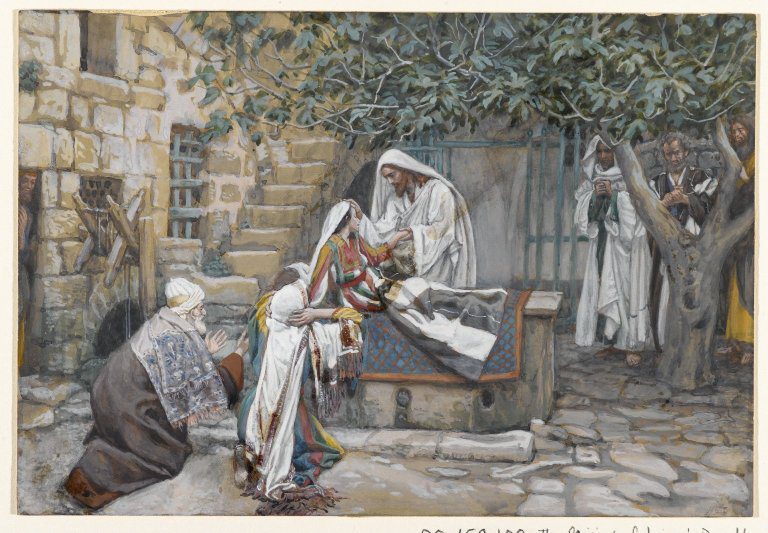
He goes right in, even though He is an unclean man and shouldn’t be welcome. And He finds that the little girl is dead. Dead bodies are unclean, like menstrual blood. You’re not supposed to touch them, but He does. He goes into the room where her lifeless body is lying on a bed.
The unclean Man who was touched by a woman defiled by menstrual blood, touches the unclean hand of the little girl’s corpse. “Talitha koum. Little girl, I say to you, arise.”
And she does.
She is not dead anymore.
She can grow up to be a woman, get married, perhaps have a baby. Perhaps the woman who lives just a short distance away will have a baby as well. They will be unclean for eight days after the baby is born, and then they will bathe and present themselves at the temple, and be clean yet again.
Jesus, now unclean in two different ways, leaves the house. He goes on His way, touching everyone and healing with His touch. In a short time, He will be cast out of town as an unclean thing, and be nailed to a cross and bleed and bleed and bleed until there is no blood left in Him, and in doing so He will give birth to a Church. Everyone who bathes in His blood will be clean, and cured of their afflictions.
All you have to do is touch the unclean God.
But you cannot be ashamed to touch the unclean.
Image via Pixabay
Mary Pezzulo is the author of Meditations on the Way of the Cross and Stumbling into Grace: How We Meet God in Tiny Works of Mercy.
Steel Magnificat operates almost entirely on tips. To tip the author, visit our donate page.
Previous Post
June 22, 2021
The Holy Family and the Just Man
Next Post

June 28, 2021 A Word on the USCCB, Who Want To Teach Us About the Eucharist
Browse Our Archives
Select a Category abortion Abuse Advent America American Christianity angel angels Annunciation Appalachia apparition apparition chaser apparition chasers apparition culture art art review babies baby baby Jesus Bad Lip Reading bad statue contest bath beauty Bible story blog blogkeeping blood book review Brandon Sanderson breastfeeding bus Catholic catholic conspiracy alarmism Catholic Oppositional Disorder Charismatic Renewal Charlie the Cat chastity Christ Christian idenitity Christianity and Judaism Chronic Illness clean clothing COD piece comedy compassion conscience conspiracy theory conversion cop-on-black violence Crucifixion cry of the poor culture Daesh Daily Saints death death penalty devotional diaconate diaper diapers dirty disability Donald Trump Dorothy Day dream drugs Eastern Catholicism Eastern Christianity education election election update Elsewhere on Patheos empathy environment Fear feminism film review fish flashback fluffy buns food Franciscan University of Steubenville Friendship Room fun Gabriel gardening gospel hair-splitting Heaven hell heresy Hillary Clinton history Holly the Witch Holy Spirit holy war Homeschooling homosexuality horror human dignity humor Icon idol immigrants infection inter-religious dialogue Interpretation of Scripture Islam Jesus Jihad Joseph joy laity and lay vocations lamb dinner laundry lent lgbtq literature love manners Mary Medicine and Science Meditation mercy mess milk misogyny Missouri monasticism monster motherhood mourn with those mourn movies movis music mystery nature neurodiversity New Pro-Life Movement news nonsense nostalgia O antiphons obituary objectification Ohio Valley Ordinary Time ordination Ordo Amoris parable paradox Passover peanut butter personal beliefs pets philosophy Planet Charismatic poetry politics polls poop Pope Francis Pope Leo power in the Church prayer prayer request prayers preferential option for non-violence president presidential election priest primary private revelation pro-life prophecy Public face of Catholicism Pure Flix Q and A race racism random rape rape. sexuality reader's request Reckoners refugee religious trauma ressurrection Right to life Saints saints and celebrations same-sex same-sex marriage satire scandal secular feasts seder Seven Joys Seven Last Words sex sexual ethics sexuality silencing six months skid row slavery social justice Speculative fiction spiritual abuse spoon stain story suffering suffrage suffragette Sunday Gospel temple Tenebrae Responsories Terror the exorcist The Friendship Room The New Pro-Life Movement Things I Learned on the Internet tin cup traffic true story tv review Uncategorized USCCB vice and temptation violence Virtue virtue and vice war Way of the Cross whimsy whole life women's ordination work of mercy Year A
Select a Month October 2026 September 2026 August 2026 July 2026 June 2026 May 2026 April 2026 March 2026 February 2026 January 2026 December 2025 November 2025 October 2025 September 2025 August 2025 July 2025 June 2025 May 2025 April 2025 March 2025 February 2025 January 2025 December 2024 November 2024 October 2024 September 2024 August 2024 July 2024 June 2024 May 2024 April 2024 March 2024 February 2024 January 2024 December 2023 November 2023 October 2023 September 2023 August 2023 July 2023 June 2023 May 2023 April 2023 March 2023 February 2023 January 2023 December 2022 November 2022 October 2022 September 2022 August 2022 July 2022 June 2022 May 2022 April 2022 March 2022 February 2022 January 2022 December 2021 November 2021 October 2021 September 2021 August 2021 July 2021 June 2021 May 2021 April 2021 March 2021 February 2021 January 2021 December 2020 November 2020 October 2020 September 2020 August 2020 July 2020 June 2020 May 2020 April 2020 March 2020 February 2020 January 2020 December 2019 November 2019 October 2019 September 2019 August 2019 July 2019 June 2019 May 2019 April 2019 March 2019 February 2019 January 2019 December 2018 November 2018 October 2018 September 2018 August 2018 July 2018 June 2018 May 2018 April 2018 March 2018 February 2018 January 2018 December 2017 November 2017 October 2017 September 2017 August 2017 July 2017 June 2017 May 2017 April 2017 March 2017 February 2017 January 2017 December 2016 November 2016 October 2016 September 2016 August 2016 July 2016 June 2016 May 2016 April 2016 March 2016
Follow Us!
TAKE THE
Religious Wisdom Quiz
Who asked, "What is truth?" while questioning Jesus?
Select your answer to see how you score.
Herod Peter Pilate Nicodemus
Related posts from Steel Magnificat

The Hedge, the Leviathan, and the Mystery of...

The Difference a Name Can Make
You Didn't Kill Jesus: A Message for Good...
January In An Ordinary Dystopia
TRENDING AT PATHEOS Catholic

The Sermon on the Mount, Part I: Matthew...
The Sermon on the Mount, Part I (Matthew 4:12-5:12) St. Matthew moves...

What's up from Crossway: Reviewing some of their latest A few weeks...

Janie Learns the Way of the Cross: A...
Teaching children about Jesus' Passion can be challenging. Many parents and educators...

Looking For Good Catholic Writing - October 2026
He alone extends the heavens, and he walks upon the waves of...

In "Irreplaceable," our book on vocation and technology, Trevor Sutton and I...

I was strolling through the top floor of the brand new Parthenon...
view all Catholic blogs
Ad-Free & Subscriber Log-In Subscription Support
- About Us
- 2026 Calendar
- Videos
- Podcasts
- Library of World Religions
- Faith In Media Tracker
- Advertise With Us
- Write for Us
- Privacy Policy
- Terms of Service
- Do Not Sell My Data
- Contact Us
- Radiant Digital
- Manage Newsletter Subscriptions
- Unsubscribe From Notifications
- Sitemap
Copyright 2008-2026, Patheos. All rights reserved.
Subscription Support Ad-Free & Subscriber Log-In
Follow Patheos