
BuddhistCatholicContemplativeEvangelicalGeneral ChristianHinduJewishLatter-day SaintMuslimNew VisionsProgressive Christian
Beliefs
- Buddhist
- Catholic
- Contemplative
- Evangelical
- General Christian
- Hindu
- Jewish
- Latter-day Saint
- More Voices
- Muslim
- New Visions
- Pagan
- Progressive Christian
Topics
- Religion News
- Food and Religion
- Sports and Religion
- Religious Art
- Religious Music and Entertainment
- Religious Events
- History and Religion
- Style and Religion
- Politics and Religion
- Women in Religion
- Recreation Outdoors and Religion
- Business Finance and Religion
- Careers Workplace and Religion
- Education and Religion
- Family Parenting and Religion
- Health Fitness and Religion
- Home and Religion
- Relationships and Religion
- Technology and Religion
- Travel and Religion
Columnists
- Buddhist Columnists
- Business Finance and Religion Columnists
- Careers Workplace and Religion Columnists
- Catholic Columnists
- Contemplative Columnists
- Education and Religion Columnists
- Evangelists Columnists
- Family Parenting and Religion Columnists
- General Christian Columnists
- Health Fitness and Religion Columnists
- Hindu Columnists
- History and Religion Columnists
- Home and Religion Columnists
- Jewish Columnists
- More Voices Columnists
- Latter Day Columnists
- Muslim Columnists
- New Visions Columnists
- Nonreligious Columnists
- Pagan Columnists
- Politics and Religion Columnists
- Progressive Columnists
- Recreation Outdoors and Religion Columnists
- Relationships and Religion Columnists
- Religion News Columnists
- Religious Art Columnists
- Religious Events Columnists
- Religious Music and Entertainment Columnists
- Sports and Religion Columnists
- Style and Religion Columnists
- Technology and Religion Columnists
- Travel and Religion Columnists
- Women in Religion Columnists
Resource Library
- 2026 Calendar
- Library of World Religions
- The 100 Most Holy Places on Earth
- Patheos Answers
- Podcasts
- Videos
- Faith Leaders Database
- Anglican Episcopalian
- Bahai
- Baptist
- Buddhism
- Christianity
- Confucianism
- Eastern Orthodoxy
- Hinduism
- Holiness and Pentecostal
- ISKCON
- Islam
- Judaism
- Lutheran
- Methodist
- The Church of Jesus Christ of Latter-day Saints
- New Age
- Paganism
- Presbytarian and Reformed
- Protestantism
- Religion Behind the Scenes
- Roman Catholic
- Scientology
- Shia Islam
- Sikhism
- Sufism
- Sunni Islam
- Taoism
- Zen
- See all religions
Research Tools
 Ad-Free & Subscriber Log-In Subscription Support
Ad-Free & Subscriber Log-In Subscription Support
Follow Patheos 

- Trending:
- Forgiveness
- |
- Marriage
- |
- Consciousness
- |
- Death Penalty
- |
- Election
- |
- Halloween

- Home
- Catholic
- The Names of the Rich are Forgotten
The Names of the Rich are Forgotten
Last updated on: September 28, 2019 at 9:43 pm by Mary Pezzulo
The Names of the Rich are Forgotten 2019-09-28T21:43:28-04:00 Mary Pezzulo
Patheos Explore the world's faith through different perspectives on religion and spirituality! Patheos has the views of the prevalent religions and spiritualities of the world.
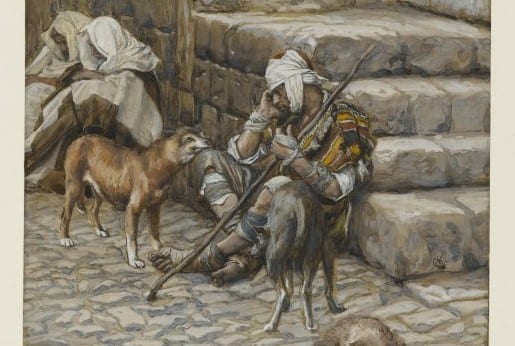
A Reading from the Holy Gospel according to Luke:
Jesus said to the Pharisees:
“There was a rich man who dressed in purple garments and fine linen
and dined sumptuously each day.
And lying at his door was a poor man named Lazarus, covered with sores,
who would gladly have eaten his fill of the scraps
that fell from the rich man’s table.
Dogs even used to come and lick his sores.
When the poor man died,
he was carried away by angels to the bosom of Abraham.
The rich man also died and was buried,
and from the netherworld, where he was in torment,
he raised his eyes and saw Abraham far off
and Lazarus at his side.
And he cried out, ‘Father Abraham, have pity on me.
Send Lazarus to dip the tip of his finger in water and cool my tongue,
for I am suffering torment in these flames.’
Abraham replied,
‘My child, remember that you received
what was good during your lifetime
while Lazarus likewise received what was bad;
but now he is comforted here, whereas you are tormented.
Moreover, between us and you a great chasm is established
to prevent anyone from crossing who might wish to go
from our side to yours or from your side to ours.’
He said, ‘Then I beg you, father,
send him to my father’s house, for I have five brothers,
so that he may warn them,
lest they too come to this place of torment.’
But Abraham replied, ‘They have Moses and the prophets.
Let them listen to them.’
He said, ‘Oh no, father Abraham,
but if someone from the dead goes to them, they will repent.’
Then Abraham said, ‘If they will not listen to Moses and the prophets,
neither will they be persuaded if someone should rise from the dead.'”
The poor man’s name was Lazarus.
I don’t know how that name rings on other people’s ears. I grew up in Columbus, where “Lazarus” was the name of a department store, the pride of the city in its prime. There was one location with bright aqua tile on the facade, and one location downtown that had fanciful displays in the windows at Christmas. I used to get a brand new Christmas teddy bear from Lazarus every year, all decked out in a unique red sweater and hat. “Lazarus” reminds me of Christmas. Of course, it turns out that the name has nothing to do with Christmas– it was the surname of the gentleman who founded the department store, a rabbi and an immigrant from Germany, may his memory be a blessing– but it remains a name that’s hard to forget. It doesn’t take long to think of “Lazarus.” “Lazarus” is a memorable name.
“Lazarus” itself is both a given name and a surname, derived from the name “Eleazar,” which means “God helps.” Eleazar was the name of the keeper of the ark of the covenant, one of King David’s warriors, one of the men responsible for the sacred vessels at the return from the Babylonian exile, the man Christ wept for and raised from the dead, and also a fictional character in one of Christ’s parables. In life, this Eleazar, Lazarus, was a poor man covered in sores, hungry for scraps, licked by dogs; in paradise, he was embraced in the bosom of Abraham his ancestor.
The rich man in the parable is not named at all. Some re-tellings of the story call him “Dives,” but that’s not a name; it’s just a word that means “rich man.”
There was a rich man named Rich Man, and we know nothing about him except for the things he possessed and the ways he enjoyed himself. He dressed in purple and fine linen, and dined sumptuously every day. Meanwhile, lying at his door, was a man named Lazarus, Eleazar, God Helps. And Lazarus was not only ill but starving.
The man whose name was Rich Man must have stepped over Lazarus at least twice every day, once on his way out and once on the way back home. Once when going out shopping for new linen clothing and once when coming home to feast. Once when going out to the synagogue, perhaps, and once on the way in to celebrate the Sabbath. Once on his way out to see to his investments, his vineyards or cattle or merchandise or whatever it is that made the rich man rich. Once on his way back to enjoy the things he bought with the money he earned, his just reward for his work and prudent investment. Each time, he stepped over Lazarus, a fellow child of Abraham.
He must have noticed Lazarus lying there at the door with dogs licking him, starving, probably reeking to high heaven.
Perhaps he thought he was generous, allowing his sick and hungry neighbor to take shelter in his doorway. Perhaps he prayed for him as he went in and out, and thought this was generous as well. “God help him.”
“Lazarus” means “God helps.”
For this, the rich man’s soul was eternally lost.
Christ doesn’t speak very often in the gospels about the torments of Hell, but he mentions them here. For the crime of never stopping to help his neighbor, the rich man was cast into the netherworld. And he looked up from the flames and saw Abraham standing there, with the man called Lazarus resting on Abraham’s bosom, because Heaven isn’t really removed from Hell. Heaven is the love of God, which is everywhere present and filling all things. There’s no getting away from that. The torment of hell is being a soul that insisted on a there being a gulf between things that ought to be close together– between neighbor and neighbor, between person and person, between icon and icon– between your state in life and the state of the reeking beggar at your door. Hell is the state of having fought as hard as you can to open up an abscess between yourself and the person God sent to you, and now you have to live on one side of that abscess you willingly made. And there, afar off, on the other side of the abscess, is your neighbor in Abraham’s bosom.
There is the man called Lazarus, who was himself covered in abscesses that the rich man could have helped to bandage but didn’t. Lazarus is loved and comforted by angels and resting in his ancestor’s embrace. The angels know his name. Abraham knows, and uses it.
The rich man has no name.
In life, the rich man insulated himself with luxury and pleasure, but now he has gone to the netherworld. The netherworld is the place where your luxury and pleasure are stripped away and everyone can see you– not what you have, but who are, who you chose of your own free will to become. He chose to become a man with no name– a man with no identity, a man who wasn’t a person but an emptiness surrounded by wealth and luxury, a heap of pleasant diversions in the shape of a man. He chose to be a man whose name was “Rich Man,” but now the man called “Rich Man” is not rich.
Even the rich man in hell knows Lazarus’s name, but he won’t address Lazarus. In life, he did not speak to Lazarus, and he doesn’t speak to him now. He speaks to their shared ancestor, the righteous Abraham. He begs Abraham to send Lazarus to hell to serve him a drink. The rich man is used to being served. He is used to having is discomfort soothed by people he considers less than he is. But in the eyes of Heaven there is no such thing as a man who is less.
Abraham is tender, and addresses the rich man as “my son.” He loves the rich man, but there’s nothing he can do. Between the netherworld and Abraham’s bosom there is a gulf that can never be crossed, because the souls in the netherworld wish it to be so. The souls in the netherworld opened up the abscess between brother and brother, and they maintain it for eternity because they want to even though it hurts. Lazarus cannot cross that. Abraham himself cannot cross that. Nobody can.
The rich man bargains. He’s used to bargaining to get what he wants. There has to be a way. Will Abraham at least send Lazarus back to the world where he was tormented and despised, as a favor, to warn the rich man’s brothers?
No, Abraham cannot. That world murdered Lazarus by neglect, and there is no getting him back now. Besides, it would do no good. They will not listen to the Law and the Prophets; they’re not going to listen to a man they thought was so much less than they, not even if he returns from the dead.
“Lazarus” is a memorable name, and the Lord granted him eternal memory. But the name of the rich is “Rich Man.” The name of the rich is “Pleasure.” The name of the rich is “Prestige.” The name of the rich is “Luxury.” The name of the rich is “Better-than-Thou.” These are names that do not go with you into the next life.
The names of the rich are forgotten.
(image via Wikimedia Commons)
Steel Magnificat runs almost entirely on tips. To tip the author, go here.
Previous Post

September 26, 2019
The Valley is Only a Place
Next Post

September 30, 2019 Abby Johnson's Racist Rant is a Disgrace
Browse Our Archives
Select a Category abortion Abuse Advent America American Christianity angel angels Annunciation Appalachia apparition apparition chaser apparition chasers apparition culture art art review babies baby baby Jesus Bad Lip Reading bad statue contest bath beauty Bible story blog blogkeeping blood book review Brandon Sanderson breastfeeding bus Catholic catholic conspiracy alarmism Catholic Oppositional Disorder Charismatic Renewal Charlie the Cat chastity Christ Christian idenitity Christianity and Judaism Chronic Illness clean clothing COD piece comedy compassion conscience conspiracy theory conversion cop-on-black violence Crucifixion cry of the poor culture Daesh Daily Saints death death penalty devotional diaconate diaper diapers dirty disability Donald Trump Dorothy Day dream drugs Eastern Catholicism Eastern Christianity education election election update Elsewhere on Patheos empathy environment Fear feminism film review fish flashback fluffy buns food Franciscan University of Steubenville Friendship Room fun Gabriel gardening gospel hair-splitting Heaven hell heresy Hillary Clinton history Holly the Witch Holy Spirit holy war Homeschooling homosexuality horror human dignity humor Icon idol immigrants infection inter-religious dialogue Interpretation of Scripture Islam Jesus Jihad Joseph joy laity and lay vocations lamb dinner laundry lent lgbtq literature love manners Mary Medicine and Science Meditation mercy mess milk misogyny Missouri monasticism monster motherhood mourn with those mourn movies movis music mystery nature neurodiversity New Pro-Life Movement news nonsense nostalgia O antiphons obituary objectification Ohio Valley Ordinary Time ordination Ordo Amoris parable paradox Passover peanut butter personal beliefs pets philosophy Planet Charismatic poetry politics polls poop Pope Francis Pope Leo power in the Church prayer prayer request prayers preferential option for non-violence president presidential election priest primary private revelation pro-life prophecy Public face of Catholicism Pure Flix Q and A race racism random rape rape. sexuality reader's request Reckoners refugee religious trauma ressurrection Right to life Saints saints and celebrations same-sex same-sex marriage satire scandal secular feasts seder Seven Joys Seven Last Words sex sexual ethics sexuality silencing six months skid row slavery social justice Speculative fiction spiritual abuse spoon stain story suffering suffrage suffragette Sunday Gospel temple Tenebrae Responsories Terror the exorcist The Friendship Room The New Pro-Life Movement Things I Learned on the Internet tin cup traffic true story tv review Uncategorized USCCB vice and temptation violence Virtue virtue and vice war Way of the Cross whimsy whole life women's ordination work of mercy Year A
Select a Month October 2026 September 2026 August 2026 July 2026 June 2026 May 2026 April 2026 March 2026 February 2026 January 2026 December 2025 November 2025 October 2025 September 2025 August 2025 July 2025 June 2025 May 2025 April 2025 March 2025 February 2025 January 2025 December 2024 November 2024 October 2024 September 2024 August 2024 July 2024 June 2024 May 2024 April 2024 March 2024 February 2024 January 2024 December 2023 November 2023 October 2023 September 2023 August 2023 July 2023 June 2023 May 2023 April 2023 March 2023 February 2023 January 2023 December 2022 November 2022 October 2022 September 2022 August 2022 July 2022 June 2022 May 2022 April 2022 March 2022 February 2022 January 2022 December 2021 November 2021 October 2021 September 2021 August 2021 July 2021 June 2021 May 2021 April 2021 March 2021 February 2021 January 2021 December 2020 November 2020 October 2020 September 2020 August 2020 July 2020 June 2020 May 2020 April 2020 March 2020 February 2020 January 2020 December 2019 November 2019 October 2019 September 2019 August 2019 July 2019 June 2019 May 2019 April 2019 March 2019 February 2019 January 2019 December 2018 November 2018 October 2018 September 2018 August 2018 July 2018 June 2018 May 2018 April 2018 March 2018 February 2018 January 2018 December 2017 November 2017 October 2017 September 2017 August 2017 July 2017 June 2017 May 2017 April 2017 March 2017 February 2017 January 2017 December 2016 November 2016 October 2016 September 2016 August 2016 July 2016 June 2016 May 2016 April 2016 March 2016
Follow Us!
TAKE THE
Religious Wisdom Quiz
Though Israel played the harlot, I will betroth you to me forever in righteousness and justice, in love and what?
Select your answer to see how you score.
Holiness Faithfulness Compassion Truth
Related posts from Steel Magnificat

The Thing I Don't Understand about Rich People...

In the World that is Passing Away


On Loaves, on Fish, on Grief, on Healing
TRENDING AT PATHEOS Catholic

The Real AI Story Is Adoption Without Trust
Artificial intelligence has crossed a political threshold. It is no longer a...

A new article, written by Jeff Lindsay and Gale L. Pooley,...

Swimfan: Forgotten Aughts Pleasures
This is a recovery effort. In 2002, My Big Fat Greek Wedding...

Top Three Anti-Catholic Lies About Catholicism
This is my initial transcript for the video, "THE 3 WORST...

Pope Leo Celebrates Mass for Nurses & Docs...
I don't have any idea how he did it, but Pope Leo...

The Sermon on the Mount, Part I: Matthew...
The Sermon on the Mount, Part I (Matthew 4:12-5:12) St. Matthew moves...
view all Catholic blogs
Ad-Free & Subscriber Log-In Subscription Support
- About Us
- 2026 Calendar
- Videos
- Podcasts
- Library of World Religions
- Faith In Media Tracker
- Advertise With Us
- Write for Us
- Privacy Policy
- Terms of Service
- Do Not Sell My Data
- Contact Us
- Radiant Digital
- Manage Newsletter Subscriptions
- Unsubscribe From Notifications
- Sitemap
Copyright 2008-2026, Patheos. All rights reserved.
Subscription Support Ad-Free & Subscriber Log-In
Follow Patheos