
BuddhistCatholicContemplativeEvangelicalGeneral ChristianHinduJewishLatter-day SaintMuslimNew VisionsProgressive Christian
Beliefs
- Buddhist
- Catholic
- Contemplative
- Evangelical
- General Christian
- Hindu
- Jewish
- Latter-day Saint
- More Voices
- Muslim
- New Visions
- Pagan
- Progressive Christian
Topics
- Religion News
- Food and Religion
- Sports and Religion
- Religious Art
- Religious Music and Entertainment
- Religious Events
- History and Religion
- Style and Religion
- Politics and Religion
- Women in Religion
- Recreation Outdoors and Religion
- Business Finance and Religion
- Careers Workplace and Religion
- Education and Religion
- Family Parenting and Religion
- Health Fitness and Religion
- Home and Religion
- Relationships and Religion
- Technology and Religion
- Travel and Religion
Columnists
- Buddhist Columnists
- Business Finance and Religion Columnists
- Careers Workplace and Religion Columnists
- Catholic Columnists
- Contemplative Columnists
- Education and Religion Columnists
- Evangelists Columnists
- Family Parenting and Religion Columnists
- General Christian Columnists
- Health Fitness and Religion Columnists
- Hindu Columnists
- History and Religion Columnists
- Home and Religion Columnists
- Jewish Columnists
- More Voices Columnists
- Latter Day Columnists
- Muslim Columnists
- New Visions Columnists
- Nonreligious Columnists
- Pagan Columnists
- Politics and Religion Columnists
- Progressive Columnists
- Recreation Outdoors and Religion Columnists
- Relationships and Religion Columnists
- Religion News Columnists
- Religious Art Columnists
- Religious Events Columnists
- Religious Music and Entertainment Columnists
- Sports and Religion Columnists
- Style and Religion Columnists
- Technology and Religion Columnists
- Travel and Religion Columnists
- Women in Religion Columnists
Resource Library
- 2026 Calendar
- Library of World Religions
- The 100 Most Holy Places on Earth
- Patheos Answers
- Podcasts
- Videos
- Faith Leaders Database
- Anglican Episcopalian
- Bahai
- Baptist
- Buddhism
- Christianity
- Confucianism
- Eastern Orthodoxy
- Hinduism
- Holiness and Pentecostal
- ISKCON
- Islam
- Judaism
- Lutheran
- Methodist
- The Church of Jesus Christ of Latter-day Saints
- New Age
- Paganism
- Presbytarian and Reformed
- Protestantism
- Religion Behind the Scenes
- Roman Catholic
- Scientology
- Shia Islam
- Sikhism
- Sufism
- Sunni Islam
- Taoism
- Zen
- See all religions
Research Tools
 Ad-Free & Subscriber Log-In Subscription Support
Ad-Free & Subscriber Log-In Subscription Support
Follow Patheos 

- Trending:
- Forgiveness
- |
- Marriage
- |
- Consciousness
- |
- Death Penalty
- |
- Election
- |
- Halloween

- Home
- Catholic
- Which of These Was Neighbor? Which of These Was Christ?
Which of These Was Neighbor? Which of These Was Christ?
Last updated on: July 16, 2019 at 3:32 pm by Mary Pezzulo
Which of These Was Neighbor? Which of These Was Christ? 2019-07-16T15:32:29-04:00 Mary Pezzulo
Patheos Explore the world's faith through different perspectives on religion and spirituality! Patheos has the views of the prevalent religions and spiritualities of the world.
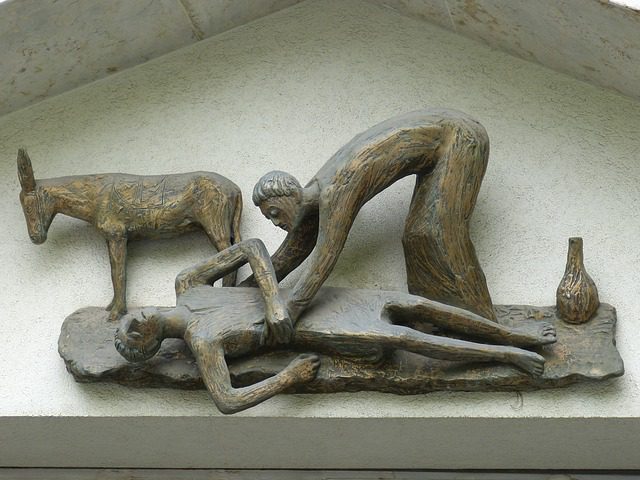
A reading from the Holy Gospel according to Luke:
There was a scholar of the law who stood up to test Jesus and said,
“Teacher, what must I do to inherit eternal life?”
Jesus said to him, “What is written in the law?
How do you read it?”
He said in reply,
“You shall love the Lord, your God,
with all your heart,
with all your being,
with all your strength,
and with all your mind,
and your neighbor as yourself.”
He replied to him, “You have answered correctly;
do this and you will live.”But because he wished to justify himself, he said to Jesus,
“And who is my neighbor?”
Jesus replied,
“A man fell victim to robbers
as he went down from Jerusalem to Jericho.
They stripped and beat him and went off leaving him half-dead.
A priest happened to be going down that road,
but when he saw him, he passed by on the opposite side.
Likewise a Levite came to the place,
and when he saw him, he passed by on the opposite side.
But a Samaritan traveler who came upon him
was moved with compassion at the sight.
He approached the victim,
poured oil and wine over his wounds and bandaged them.
Then he lifted him up on his own animal,
took him to an inn, and cared for him.
The next day he took out two silver coins
and gave them to the innkeeper with the instruction,
‘Take care of him.
If you spend more than what I have given you,
I shall repay you on my way back.’
Which of these three, in your opinion,
was neighbor to the robbers’ victim?”
He answered, “The one who treated him with mercy.”
Jesus said to him, “Go and do likewise.”
I once walked into an Orthodox Church, and was scared half to death, and this Gospel passage is to blame.
You see, I’ve always been a little cagey about the Parable of the Good Samaritan, for a rather eccentric reason. When I was in the second grade we made stick puppets out of straws to act out the parable, and the part of the injured man was played by a half-naked stick puppet lying on his side unconscious. There wasn’t a puppet of the man before his injury. You had to hold the puppet sideways for that part of the story, and pretend that he was walking from Jerusalem down to Jericho with a funny swayback, naked and with his eyes closed– or, you could do what our long-suffering teacher actually wanted, and start the dramatization after the first act, when the man was already lying half dead. Then we acted out the rest of the story– the Levite walked by, whoever that was, and the priest whom we could all picture because we’d seen priests. Then a Samaritan, an outcast, happened by and saved the poor victim. This part was easy; you just held the injured man puppet at waist-height to the Samaritan puppet. And then you handed him off to the innkeeper, who got his own puppet representation even though his part was not nearly as important as that of the victim. The Samaritan paid the innkeeper and then rode off into the sunset, promising to come back and settle his bill later.
And then, in my own improvised ending to the parable, the innkeeper waited until the Samaritan was out of sight. Then he dropped the injured man onto the ground with a hearty “Yuck!”
This counts as a funny joke when you’re in the second grade.
It did strike me as the strangest ending to a parable: that the hero of the story would abandon the critically injured, naked man at an inn and promise to come back, trusting the innkeeper wouldn’t do anything wrong. In the days before hospitals, I guess that’s what happened to people who met with misfortune on the road to Jericho if they didn’t just die. Someone would bring them to the nearest inn, and care for them themselves or trust the innkeeper to do it.
And what if he didn’t?
What if the innkeeper ended up being like the Thenardiers in Les Miserables, or Miss Minchin in A Little Princess, or worse? How could the Samaritan know he wasn’t? What if the innkeeper said “yuck!” and threw the victim away?
What would become of that helpless man?
This brings me to a few years ago, when I walked into an Orthodox church. I was gazing on the icons, and I came across the icon of the Good Samaritan. I saw that the Good Samaritan had a certain very distinctive marking on His halo, and the injured half-naked victim had a name written above his head. Thankfully it was in English and not Greek, because I can’t decipher Greek anymore than I can fly.
The injured man was called “Adam.”
And the markings on the Good Samaritan’s halo were the cross, omega, omicron, and nu that go only on the halo of Christ.
I looked this up when I got home, and it’s not unique to that particular icon. Eastern depictions of the Good Samaritan portray the Samaritan as really Christ and the victim as really Adam– us, sinful human beings in need of mercy. There are even prayers where you ask Jesus to pour on you the oil and wine, to heal you of your sins.
You and I are the man who met with robbers on his way from Jerusalem to Jericho. You and I are the naked and wounded victim who don’t remember a time when we could walk upright. We find ourselves in media res, already broken, waiting for help. Christ is the social outcast who came to pick us up when priests and holy men left us in the dust. He carries us to the inn, He pays the innkeeper and trusts there will be no foul play. And He goes away, promising to return and pay back what is owed.
This terrifies me.
This is how I have experienced the Church. I believe in Christ. He has been my only friend in the dark places I’ve been. When clerics and holy people walk by on the opposite side of the road, He comes to me and carries me forward on our journey. But there always comes a point where I find myself in a parish or a community and He doesn’t seem to be there. It’s as if He left me in the hands of these people, naively trusting that they’d do the right thing in His absence.
I can count more times that they haven’t, than that they have.
And I know plenty of people who have had a far worse time of it than I have– far worse than I can even imagine. I know people for whom the Church has been nothing from the beginning to the end but an inn where they went to find care for their wounds, and instead were neglected and abused until their faith died. I, myself, feel like my faith is hanging by a thread lately, and it’s not the Church that’s keeping that thread in place.
What if the Samaritan returns one day, and finds the injured victim starved to death or died of bedsores in his absence? What if he finds the victim was thrown out of the inn and died on the street because the innkeeper didn’t care? What if the innkeeper was a spiritual abuser, a sexual predator, or both?
He is returning to pay back what is owed, but when the Son of Man returns, will He find any faithful on the earth? And if He doesn’t, will that be the fault of the ones who died because those who had the power to help them were abusive?
He is the Resurrection and the Life, so we ought to have hope even if we die, but at this point it’s more than difficult. I don’t think He blames us for the difficulty, mind you. We’re not the ones who made it this way. I can’t imagine that He’ll be upset with people who left because of what was done to them– or because of the help they desperately needed, but weren’t given.
And there I go again, believing in Christ and His justice in spite of everything.
Maybe this is a hopeful parable after all– that wherever you are, in spite of the way that the clergy and the important people have abandoned or abused you, Christ will tend your wounds and pick you up, and carry you to a new place. And when they inevitably fail you again, He will pick you up and carry you again, and so on until the Last Day when He repays everyone for what they have done to the helpless.
And we as Christians must go and do likewise. Do not be like the clergy or the hierarchy. They have failed. Instead, be like Christ. Go out to the roadside and bring in those who have nothing, those who are dying, those whom the world tells you you ought to drop and say “yuck.” Tear your clothes to make their bandages and pour out your oil and wine. Someday, Christ is coming to gather His own to Himself, and pay back what you did for your neighbor.
We are all the injured man, but we are also the innkeeper for one another. We are also meant to be Christ the Good Samaritan.
This isn’t enough. It’s not the answer to what we have been through. I don’t think mortal tongue can ever come up with an answer to such betrayal. But it’s something.
(image via Pixabay)
Previous Post

July 14, 2019
July, July
Next Post

July 14, 2019 Why I'm Not Calling Mike Pence a Fake Christian
Browse Our Archives
Select a Category abortion Abuse Advent America American Christianity angel angels Annunciation Appalachia apparition apparition chaser apparition chasers apparition culture art art review babies baby baby Jesus Bad Lip Reading bad statue contest bath beauty Bible story blog blogkeeping blood book review Brandon Sanderson breastfeeding bus Catholic catholic conspiracy alarmism Catholic Oppositional Disorder Charismatic Renewal Charlie the Cat chastity Christ Christian idenitity Christianity and Judaism Chronic Illness clean clothing COD piece comedy compassion conscience conspiracy theory conversion cop-on-black violence Crucifixion cry of the poor culture Daesh Daily Saints death death penalty devotional diaconate diaper diapers dirty disability Donald Trump Dorothy Day dream drugs Eastern Catholicism Eastern Christianity education election election update Elsewhere on Patheos empathy environment Fear feminism film review fish flashback fluffy buns food Franciscan University of Steubenville Friendship Room fun Gabriel gardening gospel hair-splitting Heaven hell heresy Hillary Clinton history Holly the Witch Holy Spirit holy war Homeschooling homosexuality horror human dignity humor Icon idol immigrants infection inter-religious dialogue Interpretation of Scripture Islam Jesus Jihad Joseph joy laity and lay vocations lamb dinner laundry lent lgbtq literature love manners Mary Medicine and Science Meditation mercy mess milk misogyny Missouri monasticism monster motherhood mourn with those mourn movies movis music mystery nature neurodiversity New Pro-Life Movement news nonsense nostalgia O antiphons obituary objectification Ohio Valley Ordinary Time ordination Ordo Amoris parable paradox Passover peanut butter personal beliefs pets philosophy Planet Charismatic poetry politics polls poop Pope Francis Pope Leo power in the Church prayer prayer request prayers preferential option for non-violence president presidential election priest primary private revelation pro-life prophecy Public face of Catholicism Pure Flix Q and A race racism random rape rape. sexuality reader's request Reckoners refugee religious trauma ressurrection Right to life Saints saints and celebrations same-sex same-sex marriage satire scandal secular feasts seder Seven Joys Seven Last Words sex sexual ethics sexuality silencing six months skid row slavery social justice Speculative fiction spiritual abuse spoon stain story suffering suffrage suffragette Sunday Gospel temple Tenebrae Responsories Terror the exorcist The Friendship Room The New Pro-Life Movement Things I Learned on the Internet tin cup traffic true story tv review Uncategorized USCCB vice and temptation violence Virtue virtue and vice war Way of the Cross whimsy whole life women's ordination work of mercy Year A
Select a Month October 2026 September 2026 August 2026 July 2026 June 2026 May 2026 April 2026 March 2026 February 2026 January 2026 December 2025 November 2025 October 2025 September 2025 August 2025 July 2025 June 2025 May 2025 April 2025 March 2025 February 2025 January 2025 December 2024 November 2024 October 2024 September 2024 August 2024 July 2024 June 2024 May 2024 April 2024 March 2024 February 2024 January 2024 December 2023 November 2023 October 2023 September 2023 August 2023 July 2023 June 2023 May 2023 April 2023 March 2023 February 2023 January 2023 December 2022 November 2022 October 2022 September 2022 August 2022 July 2022 June 2022 May 2022 April 2022 March 2022 February 2022 January 2022 December 2021 November 2021 October 2021 September 2021 August 2021 July 2021 June 2021 May 2021 April 2021 March 2021 February 2021 January 2021 December 2020 November 2020 October 2020 September 2020 August 2020 July 2020 June 2020 May 2020 April 2020 March 2020 February 2020 January 2020 December 2019 November 2019 October 2019 September 2019 August 2019 July 2019 June 2019 May 2019 April 2019 March 2019 February 2019 January 2019 December 2018 November 2018 October 2018 September 2018 August 2018 July 2018 June 2018 May 2018 April 2018 March 2018 February 2018 January 2018 December 2017 November 2017 October 2017 September 2017 August 2017 July 2017 June 2017 May 2017 April 2017 March 2017 February 2017 January 2017 December 2016 November 2016 October 2016 September 2016 August 2016 July 2016 June 2016 May 2016 April 2016 March 2016
Follow Us!
TAKE THE
Religious Wisdom Quiz
How long did Persian empire rule?
Select your answer to see how you score.
180 years 150 years 200 years 250 years
Related posts from Steel Magnificat

The Thing I Don't Understand about Rich People...

The American Pro-Life Movement Lied. Now What?
On Loaves, on Fish, on Grief, on Healing

How Does A Seed Grow? How Does the...
TRENDING AT PATHEOS Catholic

The First Eucharistic Controversy: Christ’s Real Presence
For Catholics, the Eucharist is the source and summit of the Christian...

What a Stop Sign Can Teach Us About...
How to Make a Decision When You Can't Hear God Main point:...

Archdiocese Hosts Military Marriage Retreat in Germany
RASTATT, Germany — The transient military lifestyle, with its frequent deployments and...

Nearly every morning, I make the drive to Detroit with my high-school-age...

The Real AI Story Is Adoption Without Trust
Artificial intelligence has crossed a political threshold. It is no longer a...

A new article, written by Jeff Lindsay and Gale L. Pooley,...
view all Catholic blogs
Ad-Free & Subscriber Log-In Subscription Support
- About Us
- 2026 Calendar
- Videos
- Podcasts
- Library of World Religions
- Faith In Media Tracker
- Advertise With Us
- Write for Us
- Privacy Policy
- Terms of Service
- Do Not Sell My Data
- Contact Us
- Radiant Digital
- Manage Newsletter Subscriptions
- Unsubscribe From Notifications
- Sitemap
Copyright 2008-2026, Patheos. All rights reserved.
Subscription Support Ad-Free & Subscriber Log-In
Follow Patheos