
BuddhistCatholicContemplativeEvangelicalGeneral ChristianHinduJewishLatter-day SaintMuslimNew VisionsProgressive Christian
Beliefs
- Buddhist
- Catholic
- Contemplative
- Evangelical
- General Christian
- Hindu
- Jewish
- Latter-day Saint
- More Voices
- Muslim
- New Visions
- Pagan
- Progressive Christian
Topics
- Religion News
- Food and Religion
- Sports and Religion
- Religious Art
- Religious Music and Entertainment
- Religious Events
- History and Religion
- Style and Religion
- Politics and Religion
- Women in Religion
- Recreation Outdoors and Religion
- Business Finance and Religion
- Careers Workplace and Religion
- Education and Religion
- Family Parenting and Religion
- Health Fitness and Religion
- Home and Religion
- Relationships and Religion
- Technology and Religion
- Travel and Religion
Columnists
- Buddhist Columnists
- Business Finance and Religion Columnists
- Careers Workplace and Religion Columnists
- Catholic Columnists
- Contemplative Columnists
- Education and Religion Columnists
- Evangelists Columnists
- Family Parenting and Religion Columnists
- General Christian Columnists
- Health Fitness and Religion Columnists
- Hindu Columnists
- History and Religion Columnists
- Home and Religion Columnists
- Jewish Columnists
- More Voices Columnists
- Latter Day Columnists
- Muslim Columnists
- New Visions Columnists
- Nonreligious Columnists
- Pagan Columnists
- Politics and Religion Columnists
- Progressive Columnists
- Recreation Outdoors and Religion Columnists
- Relationships and Religion Columnists
- Religion News Columnists
- Religious Art Columnists
- Religious Events Columnists
- Religious Music and Entertainment Columnists
- Sports and Religion Columnists
- Style and Religion Columnists
- Technology and Religion Columnists
- Travel and Religion Columnists
- Women in Religion Columnists
Resource Library
- 2026 Calendar
- Library of World Religions
- The 100 Most Holy Places on Earth
- Patheos Answers
- Podcasts
- Videos
- Faith Leaders Database
- Anglican Episcopalian
- Bahai
- Baptist
- Buddhism
- Christianity
- Confucianism
- Eastern Orthodoxy
- Hinduism
- Holiness and Pentecostal
- ISKCON
- Islam
- Judaism
- Lutheran
- Methodist
- The Church of Jesus Christ of Latter-day Saints
- New Age
- Paganism
- Presbytarian and Reformed
- Protestantism
- Religion Behind the Scenes
- Roman Catholic
- Scientology
- Shia Islam
- Sikhism
- Sufism
- Sunni Islam
- Taoism
- Zen
- See all religions
Research Tools
 Ad-Free & Subscriber Log-In Subscription Support
Ad-Free & Subscriber Log-In Subscription Support
Follow Patheos 

- Trending:
- Forgiveness
- |
- Marriage
- |
- Consciousness
- |
- Death Penalty
- |
- Election
- |
- Halloween
 Fr. Dwight Longenecker
-
Archived Articles
- Everything Belongs to You
- Affirming All Things
- Home Away From Home
- The House of Mirrors
- Universal and Particular
- How Do We Know It's the True Church?
- Believing and Belonging
- Which Came First?
- Them and Us
- What is Truth?
- Authority of the First Popes
- The Authority of the Catholic Church
- Biblical Support for the Authority of the Pope
- What Do We Mean By the Real Presence?
- Baptism Now Saves You
- Mother of God – Defender of Orthodoxy
- Explaining Mary Redemptrix to an Evangelical
- Holy Mary Mother of God
- Distorted Devotions – Do Catholics Honor Mary Too Much?
- Why a Former Evangelical Loves the Rosary
- Do Catholics Pray to Mary?
- Purity is Power
- Woman and Serpent – Take 2
- Once A Virgin – Always a Virgin?
- Mary Mother of God or Mother Goddess?
- One Saving Action
- Left Behind
- Why Don't Catholics Read the Bible?
- Idol Speculation – Do Catholics Worship Idols?
- The Problem with Primitivism
- Weird Things Happen
- Paganism, Prophecies and Propaganda
- Utilitarianism – What is Good Works?
- Home
- Catholic
Mother of God – Defender of Orthodoxy
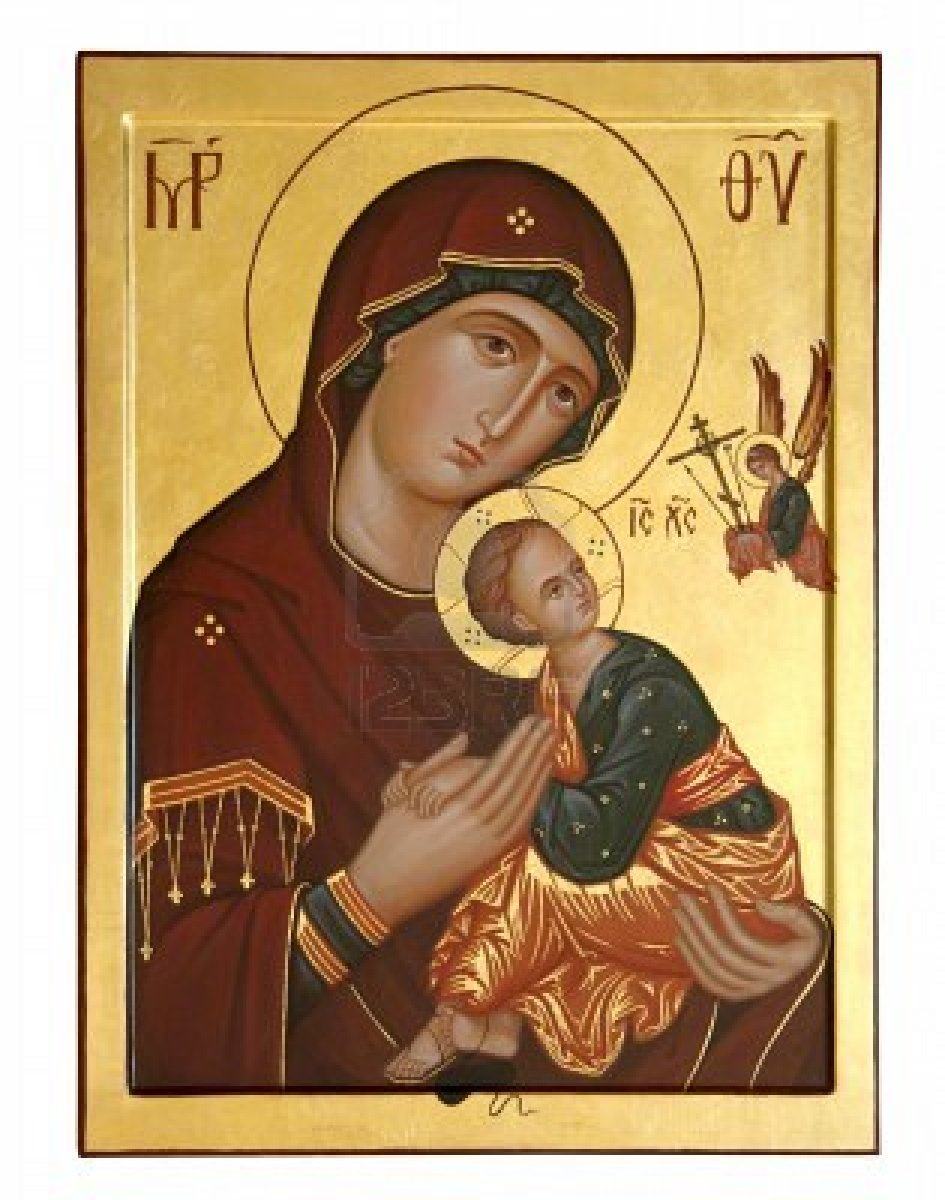 I have long recognized the unique vocation of Our Lady, called to the highest honour among all created beings. It is a fact of history that, if true honour is not paid to her as the Mother of God, people put our Lord in her place as the highest of creation rather than adoring him as God Incarnate.
–Rt Rev Mgr Graham Leonard from The Path to Rome
The former Anglican Bishop of London—later ordained as a Catholic priest– sums up the reasoning for the church’s most ancient title for the Blessed Virgin Mary. Put simply, Mary’s title of Mother of God insures Christ’s true place as the unique Son of God and Son of Man.
The title theotokos literally means God-bearer. It is the title used by the Greek fathers from Origen in the early third century, and some even think it can be traced to Hippolytus who died in the year 236. This term for the Virgin Mary was used increasingly by the early Church, but in the early fifth century it was attacked by the heretic Nestorius, who wanted to replace the term theotokos with Christotokos or ‘Christ-bearer.’ Nestorius, in a sincere attempt to avoid an earlier heresy called Apollinarianism, asserted that there were two separate persons conjoined in Jesus Christ. Thus the Blessed Virgin Mary in giving Jesus human flesh could be the ‘Christ-bearer’ but not ‘God bearer.’
Nestorius was opposed by St Cyril of Alexandria and the controversy was referred to a Council of Rome in the year 430. Pope Celestine condemned Nestorius’ teaching, and in the meantime the emperor arranged a General Council to meet at Ephesus. It met in the summer of 431 and condemned Nestorius and therefore re-affirmed the already ancient title theotokos. What is clear from the controversy surrounding Nestorius is that the title theotokos is not primarily an exaltation of the Blessed Virgin Mary, but a defense of orthodox Christology. The Council of Ephesus upheld a fully orthodox view of Jesus, and to do this they re-affirmed the devotion to the Blessed Virgin Mary which supported the fullest understanding of Christ’s divinity.
Just twenty years after the Council of Ephesus another council was held, this time in the city of Chalcedon. On 8 October 451 the council opened and dealt with another heresy called Eutychianism. As a result of the council the Definition of Chalcedon was drawn up. This definition re-affirmed the basic definition of Christ’s divinity given at the Council of Nicea in 325. It expressly repudiated those who deny the title theotokos for the Blessed Virgin Mary and went on to re-assert the orthodox position that Our Lord was ‘One Person in Two Natures which are united unconfusedly, unchangeably indivisibly inseparably’.
I have gone into a bit of detail about the events of the fifth century for a specific reason. One of the things which draws all Christians together is the fact that all who call themselves orthodox look to these first councils of the church for their definition of true belief about the united manhood and divinity of Jesus Christ. The Definition of Chalcedon, based on the earlier definitions of Ephesus and Nicea, is looked to as a test of orthodoxy not only amongst the Catholic Church and most of the Eastern Churches, but also amongst Protestant believers. However, if Protestants claim that their orthodoxy stems from these early councils, there is a problem.
The Council of Ephesus specifically upheld the title of theotokos for the Blessed Virgin Mary, and the Council of Chalcedon expressly repudiated those who would deny Mary that title. Therefore, those modern day Christians who deny Mary the title oftheotokos are actually condemned by the very councils they look to for support. One might argue that the title theotokos was affirmed by the councils as a separate measure, but it wasn’t. It was affirmed as an integral part of their defense of orthodox Christology. The historical record shows that devotion to the Blessed Virgin Mary as the Mother of God developed at the same time that the orthodox understanding of Jesus as the God-Man. Graham Leonard’s pithy statement explains why the two beliefs developed together. As Jesus came to be understood as God incarnate it became clear that Mary, as his human mother, must have been specially preserved from sin by God. This special purity made her the highest of created beings. Devotion to her was therefore totally intertwined with submission and obedience to her Son, the incarnate God. Continue Reading
Ad-Free & Subscriber Log-In Subscription Support
- About Us
- 2026 Calendar
- Videos
- Podcasts
- Library of World Religions
- Faith In Media Tracker
- Advertise With Us
- Write for Us
- Privacy Policy
- Terms of Service
- Do Not Sell My Data
- Contact Us
- Radiant Digital
- Manage Newsletter Subscriptions
- Unsubscribe From Notifications
- Sitemap
Copyright 2008-2026, Patheos. All rights reserved.
Subscription Support Ad-Free & Subscriber Log-In
Follow Patheos