
BuddhistCatholicContemplativeEvangelicalGeneral ChristianHinduJewishLatter-day SaintMuslimNew VisionsProgressive Christian
Beliefs
- Buddhist
- Catholic
- Contemplative
- Evangelical
- General Christian
- Hindu
- Jewish
- Latter-day Saint
- More Voices
- Muslim
- New Visions
- Pagan
- Progressive Christian
Topics
- Religion News
- Food and Religion
- Sports and Religion
- Religious Art
- Religious Music and Entertainment
- Religious Events
- History and Religion
- Style and Religion
- Politics and Religion
- Women in Religion
- Recreation Outdoors and Religion
- Business Finance and Religion
- Careers Workplace and Religion
- Education and Religion
- Family Parenting and Religion
- Health Fitness and Religion
- Home and Religion
- Relationships and Religion
- Technology and Religion
- Travel and Religion
Columnists
- Buddhist Columnists
- Business Finance and Religion Columnists
- Careers Workplace and Religion Columnists
- Catholic Columnists
- Contemplative Columnists
- Education and Religion Columnists
- Evangelists Columnists
- Family Parenting and Religion Columnists
- General Christian Columnists
- Health Fitness and Religion Columnists
- Hindu Columnists
- History and Religion Columnists
- Home and Religion Columnists
- Jewish Columnists
- More Voices Columnists
- Latter Day Columnists
- Muslim Columnists
- New Visions Columnists
- Nonreligious Columnists
- Pagan Columnists
- Politics and Religion Columnists
- Progressive Columnists
- Recreation Outdoors and Religion Columnists
- Relationships and Religion Columnists
- Religion News Columnists
- Religious Art Columnists
- Religious Events Columnists
- Religious Music and Entertainment Columnists
- Sports and Religion Columnists
- Style and Religion Columnists
- Technology and Religion Columnists
- Travel and Religion Columnists
- Women in Religion Columnists
Resource Library
- 2026 Calendar
- Library of World Religions
- The 100 Most Holy Places on Earth
- Patheos Answers
- Podcasts
- Videos
- Faith Leaders Database
- Anglican Episcopalian
- Bahai
- Baptist
- Buddhism
- Christianity
- Confucianism
- Eastern Orthodoxy
- Hinduism
- Holiness and Pentecostal
- ISKCON
- Islam
- Judaism
- Lutheran
- Methodist
- The Church of Jesus Christ of Latter-day Saints
- New Age
- Paganism
- Presbytarian and Reformed
- Protestantism
- Religion Behind the Scenes
- Roman Catholic
- Scientology
- Shia Islam
- Sikhism
- Sufism
- Sunni Islam
- Taoism
- Zen
- See all religions
Research Tools
 Ad-Free & Subscriber Log-In Subscription Support
Ad-Free & Subscriber Log-In Subscription Support
Follow Patheos 

- Trending:
- Forgiveness
- |
- Marriage
- |
- Consciousness
- |
- Death Penalty
- |
- Election
- |
- Halloween
 Fr. Dwight Longenecker
-
Archived Articles
- Everything Belongs to You
- Affirming All Things
- Home Away From Home
- The House of Mirrors
- Universal and Particular
- How Do We Know It's the True Church?
- Believing and Belonging
- Which Came First?
- Them and Us
- What is Truth?
- Authority of the First Popes
- The Authority of the Catholic Church
- Biblical Support for the Authority of the Pope
- What Do We Mean By the Real Presence?
- Baptism Now Saves You
- Mother of God – Defender of Orthodoxy
- Explaining Mary Redemptrix to an Evangelical
- Holy Mary Mother of God
- Distorted Devotions – Do Catholics Honor Mary Too Much?
- Why a Former Evangelical Loves the Rosary
- Do Catholics Pray to Mary?
- Purity is Power
- Woman and Serpent – Take 2
- Once A Virgin – Always a Virgin?
- Mary Mother of God or Mother Goddess?
- One Saving Action
- Left Behind
- Why Don't Catholics Read the Bible?
- Idol Speculation – Do Catholics Worship Idols?
- The Problem with Primitivism
- Weird Things Happen
- Paganism, Prophecies and Propaganda
- Utilitarianism – What is Good Works?
- Home
- Catholic
- We Are Climbing Jacob’s Ladder
We Are Climbing Jacob’s Ladder
Last updated on: July 13, 2017 at 12:26 pm by Fr. Dwight Longenecker
We Are Climbing Jacob’s Ladder 2017-07-13T12:26:28-05:00 Fr. Dwight Longenecker
Patheos Explore the world's faith through different perspectives on religion and spirituality! Patheos has the views of the prevalent religions and spiritualities of the world.
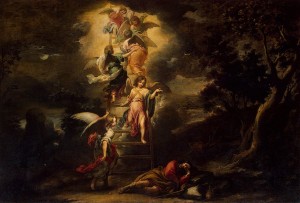
Jacob’s Dream by Murillo
Today’s first reading at Mass was the story of Jacob’s Ladder. You remember the one–where he is traveling and he camps out by a shrine and take a rock from the shrine as a pillow?
He dreams of a stairway to heaven with angels going up and down. He wakes up and calls the place “Bethel”–the threshold of heaven.
The story is interesting on several levels. Firstly, it is an insight into the primitive religions of the ancient world. Here is a story which is about 4,000 years old. What was the religion like at the time?
There were many different animistic religions, but one of the most universal was the worship of the Mountain God. This God was often believed to be the greatest and most powerful. Very often his worship was associated with a volcanic mountain–a holy mountain–the Mountain of God.
Was it the mountain God or was there also an element in which worshippers went up the mountain because that was the way to get up into the sky where God lived? Certainly if you thought God lived above the clouds, climbing the mountain (especially one which extended above the clouds) was a way to get closer to God.
Probably there was an element of both. Particular mountains became “Holy Mountains” because they spoke of the power of God because they were mysterious. If they were particularly high, or if they were volcanic with fire, smoke and earthquakes and terror, then the mountain experience both symbolized God, but also to climb the mountain was to get close to God.
Interesting that in so many religions around the world, they either worshipped on a mountain or they built a man made mountain. The “man made mountains” were, of course, they pyramids of different sorts around the world.
Whether they were Mayan or Aztec or Babylonian or Assyrian or Egyptian–the primitive peoples seemed to build man made mountains on which to worship. They were used either as tombs or temples.
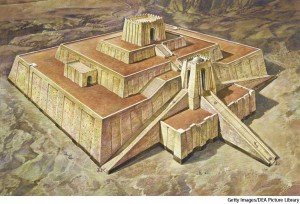
Mesopotamian Ziggaurat
The ziggurats of Mesopotamia, like the Mayan and Aztec pyramids were built with a staircase on one side and with a temple at the top where the priests and often the royal family either lived or conducted worship or both.
Most likely Jacob’s dream of angels going up and down the staircase was set in the context of the ziggurats of Mesopotamia. The pyramid with the stairway on the front was the picture of a stairway to heaven.
So what does it matter, and why is it important?
Because it is a pointer to Jesus Christ. Remember the New Testament is hidden in the Old and the Old is made manifest in the New.
Remember that curious verse in the gospel where Jesus says, “Very truly I tell you, you will see ‘heaven open, and the angels of God ascending and descending on’ the Son of Man.” (Jn. 1:51)
Jesus is, no doubt, referencing Jacob’s vision, but in doing so he is using the imagery to say three things. Firstly, he is saying that he, Jesus, is the stairway to heaven. He is the bridge between God and Man. Secondly, if Jacob’s vision was in the context of a Mesopotamian ziggurat, the Jesus is also saying he is the temple of God. He is the fulfillment of the mountain god. Thirdly, he is therefore saying he is the fulfillment not just of Jacob’s Jewish religion, but the fulfillment and completion of all that was looked for and longed for within the pagan religions of the world.
This reveals, therefore the proper relationship of the non Christian religions to Jesus Christ. Just as he is the fulfillment and completion of the Jewish religion, so he is also the completion and fulfillment of all that was beautiful, good and true in the non Christian religions. In their own way–although they were also infected with much misunderstanding and error–they also were the means by which human beings quested for the truth and searched for God.
Therefore when Jesus says, “I am the Way, the Truth and the Life and no one comes to the Father except through me” we can see that in him all the religions of the world come clear, come clean, come forth and come true.
Previous Post
June 28, 2017
Is All Sin the Same?
Next Post
July 14, 2017 Falling Short of God's Glory
Browse Our Archives
Select a Category Anglican Matters Apologetics Architecture Blobble Study Book Reviews Brideshead Caitlin O'Rourke Catholic Art Catholic Culture Church Politics Chust for Nice Contemporary Culture Duane Mandible Ed Blanch Film Reviews Fr Harvey Nicolaitan Frank Viola Mantilla the Hon More Christianity Mrs Brady Catholic Old Lady Mystery of the Magi Norman Anderson Queen Hillary Saints and Supernatural Spirituality The Inklings The Vicar Theology Todd Unctuous Uncategorized
Select a Month October 2019 September 2019 August 2019 July 2019 June 2019 May 2019 April 2019 March 2019 December 2018 November 2018 October 2018 August 2018 July 2018 June 2018 May 2018 April 2018 March 2018 February 2018 January 2018 December 2017 November 2017 October 2017 September 2017 August 2017 July 2017 June 2017 May 2017 April 2017 March 2017 February 2017 January 2017 December 2016 November 2016 October 2016 September 2016 August 2016 July 2016 June 2016 May 2016 April 2016 March 2016 February 2016 January 2016 December 2015 November 2015 October 2015 September 2015 August 2015 July 2015 June 2015 May 2015 April 2015 March 2015 February 2015 January 2015 December 2014 November 2014 October 2014 September 2014 August 2014 July 2014 June 2014 May 2014 April 2014 March 2014 February 2014 January 2014 December 2013 November 2013 October 2013 September 2013 August 2013 July 2013 June 2013 May 2013 April 2013 March 2013 February 2013 January 2013 December 2012 November 2012 October 2012 September 2012 August 2012 July 2012 June 2012 May 2012 April 2012 March 2012 February 2012 January 2012 December 2011 November 2011 October 2011 September 2011 August 2011 July 2011 June 2011 May 2011 April 2011 March 2011 February 2011 January 2011 December 2010 November 2010 October 2010 September 2010 August 2010 July 2010 June 2010 May 2010 April 2010 March 2010 February 2010 January 2010 December 2009 November 2009 October 2009 September 2009 August 2009 July 2009 June 2009 May 2009 April 2009 March 2009 February 2009 January 2009 December 2008 November 2008 October 2008 September 2008 August 2008 July 2008 June 2008 May 2008 April 2008 March 2008 February 2008 January 2008 December 2007 November 2007 October 2007 September 2007 August 2007 July 2007 June 2007 May 2007 April 2007 March 2007 February 2007 January 2007 December 2006 November 2006 October 2006 September 2006
Follow Us!
TAKE THE
Religious Wisdom Quiz
Who did Paul call "my true child in the faith"?
Select your answer to see how you score.
James Barnabas Silas Timothy
Related posts from Fr. Dwight Longenecker

Episcopal Woman Priest Says Abortionists are "Saints"

Pondering Slavery and Homosexual Actions


Pagans, Pantheism and Polytheism
TRENDING AT PATHEOS Catholic

Rejecting Doom: Christian Hope And Human Action
Christianity is a religion of hope. We are to have hope and...

It’s What Comes From Within Which Matters
One of the most difficult things for us to understand is why...

Why I Choose the Eucharist Over the Sermon
Choose the Eucharist, Not the Sermon What are we supposed to get...

5 Design Elements Found in Spiritually Rooted Homes
Putting Spirituality Into Home Decor Our homes are more than our living...

Credo: A Story of God Told with the...
About 10 years ago, I began to imagine a personal "Credo" that...

The Anatomy of Divine Revelation in Catholic Thought
The claim that God has made Himself known to human beings is...
view all Catholic blogs
Ad-Free & Subscriber Log-In Subscription Support
- About Us
- 2026 Calendar
- Videos
- Podcasts
- Library of World Religions
- Faith In Media Tracker
- Advertise With Us
- Write for Us
- Privacy Policy
- Terms of Service
- Do Not Sell My Data
- Contact Us
- Radiant Digital
- Manage Newsletter Subscriptions
- Unsubscribe From Notifications
- Sitemap
Copyright 2008-2026, Patheos. All rights reserved.
Subscription Support Ad-Free & Subscriber Log-In
Follow Patheos