
BuddhistCatholicContemplativeEvangelicalGeneral ChristianHinduJewishLatter-day SaintMuslimNew VisionsProgressive Christian
Beliefs
- Buddhist
- Catholic
- Contemplative
- Evangelical
- General Christian
- Hindu
- Jewish
- Latter-day Saint
- More Voices
- Muslim
- New Visions
- Pagan
- Progressive Christian
Topics
- Religion News
- Food and Religion
- Sports and Religion
- Religious Art
- Religious Music and Entertainment
- Religious Events
- History and Religion
- Style and Religion
- Politics and Religion
- Women in Religion
- Recreation Outdoors and Religion
- Business Finance and Religion
- Careers Workplace and Religion
- Education and Religion
- Family Parenting and Religion
- Health Fitness and Religion
- Home and Religion
- Relationships and Religion
- Technology and Religion
- Travel and Religion
Columnists
- Buddhist Columnists
- Business Finance and Religion Columnists
- Careers Workplace and Religion Columnists
- Catholic Columnists
- Contemplative Columnists
- Education and Religion Columnists
- Evangelists Columnists
- Family Parenting and Religion Columnists
- General Christian Columnists
- Health Fitness and Religion Columnists
- Hindu Columnists
- History and Religion Columnists
- Home and Religion Columnists
- Jewish Columnists
- More Voices Columnists
- Latter Day Columnists
- Muslim Columnists
- New Visions Columnists
- Nonreligious Columnists
- Pagan Columnists
- Politics and Religion Columnists
- Progressive Columnists
- Recreation Outdoors and Religion Columnists
- Relationships and Religion Columnists
- Religion News Columnists
- Religious Art Columnists
- Religious Events Columnists
- Religious Music and Entertainment Columnists
- Sports and Religion Columnists
- Style and Religion Columnists
- Technology and Religion Columnists
- Travel and Religion Columnists
- Women in Religion Columnists
Resource Library
- 2026 Calendar
- Library of World Religions
- The 100 Most Holy Places on Earth
- Patheos Answers
- Podcasts
- Videos
- Faith Leaders Database
- Anglican Episcopalian
- Bahai
- Baptist
- Buddhism
- Christianity
- Confucianism
- Eastern Orthodoxy
- Hinduism
- Holiness and Pentecostal
- ISKCON
- Islam
- Judaism
- Lutheran
- Methodist
- The Church of Jesus Christ of Latter-day Saints
- New Age
- Paganism
- Presbytarian and Reformed
- Protestantism
- Religion Behind the Scenes
- Roman Catholic
- Scientology
- Shia Islam
- Sikhism
- Sufism
- Sunni Islam
- Taoism
- Zen
- See all religions
Research Tools
 Ad-Free & Subscriber Log-In Subscription Support
Ad-Free & Subscriber Log-In Subscription Support
Follow Patheos 

- Trending:
- Forgiveness
- |
- Marriage
- |
- Consciousness
- |
- Death Penalty
- |
- Election
- |
- Halloween
 Fr. Dwight Longenecker
-
Archived Articles
- Everything Belongs to You
- Affirming All Things
- Home Away From Home
- The House of Mirrors
- Universal and Particular
- How Do We Know It's the True Church?
- Believing and Belonging
- Which Came First?
- Them and Us
- What is Truth?
- Authority of the First Popes
- The Authority of the Catholic Church
- Biblical Support for the Authority of the Pope
- What Do We Mean By the Real Presence?
- Baptism Now Saves You
- Mother of God – Defender of Orthodoxy
- Explaining Mary Redemptrix to an Evangelical
- Holy Mary Mother of God
- Distorted Devotions – Do Catholics Honor Mary Too Much?
- Why a Former Evangelical Loves the Rosary
- Do Catholics Pray to Mary?
- Purity is Power
- Woman and Serpent – Take 2
- Once A Virgin – Always a Virgin?
- Mary Mother of God or Mother Goddess?
- One Saving Action
- Left Behind
- Why Don't Catholics Read the Bible?
- Idol Speculation – Do Catholics Worship Idols?
- The Problem with Primitivism
- Weird Things Happen
- Paganism, Prophecies and Propaganda
- Utilitarianism – What is Good Works?
- Home
- Catholic
- National Catholic Reporter Praises Brutalist Architecture!
National Catholic Reporter Praises Brutalist Architecture!
Last updated on: April 14, 2017 at 9:44 am by Fr. Dwight Longenecker
National Catholic Reporter Praises Brutalist Architecture! 2017-04-14T09:44:21-05:00 Fr. Dwight Longenecker
Patheos Explore the world's faith through different perspectives on religion and spirituality! Patheos has the views of the prevalent religions and spiritualities of the world.
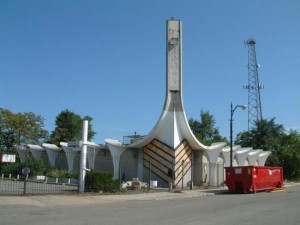 The tired and emotional progressives at National Catholic Reporter have published a piece which actually praises the brutalist “Catholic” suburban architecture of the seventies and eighties.
This article quotes Michael deSanctis a theology professor and church building consultant from Gannon University in Erie, Pennsylvania. DeSanctis says,
Restoration-minded pastors, most who came of age well after Vatican II, are ordering the changes. Gone are what they sometimes disparage as “Pizza Hut” churches. The goal is to restore tradition. They impose altar rails, the placement of the Blessed Sacrament near the altar, and use expensive marble on the floor to seal off the sanctuary area as a polished and exclusive arena for clerical liturgical action. Sometimes the choir gets relegated to a back loft, providing disembodied sound. In other parishes, circular seating arrangements are abandoned in favor of long rows of pews.
The loaded language is transparent. The priests “impose” altar rails. They use “expensive marble” to “seal off the sanctuary as an exclusive area for clerical liturgical action.”
DeSanctis uses a local church in Erie to illustrate his annoyance at the modest renovations–where pastors have tried to bring into ghastly churches even just a touch of what used to be recognized as Catholicism.
Elaborate candles now serve as boundaries to mark off the sanctuary from the pews. The altar area has now been transformed by marble, visually setting itself off. The new architecture, intended to recapture traditional elements, has a “look at me” clerical mindset.
He notes that such changes are examples of “fussy territoriality” expressed through physical changes made by “a wave of priests intent on undoing the achievements of their immediate predecessors, a generation or two of men animated by the liturgical reforms of the Second Vatican Council.”
DeSanctis’ complains that setting the sanctuary apart visually is a new form of “look at me” clericalism. But the formal instructions for the sanctuary actually call for it to be set off visually from the rest of the church. As for “clericalism” The General Instruction of the Roman Missal says the church is hierarchical and the architecture should reflect that:
The People of God which is gathered for Mass is coherently and hierarchically ordered, and this finds its expression in the variety of ministries and the variety of actions according to the different parts of the celebration. Hence the general arrangement of the sacred building must be such that in some way it conveys the image of the assembled congregation and allows the appropriate ordering of all the participants, as well as facilitating each in the proper carrying out of his function…The Priest Celebrant, the Deacon, and the other ministers have places in the sanctuary.
All these elements, even though they must express the hierarchical structure and the diversity of functions, should nevertheless bring about a close and coherent unity that is clearly expressive of the unity of the entire holy people. Indeed, the nature and beauty of the place and all its furnishings should foster devotion and express visually the holiness of the mysteries celebrated there.
The GIRM continues: “The sanctuary is the place where the altar stands, the Word of God is proclaimed, and the Priest, the Deacon, and the other ministers exercise their functions. It should be appropriately marked off from the body of the church either by its being somewhat elevated or by a particular structure and ornamentation. It should, moreover, be large enough to allow the Eucharist to be easily celebrated and seen.”
The GIRM is the universal instruction for proper celebration of the Mass. It is not an obscure document, but is printed at the front of all full sized missals.
DeSanctis claims to be a “church building consultant” and is unaware of this?
DeSanctis likes round churches:
“Architecture is how we express our liturgy,” DeSanctis recently told NCR in a phone interview, noting that the generation of post-Vatican II priests routinely came out of the sanctuary to interact with their parishioners during liturgy. They built churches with a focus on circular design, to bring the congregation closer together, as well lowered the altar to bring the priest closer to the congregation.
Our new church at Our Lady of the Rosary has an elevated sanctuary, no marble, but set off with a some tile flooring. When a visiting priest dropped by he asked in a sarcastic way, “Why is the altar way up there?” His implication was “You’re all about separating the priest from the people…” Happily the architect was present and explained, “The church calls for full participation of the people in the Mass. They can’t participate if they can’t see what’s going on. The sanctuary is elevated not to elevate the priest, but so the people can all see the Mass.”
He went on to explain about sight lines and that if people are at a distance from what is going on either the floor for the congregation needs to be raked as in a theatre or the platform for action need to be elevated. Otherwise people can’t see.” In other words, the sanctuary is elevated so the people can actually see what is going on. In a large church it seems very folksy and friendly for Father Freeforall to come down and wander among the people like a game show host, but the fact is, most of them can’t see him when he does.
DeSanctis also does’t like choir lofts and rows of pews
Sometimes the choir gets relegated to a back loft, providing disembodied sound. In other parishes, circular seating arrangements are abandoned in favor of long rows of pews.
Our new church has a traditional choir loft in the back. Here are the practical advantages: 1. The choir has lots of chairs, books, music stands and other paraphrenalia. They can keep all that stuff up there where they need it and not clutter up the space where worship is happening. 2. There is room for a pipe organ. Pipe organs are actually recommended and praised by our bishops. Why? Go here. 3. The choir and organist can see clearly what is happening in the liturgy and complement the worship 4. A choir director waving his or her arms about conducting is distracting. In the choir loft you can’t see it. 5. Choir members prefer to be heard and not seen. If that is not true there’s a problem. 6. Choirs and singers up front contribute to the entertainment feel of modern worship.
Circular seating arrangements? The comments I hear from the people who use these churches are, “I don’t really like having to sit and look at everyone else the whole time.” They say, “I am always distracted from worship by looking at the people on the other side of the room. I see them getting bored. I see the misbehavior of their children. I see them falling asleep. Its much more difficult to focus on the Mass in a round church.” They say, “Everything in the round church is about us. It is people centered worship rather than God centered worship.”
What deSanctis never references is something I have discovered in helping to build a new church in our parish, and in my visits to churches across America.
Whenever I visit one of the all too common suburban American Catholic churches that look like a cross between a flying saucer and a parking garage I ask the parishioners how the church came to be built and whether they think it is beautiful or not and whether the like it.
Keep in mind that these churches were built “for the people of God”. They were built in a wave of egalitarian idealism, but I have heard multiple stories about how Father Freeforall in the 1970s swept in and designed the church and told them this was the modern age and this was the church they were going to have. DeSanctis complains that the restorationist priests are “clericalists” who “impose” things. In fact the clericalists were the ideologically driven priests of the 1970s and 80s who imposed brutalist, modernism on their faithful people not only in architecture but in theology, pastoral practice and preaching.
It was kind of like the priest was saying, “Now you listen to me. We are getting rid of clericalism whether you like it or not…”
Hmmm.
I also ask the people whether they like their modern supermarket style church. They try to be polite and they get this wounded, nostalgic look on their face and say things like, “The padded pews are really very comfortable!” or “The sound system is really good.” Or they change the subject and start enthusing about a parish across town where the people and pastor have just built a new traditionally styled church. If they are older they hearken back to the days before all the changes and say, “There was something holy about those old churches.”
As a somewhat conservative Catholic I have been accused of imposing a traditional church on our people.
But I can honestly report what took place: When I went to a parish and the people told me they had been trying to build a new church for the last fifty years but they just hadn’t got it done. Would I help? At the first building committee meeting I didn’t “impose” anything but asked, “Do you want a modern round type church or a traditional looking church?” The uproar was unanimous: “We have had all the consultations already. Everyone wants a traditional church. No one wants a round church. We hate round churches. We want our church to look Catholic. We want stained glass windows. We want it to be beautiful.”
Finally here are some pictures. One is the new church at Our Lady of the Rosary. The other is a fairly typical modern American suburban church.
Which do you like? Which do you think is most appropriate for Catholic Worship?
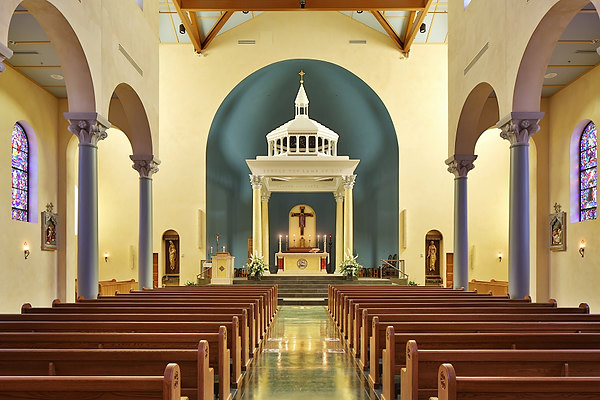
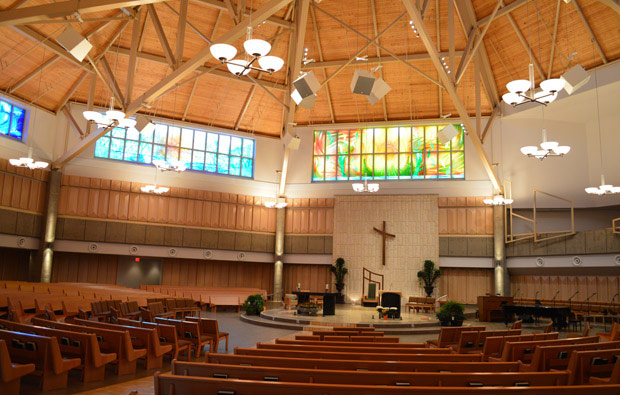
Images Creative Commons
Previous Post
April 13, 2017
Why the Vatican Sounds Increasingly Anglican
Next Post
April 14, 2017 My Scene in The Passion of the Christ
Browse Our Archives
Select a Category Anglican Matters Apologetics Architecture Blobble Study Book Reviews Brideshead Caitlin O'Rourke Catholic Art Catholic Culture Church Politics Chust for Nice Contemporary Culture Duane Mandible Ed Blanch Film Reviews Fr Harvey Nicolaitan Frank Viola Mantilla the Hon More Christianity Mrs Brady Catholic Old Lady Mystery of the Magi Norman Anderson Queen Hillary Saints and Supernatural Spirituality The Inklings The Vicar Theology Todd Unctuous Uncategorized
Select a Month October 2019 September 2019 August 2019 July 2019 June 2019 May 2019 April 2019 March 2019 December 2018 November 2018 October 2018 August 2018 July 2018 June 2018 May 2018 April 2018 March 2018 February 2018 January 2018 December 2017 November 2017 October 2017 September 2017 August 2017 July 2017 June 2017 May 2017 April 2017 March 2017 February 2017 January 2017 December 2016 November 2016 October 2016 September 2016 August 2016 July 2016 June 2016 May 2016 April 2016 March 2016 February 2016 January 2016 December 2015 November 2015 October 2015 September 2015 August 2015 July 2015 June 2015 May 2015 April 2015 March 2015 February 2015 January 2015 December 2014 November 2014 October 2014 September 2014 August 2014 July 2014 June 2014 May 2014 April 2014 March 2014 February 2014 January 2014 December 2013 November 2013 October 2013 September 2013 August 2013 July 2013 June 2013 May 2013 April 2013 March 2013 February 2013 January 2013 December 2012 November 2012 October 2012 September 2012 August 2012 July 2012 June 2012 May 2012 April 2012 March 2012 February 2012 January 2012 December 2011 November 2011 October 2011 September 2011 August 2011 July 2011 June 2011 May 2011 April 2011 March 2011 February 2011 January 2011 December 2010 November 2010 October 2010 September 2010 August 2010 July 2010 June 2010 May 2010 April 2010 March 2010 February 2010 January 2010 December 2009 November 2009 October 2009 September 2009 August 2009 July 2009 June 2009 May 2009 April 2009 March 2009 February 2009 January 2009 December 2008 November 2008 October 2008 September 2008 August 2008 July 2008 June 2008 May 2008 April 2008 March 2008 February 2008 January 2008 December 2007 November 2007 October 2007 September 2007 August 2007 July 2007 June 2007 May 2007 April 2007 March 2007 February 2007 January 2007 December 2006 November 2006 October 2006 September 2006
Follow Us!
TAKE THE
Religious Wisdom Quiz
What does the Greek word "makarios", used in the Beatitudes, mean?
Select your answer to see how you score.
Blessed Peaceful Humble Holy
Related posts from Fr. Dwight Longenecker

Episcopal Woman Priest Says Abortionists are "Saints"

Pondering Slavery and Homosexual Actions


Pagans, Pantheism and Polytheism
TRENDING AT PATHEOS Catholic

Rejecting Doom: Christian Hope And Human Action
Christianity is a religion of hope. We are to have hope and...

It’s What Comes From Within Which Matters
One of the most difficult things for us to understand is why...

Why I Choose the Eucharist Over the Sermon
Choose the Eucharist, Not the Sermon What are we supposed to get...

5 Design Elements Found in Spiritually Rooted Homes
Putting Spirituality Into Home Decor Our homes are more than our living...

Credo: A Story of God Told with the...
About 10 years ago, I began to imagine a personal "Credo" that...

The Anatomy of Divine Revelation in Catholic Thought
The claim that God has made Himself known to human beings is...
view all Catholic blogs
Ad-Free & Subscriber Log-In Subscription Support
- About Us
- 2026 Calendar
- Videos
- Podcasts
- Library of World Religions
- Faith In Media Tracker
- Advertise With Us
- Write for Us
- Privacy Policy
- Terms of Service
- Do Not Sell My Data
- Contact Us
- Radiant Digital
- Manage Newsletter Subscriptions
- Unsubscribe From Notifications
- Sitemap
Copyright 2008-2026, Patheos. All rights reserved.
Subscription Support Ad-Free & Subscriber Log-In
Follow Patheos