
BuddhistCatholicContemplativeEvangelicalGeneral ChristianHinduJewishLatter-day SaintMuslimNew VisionsProgressive Christian
Beliefs
- Buddhist
- Catholic
- Contemplative
- Evangelical
- General Christian
- Hindu
- Jewish
- Latter-day Saint
- More Voices
- Muslim
- New Visions
- Pagan
- Progressive Christian
Topics
- Religion News
- Food and Religion
- Sports and Religion
- Religious Art
- Religious Music and Entertainment
- Religious Events
- History and Religion
- Style and Religion
- Politics and Religion
- Women in Religion
- Recreation Outdoors and Religion
- Business Finance and Religion
- Careers Workplace and Religion
- Education and Religion
- Family Parenting and Religion
- Health Fitness and Religion
- Home and Religion
- Relationships and Religion
- Technology and Religion
- Travel and Religion
Columnists
- Buddhist Columnists
- Business Finance and Religion Columnists
- Careers Workplace and Religion Columnists
- Catholic Columnists
- Contemplative Columnists
- Education and Religion Columnists
- Evangelists Columnists
- Family Parenting and Religion Columnists
- General Christian Columnists
- Health Fitness and Religion Columnists
- Hindu Columnists
- History and Religion Columnists
- Home and Religion Columnists
- Jewish Columnists
- More Voices Columnists
- Latter Day Columnists
- Muslim Columnists
- New Visions Columnists
- Nonreligious Columnists
- Pagan Columnists
- Politics and Religion Columnists
- Progressive Columnists
- Recreation Outdoors and Religion Columnists
- Relationships and Religion Columnists
- Religion News Columnists
- Religious Art Columnists
- Religious Events Columnists
- Religious Music and Entertainment Columnists
- Sports and Religion Columnists
- Style and Religion Columnists
- Technology and Religion Columnists
- Travel and Religion Columnists
- Women in Religion Columnists
Resource Library
- 2026 Calendar
- Library of World Religions
- The 100 Most Holy Places on Earth
- Patheos Answers
- Podcasts
- Videos
- Faith Leaders Database
- Anglican Episcopalian
- Bahai
- Baptist
- Buddhism
- Christianity
- Confucianism
- Eastern Orthodoxy
- Hinduism
- Holiness and Pentecostal
- ISKCON
- Islam
- Judaism
- Lutheran
- Methodist
- The Church of Jesus Christ of Latter-day Saints
- New Age
- Paganism
- Presbytarian and Reformed
- Protestantism
- Religion Behind the Scenes
- Roman Catholic
- Scientology
- Shia Islam
- Sikhism
- Sufism
- Sunni Islam
- Taoism
- Zen
- See all religions
Research Tools
 Ad-Free & Subscriber Log-In Subscription Support
Ad-Free & Subscriber Log-In Subscription Support
Follow Patheos 

- Trending:
- Forgiveness
- |
- Marriage
- |
- Consciousness
- |
- Death Penalty
- |
- Election
- |
- Halloween
 Fr. Dwight Longenecker
-
Archived Articles
- Everything Belongs to You
- Affirming All Things
- Home Away From Home
- The House of Mirrors
- Universal and Particular
- How Do We Know It's the True Church?
- Believing and Belonging
- Which Came First?
- Them and Us
- What is Truth?
- Authority of the First Popes
- The Authority of the Catholic Church
- Biblical Support for the Authority of the Pope
- What Do We Mean By the Real Presence?
- Baptism Now Saves You
- Mother of God – Defender of Orthodoxy
- Explaining Mary Redemptrix to an Evangelical
- Holy Mary Mother of God
- Distorted Devotions – Do Catholics Honor Mary Too Much?
- Why a Former Evangelical Loves the Rosary
- Do Catholics Pray to Mary?
- Purity is Power
- Woman and Serpent – Take 2
- Once A Virgin – Always a Virgin?
- Mary Mother of God or Mother Goddess?
- One Saving Action
- Left Behind
- Why Don't Catholics Read the Bible?
- Idol Speculation – Do Catholics Worship Idols?
- The Problem with Primitivism
- Weird Things Happen
- Paganism, Prophecies and Propaganda
- Utilitarianism – What is Good Works?
- Home
- Catholic
- Romancing the Religion
Romancing the Religion
Last updated on: February 20, 2017 at 4:20 pm by Fr. Dwight Longenecker
Romancing the Religion 2017-02-20T16:20:52-05:00 Fr. Dwight Longenecker
Patheos Explore the world's faith through different perspectives on religion and spirituality! Patheos has the views of the prevalent religions and spiritualities of the world.
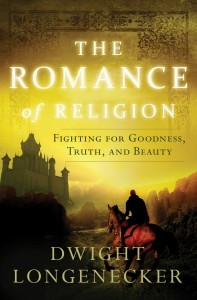 OK. Here’s another book suggestion for Lent. My book The Romance of Religion picks up on the idea that religion is a great adventure. It is not pious or puritanical or pusillanimous or pussyfooting around.
It is the stuff of all the great romances, the great adventure stories. It is full of great risks and great rewards.
Here’s an excerpt
In a world of useful things it might seem absurd to write a book in praise of romance. Who needs romance in a world that has been rationalized, economized, mechanized and computerized? Can romance survive in a world of profit margins and the bottom line? Isn’t romance (with its unfulfilled longing) a waste of time in a world where every desire can be gratified cheerfully and cheaply? Can the frail flower of romance live in the winter of a cold and cynical age? Can romance thrive where angels in full flight are shot down with facts, and fragile ideals are shattered by the hard stones of reality?
Let’s be optimistic. We should never be too convinced by the attitudes and emotions of the age in which we live. When poisonous ideas are universal, the desire for an antidote becomes all the more urgent. When certain ideas seem unassailable there is all the more reason to predict their downfall. Anything that has reached its peak must be on the brink of decline. Conversely, any process of thought that has reached its nadir can only be on the way up.
History shows that the pendulum swings back. Just when we thought a political system, a philosophy or an attitude was true and fixed for all time it is swept away by some sort of revolution. Those systems (like atheistic communism) that are built on false premises simply cannot stand. Like the house build on sand, it must fall when the tide comes in. Does our Western materialistic society seem thoroughly rationalistic, atheistic, despairing, and brutal? All the more reason to believe that the edifice is about to crumble and that everyone will soon be fascinated by faith and enchanted by the romance of religion.
It is a sad diagnosis, but the Western mind is seriously sick. Like the psychotic, we can’t think straight anymore—even if we want to. Like the psychotic there are only two options: Either we drift further into nihilism and continue to commit a kind of cultural and corporate suicide, or we get better. Put simply, we either turn into the dark void or turn away from the dark void, and to turn away from the dark void means we become romantics once more. What do I mean by becoming romantic? I mean that we realize we are members of a frail and finite little race, and as such we are all a little bit mad.
In other words, because we are limited in our knowledge, even the sanest of us are slightly insane. Our limitations are a kind of madness, and we only have two choices: to deny we are mad, and so descend into a dark spiral of total insanity, or accept we are mad and embark on a quest to regain our true and wholesome sanity.
To do this we need to engage in battle with the dark and embark on a valiant quest. We need to find the costume cupboard, dust off the broad-brimmed hat of the musketeer, practice brandishing the rapier and fare forward to defend the honor of our beloved. I’m suggesting that, like Don Quixote, we read the old books, don the armor, whistle for Rocinante and ride out to do battle with windmills. In other words, we need to discover once again that we have something to die for, for it is only when we have something to die for that we have something to live for.
The Quaint Romantic Hero
An English friend delivered a backhand slam some time ago when she said with a snooty smile, ‘The Americans are so quaint! They still think it is possible to be heroes.’ I felt chastened, but I had to admit it: some of us (and not just the Americans) retain the romantic hero as our role model. We cheerfully concede that there is something absurd about the romantic. He is not a practical sort of soul. We know that had Romeo been a utilitarian he would have chosen sensible friends, gone to a good school, married the Montague next door and inherited the family business. The mouse Reepicheep would have stayed home to consolidate his collection of fine cheeses and Don Quixote would have entered a rest home to watch daytime TV.
But then, the romantic hero has always been a figure of fun. He is blamed not only for being romantic, but for being pugnacious. ‘You are a bombastic fool!’ his sensible critics cry. ‘You are an absurd poseur, an amateur and a fake’ they accuse. ‘You deal in generalities, broadsides and caricatures.’ Of course, the critics are right. The romantic hero strides through life with an air of superiority, but that is not because he thinks himself better than everyone else, but simply because he is looking in a different direction. His nose is in the air not because he looks down on others, but because he is looking up. He marches to a different drumbeat; not because he wants everyone else to march with him, but because he wants them to hear that a different drumbeat and a different way of marching exists.
Go here to order in time for Lent.
Previous Post

February 18, 2017
Critiquing the Trump Cult
Next Post

February 21, 2017 Conservative Anglicans are like ISIS??
Browse Our Archives
Select a Category Anglican Matters Apologetics Architecture Blobble Study Book Reviews Brideshead Caitlin O'Rourke Catholic Art Catholic Culture Church Politics Chust for Nice Contemporary Culture Duane Mandible Ed Blanch Film Reviews Fr Harvey Nicolaitan Frank Viola Mantilla the Hon More Christianity Mrs Brady Catholic Old Lady Mystery of the Magi Norman Anderson Queen Hillary Saints and Supernatural Spirituality The Inklings The Vicar Theology Todd Unctuous Uncategorized
Select a Month October 2019 September 2019 August 2019 July 2019 June 2019 May 2019 April 2019 March 2019 December 2018 November 2018 October 2018 August 2018 July 2018 June 2018 May 2018 April 2018 March 2018 February 2018 January 2018 December 2017 November 2017 October 2017 September 2017 August 2017 July 2017 June 2017 May 2017 April 2017 March 2017 February 2017 January 2017 December 2016 November 2016 October 2016 September 2016 August 2016 July 2016 June 2016 May 2016 April 2016 March 2016 February 2016 January 2016 December 2015 November 2015 October 2015 September 2015 August 2015 July 2015 June 2015 May 2015 April 2015 March 2015 February 2015 January 2015 December 2014 November 2014 October 2014 September 2014 August 2014 July 2014 June 2014 May 2014 April 2014 March 2014 February 2014 January 2014 December 2013 November 2013 October 2013 September 2013 August 2013 July 2013 June 2013 May 2013 April 2013 March 2013 February 2013 January 2013 December 2012 November 2012 October 2012 September 2012 August 2012 July 2012 June 2012 May 2012 April 2012 March 2012 February 2012 January 2012 December 2011 November 2011 October 2011 September 2011 August 2011 July 2011 June 2011 May 2011 April 2011 March 2011 February 2011 January 2011 December 2010 November 2010 October 2010 September 2010 August 2010 July 2010 June 2010 May 2010 April 2010 March 2010 February 2010 January 2010 December 2009 November 2009 October 2009 September 2009 August 2009 July 2009 June 2009 May 2009 April 2009 March 2009 February 2009 January 2009 December 2008 November 2008 October 2008 September 2008 August 2008 July 2008 June 2008 May 2008 April 2008 March 2008 February 2008 January 2008 December 2007 November 2007 October 2007 September 2007 August 2007 July 2007 June 2007 May 2007 April 2007 March 2007 February 2007 January 2007 December 2006 November 2006 October 2006 September 2006
Follow Us!
TAKE THE
Religious Wisdom Quiz
What does Paul say is the greatest of faith, hope, and love?
Select your answer to see how you score.
Grace Hope Faith Love
Related posts from Fr. Dwight Longenecker

Episcopal Woman Priest Says Abortionists are "Saints"

Pondering Slavery and Homosexual Actions


Pagans, Pantheism and Polytheism
TRENDING AT PATHEOS Catholic

Rejecting Doom: Christian Hope And Human Action
Christianity is a religion of hope. We are to have hope and...

It’s What Comes From Within Which Matters
One of the most difficult things for us to understand is why...

Why I Choose the Eucharist Over the Sermon
Choose the Eucharist, Not the Sermon What are we supposed to get...

5 Design Elements Found in Spiritually Rooted Homes
Putting Spirituality Into Home Decor Our homes are more than our living...

Credo: A Story of God Told with the...
About 10 years ago, I began to imagine a personal "Credo" that...

The Anatomy of Divine Revelation in Catholic Thought
The claim that God has made Himself known to human beings is...
view all Catholic blogs
Ad-Free & Subscriber Log-In Subscription Support
- About Us
- 2026 Calendar
- Videos
- Podcasts
- Library of World Religions
- Faith In Media Tracker
- Advertise With Us
- Write for Us
- Privacy Policy
- Terms of Service
- Do Not Sell My Data
- Contact Us
- Radiant Digital
- Manage Newsletter Subscriptions
- Unsubscribe From Notifications
- Sitemap
Copyright 2008-2026, Patheos. All rights reserved.
Subscription Support Ad-Free & Subscriber Log-In
Follow Patheos