
BuddhistCatholicContemplativeEvangelicalGeneral ChristianHinduJewishLatter-day SaintMuslimNew VisionsProgressive Christian
Beliefs
- Buddhist
- Catholic
- Contemplative
- Evangelical
- General Christian
- Hindu
- Jewish
- Latter-day Saint
- More Voices
- Muslim
- New Visions
- Pagan
- Progressive Christian
Topics
- Religion News
- Food and Religion
- Sports and Religion
- Religious Art
- Religious Music and Entertainment
- Religious Events
- History and Religion
- Style and Religion
- Politics and Religion
- Women in Religion
- Recreation Outdoors and Religion
- Business Finance and Religion
- Careers Workplace and Religion
- Education and Religion
- Family Parenting and Religion
- Health Fitness and Religion
- Home and Religion
- Relationships and Religion
- Technology and Religion
- Travel and Religion
Columnists
- Buddhist Columnists
- Business Finance and Religion Columnists
- Careers Workplace and Religion Columnists
- Catholic Columnists
- Contemplative Columnists
- Education and Religion Columnists
- Evangelists Columnists
- Family Parenting and Religion Columnists
- General Christian Columnists
- Health Fitness and Religion Columnists
- Hindu Columnists
- History and Religion Columnists
- Home and Religion Columnists
- Jewish Columnists
- More Voices Columnists
- Latter Day Columnists
- Muslim Columnists
- New Visions Columnists
- Nonreligious Columnists
- Pagan Columnists
- Politics and Religion Columnists
- Progressive Columnists
- Recreation Outdoors and Religion Columnists
- Relationships and Religion Columnists
- Religion News Columnists
- Religious Art Columnists
- Religious Events Columnists
- Religious Music and Entertainment Columnists
- Sports and Religion Columnists
- Style and Religion Columnists
- Technology and Religion Columnists
- Travel and Religion Columnists
- Women in Religion Columnists
Resource Library
- 2026 Calendar
- Library of World Religions
- The 100 Most Holy Places on Earth
- Patheos Answers
- Podcasts
- Videos
- Faith Leaders Database
- Anglican Episcopalian
- Bahai
- Baptist
- Buddhism
- Christianity
- Confucianism
- Eastern Orthodoxy
- Hinduism
- Holiness and Pentecostal
- ISKCON
- Islam
- Judaism
- Lutheran
- Methodist
- The Church of Jesus Christ of Latter-day Saints
- New Age
- Paganism
- Presbytarian and Reformed
- Protestantism
- Religion Behind the Scenes
- Roman Catholic
- Scientology
- Shia Islam
- Sikhism
- Sufism
- Sunni Islam
- Taoism
- Zen
- See all religions
Research Tools
 Ad-Free & Subscriber Log-In Subscription Support
Ad-Free & Subscriber Log-In Subscription Support
Follow Patheos 

- Trending:
- Forgiveness
- |
- Marriage
- |
- Consciousness
- |
- Death Penalty
- |
- Election
- |
- Halloween
 Fr. Dwight Longenecker
-
Archived Articles
- Everything Belongs to You
- Affirming All Things
- Home Away From Home
- The House of Mirrors
- Universal and Particular
- How Do We Know It's the True Church?
- Believing and Belonging
- Which Came First?
- Them and Us
- What is Truth?
- Authority of the First Popes
- The Authority of the Catholic Church
- Biblical Support for the Authority of the Pope
- What Do We Mean By the Real Presence?
- Baptism Now Saves You
- Mother of God – Defender of Orthodoxy
- Explaining Mary Redemptrix to an Evangelical
- Holy Mary Mother of God
- Distorted Devotions – Do Catholics Honor Mary Too Much?
- Why a Former Evangelical Loves the Rosary
- Do Catholics Pray to Mary?
- Purity is Power
- Woman and Serpent – Take 2
- Once A Virgin – Always a Virgin?
- Mary Mother of God or Mother Goddess?
- One Saving Action
- Left Behind
- Why Don't Catholics Read the Bible?
- Idol Speculation – Do Catholics Worship Idols?
- The Problem with Primitivism
- Weird Things Happen
- Paganism, Prophecies and Propaganda
- Utilitarianism – What is Good Works?
- Home
- Catholic
- The Vulnerability of Beauty
The Vulnerability of Beauty
Last updated on: November 14, 2014 at 1:03 pm by Fr. Dwight Longenecker
The Vulnerability of Beauty 2014-11-14T13:03:30-05:00 Fr. Dwight Longenecker
Patheos Explore the world's faith through different perspectives on religion and spirituality! Patheos has the views of the prevalent religions and spiritualities of the world.
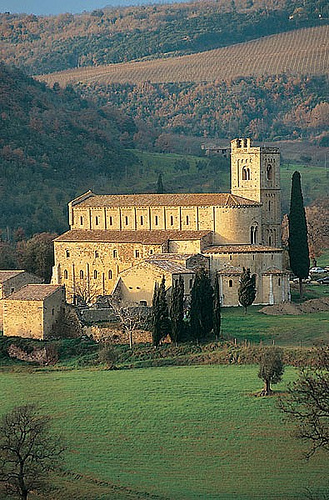
The Abbey of St Antimo, Tuscany, Italy
A friend of mine once exclaimed, “Oh, the vulnerability of beauty in a world of useful things!”
What he was observing is the fact that beauty cuts across utilitarian and economic ideals. Of course a thing that is efficient and useful might also be beautiful, but something which seeks to be beautiful first of all will seem vulnerable in the face of those twin monsters efficiency and economy.
This clash is nowhere more apparent in the brutality of church architecture in the last fifty years.
The church committees and architects, for the most part, were driven by a variety of factors which ended up producing ugly modern churches.
The basic bottom line was a shift in understanding about what a church was for.
Our grandfathers and great grandfathers understood that a Catholic church was primarily a temple or dwelling place for God. As such it was supposed to be beautiful and worthy as a home for God, but it was also supposed to be the threshold of heaven, the gate once closed now opened for the return to Eden. It was to be a glimpse of glory and an echo of eternity. Catholic Churches in the Middle Ages were richly decorated because they were the throne room of the Almighty. The pillars topped with foliage and all the floral imagery in carvings and paintings and stylized artwork was all supposed to evoke Eden–a garden in stone that would last forever.
The church was therefore packed full of amazing symbolism that opened the imagination and brought the worshipper closer to God.
All of this was thrown out in favor of efficiency and economy. After the second Vatican council the church was the “gathering place” only. The tabernacle was shunted to a side chapel and the main questions were, “Does the sound system work? Are the pews comfortable? Can everyone see? Does the heating and air work and are the toilets roomy enough?”
This was because a shift in ecclesiology took place. Worship became first and foremost about the people of God, and too often became about the worship of the people of God rather than the worship of God by the people.
So the church became people oriented rather than God oriented.
When this happened not only did the church building reflect the shift, thus giving us fan shaped auditoria, but the whole ministry of the church and reason to be Catholic shifted. Now it was not so much about the worship and adoration of God, but it was about us and our mission in the world. As the churches became people centered so did the hymns and worship songs. Now it was about “gathering” and “all are welcome” and “we can make a difference yes we can!”
This is why I am convinced that a traditionally styled church is not just preferable, but necessary.
The shift back to God centered building must create God centered liturgy which must create a God centered Catholicism which must tumble down to everything else we do.
That’s why we are making the effort to build a beautiful Romanesque temple in Greenville, South Carolina.
This will be a Catholic Church to remind us and future generations of the true center of Catholic worship and prayer.
The style will be simple, almost austere. Another inspiration for this church was Gilbert Scott’s church of Our Lady and St Alphege in Bath, England
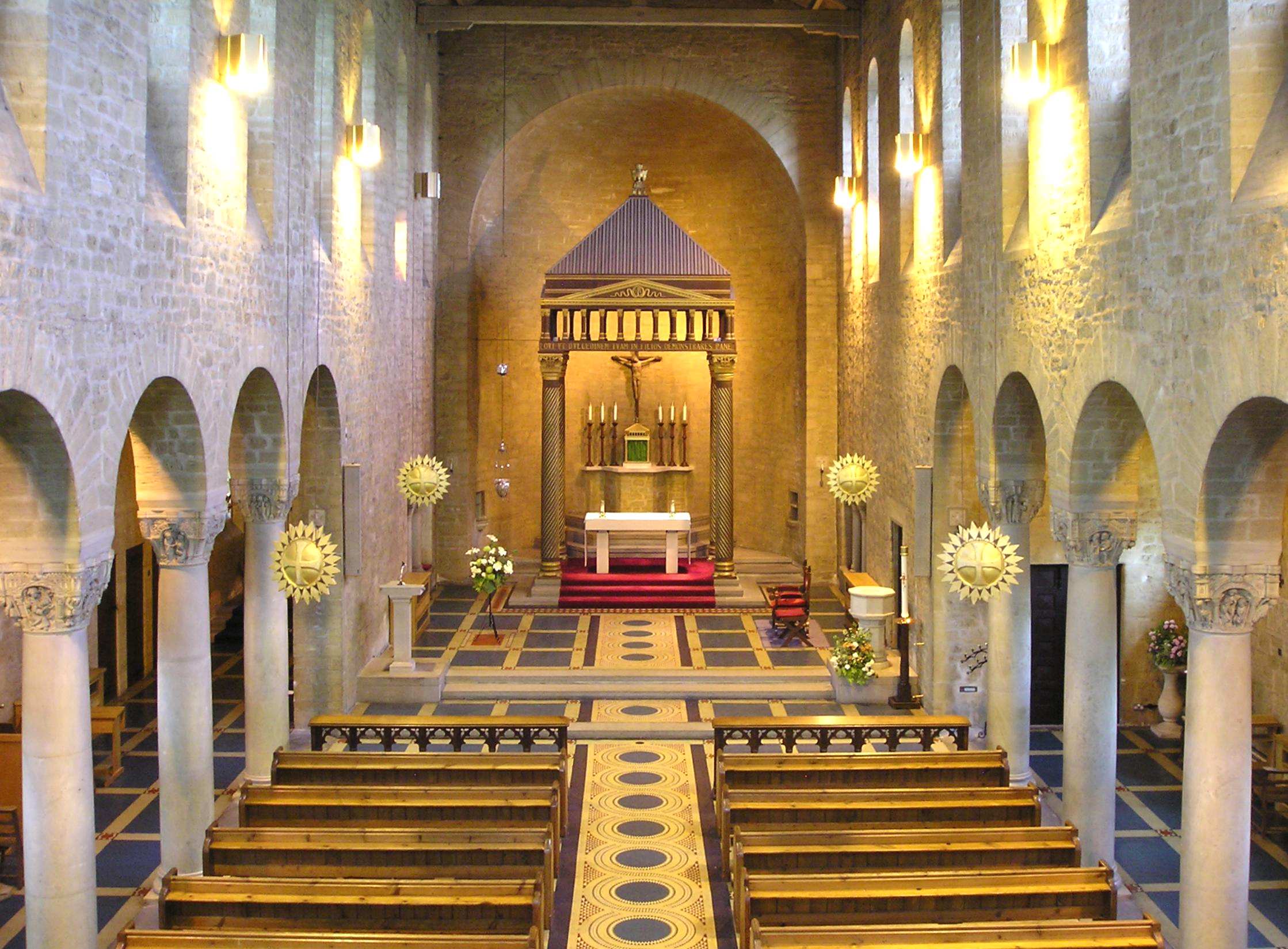
St Mary and St Alphege, Bath, England
We have purchased a beautiful set of stained glass windows in the Romanesque style from St Mary Morning Star church in Pittsfield Massachusetts. By the famed Wilbur Burhnam studios, the windows will be in a class of their own in South Carolina.
We also hope to commission some original artwork–low relief sculptures in the tympani over the doorways, murals of the Vietnamese martyrs and new sculptures of Pope St John Paul II and St Faustina for the Shrine to the Divine Mercy in the lower church. There will be a new sculpture of St Vincent de Paul and a beautiful salvaged St Francis statue.
In the lower church there will also be a beautiful columbarium. The ashes of our loved ones can be reposed there within the shrine of the Divine Mercy where Mass will be said every day.
Will you help us build this church? We are now in our final stage of fund raising. We need $650K by the end of the year to break ground in the Spring.
We are well on the way to meeting that target, but we need you help.
Please go here to make in instant donation. Readers of this blog have already been very generous, but if you have not yet contributed would you consider making a donation?
CLICK HERE TO HELP BUILD THE NEW OUR LADY OF THE ROSARY CHURCH IN GREENVILLE, SOUTH CAROLINA
If you would like more information about the naming opportunities in the church drop me a line at [email protected]
Previous Post

November 13, 2014
One of God's Little Women Warriors
Next Post
November 14, 2014 Life is a Casting Off
Browse Our Archives
Select a Category Anglican Matters Apologetics Architecture Blobble Study Book Reviews Brideshead Caitlin O'Rourke Catholic Art Catholic Culture Church Politics Chust for Nice Contemporary Culture Duane Mandible Ed Blanch Film Reviews Fr Harvey Nicolaitan Frank Viola Mantilla the Hon More Christianity Mrs Brady Catholic Old Lady Mystery of the Magi Norman Anderson Queen Hillary Saints and Supernatural Spirituality The Inklings The Vicar Theology Todd Unctuous Uncategorized
Select a Month October 2019 September 2019 August 2019 July 2019 June 2019 May 2019 April 2019 March 2019 December 2018 November 2018 October 2018 August 2018 July 2018 June 2018 May 2018 April 2018 March 2018 February 2018 January 2018 December 2017 November 2017 October 2017 September 2017 August 2017 July 2017 June 2017 May 2017 April 2017 March 2017 February 2017 January 2017 December 2016 November 2016 October 2016 September 2016 August 2016 July 2016 June 2016 May 2016 April 2016 March 2016 February 2016 January 2016 December 2015 November 2015 October 2015 September 2015 August 2015 July 2015 June 2015 May 2015 April 2015 March 2015 February 2015 January 2015 December 2014 November 2014 October 2014 September 2014 August 2014 July 2014 June 2014 May 2014 April 2014 March 2014 February 2014 January 2014 December 2013 November 2013 October 2013 September 2013 August 2013 July 2013 June 2013 May 2013 April 2013 March 2013 February 2013 January 2013 December 2012 November 2012 October 2012 September 2012 August 2012 July 2012 June 2012 May 2012 April 2012 March 2012 February 2012 January 2012 December 2011 November 2011 October 2011 September 2011 August 2011 July 2011 June 2011 May 2011 April 2011 March 2011 February 2011 January 2011 December 2010 November 2010 October 2010 September 2010 August 2010 July 2010 June 2010 May 2010 April 2010 March 2010 February 2010 January 2010 December 2009 November 2009 October 2009 September 2009 August 2009 July 2009 June 2009 May 2009 April 2009 March 2009 February 2009 January 2009 December 2008 November 2008 October 2008 September 2008 August 2008 July 2008 June 2008 May 2008 April 2008 March 2008 February 2008 January 2008 December 2007 November 2007 October 2007 September 2007 August 2007 July 2007 June 2007 May 2007 April 2007 March 2007 February 2007 January 2007 December 2006 November 2006 October 2006 September 2006
Follow Us!
TAKE THE
Religious Wisdom Quiz
Why was Jesus' eating with tax collectors controversial?
Select your answer to see how you score.
They were viewed as sinners They were healthy They were wealthy They were famous
Related posts from Fr. Dwight Longenecker
Here's Why You Hate Round Churches

Living in the Past in the Present


Materialism, Manicheanism and the Matrix
TRENDING AT PATHEOS Catholic

The Parable Of The Sower And The Word...
One of Christ’s most famous parables is that of the sower who...

Rejecting Doom: Christian Hope And Human Action
Christianity is a religion of hope. We are to have hope and...

Why I Choose the Eucharist Over the Sermon
Choose the Eucharist, Not the Sermon What are we supposed to get...

5 Design Elements Found in Spiritually Rooted Homes
Putting Spirituality Into Home Decor Our homes are more than our living...

Credo: A Story of God Told with the...
About 10 years ago, I began to imagine a personal "Credo" that...

The Anatomy of Divine Revelation in Catholic Thought
The claim that God has made Himself known to human beings is...
view all Catholic blogs
Ad-Free & Subscriber Log-In Subscription Support
- About Us
- 2026 Calendar
- Videos
- Podcasts
- Library of World Religions
- Faith In Media Tracker
- Advertise With Us
- Write for Us
- Privacy Policy
- Terms of Service
- Do Not Sell My Data
- Contact Us
- Radiant Digital
- Manage Newsletter Subscriptions
- Unsubscribe From Notifications
- Sitemap
Copyright 2008-2026, Patheos. All rights reserved.
Subscription Support Ad-Free & Subscriber Log-In
Follow Patheos