
BuddhistCatholicContemplativeEvangelicalGeneral ChristianHinduJewishLatter-day SaintMuslimNew VisionsProgressive Christian
Beliefs
- Buddhist
- Catholic
- Contemplative
- Evangelical
- General Christian
- Hindu
- Jewish
- Latter-day Saint
- More Voices
- Muslim
- New Visions
- Pagan
- Progressive Christian
Topics
- Religion News
- Food and Religion
- Sports and Religion
- Religious Art
- Religious Music and Entertainment
- Religious Events
- History and Religion
- Style and Religion
- Politics and Religion
- Women in Religion
- Recreation Outdoors and Religion
- Business Finance and Religion
- Careers Workplace and Religion
- Education and Religion
- Family Parenting and Religion
- Health Fitness and Religion
- Home and Religion
- Relationships and Religion
- Technology and Religion
- Travel and Religion
Columnists
- Buddhist Columnists
- Business Finance and Religion Columnists
- Careers Workplace and Religion Columnists
- Catholic Columnists
- Contemplative Columnists
- Education and Religion Columnists
- Evangelists Columnists
- Family Parenting and Religion Columnists
- General Christian Columnists
- Health Fitness and Religion Columnists
- Hindu Columnists
- History and Religion Columnists
- Home and Religion Columnists
- Jewish Columnists
- More Voices Columnists
- Latter Day Columnists
- Muslim Columnists
- New Visions Columnists
- Nonreligious Columnists
- Pagan Columnists
- Politics and Religion Columnists
- Progressive Columnists
- Recreation Outdoors and Religion Columnists
- Relationships and Religion Columnists
- Religion News Columnists
- Religious Art Columnists
- Religious Events Columnists
- Religious Music and Entertainment Columnists
- Sports and Religion Columnists
- Style and Religion Columnists
- Technology and Religion Columnists
- Travel and Religion Columnists
- Women in Religion Columnists
Resource Library
- 2026 Calendar
- Library of World Religions
- The 100 Most Holy Places on Earth
- Patheos Answers
- Podcasts
- Videos
- Faith Leaders Database
- Anglican Episcopalian
- Bahai
- Baptist
- Buddhism
- Christianity
- Confucianism
- Eastern Orthodoxy
- Hinduism
- Holiness and Pentecostal
- ISKCON
- Islam
- Judaism
- Lutheran
- Methodist
- The Church of Jesus Christ of Latter-day Saints
- New Age
- Paganism
- Presbytarian and Reformed
- Protestantism
- Religion Behind the Scenes
- Roman Catholic
- Scientology
- Shia Islam
- Sikhism
- Sufism
- Sunni Islam
- Taoism
- Zen
- See all religions
Research Tools
 Ad-Free & Subscriber Log-In Subscription Support
Ad-Free & Subscriber Log-In Subscription Support
Follow Patheos 

- Trending:
- Forgiveness
- |
- Marriage
- |
- Consciousness
- |
- Death Penalty
- |
- Election
- |
- Halloween
 Fr. Dwight Longenecker
-
Archived Articles
- Everything Belongs to You
- Affirming All Things
- Home Away From Home
- The House of Mirrors
- Universal and Particular
- How Do We Know It's the True Church?
- Believing and Belonging
- Which Came First?
- Them and Us
- What is Truth?
- Authority of the First Popes
- The Authority of the Catholic Church
- Biblical Support for the Authority of the Pope
- What Do We Mean By the Real Presence?
- Baptism Now Saves You
- Mother of God – Defender of Orthodoxy
- Explaining Mary Redemptrix to an Evangelical
- Holy Mary Mother of God
- Distorted Devotions – Do Catholics Honor Mary Too Much?
- Why a Former Evangelical Loves the Rosary
- Do Catholics Pray to Mary?
- Purity is Power
- Woman and Serpent – Take 2
- Once A Virgin – Always a Virgin?
- Mary Mother of God or Mother Goddess?
- One Saving Action
- Left Behind
- Why Don't Catholics Read the Bible?
- Idol Speculation – Do Catholics Worship Idols?
- The Problem with Primitivism
- Weird Things Happen
- Paganism, Prophecies and Propaganda
- Utilitarianism – What is Good Works?
- Home
- Catholic
- Are the Gospels a Myth?
Are the Gospels a Myth?
Last updated on: December 28, 2012 at 7:13 pm by Fr. Dwight Longenecker
Are the Gospels a Myth? 2012-12-28T19:13:35-05:00 Fr. Dwight Longenecker
Patheos Explore the world's faith through different perspectives on religion and spirituality! Patheos has the views of the prevalent religions and spiritualities of the world.
 One of the most common pronouncements by the atheists in the combox is that “Christianity is a myth.”
In one sense they are correct. The gospel story does operate like a myth. However, most of the atheists making this comment do not seem to have a very knowledgeable understanding of myth and how it works. They don’t seem to understand the richness and the ambiguity of the term “myth”. When they say “myth” what they mean is “fairy tale”. Even the term “fairy tale” has far deeper and richer levels of meaning than they are aware of. They use the term “myth” to indicate a funny story about gods and goddesses that simple people made up long ago. When they say “myth” and mean “fairy tale” what they really mean is that “this is a made up pretend story which has no basis in history or scientific veracity.” When they say “myth” they mean “this is not a story like they read in the newspaper or in the history books.”
Indeed, this is one definition of the word “myth”. The most popular usage of “myth” is that it is a fabricated tale. It is a fiction. At worst it is simply a lie which gullible people believe and manipulative people promulgate. For those who are only interested in facts, this means that it is worthless, or at best, interesting as a folk tale or a fable might be interesting.
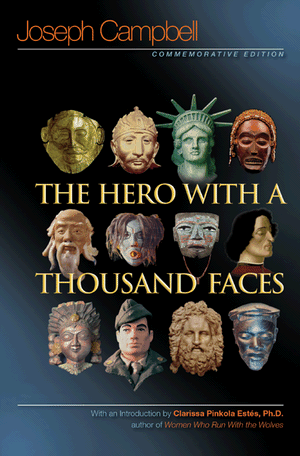
The term “myth” however, has far deeper levels of understanding. The “mythologist” Joseph Campbell in his seminal work, The Hero With a Thousand Faces shows how one particular story (which he calls the mono-myth) recurs in many different ways in virtually every society. The mono-myth is the story of how a hero leaves his ordinary world and sets out on an adventure to overcome great evil and claim a great prize before returning home to save his people. Campbell recognizes that “myth” in this sense is a story that connects individuals and groups with the deepest themes within the collective mind, and that through the re-enactment of myth and the re-telling of stories individuals identify subconsciously with the hero and go on the quest with him.
Furthermore, while the hero’s mythic journey is a visible and outward journey, the outward story is reflective of the inner journey towards enlightenment and redemption. As the audience member participates in the story they face the dangers with the hero and are faced with the same moral choices that the hero must make–thus the power of “myth” within human culture and the human experience is powerful and profound.
The term “myth” in this sense can refer to any story that works on us in this vicarious, “mythical” manner. We think of the classical myths of Greece and Rome operating in this way, but almost any story from any culture might work on the audience as a myth. A supernatural story of gods and goddesses, which has no basis in history or fact might function as a myth, but so might a work of fiction which takes place in a realistic world. Thus many movies–and not just fantasy or science fiction–work as myths. In fact a template for a typical Hollywood script very often follows the hero’s quest as outlined by Campbell. Furthermore, a story which is factual can also operate on a mythic level. When Grandad tells how he left home at eighteen to fight in the second world war, and recounts his adventures and tells how he came home a changed man and did his part to save the world, Grandad becomes a mythic hero and his story operates as a myth.
This brings us to the gospel account. Are the gospels a myth? Yes and no. If “myth” means a made up story with no basis in history or fact, then”no” the gospels are not myth. However, if “myth” means a story that functions as a myth, then “yes” the gospels (along with a good number of other Bible stories) function as myth. Through them a hero leaves his ordinary world and comfort zone and sets out on a great adventure to overcome evil and return victorious with a great prize for the salvation of his people.
Two of the twentieth century’s greatest myth makers–C.S.Lewis and J.R.R.Tolkien had a famous conversation about this very topic. Lewis was, at this point, not a Christian. Tolkien, as a Catholic, had engaged him in a discussion about the topic of myth and how it functions. Lewis said that the Christian story was a myth a lie, but a lie “breathed through with silver”–in other words, a beautiful and useful fiction. He then went on to understand that the gospel story works on us just like the other myths, except that this myth was true and historical.
Does the gospel story connect with the myths of other religions? To some extent it does–but that’s because it is dealing with the same themes and symbols of dying and rising, light and darkness, good and evil. Does the similarity of the gospel story mean that it is therefore just a made up fairy tale or fable? No. The historical evidence for the essential facticity of the gospels is sound–what it does mean is that this story of Jesus Christ(because it is historical) not only works like a myth and connects with the deepest, shared aspects of humanity but it also gathers up all the myths that came before it and followed after it and fulfills and completes them.
Previous Post

December 28, 2012
Ed Blanch the Internet Atheist
Next Post
January 1, 2013 Holy Mary Mother of God and Mother of Me
Browse Our Archives
Select a Category Anglican Matters Apologetics Architecture Blobble Study Book Reviews Brideshead Caitlin O'Rourke Catholic Art Catholic Culture Church Politics Chust for Nice Contemporary Culture Duane Mandible Ed Blanch Film Reviews Fr Harvey Nicolaitan Frank Viola Mantilla the Hon More Christianity Mrs Brady Catholic Old Lady Mystery of the Magi Norman Anderson Queen Hillary Saints and Supernatural Spirituality The Inklings The Vicar Theology Todd Unctuous Uncategorized
Select a Month October 2019 September 2019 August 2019 July 2019 June 2019 May 2019 April 2019 March 2019 December 2018 November 2018 October 2018 August 2018 July 2018 June 2018 May 2018 April 2018 March 2018 February 2018 January 2018 December 2017 November 2017 October 2017 September 2017 August 2017 July 2017 June 2017 May 2017 April 2017 March 2017 February 2017 January 2017 December 2016 November 2016 October 2016 September 2016 August 2016 July 2016 June 2016 May 2016 April 2016 March 2016 February 2016 January 2016 December 2015 November 2015 October 2015 September 2015 August 2015 July 2015 June 2015 May 2015 April 2015 March 2015 February 2015 January 2015 December 2014 November 2014 October 2014 September 2014 August 2014 July 2014 June 2014 May 2014 April 2014 March 2014 February 2014 January 2014 December 2013 November 2013 October 2013 September 2013 August 2013 July 2013 June 2013 May 2013 April 2013 March 2013 February 2013 January 2013 December 2012 November 2012 October 2012 September 2012 August 2012 July 2012 June 2012 May 2012 April 2012 March 2012 February 2012 January 2012 December 2011 November 2011 October 2011 September 2011 August 2011 July 2011 June 2011 May 2011 April 2011 March 2011 February 2011 January 2011 December 2010 November 2010 October 2010 September 2010 August 2010 July 2010 June 2010 May 2010 April 2010 March 2010 February 2010 January 2010 December 2009 November 2009 October 2009 September 2009 August 2009 July 2009 June 2009 May 2009 April 2009 March 2009 February 2009 January 2009 December 2008 November 2008 October 2008 September 2008 August 2008 July 2008 June 2008 May 2008 April 2008 March 2008 February 2008 January 2008 December 2007 November 2007 October 2007 September 2007 August 2007 July 2007 June 2007 May 2007 April 2007 March 2007 February 2007 January 2007 December 2006 November 2006 October 2006 September 2006
Follow Us!
TAKE THE
Religious Wisdom Quiz
True or False: Habakkuk complained to God about injustice and questioned why the wicked prosper.
Select your answer to see how you score.
TRUE FALSE
Related posts from Fr. Dwight Longenecker
Arians, Aliens and Body Snatchers

Is This a Miraculous Image of the Divine...
Atheism or Catholicism - You Choose
TRENDING AT PATHEOS Catholic

The Parable Of The Sower And The Word...
One of Christ’s most famous parables is that of the sower who...

Rejecting Doom: Christian Hope And Human Action
Christianity is a religion of hope. We are to have hope and...

Why I Choose the Eucharist Over the Sermon
Choose the Eucharist, Not the Sermon What are we supposed to get...

5 Design Elements Found in Spiritually Rooted Homes
Putting Spirituality Into Home Decor Our homes are more than our living...

Credo: A Story of God Told with the...
About 10 years ago, I began to imagine a personal "Credo" that...

The Anatomy of Divine Revelation in Catholic Thought
The claim that God has made Himself known to human beings is...
view all Catholic blogs
Ad-Free & Subscriber Log-In Subscription Support
- About Us
- 2026 Calendar
- Videos
- Podcasts
- Library of World Religions
- Faith In Media Tracker
- Advertise With Us
- Write for Us
- Privacy Policy
- Terms of Service
- Do Not Sell My Data
- Contact Us
- Radiant Digital
- Manage Newsletter Subscriptions
- Unsubscribe From Notifications
- Sitemap
Copyright 2008-2026, Patheos. All rights reserved.
Subscription Support Ad-Free & Subscriber Log-In
Follow Patheos